The Stirring Ghost of Chen Duxiu (1879-1942 C.E) Needs a Rest

(This article was once published in Huffpost, November 2017: https://www.huffpost.com/entry/the-stirring-ghost-of-chen-duxiu-1879-1942-ce-needs_b_59fa0817e4b09afdf01c3fb0.)

Although Ruism (Confucianism) is experiencing a powerful revival in mainland China and is consequently radiating across Asia and other parts of the world, a suspicion towards it still haunts many people’s mind. This can be seen in frequent reports in English news cycles which either ignore or misrepresent the basics of Ruism. For example, these reports usually present profiles of Ruism containing ideas such as: the Ruist idea of “filial piety” (Xiao) requires blind obedience of children to their parents; Ruism is essentially an ideology of feudal society used by authoritarian governments to manipulate their political power; Ruism oppresses women and other gender minorities; Ruist education stifles creativity, etc.

These attacks, issued by people with limited knowledge of Ruism, are neither true nor new. They share one common point of origin: Chen Duxiu and the so-called May Fourth and New Cultural Movement in the 1910s of China. The movement was launched by radical anti-Ruism Chinese intellectuals who accused it of anything and everything wrong with traditional China. For these intellectuals, Chinese people needed to completely replace their Ruism-hardwired thought with Western thought in order to keep China from being conquered and eliminated by Western colonial powers. Therefore, I must conclude that the greatest obstacle to the contemporary revival of Ruism is that the ghost of Chen Duxiu still stirs in the world.

Chen Duxiu was by far the most impactful anti-Ruist intellectual in the May Fourth and New Cultural Movement. He created the movement’s leading journal of “New Youth 新青年” in the 1910s to champion and propagate the Western ideas of “democracy” and “science”, which he thought of as representing the apex of human civilization. He founded the first communist group in China in the 1920s, and acted as the most powerful political leader of the Chinese Communist Party in its early stage. Most importantly, unlike many contemporary intellectuals who regretted their anti-Ruism thoughts in their elder years, Chen Duxiu’s anti-Ruist stance remained unchanged until his death. As a result, Mao Zedong recognized that Chen Duxiu had played a decisive role in transforming Chinese society from backwards feudalism to modern capitalism and then, ultimately, to a coming “brave new world” of socialism. Mao, in 1919, stated: “May Master Chen Duxiu’s utterly firm and absolutely sublime spirit live for thousands of years!” and in 1942 recognized him as “the Commander-in-Chief of May Fourth Movement.”[1] In hindsight, it is not surprising why Mao had such a high evaluation of Chen Duxiu, which was a rare occurrence for Mao’s contemporary intellectuals at the time. It was Chen Duxiu who helped to introduce Mao to communist thought from the Soviet Union, and it was also Chen Duxiu who finally converted the young Mao (in his late 20s) into a staunch believer in communism.

Therefore, as seeded in Chen Duxiu’s provocative journal essays in the 1910s and approved by Mao, and as a central ideology of the Chinese Community Party until the 1980s, the radical anti-Ruist thought ran consistently throughout most of the history of China in the 20th century.

Nevertheless, for our understanding of Ruism’s contemporary revival, a crucial philosophical question remains to be asked: Is Chen Duxiu’s anti-Ruism correct?

Triggered by the deteriorating conditions of the late Qing dynasty (1644-1911 C.E), and also inspired by social Darwinism, Chen Duxiu held an extremely dualistic view between pre-modernity and modernity, between the East and the West. Chen viewed Ruism as essentially a pre-modern, feudal, system of thought which had nothing in common with “science” and “democracy”, the two central tenets of modern human civilization. Unfortunately, in the remaining part of this essay, we will see that Chen Duxiu’s anti-Ruist arguments were neither accurate nor self-coherent.

When Chen Duxiu talked about democracy, he mainly referred to the European Enlightenment philosophers, such as Rousseau and his theory of social contract, which inspired the French Revolution and led to the establishment of the modern French republic. According to Chen Duxiu, France’s great democratic achievement was based upon those Enlightenment philosophers’ unflinching defense of the autonomous and free use of human reason, and the accordingly inalienable political and social human rights of each individual.

In contrast, Chen Duxiu viewed the traditional Ruist ethical teaching of the “Three Bonds 三綱” (between rulers and ministers, fathers and sons, and husbands and wives) as incompatible with these democratic moral values. In Chen’s mind, the Ruist ethic of the “Three Bonds” requires that persons of a lower rank blindly obey those of a higher rank and, therefore, it is essentially an ethic designed to enslave, allowing the elite to misuse their authority and solidify an unjustifiable feudal hierarchy.

Chen Duxiu’s argument is wrong on at least two fronts. First, it is unwarranted to identify the ethic of the “Three Bonds” as representing the essence of Ruism. The doctrine of the “Three Bonds” was formulated in Dong Zhongshu’s Chunqiu fanlu (Luxuriant Dew of the Spring and Autumn Annals) and Ban Gu’s Baihutongyi (A General Discourse on the Meeting at White Dragon) in the Han Dynasty (202 B.C.E – 220 C.E). These Ruist thinkers distilled all relevant elements of pre-Han Chinese thought in an attempt to adjust Ruism to a new political and social situation. In other words, this ethic didn’t even exist in any pre-Qin classical Ruist text (including the well-known Analects of Confucius and Mencius). Since this is the case, it is impossible to use the ethic to epitomize Ruism. Second, even if we can take the “Three Bonds” as a sort of essential Ruist ethical teaching, neither of the texts mentioned above ever taught that ministers, children, or wives should “blindly obey” their counterparts. In actuality, the Ruist ethic of the “Three Bonds” requires that, although someone usually takes a leadership role, all persons have a particular role to play and a special responsibility to fulfill in order to maximize the benefits of everyone involved in a particular relationship. This includes moments when a person in a lower political or social rank sees someone of a higher rank do something wrong, the person is obliged to denounce and rectify it in an appropriate and efficient way. Accordingly, a great portion of the two aforementioned texts are dedicated to exploring effective ways for ministers, children, and wives to “remonstrate” (谏) against their counterparts’ wrong doing. From today’s perspective, it is indeed inappropriate to conceive of the relationship between husband and wife as hierarchical. However, if we focus on the social situation when the ethic was formulated and promoted, we will find that it conveys a perennial wisdom on how to deal with human relationships: no matter who we are, in whatever relationship, we need to follow rules, abide by virtue and, thus, fulfill a responsibility to bring maximum harmony to all parties involved. Quite obviously, the implementation of this ethic requires strong individuality in the sense that each individual needs to learn, manage, and discipline themselves in order to recognize and rectify potentially harmful behaviors in their counterparts, thus creating a sustainable condition of social harmony.

In this sense, Chen Yinque (1890-1969 C.E), a great historian and contemporary of Chen Duxiu, once acclaimed the ethic of the “Three Bonds” as representing the best of ancient Chinese ethical wisdom, as it champions individuals’ “independent spirit and free thought 獨立之精神,自由之思想” within varying human relationships. In other words, the “Three Bonds” ethic was not designed for slaves. Its Ruist kernel expresses a commitment of knowledgeable and conscientious individuals, i.e., the noble-minded Ruist persons (junzi), to moral autonomy and social harmony.

Chen Duxiu’s misunderstanding of the “Three Bonds” and his misjudgment on the incompatibility of Ru ethics with democratic values are also evidenced in his understanding of “science.” Chen’s idea of science as the second pillar of modern civilization was influenced by Auguste Comte’s positivism and Karl Marx’s materialist philosophy of history. He thought there are rules and laws governing natural and social phenomena, and in reliance upon scientific methods(such as the one of induction), Chen Duxiu believed that humans can generalize these rules and laws so as to make the subjective mind correspond to objective reality. This surely requires human individuals to freely use their reason to critically think of any established knowledge so that human science can be continually improved upon to become more and more able to map objective reality.

Ironically, although once lavishly lampooning traditional Ruist scientific naiveté towards the objective natural world in his early essays written in the 1910s, Chen Duxiu concluded his life-long anti-Ruism thinking in his last article on the theme of Confucius in 1937 in this way: because Confucius’ ethical teachings do not include any idea of ghosts, spirits or deities, his thought is in line with the spirit of critical thinking as embodied in the European Enlightenment which challenged the religious authority of the Roman Catholic church. Therefore, Chen acknowledged that Confucius’ thought may be helpful for Chinese people to accept Western science. However, because of the existence of the Ruist ethic of the “Three Bonds,” Chen Duxiu still thought Ruism was incompatible with “democracy” and, thus, Ru thought would be utterly useless in helping the Chinese people to embrace democratic values [2].

Nevertheless, the process of political negotiation in a modern democratic polity actually shares the same commitment to critical thinking and social collaboration as the process of rational criticism in any modern scientific project. In this sense, the values of “democracy” and “science” are generally closely tied together so that neither can function well apart from the other. In this way, Chen Duxiu’s final conclusion of Ruism’s compatibility with modern science and of its incompatibility with modern democratic values is incoherent in and of itself.

In brief, Chen Duxiu’s radical anti-Ruism attitude, which was emblematic of other key participants in the May Fourth and New Cultural Movement, was historically ungrounded and philosophically unwarranted. As a proponent of Ruism’s contemporary revival, I believe that Ruism, as a comprehensive and profound way of living, furnishes great wisdom to enable people around the world to positively engage modern life, and to perfect modern human civilization into a more desired form. In the face of all the “fake news” on Ruism, rooted in the radical anti-Ruist movement in the 1910s in China, we have to say: the ghost of Chen Duxiu needs to take a rest.

[1] 《毛泽东早期文稿》,长沙:湖南人民出版社,2008,279-282. 《毛泽东文集》(第3卷),北京:人民出版社,1996, 289.

[2] 陈独秀,“孔子与中国”,《陈独秀著作选》(第2卷),上海人民出版社,1993, 232.

(Editor: Don Li)

The Height of Ru Spirituality: Gao Panlong (1562-1626)

Video Lecture: Ru Meditation: Gao Panlong by Bin Song.

Hallo, this is Dr. Bin Song at Washington College, and I am talking of the Ru style of meditation for varying courses I am offering to the college on the topics of Asian and comparative philosophy, religion, theology and literature.

The ancient Chinese Ru tradition, also named Confucianism in English, experienced its second peak time in the second millennium of imperial China (which is approximately from 9th to 17th century C.E). This period of Ruism is termed as Neo-Confucianism in English. Using its original Chinese self-reference, I’d like to name this period of Ruism as the Daoxue movement (道學). Daoxue means the learning of Dao. Among many new traits of Ruism that the Daoxue movement embodied, the practice of quiet-sitting and other related forms of meditation stand out impressively. As influenced by the Daoist and Buddhist styles of meditation, the Daoxue movement developed its unique Ruist style. This style cares about the holistic well-being of human individuals, advocates social activism, cherishes a this-worldly oriented ethic, and is very friendly to intellectual analysis and integrative learning. In this talk, I’ll use the example of Gao Panlong to illustrate these distinctive traits of Ru Meditation.

In the introductory part of the assigned book “Ru Meditation: Gao Panlong,” I furnished a short biography of Gao Panlong. He was a typical Ru governmental-official who had dedicated his entire career to philosophy, community-building and politics. Among his many venerated philosophical accomplishments, Gao Panlong’s practice and contemplative writing of Ru meditation are particularly influential, and in my view, Gao is among the Ru scholars who has achieved the highest spiritual state of contemplative life in the Ru tradition.

Three traits highlight Gao Panlong (1562-1626)’s contemplative practice and writings:

Firstly, Gao’s understanding of the significance of quiet-sitting evolved throughout his life, and he also furnished rich phenomenological descriptions of his meditative experiences in varying genres of literature such as poetry and prose. For instance, his four five-character poems titled as “Chants for Quiet-Sitting” describes his sitting meditation in the mountains, on the river bank, among the flowers, and beneath the tree. These are really among the best contemplative poems we can find in the Ru tradition.

Secondly, living in the conclusive decades of the Daoxue movement, Gao sought to ritualize Ru meditation in a fixed format of time, place and agenda. For instance, his “A Syllabus for Living in the Mountains” and “Rule for a Seven-Day Renewal” (2018:19-26) describe how he conducts a meditative retreat respectively in a one-day and seven-day format. I once assigned my students at Washington College to come up with their own agendas if they had a chance to organize a spiritual retreat inspired by Gao’s, and the results are just lovely.

Thirdly, in the advanced stage of his contemplative practice, Gao conceived of the goal of Ru meditation as the achievement of “being normal-and-ordinary (pingchang 平常).” Resonating with the Centrality and Commonality (zhongyong 中庸), one of the four Ruist classics canonized by the Daoxue movement, the state of pingchang intends to execute the norm, viz., the varying pattern-principles (理, li) which indicate how diverse factors in a given situation dynamically and harmoniously fit together, in the ordinary moments of everyday life. In other words, a person of pingchang would try to realize the highest spiritual awareness within ordinary moments of their mundane life, such as how to conduct one’s morning routines, how to interact with human fellows in varying relationships, and how to be dedicated to one’s meaningful work for the benefits of oneself and others. In consideration of the prevalence of the emphasis by global traditions over the mysterious and extraordinary nature of meditative experience, the culmination of Gao’s contemplative philosophy in pingchang speaks to the this-worldly oriented spirituality of Ruism exquisitely.

Fourthly, regarding the method of achieving pingchang, Gao (2018:34) says, “in everyday life, whenever we don clothes, put on our hats, or see and meet with one another, we do so with order and decorum. Through this practice, our heartmind (xin 心) gradually trains itself over a long period, and then, just as gradually, it becomes normal-and-ordinary.” In other words, the sustaining practice of “reverence (jing 敬)” towards the appropriately ritualized details of everyday life leads to pingchang. More importantly, Gao thinks that one’s ability of discerning appropriate ritualizations depends upon the final and utmost endeavor of self-cultivation elaborated by the Daxue, viz., “investigation of things (gewu 格物),” since it is only via the investigation of things that the rationales of ritualization, viz., the pattern-principles of things, can be discerned.

The fourth trait highlights the distinction of Gao Panlong’s contemplative lifestyle from previous Ru meditators. In the Daoxue movement, there is a distinction of the lineage of pattern-principle led by Ru exemplars such as Cheng Yi (1033-1107) and Zhu Xi (1130-1200) from the lineage of heartmind led by Ru thinkers such as Wang Yangming (1472-1529). There would not be enough time here to elaborate their differences, about which I do encourage you to take on my more advanced level of courses such as the three hundred “Ru and Confucianism.” However, it suffices to say that Cheng-Zhu’s learning style is more externalist, since they predicate their Ru learning upon the investigation of pattern-principles of things in the world. Nevertheless, Wang Yangming’s learning style is more internalist, because Wang thinks the gist of Ru learning consists in recovering the pure moral intuitions which are already within the human heartmind. In Gao’s time, Wang Yangming’s influence was widely felt and kept rising. Gao Panlong, however, systematically refuted the critiques offered by Wang Yangming and Wang’s follows to Zhu Xi, and sought to strengthen the lineage of the Cheng-Zhu learning of pattern-principle. I will raise one instance as follows to illuminate such a distinctive role of Gao in the Daoxue movement. Once again, the following instance has a very dense philosophical context, and if some of my listening students feels it difficult to grasp the essentials of the addressed philosophy, please seek my other courses on Eastern Religions. So, the instance goes on like this:

As mentioned, Wang Yangming believes in the existence of an innate moral capacity of liangzhi, translatable as good knowing or conscientious knowing. In reliance upon the intuitive capacity of liangzhi to grasp pattern-principles of things in the world, Wang Yangming (Chuanxilu: 2) once employed the dictum “no pattern-principle exists outside the heartmind (xinwaiwuli 心外无理)” to repudiate the externalist and intellectualist tendency of Zhu Xi. For Zhu Xi (14 Zhuziyulei 3:298) once insisted that the knowledge of pattern-principles of realities ought to be obtained prior to one’s moral actions towards them. However, to refute Wang’s critique and clarify Zhu’s instruction, Gao Panlong (1773 8a:24) says, “Pattern-principles belong to the heartmind, and it is also up to the heartmind to scrutinize the pattern-principles. However, if the heartmind is not dedicated to scrutinizing (a pattern-principle), we cannot say that the heartmind has possessed the pattern-principle. If a pattern-principle has not been scrutinized, the pattern-principle cannot be deemed as belonging to the heartmind either. … Everything has its own norm endowed by Tian (heaven or the universe), and we humans just need to abstain ourselves so as to treat things as they are in our everyday life.” In other words, Gao agrees with Wang in principle that “no pattern-principle exists outside the heartmind.” However, Gao does not think that the pattern-principles are therefore able to be totally invented by the heartmind. Instead, only when the heartmind invests itself in scrutinizing the pattern-principles of existing things in the world, the ontological reference of “heartmind” can be deemed as equivalent to the one of “pattern-principle.” To highlight this outwardly oriented method of scrutinizing pattern-principles, Gao (1773 8a:3-8) insists that even the pattern-principles of seemingly trivial things such as a blade of grass or a piece of wood (yicaoyiwu 一草一物) ought to be investigated. This is because one would then be aware of how the life-generating power of the universe is concretely manifested in grasses and woods, and the awareness shall connect one to the power so as to nourish their own heartmind (yangxin 养心). This contemplative and self-nourishing attitude towards the investigation of outside things puts Gao’s thought in a direct opposition to Wang Yangming since Wang once famously told (Chuanxilu:120) that he turned into the inward learning of heartmind because he once failed so miserably to investigate the pattern-principle of bamboo trees using Zhu Xi’s method.

In a word, Gao Panlong exemplifies how a Ru meditator is able to do meticulous intellectual work and access the sublime experience of spiritual transcendence simultaneously. For students, scholars and professionals who are either working in or next to the environment of modern universities and colleges of liberal arts, I think such an approach to meditation of Gao Panlong would appear very appealing.

References:

Gao, Panlong 高攀龙. 1773. The Posthumous Works of Master Gao高子遗书. Qin Ding Si Ku Quan Shu Ben 欽定四庫全書本.
——. 2018. Ru Meditation: Gao Panlong (1562-1626). Translated by Bin Song. Boston: The Ru Media Company.

Wang, Yangming 王阳明. 1992. The Complete Works of Wang Yangming 王阳明全集. Shanghai: Shang Hai Gu Ji Chu Ban She.

Wang Yangming’s Dissent from Zhu Xi

Hallo, this is Dr. Bin Song at Washington College to teach Ruism, global philosophies and religions.

We have used one session to introduce the thought of Zhu Xi as the reservoir of the Daoxue movement. As explained in that session, the term “reservoir” means that not only the thought of Daoxue prior to Zhu Xi confluenced into him, but that later thinkers may disagree with him after learning him. Therefore, in this session, we’ll introduce the thought of Wang Yangming (1472-1529 C.E), a major dissent from Zhu Xi in the later Daoxue movement.

A major historical context to understand the rising of Wang Yangming’s thought is that since being endorsed officially by Yuan Dynasty (1271-1368), Zhu Xi’s philosophy, which emphasizes the intellectual investigation and analytic analysis of the principles (理) of things and affairs, had been misused by many Ru literati as an excuse of pedantry and formalism just for tactically making it through the civil examination. This engendered strong critiques from devoted Ru practitioners such as Wang Yangming. Moreover, after the defeat of Song Dynasty by the nomadic Mongols, the imperial regime became increasingly authoritarian, and the royal families headed by mercurial emperors were also more and more reluctant to accept the co-governing role of Ru governmental-officials. Since the top down approach of relying upon emperors’ support to realize Ruism being shut down, Ru activists had to pave an alternative path from the bottom up capable of propagating Ruism extensively among commoners. Wang Yangming advocates the attainment of the “conscientious knowing (良知, liangzhi),” an innate intuitive awareness of morality, as the sole and final pursuit of individuals’ self-cultivation, and hence, furnishes a new foundation for the changing ethos in the conclusive stage of the Daoxue movement.

No dissent of Wang Yangming from Zhu Xi is more visible than their varying interpretations of the spiritual steps of self-cultivation in the Great Learning. For Zhu Xi, whether one is able to authenticate their intentions so as to rectify their heartmind depends upon a cumulative process of investigating things to attain the knowledge of principles. The dimension of the heartmind which complies with principles comprises the innately good human nature endowed by Tian, whereas the one of the heartmind which does not entirely abide by principles is considered as human feelings, which include sensations, emotions, desires and other embodied human dispositions. Therefore, a dictum of Zhu Xi’s philosophy is “the heartmind encompasses (human) nature and feelings (心统性情).” (Chen 2000: 251-256) Self-cultivation is accordingly characterized as a process of perfecting human feelings via cumulatively investigating things so as to preserve the good human nature rooted in the cosmic principle of Tian. Nevertheless, for Wang, the authentication of intentions does not rest upon this outwardly oriented process of investigating principles of things. Traditional Ru virtues (such as humaneness, righteousness, ritual-propriety and wisdom) are thought of by Wang as being inherent to the heartmind. Consequently, the principles of these virtues, which speak to the ways how individuals co-flourish in nurturing human relationships integral to a sustainable civilization, are also inherent to the heartmind. Instead of considering the heartmind as encompassing the “nature” and “feelings” of which only the nature abides by principles, Wang insists that “the heartmind is the principle (心即理)” and “no principle outside the heartmind (心外无理).” (Wang 1992, 传习录 Instruction for Practical Living: 2)

Zhu’s insistence upon the necessity of investigating principles of things leads to his tendency of emphasizing the temporary priority of knowledge over action. However, since he advocates no principle outside the heartmind, Wang exhorts “the union of knowledge and action (知行合一),” which implies that the sheer awareness towards a concrete case of being moral leads immediately to one’s attitude of affirming as well as the action of executing it. (Wang 1992: 3-5) For instance, if one merely knows the virtue of filiety (孝) towards their parents without actually doing anything about it, this is for Wang not a genuine kind of moral knowledge. In the more mature stage of his thought, Wang furthermore developed the idea of genuine moral knowledge into one of “conscientious knowing (良知, liangzhi),” and pivoted his entire moral philosophy upon the action of “attaining conscientious knowing (致良知).” In other words, Wang believes that there is an innate dimension of the human heartmind which provides individuals with spontaneous and infallible moral intuitions to varying situations. Rather than construing zhizhi (致知) in the Great Learning as “attaining the knowledge” of principles which comes after investigating things (格物, gewu), Wang interpretes zhizhi as “attaining conscientious knowing” and gewu as “rectifying things.” Wang claims that the primary step of self-cultivation should be to recover one’s innate conscientious knowing which does not derive from empirical knowledge of the outside world, and then, to rectify outward things from evil to good using the standard of moral intuitions furnished by the conscientious knowing. (Wang 1992, 大学问 An Inquiry into the Great Learning: 967-973)

In the second before the last year of his life, Wang developed a “four-sentence teaching (四句教),” which crystallizes all the aforementioned major propositions of Wang’s moral philosophy and has engendered riveting debates and controversies among later Ru thinkers. Wang says “The fundamental state of heartmind is neither good nor evil. There are good and evil when intentions are aroused. The conscientious knowing knows good and evil. Doing good and eliminating evil is to rectify things.” (Wang 1992: 117) An exegesis is furnished as follows:

The term xinti (心體) in the first sentence reminds of Mengzi’s contemplative practice of oceanic vital-energy conducive to the unitary feeling of one body with the universe, and signifies the ontological bond of humanity with Tian. The fundamental state of human existence is neither good nor evil because Tian has its mysterious power to have everything exist and change together in the broadest cosmic scale. From the perspective of Tian, any created thing is ipso facto good since it manifests Tian’s sublime creativity by default. This sort of “goodness,” characterized by Wang also as “utterly good (至善),” has no dialectical relationship with “evil,” and is thus nondualist par excellence. (Wang 1992: 29, 119) More importantly, if the fundamental state of heartmind endowed by Tian is well maintained, the way one does good and eliminates evil in the human world would be just as spontaneous and non-contrived as how Tian’s creativity proceeds in the cosmic realm. Such a naturally flowing state of being moral appears to be “as if there is neither good nor evil.” (Wang 1992: 29) Wang highlights this ideal state of morality in order to prevent humans from being mired into dualistic or oppositional moralistic wars, in which they may fight each other using one limited perception of goodness against another.

Wang construes the yi (意) in the second sentence as “the arousal of heartmind,” viz., the affective reaction of heartmind to external things, such as the feelings of love towards benefits and of hate towards harms. (Wang 1992: 6)Therefore, it means intentions. One’s intentions towards concrete things could be good and evil because it is not the case that every intention complies with the utter goodness of Tian’s all-encompassing and spontaneous creativity, and is able to respond to things appropriately so as to create evolving harmonies in the human world. Instead, one’s “habitual dispositions (習氣)” and “selfish desires (私慾)” (Wang 1992: 2, 984) obscure the original good state of heartmind, and force them to intend benefits and avoid harms not according to the cosmic principle of Tian, but per their possessive, divisive and combative needs. One’s perceptions and pursuits of good and evil would consequently lose the nondualist nature of the fundamental state of heartmind, and inevitably lead to disharmonies in society.

However, despite the potential of intentions to go astray from the fundamental state of heartmind, there always remains a consciousness integral to the state, which can pull back the strayed intentions and reorient them towards the right path. Wang terms the consciousness as conscientious knowing (liangzhi), and believes it has an innate epistemic ability of knowing morals as stated in the third sentence. Since liangzhi belongs to the fundamental state of heartmind continuous with Tian’s creativity, moral judgements made by liangzhi are also spontaneous and natural, as Wang says, “The heartmind can naturally know, … as one naturally knows to be commiserate with a baby about to fall into a well. This is what I mean by ‘conscientious knowing.’” (Wang 1992: 2) Finally, since the liangzhi spontaneously and perfectly knows good and evil, one just needs to invest efforts maintaining it while rectifying things into good per the injunction of liangzhi.

Among the four sentences, the first one has been the most controversial because devoted Ru after Wang opposed the seemingly Buddhist language using which Wang described the cosmic root of human nature as with no good nor evil. Ru scholars more prone to Zhu Xi’s thought also reemphasized the role of empirical knowledge in one’s moral pursuit, and hence, disapproved of the apparently anti-intellectual moral intuitionism hinted by Wang’s teaching of liangzhi. The origin of evil as rooted in one’s selfish desires is also frequently challenged, since these desires, as being integral to human heartmind, are also supposed to be manifestations of the utterly good cosmic creative power of Tian. In a historical hindsight, Wang Yangming’s four- sentence teaching is a potent catalyst for the conclusive stage of the Daoxue movement, which has continually stimulated the innovation of Ru thought in its modern and contemporary forms.

Zhu Xi as the Reservoir of the Daoxue (道學) Movement

Hallo, this is Dr. Bin Song at Washington College to teach Ruism, global philosophies and religions.

The Ru tradition experienced a major reboot in its second millennium after being adopted as the state ideology in Han Dynasty (202 BCE – 220 CE). And there are two major historical backgrounds of this reboot. Firstly, the immigration of Buddhism and the establishment of Daoist religions stimulated Ru thinkers to create a new version of Ruism able to orient individuals’ life more comprehensively. Since seeking the genuine Dao, the Way, so as to provide guidance to all major aspects of human life is always a goal of Ru self-cultivation, these Ru thinkers referred to this historical reboot of Ruism as a Daoxue movement, and Daoxue (道學) means the learning of Dao. In English scholarship, we also call it Neo-Confucianism. Secondly, since the 8th century, the Chinese imperial system had endured a series of severe domestic and foreign threats. Ru literati therefore sought to overcome the threats and recover the ancient ideal of humane governance while creatively reinterpreting Ru classics. To such a reacting and synthesizing Daoxue movement, Zhu Xi (1130-1200)’s philosophy played the role of an intellectual reservoir into which his predecessors’ thoughts confluence and out of which later Ru thinkers derive and diverge. To evidence such a role, Zhu Xi condensed the originally expansive Ru classics into a new canon comprising four books, viz., the Great Learning, the Analects, the Mengzi and the Centrality and Commonality, and his 四书章句集注 (Commentaries of the Four Books) was thereafter officialized as a textbook for the systems of civil examination in East Asia.

Zhu Xi’s synthetic Ru philosophy, despite its extraordinary scope and complexity, pivots itself upon one singular concept, Li (理, translated alternatively as principle, pattern-principle, Pattern, or coherence, see Angle & Tiwald 2017:28-34), and aims to parse out the three phases and eight steps of self-cultivation articulated by the Great Learning which furnishes a comprehensive guide to the Ru way of life. According to the Great Learning, the realization of the ideal of peace and harmony among all under heaven rests upon the regulation of one’s state and the alignment of one’s family, which furthermore rest upon the cultivation of one’s genuine self comprising four major steps, viz., rectifying the heartmind, authenticating intentions, attaining the knowledge, and investigating things (格物, gewu). Zhu Xi maintains that the object of the ultimate step of gewu is Li, defined as “the reason why things come to be so and the rule how things ought to be so.” (Zhu 2002 Vol. 6 大学或问 An Inquiry into the Great Learning:512)For instance, the Li of a table is the sum of all the conditions which explain why the table is produced in a certain material with a certain shape so as to fit itself with all surrounding items in a given environment. Because the factual ways to fit oneself with all the others in a given context lead to the ideal state of harmonization in which all beings evolve and thrive together without undermining the essential identity of each, Li is both descriptive and prescriptive. In the natural world, Li refers to the patterns of changing realities which co-exist in the broadest ontological scale of the whole universe, viz., Tian. In the human world, Li designates the moral principles and social conventions which perfect human relationships so as to sustain the development of civilization, and hence, to manifest the cosmic harmony of Tian in the human realm.

With Li construed as such, appropriate intentions of the heartmind towards external things are those in line with Li so that one does not merely intend objectives sincerely, but also authentically. For Zhu Xi, the process of authenticating intentions to rectify the heartmind leads to the recovery of one’s genuine human nature endowed by Tian, a trope continuous with the teaching of the Mengzi and the Centrality and Commonality. And the process is characterized by accumulation, ecstasy and extrapolation. Accumulatively, one needs to broadly engage the world via activities such as reading classics, canvassing histories, studying the nature, having discussions with friends, and dealing with human affairs so as to learn each and every Li. (Zhu 2002 Vol. 6 大学或问:527-528) While one’s practical knowledge of Li continually increases, an ecstatic moment would transpire when one can comprehend the coherence of all Li in the universe, and hence, grasp the interconnection of all dimensions of moral living. (Zhu 2002 Vol. 6 大学章句 An Exegesis of the Great Learning: 20) After the ecstasy, one needs to extrapolate their general knowledge of the Li of the world into minute and novel details, and hence, keep being centered in the everyday moments of mundane life. (Chen 2000: 309-314)  

Among the three aspects of “thoroughly studying Li (穷理),” the ecstatic moment begs more attention since it reveals the overarching structure of Zhu Xi’s thought. The following chart illuminates the structure via illustrating Zhu Xi’s treatise of “On Ren (humaneness) (仁说).” I link my full translation of this treatise here, and I’ll read the most relevant few paragraphs in this treatise, and explain them later.

A Chart of Ren (Humaneness) according to Zhu Xi

The being of Heaven and Earth consists in creativity. When things and people come into existence, they are endowed by Heaven and Earth with their natures. Because of this, the human heartmind—within which human nature is embodied—has virtues which embrace all, penetrate all and thus, lack nothing. Nevertheless, one word can sum them up: Ren (仁, humaneness). Let me try to explain in detail.

There are four virtues for the creativity of Heaven and Earth: initiation, permeation, harmonization, and integration. The virtue of initiation governs them all. In their operation, these virtues are manifested in the four seasons—the vital-energy of spring permeates them all .

Correspondingly, there are four virtues for the human heartmind: Ren, righteousness, ritual-propriety, and wisdom—the virtue of Ren embraces them all. When these virtues come forth and function, they are manifested in the human feelings of love, obligation, respect, and judiciousness—the feeling of commiseration pervades them all.

Therefore, when discussing the creativity of Heaven and Earth, if we simply say, ‘the initiative power of Qian (Heaven), the initiative power of Kun (Earth),’ then its four virtues and their functions are encapsulated.

For discussing the magnificence of the human heartmind, if we simply say, “Ren is what the human heartmind is,” then its four virtues and their functions are summarized.

So, the virtue of Ren is actually what the human heartmind—which is produced and sustained by the creativity of Heaven and Earth—consists in. It functions when the human heartmind engages with things. When feelings are not aroused, the virtue is already there. When feelings are aroused, it functions inexhaustibly.

If we can sincerely embody and preserve the virtue of Ren, then we have in it the fountain of all goodness and the root of all deeds. This is why the teachings of the Confucian school (Ruism) urge scholars to pursue, keenly and unceasingly, the virtue of Ren.

As demonstrated by the chart, several categorical dyads have structured Zhu Xi’s philosophy. Firstly, with Li construed as principle, Qi (气) is the material vital-energy pervading the entire universe, the dynamics of which manifests the normativity of principles. The dyad of principle and vital-energy is thus, albeit with an emphasis on process and change, comparable to the one of form and matter in ancient Greek philosophy. Secondly, the relationship between Li and Qi is further interpreted as the one of Ti (体, substance) and Yong (用, function). The Ti of a thing is what the thing per se consists in in its enduring form, while its Yong is the manifested functions of the thing when it engages with other things. Thirdly, Xing (性, nature) and Qing (情, feeling) characterize the dimensions of human heartmind which correspond to the dyads “Li-Qi” and “Ti-Yong.” For Zhu Xi, human nature is equivalent to the Li or Ti aspect of the heartmind, while the nature is signified by four cardinal virtues of Ren, righteousness, ritual-propriety and wisdom. Human feelings are the Yong, viz., the manifested functions of Qi, aspect of the heartmind. Using a contemplative language, Zhu Xi also describes the aspect of principle, substance or nature of the heartmind as underlying one’s experience of inner peace and centrality prior to any concrete feeling aroused by external things. Therefore, another dyad of “non-aroused (未发)” and “being-aroused (已发)” indicates one’s respective experiences of spiritual formation in the different states of heartmind characterized by the aforementioned dyads.  

Understood as such, the system of Zhu Xi’s thought per the chart can be explained as follows: 

According to the Classic of Change, The nature of Tian is creativity. Creativity primarily means initiation. The initiative power of Tian is manifested jointly by the proactive Heaven (Qian, the most Yang hexagram) and the receptive Earth (Kun, the most Yin hexagram). There are four virtues, viz., four generic traits, of the creativity of Heaven and Earth: initiation (which means Tian creates everything from nothing), permeation (which means Tian’s creativity pervades everything), harmonization (which means everything dynamically co-exists within Tian), and integration (which means each created thing is endowed with a nature and all things comprise an interconnected whole within Tian). The virtue of initiation governs them all. These four virtues are manifested in the proceeding of cosmic vital-energy during the course of four seasons. The vital-energy of spring permeates them all.

Those four virtues are the principle and living substance of Tian’s creativity, while the four seasons manifest its vital-energy and function. Therefore, for discussing the creativity of Tian, when the initiative power of Qian (heaven) and the initiative power of Kun (earth) are mentioned,  both the four virtues and their functions are encapsulated.

The lower part of the chart is about human beings. It has a parallel structure to the upper one. Human beings are born from the process of cosmic creativity of Tian, and the endowed human nature is the virtue of Ren embedded in the human heartmind. There are four cardinal virtues for the heartmind, viz., Ren, righteousness, ritual-propriety, and wisdom, and the virtue of Ren embraces them all. When the heartmind is aroused and engages with things, the four virtues are manifested as four incipient moral feelings.

There are two alternative ways to name these four feelings. For Zhu Xi, they are the feelings of love, obligation, deference, and judiciousness. For Mengzi, they are the feelings of commiseration, shame and disgust, deference, and distinguishing right and wrong. Zhu Xi’s alternative way to name the feelings derive from Mengzi, but is more succinct. Overall, the feeling of love or commiseration pervades all the other feelings.

The four virtues are the principle, substance, nature or non-aroused status of the human heartmind. The four human feelings for Zhu Xi, which are the four moral incipient sprouts for Mengzi, manifest the vital-energy, function, feeling, or aroused status of the heartmind. Therefore, for discussing the magnificence of the human heartmind, once it is pointed out that Ren is what the heartmind consists in,  then both its four virtues and their functions are summarized.

In a word, Zhu Xi’s treatise of “On Ren” demonstrates the cosmological root of the distinctively good human nature, which is summarized by the cardinal human virtue, humaneness. While urging individuals to rediscover and nurture such a cosmically endowed human nature via cumulatively studying and practicing Li, Zhu Xi’s philosophy can be understood overall as an all-encompassing ethical metaphysics which aims to manifest the supreme harmonization of Tian’s creativity in the human world. 

Where, How, and What is Ru Metaphysics? – Ruism (Confucianism) is a Mono-pan-en-non-theism

Metaphysics, as a discipline beyond physics, concerns itself with something more abstract than the concrete stuff of the world. It includes two major sections: cosmology and ontology. Cosmology, as the logos (science) of cosmos, investigates how the cosmos originates and evolves. Ontology, as the logos (science) of ‘being’, probes the most generic features of entities in so far as they ‘are.’ In western philosophy, these two parts of metaphysics can be discussed together, such as in Plato’s Timaeus. Or, they may be elaborated separately. For instance, Aristotle’s De Caelo prioritizes cosmology, while his Metaphysics prioritizes ontology.

Today, a rumor has been circulating among scholars that Ruism pays too much attention to ethics and statecraft to show much, or even any, interest in metaphysics. These scholars include New Age orientalists: they are dismayed by classical western thought for a variety of reasons, and are trying to find a total alternative in ancient Chinese thought. Similar ideas are entertained by some begrudging Daoists: they strive to usurp every sentence mentioning ‘Dao’ in ancient Chinese texts and to assert, therefore, that Ruism has nothing distinctive to contribute to ancient Chinese metaphysics. There are also some East Asian scholars, who are so obsessed with the agenda of post-modernism that they tend to be opposed to investigating the deepest, grandest and most imperishable concerns of ancient Chinese thought. Regardless, all these scholars commit a common error: they see in Ruism what they want to see even before they turned their eyes to it. Using the words of Xunzi (313-238 BCE), a great Ru philosopher in classical Ruism, these scholars’ minds are all ‘narrowed by one particular angle and thus become ignorant of the complete truth’ (蔽於一曲而暗於大理).

Ruism, as a comprehensive way of life which has had so deep an influence upon virtually every facet of ancient East and South Asian civilization, cannot have failed to have a deep interest in metaphysics. Its well-known strong emphasis upon ethics was actually always grounded in its systematic thinking about the origin of cosmos and the regulative principles of cosmic realities. For me, this is the major reason why I once portrayed Ruism as a religious humanism, rather than simply humanism per se.

Interestingly enough, for a Ru learner, Ru metaphysics is even easier to find than its western partner since cosmology and ontology were almost always discussed together in the same texts. In the remaining part of this essay, I will try to illustrate, in the most succinct way, where, how and what is Ru metaphysics.

Firstly, where did Ruist metaphysics come from?

Two seminal texts, together with their commentaries, define Ru metaphysics. One is the Appended Texts (繫辭), also called the Great Commentary (大傳), part of the Classic of Change (易經). This text was perhaps compiled between Mencius (372-289 BCE) and Xunzi; even so, the Ru tradition ascribed its authorship to Confucius himself. Although this ascription is continually debated, I tend to believe, relying on all evidence that we can gather today, that even if it was not actually written by Confucius, it is certain that this text was heavily influenced by Confucius’s thought. Among commentaries on the Great Commentary, the most influential for the Ru metaphysical tradition were composed by Ru scholars between the Han and Tang Dynasties: Zheng Xuan (鄭玄, 127-200 CE), Wang Bi (王弼, 226-249 CE), Han Kang-bo (韓康伯, 332-380 CE), and Kong Ying-da (孔穎達, 574-648 CE), for instance. For English readers, Richard J. Lynn’s translation of the Classic of Changes is a good start for learning both the seminal text and its commentaries.

The other fundamental text is the Diagram of Ultimate Polarity (太極圖) and its Illustration of the Diagram of Ultimate Polarity (太極圖說), which was composed by Zhou Dun-yi (周敦颐, 1017-1073 CE). Based upon Confucius’s insights in the Great Commentary, Zhou Dun-yi presented the densest and most vivid illustration of Ru metaphysics for Song and Ming Neo-Ruism. After Zhou Dun-yi, it was Zhu Xi’s commentaries and essays on Zhou Dun-Yi’s seminal text that systematized and deepened the Neo-Ruist metaphysics. Although there were exemplary thinkers later, such as Cao Duan (曹端, 1376-1434 CE) and Luo Qin-shun (羅欽順, 1465-1547 CE), who revised Zhu Xi’s metaphysics quite a bit, the basic metaphysical structure of Neo-Ruism remained definitive in Zhou Dun-yi’s and Zhu Xi’s thought. For English readers, the best starting-point for appreciating this tradition is Joseph A. Adler’s translation and study of the concerned texts.

Secondly, how metaphysical is Ruism?

The short answer is, very. To prove this, I only need to point out that Ru spirituality in some of its historical periods was even thought to be too metaphysical by later Ru scholars so that they needed to launch a movement to counteract it. One example is Han Yu (768-824 CE)’s ‘Movement of Ancient Prose.’ In the face of the Tang Dynasty’s decline, triggered by the An-Shi Rebellion (安史之亂, 755-763 CE) , Han Yu thought that the major reason leading to this crisis had been that the Ru literati in his time had learned too much metaphysics from pre-Tang dynasties’ metaphysicians and that these literati’s genre of writing was accordingly too decorative and flowery. Instead, in order to stop the dynastic decline, Han Yu urged a plainer genre of literary writing and required Ru literati to focus more on ethics and statecraft, rather than metaphysics. On similar grounds, the challenge brought by Lu Jiu-yuan (1139-1193 CE) and Wang Yang-ming’s School of Mind-Heart in opposition to Cheng Yi and Zhu Xi’s School of Principle within Neo-Ruism is another great example. What happened was that, since he was one of the most metaphysical minds in the Ru tradition, Zhu Xi’s teaching encouraged a tendency among Ru literati which emphasized the meticulous study of Ru literature along with metaphysical speculations concerning the outside world. Instead, Lu Xiang-shan and Wang Yang-ming urged the literati to concentrate more upon one’s own inner personality so that one’s Ru knowledge could be of more practical use in the actual human world. Unsurprisingly, since these reform movements within Ruism were not very friendly to metaphysical thinking, their contribution to Ru spirituality was mainly about ethics, spiritual formation and statecraft. In other words, if nowadays people want to learn the basics of Ru metaphysics, they still need to look for it in the Ru schools that these movements were opposing: Wang Bi’s and Han Kang-bo’s commentaries of the Great Commentary, and Zhou Dun-yi’s and Zhu Xi’s thoughts on Ultimate Polarity.

Finally, what exactly is Ru metaphysics?

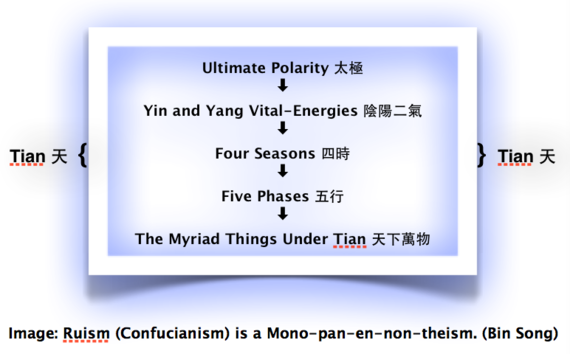
It is impossible to present a full profile of Ru metaphysics in one Huff-Post essay. However, in order to glimpse at the depth of Ru metaphysics, it would be helpful to address one of its key issues: the relationship between the ultimate reality, Tian (天, Heaven), and derived realities, the myriad things under Tian (天下萬物, tian-xia-wan-wu). Apparently, this issue is similar to the one of the relationship between God and the world in the Greek-Christian tradition.

In the Greek-Christian tradition, according to how God or God’s existence is conceived, theological discourses are divided into theism, polytheism, henotheism, and atheism, etc. According to how the relationship between God and the created world is conceived, theological discourse could be further categorized as pantheism (God is equal to everything in the world), panentheism (God permeates while simultaneously transcending everything in the world), deism, or acosmism (the world is not real but an illusion), etc. Keeping all these terms in mind, and relying upon my knowledge of the Ru metaphysics implied by the aforementioned seminal texts and commentaries, I will try my best to characterize Ruism as a Mono-Pan-En-Non-Theism. Yes, you read it right! I indeed wrote, ‘monopanennontheism’, which term’s complexity may sound awkward enough to require the following explanations.

Firstly, why ‘mono-‘? As I have explained several times before, ultimate reality in Ruism is Tian, an all-encompassing, constantly creative cosmic power which permeates everything. However, within this all-inclusive cap phenomenon, Ru metaphysics investigates further various ontological principles that can explain both the origin and the order of cosmic changes. For example, these principles include ‘the five phases’ (water, wood, metal, fire, earth), the interaction of which explains how things emerge and become. These five phases are thought of as functioning in the temporal framework of ‘the four seasons’ (spring, summer, autumn and winter), whose generative power is periodic but not cyclic. In other words, the creative force symbolized by the periodic movement of ‘the four seasons’ realizes the entire cosmos as an endless process advancing into novelty. Further, all the creative powers of ‘the five phases’ and ‘the four seasons’ are a manifestation of the one of ‘Yin and Yang vital-energies’ (氣, qi) , which are the most generic and determinate pair of categories that the traditional Chinese mindset ever invented for explaining the world. Yet, the story doesn’t stop there. Even beyond ‘Yin and Yang vital-energies’, Ru metaphysics believes that there is one singular, ontologically unconditional creative act, Ultimate Polarity (太極), which creates the entire world, including the Yin and Yang vital-energies, the four seasons, and the five phases, etc. In so far as Ru metaphysics avers that there is one singular principle that accounts for both the origin and the order of the entire created world, it is a ‘mono-‘ tradition.

Secondly, why ‘pan-‘ ? This is because of the Ru metaphysical view that the changing-and-becoming process experienced by each determinate thing within Tian is a manifestation of Tian’s creative power. Not only does Tian create, but everything within Tian also strives for being, becoming and growing. Because Tian’s creativity is ultimately grounded in the one of Ultimate Polarity, this ‘pan-‘ mode of Ru metaphysics is nicely captured by the Neo-Ruist motto that ‘Each thing has its own Ultimate Polarity’ (物物一太極) .

Thirdly, why ‘en-‘? All the creative powers that are embodied and brought about in the becomings of all concrete things cannot exhaust Ultimate Polarity’s creativity. In other words, Tian is not equal to the myriad things under Tian, and as a result, Tian’s creativity always has the potential to break through and challenge any status quo of cosmic realities which may have already been safely grasped by an established set of human knowledge. In the words of the Great Commentary, this inexhaustible and unfathomable creative power of Tian is termed as the one of ‘birth birth’ (生生, sheng-sheng), or ‘continual creation’.

Fourthly, why ‘non-theism’? First, Ruism is not atheism. Atheism, as it is particularly meant by Marxism in today’s China, is anti-religious and thus, denies any kind of ‘divine reality.’ However, for Ruism, Tian is ultimate. Its creative power ‘grounds’ all derived realities, and hence, its sublime creativity is taken to be an ideal that Ru learners (士, shi) try to emulate and realize in the human world. In this sense, Tian is holy and sacred. Ruism’s commitment to Tian’s creativity has a distinctively religious character.

On the other hand, Ruism is not theism, either. As described above, the deepest dimension of Tian’s creativity, Ultimate Polarity, is an unconditional ontological creative act without an actor or creator standing behind the scene. Because of Ultimate Polarity’s non-theistic and unconditional features, the process by means of which Tian creates the myriad of things under itself is incongruent with what the mainstream Greek-Christian idea of divine creation tries to convey. In particular, it is not that Tian puts intelligible forms into an amorphous matter so that concrete things are created. Instead, in the Ruist case, ultimate reality and derived realities maintain a tricky relationship of ‘two-fold asymmetry’. On the one hand, Ultimate Polarity is ontologically prior to all concrete cosmic realities, and therefore, Ruism believes that, as the singular ontological principle, Ultimate Polarity creates the entire world. On the other hand, since Ultimate Polarity is ontologically prior to anything in the world, including human intelligence and knowledge, anything we can know about how Ultimate Polarity creates must be drawn out 100% from our investigation about the de facto statuses of derived realities. In other words, derived realities are epistemologically prior to ultimate reality, and therefore, there is just no way for Ruism to assert that there might be any purpose, plan, or anthropomorphic telos which is inserted into the created world by Ultimate Polarity prior to its creative act actually taking place. As a consequence, Ruism’s standard conception of the cosmos is that this is a natural process of spontaneous emergence, which has no theistic telos to guide it.

In a word, Tian’s creativity is sublime. It is constant and all-encompassing. Nevertheless, ultimately, Tian’s creativity is not human. In Ruism’s view, only humans have visions and responsibilities to manifest Tian’s creativity in the human world and in a particularly human, that is, humane (仁, ren), way. At the conclusion of this essay, we can see that the religious commitment of Ruism towards the ‘non-theism’ of Tian’s creativity lays down a firm ground for its equally unflinching emphasis upon humanistic thinking and practices.