Mencius: A Short Introduction

Audio: a short introduction to Mencius, by Dr. Bin Song.
Video: a short introduction to Mencius, by Dr. Bin Song.

Hallo, this is Dr. Bin Song in the course of “Ru and Confucianism” at Washington College.

When Confucius passed away, his students built schools and academies which furthermore ramified to varying lineages of philosophical and religious thought. Within these lineages, there is one which is particularly favored by later Ruists, and in the second millennium of imperial China, it is also enshrined by scholar-officials as the orthodox version of Ru thought, the so-called lineage of Dao (道统). Allegedly, this lineage started from all those sage-kings discussed by the previous units of our course, such as Yao, Shun, Yu, King Wen, Wing Wu, and Duke of Zhou, continued with Confucius, and then, was finally passed down to Zeng Zi, the immediate student of Confucius as also the alleged author of the text “Great Learning,” to Zi Si, the grandson of Confucius as also the purported author of the text “Centrality and Commonality”, and eventually to Mencius.

As indicated, Confucius, Mencius, Zeng Zi and Zi Si are the authors of four Ru classics: The Analects, Mencius, Great Learning, and Centrality and Commonality. Overall, these four books formed a new canon system, the significance of which in the second millennium even surpassed the Six Classics that Confucius originally taught in his own school.

However, starting from the 221 B.C.E, the beginning point of Qin Dynasty, Mencius’s status was not that prominent for the Ru tradition in the first millennium of imperial China. Yes, he was as important as being seen as a principal Ru thinker; his book was also taken as having furnished an important interpretation of Confucius’s thought. However, during this earlier period, this interpretation did not grant Mencius the title, the so-called “Secondary Sage” (亚聖), through which later Ruists honored him as the sage only secondary to Confucius.

Mencius - Wikipedia

Why so? Why were the emphases of the Ru tradition during the first and second millennia of imperial China different? The answer to this question can be explained as follows.

There were two vast, long-standing, and unifying dynasties during the first millennium, viz., Han and Tang, and somewhat in-between them was another long period of social disintegration and political division. Seen from a historical hindsight, the most significant moment for the Ru tradition in this earlier period was that under the efforts of Ru scholars in Han Dynasty, Confucius’s teaching was adopted as a state ideology, and thus, established its mainstream status in the intellectual and political history of ancient China once for all. However, this also means that Ruism was seen as a major resource for the statecraft and institutional structures of the emerging and developing imperial system of ancient China. More importantly, those impactful non-Confucian thought in the pre-Qin dynasty still existed and developed in their own terms (for instance, Daoism got established as a religion during this time); also, Buddhism migrated from India, and gradually took a strong root in Chinese people’s spiritual life. In face of all these competing schools and traditions, it took time for Ru scholars to learn, interact, and incorporate their thought. In other words, the politically mainstream status of Ruism and the increasingly diversifying intellectual landscape of ancient China made the Ru tradition predominately focus upon elaborating the “ritual” side of Confucius’s thought, rather than its inner-dispositional aspect of ethics and metaphysics. In other words, because Ruism was dedicated to constructing the political and societal ritual-system of imperial China and to confronting the influence of varying schools of thought, it had not yet developed its own all-compassing, holistic discourse which grounds those political and social rituals upon a sophisticated conception of human nature and furthermore, grounds this conception of human nature upon a cosmology which addresses the most generic features of beings in the universe.

However, the situation changes quite drastically in the second millennium, when the so-called “neo-Confucianism”, viz., the form of Ruism in Song through Ming dynasties, arises and gradually regains the mainstream influence in the areas of ethics, metaphysics, and spirituality. Intellectually speaking, the competition and interaction among Ruism, Buddhism, and Daoism prepare the formation of Neo-Confucianism, and what Neo-Confucianism succeeds to provide is exactly the sort of ethical-metaphysics or metaphysical-ethics that completes the two layers of “grounding” mentioned above. In comparison with Han and Tang Ruism, we also find that Neo-Confucianism systemizes the teaching of the “humane” side of Confucius’s thought, and thus, perfects the systemacity of Ruism into an unprecedented level.

Against this background of the rising of neo-Confucianism, it is easier for us to understand why the status of Mencius was also rising in the same period. That’s because Mencius’s thought provided the backbone elements for the all-encompassing ethical-metaphysics needed by the Ru tradition in that particular historical situation.

Now, let me enumerate several major points of Mencius’s thought to help you understand his major contribution to the Ru thought.

Human Nature is Innately Good.

As explained before, there are three aspects of the golden rule of ethics in Confucius’s thought: 1) the negative: do not do to others you do not want to be done, 2) the positive: do to others what you want to do to yourself, and 3) the corrective: treat people’s wrong-doing to yourself with justice. In another statement (Analects 15.3, 15.24), Confucius also insinuated that this rule is one singlular thread to run through all his teaching.

However, without knowing what one genuinely wants and desires, and thus, having a robust moral standard of right or wrong, we still do not know how to implement the rule. Confucius called the rule “the method of practicing humaneness” (仁之方, Analects 6:30), but without knowing the content of “humaneness” per se, the method has no substance to apply. In other words, without a clarification of what the genuine humanity consists in, the one singlular thread is just a formal string to connect no content.

To continue Confucius’s thought on the concept of “humaneness,” it was Mencius who furnished a systematic and substantial elaboration on what the “genuine self” of each human individual entails, and this also constitutes the most significant philosophical proposition in Mencius’s thought: human nature is innately good.

In a thought experiment (Mencius 2A), Mencius envisions every ordinary human being will spontaneously have a feeling of alarm and fright when seeing a baby about to fall into a well. Accordingly, if one does not act upon the feeling, they will spontaneously have another feeling of shame and disgust. If one succeeds to act upon those feelings and saves the baby, others will look at them with the feeling of respect and deference. Overall, these spontaneous reactions speak to the fact that every ordinary human being has an inner moral sense of right and wrong. So, these four interconnected feelings, the one of the commiseration of alarm and fright, the one of shame and disgust, the one of respect and deference, and the one of right and wrong, were thought of by Mencius as the manifestation of four character traits, viz., four virtues, which define the good part of human nature which distinguishes humans from non-human beings on the earth. And these four virtues are humaneness, rightness, ritual-propriety and wisdom.

Once clarified about what is their genuine humanity, what each human individual remains to do is to nurture and develop these moral sprouts in gradually expanding social circles: family, community, state, and all under the heavens, just as what the three-phase and eight-step program of the Great Learning indicates. For me, this is a very wise way to elaborate the concept of “genuine self,” because it is focused upon virtues and moral excellences, rather than any rigid prescriptive rule to dictate what we should or should not do. In other words, under the general framework of those definitive virtues elaborated by Mencius, each individual can develop their own stable character traits in different situations and regarding different conditions of their life, and this approach to envisioning human self therefore maintains a balance between certainty and flexibility.

In a more general term, I think of Mencius’s proposition “human nature is good” as being both descriptive and prescriptive, since it describes a fact that could happen to humans’ emotional reaction to a certain circumstance, viz., the stimulation of the aforementioned moral sentiments. Moreover, it is also prescriptive since it says that these moral feelings distinguish humans from non-human beings, and thus, everyone “should” hold on to them so as to re-discover and enlarge their humanity.

Another very important nature of Mencius’s proposition, which learners of Ruism nowadays often overlook, is that it is a conditional, rather than categorical statement. It implies that only under certain circumstances, human nature is good. Two such conditions were articulated by Mencius: firstly, humans need to intend to re-discover and maintain our good human nature in terms of seeking education and self-cultivation. (Mencius 4A) Secondly, the societal environment needs to be just and peaceful so that the good part of human nature is encouraged and practiced. (Mencius 6A) More interestingly, Mencius had a very unique thought to connect varying contemplative practices such as sleeping and meditation to his moral philosophy, and hence, this leads to the second most important point of Mencius’s thought:

Sleep well, Breathe deeply, and then, Your Human Nature would be Good.

When addressing the question that since human nature is good, why so many bad things are committed by humans, Mencius thinks that this is like asking why a once verdant mountain can one day become barren. Mencius explains that if you continue to use axes and hatchets to destroy every sprout of plants naturally growing in the mountain, no matter how good the quality of soil is, the mountain still would not provide. By the same token, as long as one has a good sleep during a night, in the morning, they will naturally feel a clearer mind and a more sensitive heart to connect to beings in the world. In this case, people will be easier to feel their sympathy and co-existence with the world so that their innately good human nature is well-kept. (Mencius 6A)

Based upon this exhortation to nourish one’s “night vital-energy,” Mencius furthermore puts forward one most charming aspect of this thought: he is after all a mystic, and says that we should continue to nourish the nightly and early-morning sort of vital-energy up to a point when we can feel a union with the entire cosmos through the medium of these all-pervasive vital-energies, to which Mencius gave a remarkable name: the Oceanic Vital-Energies (浩然之氣, Mencius 2A).

In other words, Mencius states that human nature is and should be good, since, as analyzed, the statement is both descriptive and prescriptive. But why can it be good in the final analysis? That’s because humans evolve from the constantly life-generating process of the cosmos (天). Since the cosmos creates constantly and all-inclusively, each human individual, as a result of cosmic creation, can also take care of themselves and other cosmic beings because ultimately, every being in the universe is interconnected through the all-pervasive oceanic vital-energies.

Because humans are envisioned as being endowed by the cosmos with a mission to manifest the all-creating cosmic power in the human world, Mencius articulates his understanding of human fate, which leads to the third most important point of his thought:

Await, Straighten and Establish Your Fate: a Quasi-Stoic Point in Mencius’s Thought

Similar to the ancient Greek Stoic thought, Mencius believes that a joyful, peaceful, and flourished human life consists in distinguishing what can from what cannot be controlled by human beings. So, fame, wealth, property, approval from others, all of these cannot be fully controlled by human efforts. There is a fatalist element of human life to determine whether one can obtain these things or not. However, Confucius once commented, “whenever I desire to be humane, I can be humane.” (Analects 7.30) Similarly, Mencius thought that whether one can practice good sleeping, breathe deeply to keep mindful and nurture one’s inner energy, and hence, be dedicated to cultivating the aforementioned four virtues rooted in one’s inborn moral sentiments is completely under human control. Therefore, Mencius taught that the focus of an exemplary human’s life should be upon these controllable elements of learning and moral self-cultivation. (Mencius 6A, 7A, 7B) In time, the accumulated efforts of self-cultivation will lead to a feeling of self-contentedness and constant joy no matter what situation one happens to enter.

However, in a slightly different mode from the Stoic counterpart, Mencius also believes that if one constantly focuses upon learning and self-cultivation, viz., the aspect of human life that is under our control, we can gradually change the seemingly uncontrollable aspects of human life as well. In Mencius’s term, this is to “wait for one’s fate.” (俟命, Mencius 7B) In this way, since we choose the right aspects of human life to focus on, Mencius also described the resulted situation of human life as “straightening our fate” (正命, Mencius 7A) ; eventually, we humans can also “establish our fate” (立命, Mencius 7A) in the sense that we fulfill the potential of being a human to the greatest extent, and thus, try our best to serve our cosmic consciousness which aims to advance the life-affirming power of the cosmos in the human world.

So, in a word, if I have to use one sentence to summarize Mencius’s thought in light of its significance in Neo-Confucianism, I will do it as follows:

Find your genuine self in terms of four cardinal virtues, cultivate them using all contemplative practices, and eventually, establish the right path of your fate to fulfill the intimate position of your human life within the cosmos.

Required Reading:

Selections from the book of Mengzi (translated by Bryan Van Norden).

Quiz:

1, Which of the following figures were included in the “lineage of Dao” in Neo-Confucianism:

A) Duke of Zhou
B) Confucius
C) Mencius
D) Xunzi

2, What are the foci of Ru scholars in the first millennium of imperical China?

A) To build the political and social ritual-systems.
B) To interact with varying schools and traditions of thought.
C) To be dedicated to systemizing the ethical-metaphysics of Ru thought.
D) To be dedicated to elaborating the “humane” side of Confucius’s thought

3, Which of the following terms can be used to describe Mencius’s statement that “human nature is good”?

A) Descriptive
B) Prescriptive
C) Categorical
D) Conditional

4, Which of the following moral sentiments are thought of by Mencius as being innate for human beings?

A) Commiseration (fright and alarm)
B) Shame and disgust
C) Right and wrong
D) Respect and yield

5, Which of the following belong to Mencius’s attitude towards human fate?

A) To wait for one’s fate.
B) To straighten one’s fate.
C) To establish one’s fate.
D) To blindly obey one’s fate.

6, please pick up one point of Mencius’s views, and argue your own view about it.

Voting with Their Feet: How Early Ruism (Confucianism) Conceived of the Relationship Between the State and its Citizens

(This article was originally published in Huffpost, Oct 24 2016)

Among the five cardinal human relationships taught by Mencius (372-289 BCE), that of friendship is very special. Unlike the other human relationships, friendship is generally with people who are outside of the family, and it is also egalitarian. Considering that Ruist ethics is usually thought of as centering upon family and socio-political hierarchy, it may be a surprise to learn that Ruism actually places a human relationship which is neither familial nor hierarchical among the five most important ones!

What may seem even more surprising is that for Mencius and his Ru school, friendship is not only one of the five most important human relationships, but it is also the model for the relationship between the state and its citizens: “Friendship is the Way (Dao) between the ruler and his subjects” (“友, 君臣之道.” – the Chu Bamboo Stripes in Guodian). In other words, just as people can freely choose their friends based upon their virtues and merits, the ruler of a state can also be chosen! Though the ruler could not, of course, have been chosen by ballot, something which was not available in the social context of Mencius’ time, even so, Mencius highly recommended that people should vote with their feet! We can see this is the case from the following conversation between Mencius and King Xuan of Qi, which concerns the difference between two kinds of ministers:

The King Xuan of Qi asked about the ministers who are noble and relatives of a ruler. Mencius answered, “If the ruler has great faults, they ought to remonstrate against him, and if he does not listen to them after they have done so again and again, they ought to dethrone him.” The king was stunned and changed his countenance. Mencius said, “Let not your Majesty be offended. You asked me, and I dare not answer but according to truth.”

The king’s countenance became composed, and he then asked about ministers who were of a different surname from the ruler. Mencius said, “When the ruler has faults, they ought to remonstrate against him; and if he does not listen to them after they have done this again and again, they ought to leave the state.” (Mencius 5B)

Relying on this conversation and other related texts, we can summarize Mencius’ view as follows: within an aristocratic monarchy, which was the prevalent form of government in the period of the Warring States (475-221 B.C.E), ministers should assist their ruler in being virtuous just as though they were exhorting a friend. Even so, if a ruler behaves really badly and refuses to be corrected, the senior members of his or her royal family should dethrone him or her, and ordinary ministers should leave the state. Ordinary people should also leave the state in order to look for a virtuous ruler. Such a virtuous ruler can then rally the support of a now larger population and thereby become capable of conquering the surrounding states, not with military arms but by applying moral charisma (德, de). This form of conquest and governance by virtue is extolled by Mencius as the Dao of a Sagely-King (王道, wang-dao), in contrast with the Dao of Hegemony (霸道, ba-dao), a lesser way of governance using deceit and violence, which most rulers of Mencius’ time pursued. Quite obviously, the Dao of a Sagely-King is premised upon the co-government of a virtuous ruler and his meritorious ministers, and ultimately, can only be realized through the people’s voluntary and warm endorsement of the ruler and his or her policies. Therefore, I believe that if Mencius were to be living in the 21st century, he would be delighted to find that since contemporary democracy guarantees the right of universal suffrage, people not only have the freedom to vote with their feet, but they can also vote with their ballots! Ballots are, I think, much closer to Mencius’ ideal of living under the rule of the Dao of a Sagely-King than any of the polities of his own time.

Actually, in order to fully appreciate Mencius’s idea about the interconnection between friendship and good government, we must put this idea in an historical context and understand that this view did not belong to Mencius alone. Instead, it speaks to the nature of the thought of Confucius (551-479 BCE), and to the nature of Ruism as a school of government.

Pre-Confucian China was a feudal empire. Its territory was enfeoffed by the sovereign king, the Son of Heaven, to various aristocratic families mainly in accordance with their pedigree connection to the king. In this feudal system, each rank in the government had its own back-up team for policy consultation and administrative support, which mainly consisted of the concerned dignitary’s intimate family members. For example, the Son of Heaven had his team of dukes (公, gong), a prince had his team of high officers (卿, qing), and high officers had their ‘side house’ (侧室, ce-shi), etc. The lowest rank was called shi (士, scholarly-gentleman), and its back-up team was called you (友, friends). In this way, in the pre-Confucian feudal society, the term, ‘friends,’ mainly referred to members of an extended family or clan, and they were treated as the back-up team for this lowest governmental position of shi.

By Confucius’s time, this arrangement was no longer the case. In the late Zhou period, a series of social crises had caused the sovereign king to gradually lose his authority, and princes became warlords (霸, ba), continually competing with one another for territory and power. The social consequence of this process was the diffusion of the class of shi (scholarly-gentlemen), and the corresponding change of reference for you (friend). Shi were no longer to be appointed from above depending upon their relationship to the emperor, and accordingly, the reference for you was no longer confined to one’s own family clan. Instead, a shi could virtually be anybody as long as he or she was thought of by the state as being useful for its governance, and friends could virtually refer to any ordinary person as long as he or she was considered by anyone to be somewhat like-minded. Since virtually anyone could become the friend of a shi who, as they were in the lowest rank of government, might be promoted to high office, the original highly hierarchical relationship between ruler and subjects gathered momentum to become more equalized. In other words, a flattening trend of social egalitarianism became the historical context in which Ruism arose as a school.

Understood in this way, the earliest Ru community under the inspiration of Confucius was a community of friends. People of various backgrounds and social statuses came together because of a shared vision. They read foundational books, they practiced skills such as music, archery, charioteering and calligraphy, and they also performed various rituals. In other words, they tried to learn all the necessary expertise required for becoming a civilized human being who would be able to embody social norms and behave as a moral model for others. During this process, Confucius’ group of Ru scholars maintained a relationship of friendship through mutual trust (信, xin) and common commitment. The cardinal responsibility for Ru friends was thus to urge one another to become better people(责善, ze-shan), and hence, ‘to help one another to cultivate the virtue of humaneness’ (辅仁, fu-ren, Analects 12:24). Ultimately, they would be trained as shi, serving in governments or local communities in order to help recover the earlier social order and bring about social harmony in a time of intense political turmoil and moral crisis. From the perspective of the five cardinal human relationships taught by Mencius, the role of Ru friends was to be seen as a back-up whose task was to urge one another to behave well in all the other human relationships.

After arriving at this point, we will feel no surprise when we read the teachings of Confucius, which were the basis for the ideas of Mencius. Confucius taught his students, and also his Ru friends, to serve in government, but only if the government was orderly enough to be serviceable, and to remain concealed if it was not (Analects, 8.13). Just as friends were to urge one another to do good, a minister should also remonstrate with his ruler if the ruler’s intentions and actions were not good. However, if frequent remonstration failed to work, the minister ought to resign lest further engagement bring humiliation, just as friends ought to break off the friendship if frequent moral exhortations fail to take effect (Analects, 4.26). By Mencius’ time, because the social collapse had gone deeper and further, these aspects of Confucius’ earlier teachings had to be more explicitly expressed. As a result, the nature of the Ru school as a scholarly community aiming for a non-violent transformation of individuals, families, communities and states, became more explicit.

In a word, Ruism has its own distinctive vision of good governance. The Dao of a Sagely-King (王道, wang-dao) is based upon and leads to the formation of everyone’s moral character. It is the result of trustworthy cooperation among all involved people, who are friends, and who use their virtues and merits to achieve a non-violent transformation of society. Once we have understood this, we can appreciate that Ruism has great value for contemporary democracy. A revisited Ru community will be more than helpful for improving the quality of democracy and bringing about social harmony, something still badly needed by our human societies.

Unit 7: Ritual-Abiding or Goodwill?

Audio: ritual and humaneness, by Dr. Bin Song
Video: ritual and humaneness, by Dr. Bin Song

Ritual-abiding or goodwill? A Confucian Question.

If we have to use one unit to focus on Confucius’s thought, we should do so about the concept of Ren, translatable as humaneness, humanity, benevolence, kindness, goodwill, etc.

The reason I said so is due to the historical situation that Confucius was facing when he tried to revive the Zhou ritual system to regain the peace of society in his time. Rituals, understood in the broad Ruist sense of “civilizational conventions,” changed since they are after all “conventions”. Even if we assume that none ritual prior to Zhou had never been considered by Confucius (which may be not accurate since he frequently mentioned ancient stories and cultures in the Analects), there had already been 5 hundred years passed after the event of “Duke of Zhou made rituals and composed music.” Yes, in Confucius’s time, rulers of states frequently usurped power to perform rituals that were supposed to be solely performed by the emperor. In this case, it was clear to Confucius what rituals these local lords should not perform and thus, he also condemned these hegemons relentlessly. (Analects 3.1) However, for rituals that are of less outstanding status, people in different times and places are just doing them differently, or in certain cases, people may stop doing them even if scholars can find the historical evidences of these abandoned rituals. Therefore, in order to teach rituals to his students to serve a distinctive social and political purpose, Confucius must have been delved into a quite serious, systematic thought about the origin, function and purpose of ritual in general, so that he could have a standard to advocate certain rituals over others, and in certain circumstances, even to invent rituals fit for his time. A visible instance on the creative ritual practice of Confucius can be found in those analyzed educational principles (please look into unit 6 of the course) that Confucius implemented in the first private school he founded.

So, what is the origin, function and purpose of ritual?

Regarding the origin of ritual, Confucius said, once ritual is lost, we should seek it in the wild field, which means seeking it in the uncultivated, non-urban areas where people still keep their naturally kind and warm-hearted dispositions. (Analects 11.1) He also likened the creation of ritual to drawing pictures on a plainly white canvas (Analects 3.8), and this means that only when we possess a solid foundation of those inborn dispositions of human beings, we can start to design rituals based upon it. In a more concrete term, when he explained why, in his time, people needed to mourn for three years after their parents passed away, Confucius said that people normally “derive no pleasure from the food that they eat, no joy from the music that they hear, and no comforts from their dwelling” after their parents die (Analects 17.21), and therefore, they need a ritual to perform and abide by to help them to go through this difficult time of deep grieving.

So, in the view of Confucius’s, rituals are needed to express and manifest the naturally given inner dispositions of human beings. This view is highly understandable even from today’s perspectives; for instance, we normally get excited, or feel somewhat different about ourselves when our birthday is approaching. It seems that we need something to mark this day, to celebrate what is meaningful to us, and also to project a conceivable future. All of these constitute the rationale of the perhaps most performed rituals of birthday party all over the world.

However, although rituals manifest the inner dispositions of humanity, they can also discipline and refine the latter. The Analects 12:1 noticeably instructs that “Humanity is realized through enabling oneself to return to ritual-propriety,” and also that “Look not at what is contrary to ritual-propriety; listen not to what is contrary to ritual-propriety; speak not what is contrary to ritual-propriety; make no movement which is contrary to ritual-propriety.” Given all our previous discussions of the significance of 禮, it is not difficult for us to understand this aspect of Confucius’s thought. Yes, the inner dispositions of humanity, no matter how naturally good they are, can serious go over their due measure, and become harmful. Think about the aforementioned mourning ritual, if there is no such a ritual to refine people’s natural feeling of grief, this feeling may be indulged for too long a period of time, and for too intensive a degree. If this happened, the community surrounding the grieving person might not have any means to interact the person, and the ordinary activities in that person’s life can also be greatly undermined. The same goes to every “goodwill” that human individuals may have towards certain aspects of life. For instance, I habituate myself to getting up early in the morning, and reading and writing as a scholar; however, in order to regather myself and maintain my creativity, I also drink a cup of coffee, do some meditation, and walk around the neighborhood every one or two hours when I am writing. If I only have a goodwill to balance the stillness and activities of my body without a routinely, materialized way to do it, the goodwill cannot be made true, and whether I have this goodwill at all can also be doubted.

Since ritual both manifests and refines inner dispositions of humanity, when these inward and outward aspects of human living hit a perfect balance and harmony, Confucius has an overall term to describe this ideal state of human character and personality: 仁, the virtue of humanity or humaneness.

Confucius once says that “if a person is not humane, what do they do with ritual-propriety? If a person is not humane, what do they do with music?” (Analects 3.3) So, to acquire the virtue of humaneness is the ultimate purpose of ritual performance. However, ancient Chinese characters normally have a cluster of meanings to apply in varying contexts. Treated as one among many virtues that Confucius advocated in the Analects, the virtue of humaneness refers to the sincere goodwill of human beings whenever we conduct ourselves kindly and benevolently in varying human relationships. However, seen as the cardinal human virtue on top of all virtues, the virtue of humaneness means “to love both oneself and the people” so as to fulfill the distinctive and all-encompassing human love in a cosmic consciousness. In other words, universal human love is how we realize what human beings can best achieve in an endlessly creating and renewing cosmos. Understood in both the minor and major meanings, the virtue of humaneness relates to rituals in a way that I can summarize as follows: Humaneness is the ontological origin, and existential purpose of ritual, while ritual both manifests, refines, and helps to nurture the virtue of humaneness. With this standard of ritual-propriety been set, Confucius can then select, invent and teach rituals in his school as a bunch of examples in this regard are indicated in the Analects.

Last but not least, among all the ways of ritual-propriety that Confucius thinks can help to manifest and realize the virtue of humaneness, there is one that stands prominently. Confucius called it “the method of practicing humaneness” and instructed his students to employ this method uninterruptedly for their whole life. (Analects 15.24) This is normally called the “golden rule” of ethics in the Confucian case. It has three major, inter-related aspects:

  • Firstly, the negative golden rule, which is told by Analects 15.24: do not do to others what you do not want done to yourself.
  • Secondly, the positive golden rule, which is told by Analects 6:30: establish others what you want to establish yourself; help others to achieve what you want to achieve yourself.
  • Thirdly, the corrective golden rule, which is told by Analects 14.34: when someone does something wrong to you, you should neither revenge nor tolerate. Instead, you should treat them with justice, viz., to correct their wrong-doing in a loving, but just and righteous way.

Given our previous analysis of the relationship between ritual-propriety and humaneness, we will understand that none of these three aspects can be implemented separately. For instance, if you merely refuse to impose to others what you do not want to be imposed, but not proactively care and promote the well-being of your human fellows, your “humanity,” viz., the full potential to be a thriving human, will be greatly undermined. Most importantly, in mere reliance upon these three golden rules, we cannot become genuinely humane either. That’s because the implementation of these rules, just as any other practice of ritual-propriety, originates from the inner and deeper source of humanity, and thus, must be based upon the re-discovery and nurturing of certain aspects of our innately given human dispositions. For instance, if you do not like to eat American cheese, according to the negative golden rule, you cannot feed the American cheese to whomsoever. For starving and poor people who need the cheese and nutrition, this cannot be said as a humane deed. Therefore, the implementation of ritual-propriety must be based upon our good judgement of which naturally given pre-dispositions lead to the co-thriving of human fellows. In a Confucian term, this means the practice of ritual-propriety is premised upon and checked by our inner virtue of humaneness. In other words, the so-called golden rule of ethics can be best described as a silver rule according to a Confucian perspective.

The ritual-abiding behaviors alone cannot strengthen our goodwill to be a good human, while as analyzed before, the goodwill alone cannot guarantee us to be so either. An exemplary human should not let either aspect of the goodness of human life triumph over the other, and only when we reach an ideal balance between the raw and vibrant inner-dispositions and outward ritual-abiding behaviors, we can be called an exemplary human being, junzi. (Analects 6.18)

Required Reading:

Selections of Confucius’s sayings on humaneness and ritual-propriety in the Analects.

Recommended further watch:

Video: Dr. Bin Song on the significance of Ren for Confucianism.

Quiz:

1, Confucius never changed ancient rituals or invented new ones in his teaching. Is this statement right or wrong?

2, Confucius once said that in order to seek lost rituals, we should ask those seemingly uncultured human beings living in non-urban, wild field. What did he mean by this?

A, we should seek the manifestations of raw, inborn human dispositions.
B, Rural people are naturally more moral than urban ones.

3, Since Confucius advocated to “look, listen, speak and move in ways not contrary to ritual-propriety,” he would follow whatsoever rituals was prevalently practiced in his community and culture. Is this statement true or false?

4, The character 仁 have both minor and major meanings. What is the minor reference of 仁?

A, the sincere goodwill of humans when we perform rituals.
B, the cardinal human virtue of universal love as the ultimate purpose of ritual-abiding.

5, The character 仁 have both minor and major meanings. What is the major reference of 仁?

A, the sincere goodwill of humans when we perform rituals.
B, the cardinal human virtue of universal love as the ultimate purpose of ritual-abiding.

6, what is the golden rule of ethics in Confucius thought?

A, do not do to others what you do not want done to yourself.
B, help others to achieve what you want to achieve yourself.
C, treat someone who did wrong to you with justice.

7, “Filiality and fraternal respect – are they not the root of humaneness?” Whose view does this belong to?

A, Confucius’s student, You
B, Confucius
C, Mencius.

8, There are so many cultures, subjects and knowledge to learn in a liberal arts college. Can you describe the standard by which you select some ones rather than others to learn? And what do you think is the ultimate purpose of learning all of these? Do you find any similarity between your thought and Confucius’s on ritual-propriety and humaneness? Please answer these questions using a couple of sentences.

Unit 6: The Life of Confucius

Audio: Life of Confucius, by Dr. Bin Song.
Video: Life of Confucius, by Dr. Bin Song.

Hallo, this is Dr. Bin Song at Washington College!

We have spent the previous units to talk about the name, the entering text, and several pre-Confucian exemplary figures of the Ru tradition. Now, we finally get to Confucius, which the English name of the Ru tradition, Confucianism, refers to.

It was the Jesuits who gave us this name “Confucius” in around the 16th century. When they did so, they tried to pronounce how Confucius was honored by Chinese people at that time. Kong is the surname, and Fuzi, means “honored master”; so Confucius sounds like Kong Fuzi, and it was not the original name of Confucius. The original name of Confucius is Kong Qiu, and he has a style name called Zhong Ni. Qiu means a hill, referring to what the forehead of Confucius looked like; Zhong means that Kong Qiu is the second son in the family, and Ni refers to the place where Confucius was born, a hill called Ni in the state of Lu, the state that we have discussed as the place where the offspring of the Duke of Zhou were enfeoffed, and thus, it preserved many ancient rituals and cultures of Zhou Dynasty.

I get into these fair details of Confucius’s birthplace and his name because I want to express my general feeling towards Confucius’s life: Confucius is such a real figure that his down-to-earth humanity stands very prominently among the leaders or founders of major world philosophies and religions. Firstly, this very human profile of Confucius is different from founding figures in the Abrahamic religious traditions such as Christianity, Judaism and Islam. From varying scriptures, we read a number of miraculous, nearly or fully divine deeds of these religious founding figures such as Jesus, Moses and Muhammad, which we barely find any resemblance in the case of Confucius. Secondly, the number of historical evidences we can gather about Confucius’s life and thought surpasses other legendary thinkers, the reality of whose life we can normally just guess and speculate. For instance, many scholars doubt whether we can know anything sure about the life of the Gautama Buddha, or the life of Laozi, the founder of philosophical Daoism.

However, this down-to-earth human face of Confucius does not mean that his life is merely human, secular, and thus deficient of all transcendent or spiritual commitment. As I will analyze in more details, the concept of “mandate of heaven” (天命) plays a significant role in Confucius’s life, and he indeed tried to live a meaningful and powerful human life with a cosmic consciousness towards what humans can and should do within the entire universe. In this sense, the person of Confucius indicates a lifestyle which we can name as “this worldly spirituality,” and for me, because the lifestyle seems naturally fit into many aspects of human consciousness in modern society, I find it very appealing.

The significance of Confucius to the Ru tradition is that he established the first private school in ancient China, and started to systematically study, teach and propagate ancient wisdom with an ultimate purpose of improving the society where he lived in. In other words, before Confucius, although legendary sages such as Yao, Shun and Duke of Zhou had furnished great wisdom for later generations to follow, all educational resources were monopolized by the government, and therefore, no commoner, which referred to people with no noble pedigree, could become an educated person. However, in the time of Confucius, the central authority of Zhou Dynasty was collapsing, and the official school system was crumbling. This situation furnished a historic opportunity for such a highly intelligent and dedicated human being, Confucius, to democratize the educational enterprise so that he could help his society through making education more accessible. This was unprecedented in ancient China, and in this regard, we can compare Confucius to Plato and Aristotle who opened the earliest schools of liberal arts in ancient Greece. This is also the reason why, comparatively speaking, we can have more historical evidences of Confucius’s sayings and deeds, since he had a large group of students and followers, and his main social activities took place within or in connection to his school. Because of the huge impact of Confucius upon the Ru tradition which he helped to continue and incubate, he was almost universally respected by whomsoever pursued their education in any school system in the context of ancient China. So, without any surprise, Protestant missionaries named the Ru tradition as “Confucianism” in the 19th century partly because of the universal respect to Confucius that these missionaries have witnessed among ancient Chinese people, although as I explained before, the name “Confucianism” is a misnomer.

Since the last topic to avoid in a course about “Confucianism” is Confucius, we will use two units to talk about Confucius. One is about his life and another is on his thought.

There is no better way to decipher Confucius’s life than his own autobiography. My teacher back at Boston, Prof. John H. Berthrong, once told me that this is perhaps the shortest, and also the most famous autobiography ever written by a human being, and it reads like this:

The Master said, “At fifteen, I set my mind upon learning (or, establish my will on learning); at thirty, I took my stand in society; at forty, I became free of doubts; at fifty, I understood the Mandate of Heaven; at sixty, my ears were attuned to it [or, I obeyed it (the Mandate of Heaven) ]; and at seventy, I could follow my heart’s desires without overstepping the bounds of propriety (or, without overstepping the due measures).” (Analects 2.4 – Translation based on Slingerland.)

Here, I will try my best to explain what Confucius looked like at each of these self-described stages of life. But I also highly recommend you to do the required reading, and watch the required video, so that you can get more details about how scholars have tried to confirm the details of Confucius’s life. So, let’s do it one stage after another:

Stage One: “At fifteen, I set my mind upon learning (or, establish my will on learning).”
Many books on self-care or success share a truism about human life: unless you want to be successful, you cannot be a successful person. The same goes to Confucius’s life. He said he established his will on learning, and after 60 years of ceaseless learning (Confucius died at the age of 73, the year of 479 B.C.E), Confucius became the most learned person in his time.

There are several factors to stimulate Confucius’s will of learning.

Firstly, he was born in a declined noble family, and as the youngest son of a concubine to his father, he definitely harbored a will to recover his family’s honor. This will was best represented by one story in his earlier life. It was told by Si Maqian that when Confucius was a teenager, he tried to approach the noble family of Ji Sun, a man that held a great power in the state of Lu, to find needed connections to strengthen Confucius’s own career. However, because Confucius was merely a son of a concubine, and hence, not noble enough, he was rejected. To his great dismay, Confucius realized that he could not rely upon his pedigree to get a stand in the society, and thus, he set his mind upon learning so that he can become a successful man through his own endeavor and hard-working.

Secondly, the city where Confucius was raised in was the capital of the state of Lu, where many ancient rituals and cultures were preserved since the offspring of the Duke of Zhou were all enfeoffed in the state. However, Confucius was not allowed into official schools which at that time admitted students exclusively from noble families. Scholars guessed that Confucius’s single-mother, the great woman of Yan Zhengzai, must have played a great role to nurture Confucius’s interest in ancient culture. However, we do know that Confucius was mostly self-taught, and he just sought and tried to grasp any opportunity that he could learn from somebody or somewhere certain knowledge of the past of his country and culture. During the process, he also earned his livelihood while doing ordinary jobs such as being a bookkeeper of a granary and a shepherd.

Stage Two: “at thirty, I took my stand in society.”
Confucius once described part of the curriculum of his teaching as “Be inspired by poetry, stand on the rituals, and be consummate in music.” (Analects 8.8). Hence, when Confucius said he could stand in society when he was around his thirties, it means he commanded a sufficient amount of knowledge on the ritual system of the time so that he can earn his livelihood, raise his family, and thus, find a position in the society.

In a more concrete term, this means that after at least 15 years of self-learning, Confucius was learned enough to open his school. He taught ancient classics, and six arts (ritual, music, archery, charioteering, calligraphy and arithmetic) to people from all backgrounds, and thus, prepared them to get hired by varying governments and noble families. During the process, Confucius could definitely charge his tuition, and became economically independent. To be a teacher, an independent thinker and scholar, and to be economically independent because of teaching and thinking, these were all entirely new phenomena in ancient Chinese history, and the accomplishment of Confucius in this regard cannot be underestimated.

Because Confucius took education as his major job, there were many verses in the Analects to indicate his wisdom on education. For instance, the following three principles of Confucius’s philosophy of education are my favorite. First, “learning without a constant teacher” (學無常師), which means you cannot blindly follow any teacher, but instead, you need to learn from anyone who may benefit your learning. Second, “teaching without discrimination,” (有教無類), which means education should be universally accessible to people of all backgrounds. It is said that a bunch of dry meat can be taken by Confucius as the tuition to accept one student willing to learn; but Confucius also had some extremely rich students such as Zi Gong, a merchant coming from the state of Wei. This speaks to the fact that the admission policy of Confucius’s school was flexible, and as the first school builder in ancient China, Confucius was indeed dedicated to broadening the accessibility of education. Third, “A noble-minded person cannot be like a utensil” (君子不器), which means everyone needs to learn broadly to be a good human being at first, and then, to be good at a specific career to serve a specific aspect of human society. This is very congenial to the western tradition of liberal arts, and probably a major reason why I choose to teach at a very historical liberal arts college in the U.S.

Stage Three: “at forty, I became free of doubts.”
At the age around 40, Confucius gathered much reputation because of his teaching and knowledge. He also started to seek opportunities of serving in government in his home state of Lu and its adjacent state of Qi. One event that marked the maturity of Confucius’s knowledge is that the ruler of Qi once asked him about how to govern, and Confucius answered the question in a very concise way: “let the lord be a true lord, the ministers true ministers, the fathers true fathers, and the sons true sons.” (Analects 12.11) Since we already studied the Duke of Zhou, we find that Confucius’s saying is a concise re-statement of Duke of Zhou’s role ethics which was taken to be the key to all good human life and government: every human needs to shoulder their duty to fulfill their role in varying human relationships.

In a word, in the age around forty, Confucius mastered his comprehensive and principled knowledge on human affairs, and started to apply the knowledge to realms of practical human life. In this sense, he described himself as being “free of doubts.”

Stage Four: “at fifty, I understood the Mandate of Heaven.”
At the age around 50, there is a major upgrade of intensity and change during Confucius’s life.

Firstly, he got to work in the highest level of the state government of Lu, and broadly engaged himself in economical, diplomatic, and military matters. Because he was so successful as a statesman and increased the interstate influence of Lu, the adjacent state Qi tried to find all means to undermine Confucius’s position and the power of Lu. A cohort of courtesans were sent by Qi to the duke of Lu with a result that the duke indulged himself days and nights to totally abandon his state responsibility. This made Confucius realized that he had no more room to employ his political talents. He decided to leave his home state, and plunged into a journey of self-exile and wandering among states for another 14 years, with a hope that he might find an enlightened ruler to realize his political and social ambition.

Secondly, another decisive event for Confucius’s life around the age of 50 was that he started to systematically learn the Zhou Book of Change, 周易. This is originally a book of divination, but because it contains ancient wisdom of human life in a very condensed and comprehensive way, Confucius treated it mainly as a wisdom book to help him understand the position of human beings in changing societies and in the entire universe. If Confucius’s knowledge before he learned the Zhou Book of Change was comprehensive in the practical sense that the knowledge could serve concrete teaching and governmental jobs, his understanding of human conditions after he learned the Book of Change was upgraded into an all-encompassing cosmic consciousness.

Therefore, this is my understanding about why Confucius said that in his fifty, he could understand the “Mandate of Heaven.” Firstly, he knew his “talent,” viz., what he was good at and what he could contribute to society while establishing his own life in the society. Secondly, he knew his “limit”, viz., the practical obstacles that existed in his life to preclude his full flourishing. The dire political situation that his home state was trapped into definitely referred to this limit which urged Confucius’s departure. Finally, he eventually comprehended the “mission” of his life, so that he would fearlessly exile himself in varying foreign states so as to try his best to fulfill the ultimate meaning of his life. In a word, under a cosmic consciousness, Confucius was crystal-clear of his own talent, would like to try his best to both acknowledge and overcome the limit of objective conditions, and finally, to fight his best to continually fulfill the ultimate mission of his life. Compared to the trope of this term “Mandate of Heaven” in early Zhou dynasty which was mainly used to legitimize a political regime, Confucius’s understanding of the term is definitely more individualistic, more spiritual, and because of this, more relatable to contemporary readers.

Stage Five: “at sixty, my ears were attuned to it [or, I obeyed it (the Mandate of Heaven) ].”
The life of self-exile in order to find supportive and enlightened rulers is not easy. Confucius’s life was under serious threat in several occasions. However, at the age around sixty, all these difficulties strengthened Confucius’s cosmic consciousness on his “mandate of heaven” to a further phase, and the strengthened consciousness made him accept whatever may befall him with a total equanimity. For instance, when Huan Tui intended to kill Confucius, Confucius said: “it is Tian (heaven) itself that has endowed me with virtue. What need I fear from the likes of Huan Tui?” (Analects 7.23)

More importantly, regardless of those difficulties that either put Confucius in a life/death situation or drove him to seek tirelessly enlightened rulers, eventually of no avail, Confucius was firm on his mission and would like to do whatsoever ought to be done regardless of consequences. For instance, when a hermit mocked him to say: “The whole world is as if engulfed in a great flood, and who can change it? … Wouldn’t it be better to follow men like us, who avoid the world entirely?” Confucius’s answer was that “A person cannot flock together with the birds and beasts. If I do not associate the followers of men, then with whom I associate? If the Way were realized in the world, then I would not need to change anything.” (18.6). Similarly, he also forcefully encouraged his sometimes quite frustrated students in this way: “it is humans who can enlarge the Way, not the Way that can enlarge humans.” (15.29)

Therefore, with a firm belief in his Mandate of Heaven, Confucius accepted whatever may befall him in the evolving difficult situations of the 14-year self-exile with a total equanimity. In this sense, he can totally attune himself to the Mandate of Heaven without any doubt or complaint.

Final stage: “at seventy, I could follow my heart’s desires without overstepping the bounds of propriety (or, without overstepping the due measures).”
Confucius came back to his home state when he was 68. He was dedicated to studying ancient classics and teaching, and meanwhile, he was consulted on state affairs by the state while not pursuing any formal role in office. After decades of learning and practicing, Confucius was able to feel completely at ease with himself while still diligently pursuing those noble ideals of his life. So, in the age of fifty, he understood his mandate of heaven; at sixty, he obeyed his mandate of heaven; at seventy, he was his mandate of heaven, united himself completely with his mandate of heaven, without any second of his life to depart from the mandate.

However, this completely free and easy-going way of life is not without stress and grief. Several of Confucius’s best students died before him, his son also died earlier than him, and most importantly, until the end of his life, Confucius still didn’t find any enlightened ruler to help him to realize his political ideal. In many of these occasions, Confucius overwhelmed himself with the feeling of sorrow and grief to the effect that even his students were doubting whether his emotions were appropriate. (Analects 11.9). However, Confucius would say: when you need to grieve, grieve in the best and right way! That’s why he could follow his heart without overstepping the appropriate measure!

This is exactly the Confucius whom we were familiar with: a down-to-earth ordinary human with an extraordinary level of cosmic consciousness while never giving up his dream to make the world be better!

Required Reading:

Bin Song, “命 (Ming) – Mandate, Talent, Fate and Mission,” Huffpost.
Peimin Ni, “Life of Confucius,” in Understanding the Analects of Confucius (SUNY press, 2017): pp. 4-8.

Required Watch:

BBC Documentary: Genius of the Ancient World, Confucius

Recommended Watch:

Who was Confucius? Written by Dr. Bryan Van Norden.

Quiz:

1, The birthplace of Confucius helps his early learning of the Ru tradition because

A, The Duke of Zhou’s offspring were enfeoffed there.
B, Ancient rituals and cultures were preserved there.

2, We get relatively more evidences of Confucius’s life in comparison to other founders of world philosophies and religions around the same time. Is this true or false?

3, Confucius built the first private school in ancient Chinese civilization, and broadened the accessibility of education. This becomes one of the greatest accomplishments of Confucius. Is this statement true or false?

4, what factors stimulated Confucius’s will of learning when he was fifteen?

A, He wanted to recover the honor of his family.
B, He could not rely upon his pedigree for his career.
C, His mother helped to nurture his interest in learning.
D, He lived in a historic and culturally rich city.

5, what principles of philosophy of education did Confucius advocate?

A, Learning without a constant teacher.
B, Teaching without discrimination.
C, A noble-minded person cannot be like a utensil.

6, “Let the lord be a true lord, the ministers true ministers, the fathers true fathers, and the sons true sons.” In what context did Confucius say these words?

A, to answer questions about governance and statecraft.
B, to answer questions about family ethics.
C, to answer questions about his own life.

7, “Mandate of Heaven” for Confucius means:

A, his talent.
B, the fate and limit of his life.
C, the mission of his life.

8, For Confucius, freely following his desires without overstepping appropriate measures means no stress, sorrow, or other seemingly “negative” emotions in human life. Is this statement true or false?

9, Please use a couple of sentences to write what strikes you the most in the details of Confucius’s life, and what you have learned from them.

Unit 5: Duke of Zhou for Confucianism

Title: Duke of Zhou Made Rituals and Composed Music.

Audio: Duke of Zhou Made Rituals and Composed Music, by Dr. Bin Song
Video: Duke of Zhou Made Rituals and Composed Music, by Dr. Bin Song.

Hallo! This is Dr. Bin Song in the course of “Ru and Confucianism” at Washington College.

The first unit of our course starts from explaining a key concept of Ruist philosophy, 禮, normally translated as ritual or ritual-propriety, and its significance for us to understand the name of the tradition, 儒.

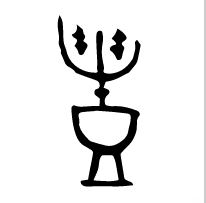
If we look into some earlier forms of the character 禮, it looks like a utensil holding jade or other rarities.

Quite visibly, the origin of the term 禮 pertains to religious ceremonies by which people follow customs and utilize facilities to express their pious feelings towards ancestors and other deities. Therefore, the normal translation of 禮, ritual or ritual-propriety, is quite literal. However, in the Ru school, the school that almost single-handedly took charge of inheriting, perfecting, and philosophizing ancient rituals in the context of ancient China, the meaning of 禮 greatly expands, and becomes a unique, hardly translatable, concept and perspective to ponder the overall nature of human civilization. Let’s read how the Classic of Rites describes this broad significance of 禮:

“The course of the Way, human excellence, benevolence, and righteousness cannot be fully carried out without the rules of ritual-propriety; nor are training and oral lessons for the rectification of manners complete; nor can the clearing up of quarrels and discriminating in disputes be accomplished; nor can the duties between ruler and minister, high and low, father and son, elder brother and younger, be determined; nor can students for office and other learners, in serving their teachers, have an attachment for them; nor can majesty and dignity be shown in assigning the different places at court, in the government of the armies, and in discharging the duties of office so as to secure the operation of the laws; nor can there be the proper sincerity and gravity in presenting the offerings to spiritual beings on occasions of supplication, thanksgiving, and the various sacrifices. Therefore an exemplary human is respectful and reverent, assiduous in their duties and not going beyond them, retiring and yielding – thus illustrating the principle of ritual-propriety.” (《禮記 曲禮》adapted from the translation of James Legge)

Here, any rule or convention that can lead to the re-ordering of an aspect of human civilization, such as individual moral self-cultivation, varying human interactions, education, the execution of law, the establishment of political institutions, leadership in army, court and other governmental offices, etc., can all be called 禮. In my frank opinion, there is really no singular English word which can capture this broad implication of 禮. Trying the best that I can, I would like to say 禮 is any “civilizational convention.” The philosophical reason why the Ru school came up with this concept to designate the essential nature of human beings is understandable: once having evolved with a capacity of using signs, symbols and languages to interact with the world, the relationship of humans to humans, and the one between humans and the nature are always mediated. In other words, humans interact with the realm of uncarved realities, the nature, through our interpretations of the meaning of these realities to us, and using a Ruist term, these human interpretations are constructed by our use of varying 禮. For instance, our mind reads people’s smiles in different ways, depending upon the cultural and societal environment we live in, and furthermore, we also interact with these smiles using postures and expressions fit for our purpose. Natural impulses such as those raw emotions of wonder, joy or anger, may play a certain role during this interaction, but they are all embedded in a much more complicated cognitive and emotional process mediated by our interpretations of the meanings of the world. Understood in this perspective, every means to mediate the relationships between humans and between humans and nature in a uniquely human way can all be called 禮. Therefore, my translation of it, civilizational convention.

In the Analects, the book that furnishes the most authentic record of Confucius’s deeds and sayings, there are plenty of scenarios where Confucius either talked of or actually performed ritual or ritual-propriety in the analyzed sense of civilizational conventions. He cared about any knowledge about the sacrificial rituals in temples, he talked of why people in his time needed to mourn for three years after their parents’ death, and other related topics, such as how to conduct human relationships, what are the best qualities of a state leader, what music is the most appropriate for a certain social occasion, and even how to stand, walk, speak, look, eat, etc. In fact, one of Confucius’s self-suggested missions is that because the system of ancient rituals in his time were collapsing, and music was decaying, so that he would try his best to learn, discover and even redesign the best rituals fit for his time, and then, he would teach and propagate these ideal rituals so as to recover social order and lay a solid foundation for the sustainable development of civilization. He called the entire body of these ancient rituals as “civilization” (文), and was quite confident to assert that the destiny of this civilization is on his shoulder. In extreme difficult situations, such as when he almost got murdered by political opponents during his exile, he relied upon this deep sense of mission and responsibility to strengthen his will of life, and eventually survive the distress.

However, a legitimate question for us to understand Confucius’s mission is that since he was a learner and advocate of ancient rituals, where were these ancient rituals come from? If he was the most respected teacher in the Ru tradition who has built the first private school to pass on ancient civilization to later generations, whom did he learn from? In the past several units of this course, we discussed Yao and Shun, these ancient sage-kings who had accomplished great deeds for Confucius to admire. But they lived thousands of years before Confucius, and Confucius’s admiration of them cannot be converted into the solid knowledge of their times. So, just like Americans who quite often evoke their founding fathers to make their contemporary moral and political cases, Confucius looked into the founding fathers of the dynasty he lived in, the Zhou dynasty, which had already endured about 500 years before Confucius. Among all these founding fathers of Zhou dynasty, one figure, the Duke of Zhou, whose name is Dan, stands prominently, and he turned out to be the most impactful figure on Confucius’s learning and teaching.

Let’s read several sayings in the Analects to understand this lineage of wisdom that Confucius tried to continue:

19.22 Gongsun Chao of Wei asked Zigong, saying, “From whom did Zhongni (Confucius) get his learning?”
Zi Gong replied, “The Way of Wen and Wu has not fallen to the ground. It is still there among the people. The worthy remember its major tenets, and the unworthy remember the minor ones, so the Way of Wen and Wu is nowhere not to be found. Where could not the Master learn from? Yet, what regular teacher did he have?”
7.5 The Master said, “Extreme is my decline! I have not dreamed of the Duke of Zhou for a long time!”
3.14 The Master said, “The Zhou sits on top of two previous dynasties. How rich and well developed is their civilization! I follow the Zhou.”
3.9 The Master said, “I could describe the rituals of the Xia dynasty, but the state of Qi cannot sufficiently attest to my words. I could describe the rituals of the Yin dynasty, but the state of Song cannot sufficiently attest to my words. This is because these states have inadequate records and worthies. If those were sufficient, I could adduce them in support of my words.”
2.23 The Master said: “the Yin (Shang) dynasty followed the rituals of the Xia, and wherein it took from or added to them may be known. The Zhou dynasty followed the rituals of the Yin, and wherein it took from or added to them may be known. Should there be a successor of the Zhou, even if it happens a hundred generations from now, its affairs may be known.” (Translation adapted from Ni, Peimin)

In the first two quotes, Confucius and his students indicated the origin of Confucius’s learning. It is the Way of Wen and Wu, and the teaching of the Duke of Zhou. These three mentioned figures, King Wen, who is the father of the other two, King Wu, the elder brother, and the Duke of Zhou are three most important founding fathers of the Zhou Dynasty. Among the three, Duke of Zhou’s role is the most significant since Confucius dreamed him all the time. And the last three quotes speak to the three major reasons why Confucius took the ritual system of Zhou as his primary masterpiece to learn and teach:

  • First, The ritual system of Zhou Dynasty synthesized previous ones, and thus, represented the gist of ancient Chinese civilization in Confucius’s time.
  • Second, Previous ritual systems are too remote to corroborate and study in details. But the Zhou rituals are well preserved in the state of Lu, which is the home state of Confucius, and also where the offspring of Duke of Zhou were enfeoffed.
  • Third, the ritual system of Zhou Dynasty represents principles of human civilization that Confucius believes are eternal and everlasting so that any future generations, as long as they aspire to a sustainable civilization, still need to learn them.

Since Duke of Zhou was so important for Confucius’s learning, in the remaining part of this unit, we will focus on his personality, deeds, and his accomplishment in making rituals and composing music to eventually lead to Confucius’s admiration.

《三才圖會》的周公像
An image of the Duke of Zhou, from 《三才圖會》

As indicated by the required readings, regarding the personality and the political accomplishments of Duke of Zhou, there were several major points to be honored by Confucius and later Ru scholars:

  • 1, He helped his father, King Wen, and his brother, King Wu, to overthrow the last king in Shang Dynasty, and justified the conquest using a very new political theory: the legitimacy of rulership consists in the virtues of the rulers, which are confirmed by the support of the people. If a ruler succeeds to be virtuous and earn the support of their people, they will have the Mandate of Heaven, and thus, be legitimate to govern.
  • 2, He helped his brother King Wu to govern the newly established state. In a crucial situation, he even would like to sacrifice his own life to secure his brother’s health. Also in light of his assistance to his father King Wen, Duke of Zhou represented the cherished family virtues such as filiality, and brotherly love in quite an eminent way.
  • 3, When King Wu died, his son King Cheng was too young, and thus, Duke of Zhou had to act as a regent. On the one hand, he was the teacher of King Cheng so as to prepare his enthronement. On the other hand, when King Cheng was mature enough, Duke of Zhou fulfilled his promise and resigned from his regency. In this part of his story, Duke of Zhou was an uncle, a teacher, and a supreme governor, and he performed superbly in all of these three roles. Mostly importantly, his attitude towards political power earned much kudos from later Ru scholars: firstly, he was not obsessed with political power; when time is right, he would step down and yield to King Cheng as a subject. Secondly, his ultimate goal was to teach King Cheng to be a good ruler during the time of his regency, and this ideal of being an educator to political leaders quite fits the self-identity of later Ru scholars.
  • 4, Duke of Zhou suppressed the rebellion in the eastern part of the country, punished its wicked leaders, appointed new leaders, and laid out a series of rules of government to stabilize the new dynasty.

In human history, I believe as long as any political figure succeeded to achieve similar deeds, they would be put on a pedestal to be memorized by later generations. However, the most important accomplishment of Duke of Zhou, from a Ruist perspective, still surpass the areas of self-cultivation, family-regulation, and governance. That took place in the form that Duke of Zhou established a whole system of rituals to reconstruct the entire Zhou civilization. This historical event was normally named by historians as “Duke of Zhou made rituals and composed music” (製禮作樂).

According to Wang Guowei (1877-1927), a prominent sinologist, there are three major breakthroughs that Duke of Zhou has made in this historic event:

  • Firstly, he established the institution that kingship must be passed down to the eldest son in the royal family;
  • Secondly, he re-organized the system of sacrificial rituals to one’s ancestors so that the relationship among different generations and branches of an extensive family is ordered;
  • Thirdly, he prohibited marriage within a family of the same surname.

All these three major points of the Zhou ritual system are extremely important because Zhou dynasty is a feudal society, and the King appointed local political leaders according to their merits and their closeness of pedigree to the royal family. So, an elaborated family ethic to distinguish the duty and role of varying family members is crucial to the well-functioning of the entire political system. On the other hand, Duke of Zhou designed other aspects of the ritual system such as about how to recruit able people to fit government posts, how to distinguish offices, and how to hold many civil and religious ceremonies, etc.

Underlying all these concrete ritual arrangements of the newly established dynasty, there are several major principles that Confucius admired, and believed can guide human civilization for future generations:

Firstly, the purpose of ritual-performance is to cultivate people’s virtues so as to bring order to society. Although the blessing of deities and the divine power of Heaven were thought of as important, Duke of Zhou prioritized the role of humans in securing the blessing. In other words, in order to earn the divine support, humans need to primarily dedicate themselves to cultivating virtues through performing rituals. This spirit of humanism was continually developed in later Ruist thought.

Secondly, each human needs to fulfill their duty required by their role in a specific human relationship, and this role ethics, so-to-speak, was thought of as the foundation of individual well-being, social order and good government.

In a more concrete term, this second principle consists of the following aspects:

  • First, 親親, that is to treat your family as your most close and important human fellows.
  • Second, 長長, that is, within a family, the order of seniority is respected.
  • Third, 男女有別, that is, men and women are different; marriage should not happen within the same family; and the right of a couple upon the management of their household must be fully respected.
  • Fourth, 賢賢, that is, to respect people of good education and moral excellence. Accordingly, a key principle of good governance is meritocracy, which implies that a good leader must appoint the right people in the right positions.

On top of all of these ritual principles and initiatives, Duke of Zhou also composed poems, lyrics and music, and utilized these arts to educate the people of all these important ethical and political principles.

In a word, Duke of Zhou has cultivated great virtues, governed his country well, and more importantly, made rituals and composed music to lay a foundation for sustainable human civilization. Because of this, he was treated by Confucius as the most significant founding father of Zhou civilization, and became Confucius’s teacher secondary to none.

Required Readings:

“The Story of The Duke of Zhou,” compiled by Robert Eno in https://chinatxt.sitehost.iu.edu/Resources.html.

“The Announcement to Kang”, in the Classic of Documents, adapted translations by Bin Song from multiple sources.

Quiz:

1, In light of the etymology of the character 禮, what is the literal meaning of it?
A, religious ceremony/ritual
B, social etiquette
C, political institutuion

2, 禮 represents the distinctive nature of human civilization because:
A, the relationship between humans, and the one between humans and the nature are mediated by 禮.
B, uncultivated raw emotions have no role to play in human interaction.

3, Confucius described his own mission as to teach ancient rituals to all the people in order to recover social harmony for his time. Is this statement true or false?

4, Among King Wen, King Wu, King Cheng and Duke of Zhou, who is the eldest?

A, King Wen
B, King Wu
C, King Cheng
D, Duke of Zhou

5, which of the following reasons does not belong to the ones why Confucius chose the Zhou system of ritual as his target of learning?

A, the Zhou system of ritual is synthetic.
B, the Zhou system of ritual can be studied in greater details.
C, the Zhou system of ritual represents principles of human and civilizational thriving.
D, none of the above.

6, “Yet each time I bathe, I am called away three times, wringing out my hair in haste; each time I dine, I rush off three times, spitting out my food in haste, in order to wait upon some gentleman. I do so because I am always fearful that I may otherwise fail to gain the service of a worthy man.” This quote describes one governor’s willingness to respect and appoint talented people to the right governmental positions. Which governor does this depiction refer to?

A, King Wen
B, King Wu
C, Duke of Zhou

7, “O Feng, such great criminals are greatly abhorred, and how much more (detestable) are the unfilial (不孝) and unbrotherly (不友)! – as the son who does not reverently discharge his duty to his father, but greatly wounds his father’s heart, and the father who can no longer love his son, but hates him; as the younger brother who does not think of the manifest will of Tian, and refuses to respect his elder brother, and the elder brother who does not think of the suffering of his junior, and is very unfriendly to his younger brother.” Which principle of the Zhou ritual system do these words of Duke of Zhou’s represent?

A, reciprocal role ethics: every human needs to shoulder their duty defined by their role in a human relationship.
B, utilitarianism
C, deontology.

8, What have you learned from the thought and deed of Duke of Zhou? Please share your critical thought on this unit’s teaching.