Confucianism as Religion in Light of Indonesia

Dr. Bin Song: Prospects of Confucianism as Religion in light of Indonesia

[I deliver a speech “Prospects of Confucianism as Religion in light of Indonesia” to the Way of Wisdom (WOW) Confucian community in Indonesia on June 20/2020. Here is the audio record.]

Thanks a lot for inviting me to talk with Confucian friends in Indonesia. Liong, your passion inspires me, and thank you for organizing this wonderful forum! Mr. Budi Wijaya (姚平波), I know you may be here, your courage and persistence to fight for your right of marriage always remind me of what a genuine Confucian gentleman should do in a similar situation. So, thank you! And Mr. Kris Tan, I know you may also be here, thanks for teaching me of the life of a Confucian priest in Indonesia. I do hope there is a profession of Confucian priest in the U.S. as well, and that will be my No. 1 option for jobs outside the academy. And thanks also go to so many other people! Thank you for coming here. It is really a special honor for me to deliver this speech to such a special audience!

While learning the history of Confucianism in Indonesia, I get to know that Confucianism is one among six officially recognized religions, and normal people need to put your religious affiliation on your citizen ID card. If you do not have an identifiable religious affiliation, you will be disfavored by the society and the government in all sorts of visible or invisible manners that may bring unwanted consequences to your life. But Confucianism is not always so in Indonesia, I know that Indonesian Confucians fought very hard to obtain and maintain the status of official religion. The status is after all hard won, but not freely granted.

I will not get into too many details of the history about how Confucianism develops into an official religion in Indonesia in today’s talk. For friends who are interested in this topic, please go to my website, and I make a series of posters to explain this. I also share my screen of the posters here, you can get an initial look.

From the history of the Confucian religion in Indonesia, I get to know and admire how special Indonesian Confucianism is in comparison with other forms of Confucianism developed in other countries and in different periods of history. I will highlight three major features of Indonesian Confucianism in this speech.

First, the emigration of Confucianism to Indonesia happened in a very special time. That is in late 19th century, when most of East Asian Confucianisms were either declining or facing unprecedented challenges from the Western colonial powers such as in China, Korea, Japan and Vietnam. During that time, the Dutch colonial government in Indonesia took a racially stratified system, and labeled Chinese immigrants as the second tier of citizens called “Foreign Orientals”, which is lower than European White people, but slightly higher than indigenous Indonesians. In this system, race, religion, culture, and economic and politic statuses are all lined up together in order for the Dutch government to bring order to their colony. Obviously, in this situation, if all your fellow citizens have a religion, you have to develop one on a par as well. Otherwise, without a religion, you will be either converted to other racial groups and accordingly undermine the solidarity of your own community, or have to bear all undesirable consequences as a religionless person. And this term, “being religionless,” in the environment of colonial Indonesia and afterwards, is always a derogatory one. In a word, the initial impetus of Indonesian Confucianism as a religious movement pertains to an issue of survival, an issue of living, living better or worse, rich or poor, an issue whether your kids can go to good schools, and whether you can continually and safely bring food to the table to feed your family. It is a historical must-do, and it does not entirely derive from free deliberation or voluntary association of a group of believers to form a religious organization. That is the first point I need to highlight for understanding the very special Confucian religion in Indonesia.

Second, the political pressure from the Indonesian government to force Chinese Indonesians to choose and organize their own religion is even higher after Indonesia’s independence in 1950s. Since the Sukarno presidency of the independent Indonesia, the so-called old order regime, the Indonesian government adopts four criteria of religion, which are highly influenced by the country’s Muslim majority’s understanding of religion: 1) if some tradition is counted as religion, it must believe in “Almighty God,” 2) it must have its own bible or holy text, 3) having a prophet who delivered divine revelation, and 4) having laws and rituals to provide moral guidance for believers. Meanwhile, the Indonesian government also took the policy of “one person, one religion” by registering its citizens’ religions in their identity card. The darkest age of Indonesian Confucianism came under the New Order of Suharto presidency. The government at that time was highly suspicious towards the tie of Chinese Indonesians to Chinese communism, and repealed the official status of religion of Confucianism. At this time, indigenous people who happened to be hostile to Chinese Indonesians also found a way to release their resentment in violence. This situation lasted for about 30 years, and Indonesian Confucians underwent a massive number of conversions to other religions, most likely Christianity or Islam, because of the unsustainable lifestyle due to their Confucian identity. Even so, there were sparks of hope, persistence and strength in this pervasively difficult days and years for Indonesian Confucians. A widely reported case is that Mr. Budi Wijaya, one of my best Indonesian Confucian friends, and his wife Ms. Lanny Guito married through the Confucian ritual in a Confucian temple. However, the local government refused to certificate the marriage as it did not recognize the Confucian ceremony as legal. This would surely bring a number of harmful impacts upon Mr. Wijaya’s family and children. In 1996, the couple filed a suit against the government, and only after the Suharto presidency ended, the couple finally won their case in the year of 2000. In a word, the issue whether to sustain Confucianism as a religion after Indonesia’s independence for Indonesian Confucian believers is still primarily an issue of survival. It is about whether you can get married legally, whether your children would not be bullied in their schools, and whether you can continually live out a safe and decent human life in an overall unfriendly environment relying upon your deep spiritual power rooted in your faith. In this way, for discussing whether Confucianism is a religion, Indonesian Confucianism distinguishes itself from other forms of Confucianism in that it has a very solid political ground, and a very fixed conceptual framework to frame the debate. Even if scholars may disagree with answers given by Indonesian Confucian thinkers to the debated question, I am extremely sympathetic with the utterly real social situation that Indonesian Confucianism constantly faces, and I also genuinely admire its creativity, persistence, and hopefulness as a result.

Third, because of the special features of Indonesian Confucianism in its time of inauguration, its largely immigrative status, and its inevitable domestic and international geo-political involvement, it is also special in its third feature that I truly admire and appreciate. That is the creativity of thought and practice in its daily Confucian way of life. I will elaborate this using two major points:

Firstly, the textual and vocabulary base of Indonesian Confucianism is fairly unique. At the point of time when Chinese Indonesians were driven to organize their own religion, most of them could not speak or read Chinese. Therefore, they mainly relied upon European or Malay translations of Confucian classics. As we know, every translation is an interpretation. Together with the pressure of religionizing Confucianism due to the policy of the Dutch colonial government, these sources provided a fairly unique angle to look at traditional Confucian classics. For instance, Indonesian Confucianism highlights the religious terms and concepts in classical Confucian texts, such as 上帝 (upper-lord), 天命(divine command), that were once highlighted by the translations of early Christian missionaries. However, the purpose of these Christian missionaries to laser focus upon these terms in Confucian classics is to prove there are seeds of religious truth in classical Confucianism so that the spread of Christianity can fulfill them, can make them grow. In other words, the selection of Confucian terms for such a translation is actually the strategy of Christian missionaries to convert Chinese literati. However, the conversion to western religions is always the No.1 concern of Confucian believers in Indonesia, so, different from those Christian missionaries, Indonesian Confucianism also utilized European enlightenment thinkers’ writings on Confucianism to argue for the modern and advanced nature of Confucian thought. In combining these two apparently contradictory European interpretations of Confucianism, Indonesian Confucianism accomplished a mission impossible to fit its unique communal, racial and political needs. Let’s use an example to illustrate how special this is. My friend Kris Tan informs me that using English terms, the Indonesian translation of the first chapter of Zhong Yong, one of the Confucian four books, can be understood as such: “The Word of Tian is called the True Nature. Doing to follow the True Character is named after taking the Holy way. And Guidance to take the Holy way is called Religion.” Here, “word” “holy way” and “religion” all remind us of the need of religionizing Confucianism according to the Abrahamic definition of religion. However, the emphasis on “true nature” of humanity, or “true character” of human individuals also makes the intrinsic tension in Abrahamic religions between divine and human natures almost entirely disappear. When reading this translation, I cannot help asking myself: can it still be counted as a Confucian tenet? I think it is absolutely yes, but the translation looks familiar while being novel and fresh. I am also highly confident to say that it serves very well the needs of Indonesian Confucians. For me, all of these are signs of the genuine creativity of Indonesian Confucianism as a religious movement.

Secondly, not only in translation, the creativity of Indonesian Confucianism also consists in how it selects traditional sources throughout the entire history of Confucianism to make its case and serve its own distinctive needs. Per the four aforementioned criteria of religion established by the Indonesian government, we find there is actually no uniform expression of such a religion in the history of Confucianism. The tradition before Confucius was more religious, but it is less religious during the time between Confucius and Xunzi when humanism and practical rationality were rising; under the influence of Yin-Yang theory and folk religious practice, Confucianism in Han Dynasty became more religious again, but in Song-Ming Neo-Confucianism, the tradition went back to the less religious route as it claimed to continue the lineage of Dao initiated by Confucius and Mencius. In particular, the aforementioned criteria of religion require that Confucius is a prophet and delivers divine revelation. Throughout the entire history of Confucianism, we find only the New Text school of Confucianism in Han Dynasty furnishes a similar narrative to say that Confucius was born because of his mother’s divine encounter, and Confucius was therefore worshiped as an uncrowned king to prescribe laws and orders for later generations. This deified image of Confucius, the magical worldview, and the accordingly very progressive political philosophy in the New Text Learning of Confucianism were largely ignored after Han Dynasty, and only until Qing Dynasty, more than one millennium later, it revived again to become a major source for Confucian scholars’ reformative political thought. In 1903, Kang Youwei, a major voice of the New Text learning in late Qing Dynasty, visited Indonesia, and passed on his idea of the Confucian religion to Indonesian Confucians. Ever since, this New Text Learning becomes a foundational source for Indonesian Confucians to argue for their case and organize their institutions. However, as indicated in the case of translation, there are other forms of Confucian thought, or other forms of Confucian religiosity in the tradition. If we change the definition of religion, we will find the spiritual way of life that is constructed by the so-called Neo-Confucianism in mainly Song-Ming dynasty of China and other East Asian countries is actually the most prevalent and influential form of Confucian religion regarding the space it has reached and the time it has gone through. In this Confucian religion, Confucius is not a deified prophet any more, but a sage to inspire humans to live a fulfilled human life here and now. So, what does Indonesian Confucianism do with this dimension of Confucian religiosity? Again, while maintaining the basic framework of New Text learning as its major source to argue for Confucian religion per the criteria of Abrahamic religions, Indonesian Confucians incorporated Neo-Confucianism as much as they can to serve their distinctive needs. For instance, some Indonesian friends informed me that Mr. Tjhie Tjay Ing (1935-2016, forgive my pronunciation if it is wrong) was the best Confucian theologian in Indonesia in his generation. While debating with people dubious of the claim that Confucianism believes in afterlife in the highly oppressive period of Suharto presidency, Mr. Tjhie Tjay Ing, on the one hand, cites texts in the Classic of Rites to indicate that two sorts of souls were thought of as surviving the death of human body, and on the other hand, Mr. Ing also uses Wang Yangming’s thought in Neo-Confucianism to emphasize that for Confucianism, whether to abide by one’s conscience at each moment of human life determines whether one lives in a hell or a paradise here and now. See how creative this is! How convincing this is! As indicated by the example, we can say Indonesian Confucianism adapts to the need of folk religious practice in ancestor worship, but still keeps the very this-worldly, and deeply spiritual Confucian attitude towards human life here and now.

Good, at this moment, my speech covers three very special, and major features of Indonesian Confucianism: its initiative in the period of Dutch colonial government, its sustaining effort after Indonesia’s independence, and its creativity. The biggest lesson I learned from this very unique, on-going process of Confucian religion in Indonesia is that religion does not yield. Yes, let me repeat this, religion does not yield. Human activities are always constrained by varying objective forces such as politics, economy, geography, family history, etc.; however, the deep spiritual power of humanity rooted in their faith as it is articulated by a specific tradition never yields. It just makes use of whatever is available to create whatever is useful to make people’s life better and worth living. I am informed that when Indonesian Confucians travelled to the mainland of China nowadays, they found some mainland Confucian scholars dismissed the idea and the practice of Confucianism as a religion; this is highly understandable given the overall atheistic state ideology in the mainland of China now. However, if we learn the history of Indonesian Confucianism and actually talk with Indonesian Confucian friends, we will understand how perfect the sense is to make Confucianism a religion in their situation. They just have to do so. As I mentioned time and time again, for Indonesian Confucians, whether Confucianism is a religion is not primarily an issue of academic debate. It is an issue of survival, an issue of whether human life matters, and an issue as tangible and concrete as whether you can marry to someone you love. There is a Chinese idiom to say that only when forced into a corner of death, one can re-gain their life. (置之死地而後生) Yes, this is exactly what I found in the case of Indonesian Confucianism. Confucianism almost died out in late Qing Dynasty, but in Indonesia, it is the indomitable will of life of the people that make it alive again. So, as a Confucian scholar, I would say, thank you, Indonesian Friends, you, your family and your ancestors have done something extraordinary that is truly admirable.

Before ending my speech, I want to talk of briefly Confucianism in the U.S. and the contemporary world at large, since the title of this speech implies my prospects of Confucianism in the future.

When I learned the history of Indonesian Confucianism, I keep rethinking of my own experience of growing up to become a Confucian scholar and practitioner. Although there is no time for me to share with you my personal experience of Confucian practice in this speech, I hope there is further opportunity for me to do so in the future. However, one of my central foci in my work in the U.S. is indeed trying to increase the public awareness of the Confucian tradition in the English-speaking world. In the recent decades, I studied with the so-called school of Boston Confucianism, I organized the first college student Confucian group in the U.S., titled as Boston University Confucian Association. Right now, I am also helping to organize an educational organization called Ruist Association of America (RAA), and teach, research and speak on Confucianism in the academy.

As I commented above, religion does not yield. The will of life does not yield. This means no objective situation can eventually smother a tradition as long as its faith is kept and prevails. But it also means the way of religionzing one tradition in one situation may not be fit in another one. If we look into the situation of Confucianism in the U.S., we find those powerful factors that drive Confucianism into being organized as a religion in Indonesia do not apply. The emigration of Chinese or East Asian Americans into U.S. happened even later than the one into Indonesia, and it happened after when Confucianism was radically critiqued by Chinese intellectuals themselves in the early 20th century. This means there is no natural attachment to the so-called Confucian tradition in most of Chinese Americans. Also, there is no strict lining-up of race, culture and religion in America as it happens in Indonesia, and therefore, the life of faith for Chinese immigrates is actually very diverse and in a certain sense, de-centered. In particular, according to social surveys conducted in recent years, the traditional organized way of religious life in the U.S in general is declining. There is a growing percentage of people identifying themselves as religious “nones” or “being spiritual but not religious.” My friend, Ben Butina, and I, did a similar survey to clarify the perception of ordinary American people about Confucianism. We find that the majority of ordinary Americans do not see Confucianism as a religion, but as a philosophy or a way of life. All of these guide my own thinking, practice, and teaching on Confucianism in the U.S, which may be different from the one that is organized under the very strict criteria of “religion” explained above.

However, no matter what a concrete pattern of Confucian life that America could take in the future, one thing remains sure for me from my knowledge of Indonesian Confucianism: the Confucianism that could be counted as a possible, significant portion of American spiritual life must be down-to-earthly real. It must be as real as what Indonesian Confucianism has gone through. In other words, it needs to poke people’s nerves, go under their muscles, and sink in the depth of people’s heart, in whatever ways this can be imagined or expected.

The following is a preliminary list of potentials that Confucianism has, and which I also hope can help Confucianism to achieve this down-to-earthly real presence in the U.S. and in the contemporary world at large. This is not an easy list to do, but I do believe it is hopeful.

First, the Confucian wisdom on harmonization in the realm of government, social and business management can help to transform the highly polarized politics in the U.S. and other countries that are having a similar problem.

Second, the human-centered pedagogy of liberal arts in Confucianism can inspire unity for the highly compartmentalized institution of education, and thus, bring more integrity to students and scholars’ life.

Third, the spiritual practice of Confucianism to focus on meditation, arts, and minor ritual details of human daily life is that type of spiritual life which modern professionals are longing for.

Fourth, the Confucian wisdom on a balanced community life between authority and individual autonomy can enlighten how faith communities get organized in the contemporary world.

Of course, this list can go on, and people may have different prospects of Confucianism per their own judgment. But a bottom line is that, let me repeat it, human life is primarily about survival, subsisting, and participating the eternal meaning of life here and now. Whether Confucianism can prevail here and there in the world will be decisively dependent upon whether it can operate itself well along this bottom line, as it is so vividly indicated by the case of Indonesian Confucianism. In particular, since Indonesian Confucianism has its own very robust organized forms right now, I also hope the aforementioned four prospects of Confucianism can be vividly and continually manifested in Indonesia as well.

Good, this will be the end of my speech. Thanks for the invitation again! And I look forward to more conversations with you during the Q and A section.

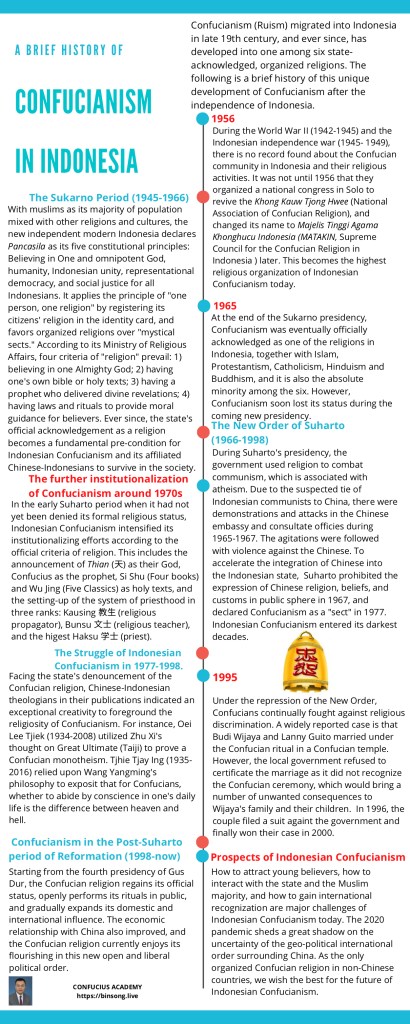
A Brief History of Confucianism in Indonesia

I created this series of posters “A Brief History of Confucianism in Indonesia,” and translated its Eight Faith Declarations to empower students with a means to quickly understand the Confucian religion in Indonesia.

[convertful id=”36168″]

References:

Evi Lina Sutrisno, “Negotiating the Confucian Religion in Indonesia: Invention, Resilience and Revival (1900-2010),” Dissertation, University of Washington, 2018.

IVANA PRAŽIĆ, “The Politics of Cheng Ho-Related Piety in Post-New Order Indonesia Theologies of Emancipation.” Dissertation, The University of Sydney, 2016.

王爱平,印度尼西亚孔教研究,中国文史出版社, 2010.

How To Make Sense of the Pandemic as a Ruist (Confucianist) ?

Hallo, my name is Bin Song. I am a Ru scholar, therapist, and college professor in the disciplines of philosophy, religion, and theology. This audio is written and recorded by me to help make sense of the cause of this pandemic in light of the spiritual practice of Ru (Confucian) meditation.

Before you start to listen to my words, I recommend you to do a short breathing practice to calm our heart and illuminate our mind. So, please position yourself well, sit, incline, or simply lie down. Using your belly muscles, be aware of the minor movements of your body, and then, focus upon your breath. Breathe in, deeply, slowly, and comfortably. Breathe out, feel the release, and feel the relax. And a short pause. Again, breathe in, breathe out. remember, no matter how bad the pandemic is, how frustrated you feel about your situation, there is always air and oxygen flowing around. The fact that you can breathe in to reenergize and re-tranquilize yourself should be deeply appreciated. So, breathe in, breathe out. Release the anxiety, worry, and all feelings of uncertainty. We need to focus upon things that we can control and improve, not things that are out of our control; so all anxieties, worries, and the feeling of uncertainty caused by the uncontrollable facts of life should all be released. Take care of yourself, be kind to your family, do your duties of your work; these are what we can control, and what we can do well if we breathe and meditate in the place here and in the time now. After you breathe out, let’s feel the short pause before next breathe in. Yes, when you stay home because of the pandemic, this is just a short pause of your entire life. For everybody, this is a good moment to reflect, to slow down, and to learn and plan for a better future.

While I am speaking, please continue to enjoy your breathing. Breathe in, breathe out, and a short pause.

From a Ruist perspective, the pandemic is neither an ineluctable natural disaster such as hurricanes or earthquake, nor the punishment by a supreme deity to humans’ violation of preestablished divine laws. It is not a sign of an apocalyptic event predetermined by some divine plan either. Instead, regardless of the origin of the fatal virus which the best scientific minds in the world are still trying to figure out, the development of the original outbreak to the current pandemic is a completely human disaster. It is caused by the non-transparency, dishonesty, injustice, malfunction, and inhumaneness of human governance and social management in face of this unprecedented event of global health crisis.

Let’s use one of the canonical texts of Ruism, Zhong Yong, to explain why theism is not a model for Ruism to make sense of the pandemic. The title of the text can be translated as “centrality and normality” or “keeping centered in the everyday world”, and it is said to be written by the grandson of Confucius, Zi Si, who lived around the 5 century B.C.E.

According to this text, what creates this world is not a supreme personal deity, but an all-encompassing, constantly generating cosmic power, which is called Tian. It says Tian “has no goal other than creating, and its power of constant creativity is beyond fathom.” (為物不貳,生物不測). So, what is Tian? Tian is the breathed air when you meditate; Tian is the beautiful sunshine in a nice and warm spring afternoon; Tian is also the colorful flowers, your cute puppet, and everything you love and cherish to your heart. However, Tian is also your bad moods when you are hungry, and your feelings of envy and jealousy when your peers get promoted. Tian is also all the frequently arrived natural disasters on the earth: hurricane, earthquake, famine, drought, flooding. And Tian is also the birth, explosion, and even disappearance of a remote star in a galaxy we humans can never imagine to reach. Seen from this perspective, the greatest virtue of Tian, which Ruism calls 德, is to have each and everything in the universe exist, become and change together in the eternal temporal scale of all possible past, present and future moments. In other words, Tian is beyond which nothing greater can be imagined, and this is the reason why the Chinese character of Tian 天adds a small stroke upon a lower character read as “great”, and indicates that Tian is the greatest being that humans can ever imagine when referring to the evolving world and its origin.

While we ponder the unfathomable and all-encompassing creative power of the universe of Tian as such, a feeling of wonder and awe towards it will naturally arise in our heart. Also, we will feel released by the fact that although Tian’s awesome creative power reaches anything and everything in the universe, it is not centered and calibrated to human needs. So, even if it would be possible for human civilization to be completely wiped out from the universe one day perhaps because of some natural disaster, pandemic or other devastating events, Tian is still Tian. It is still changing, becoming and creating; perhaps generating another civilization in another planets, or perhaps not.

This brings at least two central points of Ru spirituality: one, if we understand the co-existence of each and everything in the universe of Tian as the broadest case of “harmony” humans can ever imagine, the humans’ efforts of building a human civilization so as to satisfy the human interests of existing, surviving, and thriving together with a non-human nature should take the unfathomable creativity power of Tian as an ideal. This means we shall try to love and nurture as many living and natural beings as possible; but second, whether humans can harmonize all interests of human beings and furthermore, harmonize and co-flourish both human civilization and the non-human nature, will entirely depend upon our own efforts. Translated in terms accessible to Ru meditation, I will say, Tian provides abundant energy flowing around for human individuals to breathe in and utilize, but whether human individuals can breathe in and utilize them in the most effective way entirely depend upon our discipline and practice.

But how humans can rely upon our own efforts to harmonize and co-flourish all involved beings in a civilization to try our best to manifest the all-encompassing creative and loving power of Tian in the human world? Here, the text of Zhong Yong gives us a crucial verse for guidance, and it is also highly helpful for us to make sense of the cause of the pandemic: the verse reads, “不誠無物”, which can be literally translated as “if humans are not honest, nothing exists in the human world.” Yes, that’s it! Let me read the verse again: “if humans are not honest, nothing exists in the human world.” Look at the world now: schools closed, restaurants shut down, cinemas cannot be walked into. Even when humans meet each other, we cannot see our faces, or we can only greet each other from a far distance. How sad this is! How bad this is! But who causes this? It is those dishonest people rightly in the epi-centers of this pandemic!

There are three meanings of the Chinese character Cheng in this verse, each meaning is deeper than its prior one, and it also includes but is not limited by the prior meaning.

Firstly, Cheng means simply honesty. Human words and deeds must be in line with each other. And this is the bottom-line principles of human interaction. If parents are not honest to children, husband is not honest to wife, a government is not honest to its citizens, nothing remains to sustain these human relationships.

Secondly, Cheng means sincerity. The correspondence between words and deeds may not endure if an individual is not sincerely believing the value of what they are pursuing. In this case, the apparent correspondence may derive from blind thought habit, or just pretend to be so to fulfill some strategic, utilitarian needs. On the other hand, extreme situations may require humans to temporarily break their promise of words to accommodate emergency needs, and in these unusual situations, it is still the indicated sincere good intention of those individuals to account for why they need break their promises and hence, induce some dishonesty in their deeds. In other words, a deeper meaning of Cheng refers to the devotional dimension of inner sincerity of human heart when we are saying words and doing deeds.

Thirdly, Cheng means authenticity. If one’s devotion to a certain cause of life does not line up with principles about how individuals thrive themselves in an all-interconnected human society, their devotion may be sincere, but not authentic. So, according to the text of Zhong Yong, what is the most important for each individual to manifest the all-encompassing creativity of Tian in the human world is to remain authentic to their enduring, irreplaceable and genuine self, and thus, harmonize the needs of their self with other human and natural beings, so as to realize harmonies in its varying forms and in evolving life situations. If we humans can achieve this, we will “assistant the transformation and nurturing of heaven and earth”, and thus become one of the triadic, divine powers: heaven, earth and human beings, within the universe of Tian.

So, in light of this crucial verse of Zhong Yong, how can we make sense of the cause of the pandemic? I think we just need to ask these questions to all those involved human fellows who are responsible to monitor, plan, and execute policies of public health: are they honest in their words and deeds? Are they sincerely devoted to what their responsibilities require to? And are their personalities or the institutions where they work in authentic to principles of the sustainability of human civilization and the co-thriving harmonization of all involved living beings? If not, then, the result has already been mandated by the text: “ if not Cheng, nothing exists in the human world.” Yes, “if not Cheng, nothing exists in the human world.”

Then, since we can make sense of it, the last question we need to ask is that, in order for things in the human world to exist and flourish again, how can we make our human life continually honest, sincere and authentic? In the context of Ru meditation, a disciplined practice of re-centering ourselves in evolving moments of our everyday life is definitely a starting point for each individual. As Mencius said, if each of us can have a good sleep, practice meditative breathing in a daily basis, and thus, nurture the oceanic Qi within our bodies, we will be more ready to feel the interconnection of all living beings in the universe, and thus, be more honest, sincere and authentic to do what is right, to live out what is meaningful and valuable. So, let’s continue to breathe in, breathe out, and enjoy the incoming peaceful and temporary rest.

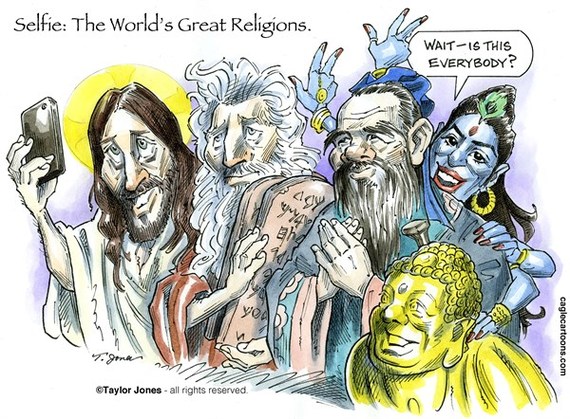
Is Confucius a Confucian?

2016-02-06-1454789056-6326582-misnomerofConfucianism.jpg

In the early 15th century, several Confucian missionaries embarked with Zheng He’s fleet, which was being sent out by the Ming emperor, Cheng Zu, both to demonstrate China’s national power and to build up international friendship with foreign countries. Relying on Zheng He’s incredible navigational skills and his massive ships, these missionaries reached every major country in southern and western Asia, eastern Africa, and the Cape of Good Hope, eventually arriving at their final destination, Europe. Their primary goal was to convert each non-Confucian, that is, each barbarian nation to Confucianism in order to spread Chinese civilization and also to bring, according to their view, ultimate goodness to everyone under the Heavens. But in order to do this, the missionaries first needed to understand the kind of education European people traditionally received. They found that in Europe everyone talked about Jesus. Jesus’ not so decent image, a nude, bloody and somewhat mutilated body crucified on a cross, was hanging everywhere and was venerated by almost everyone. As a result, the Confucian missionaries thought that since Jesus seemed to be the European’s sage, this tradition should be named, ‘Jesusism.’ Meanwhile, the missionaries reported this to the emperor of the Central Kingdom, and accordingly, the Chinese came to know the major teaching of Europe as Jesusism. However, these early Confucian missionaries’ efforts in Europe were not very successful. The Jesus believers refused to admit that Jesus was merely a sage, and it appeared that, to them, Jesus was much more than a sage. But because Chinese civilization maintained its technological and economic hegemony in the world from the early 15th century until the present, Chinese became such a powerful language that everyone in the world continually talked about ‘Jesusism,’ no matter whether ‘Jesusians’ approved of this name or not. At the same time, Confucianism spread into every corner of the world, and entertained, sometimes harmonious and sometimes conflicting, relationships with various indigenous traditions.

Yes, you are right! This is a fairy tale, a total fiction! But if you exchange ‘China’ for ‘Europe,’ replace ‘Confucianism’ by ‘Jesusism,’ and switch all the other relevant historical factors in this fiction, then I have been describing exactly what happened in the case of ‘Confucianism’!

Confucianism is a misnomer. It was created by early Christian missionaries for the purpose of comparison and, especially, of conversion. Although Christian missionaries created a number of names for the now so-called world religions, the term ‘Confucianism’ is especially unfortunate since it says nothing at all that is essential about the tradition that the name purports to describe.

We can see that this is so by making a comparison with other major world religions. In Christianity, ‘Christ’ means ‘the anointed,’ or ‘the savior.’ This is the Greek translation of the Hebrew word, ‘Messiah.’ For Christians, Jesus is the Christ, because he is thought to have cleansed the original sin of human beings through his crucifixion, and thus to be able to bring salvation to all the world. Similarly, in Buddhism, ‘Buddha’ means ‘the awakened’ or ‘the enlightened.’ For Buddhists, Siddhartha Gautama is a ‘Buddha’ because he has attained enlightenment. His teaching is thought to be capable of awakening people, allowing them to understand the origin of human suffering and helping them to transcend the otherwise endless cycle of reincarnation, the samsara.

By contrast, if we follow the name ‘Confucianism,’ and claim that Confucius is a Confucian, what could this mean? It is as tautological as to say a dog is doggy and the sun is sunny. I am quite skeptical concerning whether any Confucian practitioner approves of this name.

So what is the Chinese name for ‘Confucianism’? In other words, how would a contemporary Confucian wish to identify himself or herself when following this tradition? It is Ru (儒, pronounced like ‘zoo,’ but in an ascending tone). Given this name, it makes sense for Confucian practitioners to say that Confucius is a Ru because, similar to ‘Christ’ and ‘Buddha,’ Ru is not only a name. It also represents an ideal for human life. In this sense, to know why Confucius is venerated as a Ru is to understand the essential teaching of ‘Ruism,’ which in my view is the correct name to replace ‘Confucianism.’ So, what is this ideal? And what is the meaning of the Chinese character ‘儒’?

Although the division of ancient Chinese thought into named schools, such as Ruism, Daoism, Legalism, etc., was brought about by intellectual historians in the Han Dynasty (202 BCE-220 CE), the philosophical debate among major Chinese thinkers who were designated by these names had already begun several hundred years earlier. Mencius (approximately 372-289 BCE) considered that his own thought belonged to the school of Ru (Mencius, 7B). In addition, separate chapters entitled, “The Influence of a Ru“ (儒效) and “The Deeds of a Ru“ (儒行) are contained in Confucian classics such as the Xunzi and the Book of Rites, which were written during approximately the same time period as the Mencius. In other words, among various schools of ancient Chinese thought, the strong self-designation of Confucius’ students as Ru began shortly after Confucius passed away. If we now pay attention to the reason that the tradition selected the character 儒 (ru) to identify itself, we find there are two major meanings of 儒, both of which are warmly endorsed by Confucian practitioners.

First, rou (柔), a closely related character, means ‘being soft’. Why soft? This meaning relates to the sociological status of the term Ru before the time of Confucius. At this time, as a social order, Ru referred to a variety of professions: shamans, diviners, those who prayed for rain, dancers, those who presided over religious ceremonies, etc. In pre-Confucian China, this rank of people possessed one key skill which was thought by early Confucian thinkers to be of the utmost importance to human civilization: knowledge of ritual (li, 禮). From a Ruist perspective, the relationships among human beings and that between human beings and non-human nature are not immediate. Quite often, these relationships are, and ought to be, mediated by a variety of li: language, art, ceremonies, social etiquette, political institutions, technology, etc. In this way, li, although conventionally translated in English as ‘ritual,’ actually refers to all possible means of human civilization, and thus it is fair for us to paraphrase the Ruist concept of li to refer to all ‘civilized symbols.’ For example, faced with a beautiful, charming woman, no suggestion would ever be made that a civilized man should be driven immediately by his sexual impulses to grab her, kiss her, and touch her, without any scruple. On the contrary, civilized human sexual relationship is always mediated by kinds of symbols: a smile, particularized eye contact, intimate language, and probably also messages, emails, heartfelt gifts, etc. Finally, a civilized, more ideal result in this case for humans may be that even if the woman fails to accept the man, both must still show basic respect for each other, and thereby maintain a degree of humaneness throughout such interactive processes. Understood in this way, the uniqueness of civilized symbols consists in this, that as media, they are used by human beings to represent what happens in their subjective inner worlds in order to engage the objective realities which exist outside that inner world.

Therefore, li, according to this broad Ruist understanding, is a non-violent, uniquely human, way to facilitate human to human and human to nature relationships in order to advance human growth and to achieve the condition of dynamic harmony (he, 和) in every domain of human life. In a word, the ‘softness’ connoted by the character 儒 implies the essential and ideally non-violent nature of human civilization.

Secondly, ru means ‘to moisten’ (濡). In order to grasp the significance of this meaning of ru to Ruism, we must first understand a traditional Chinese idiom, 相濡以沫 (xiang-ru-yi-mo), which can be roughly translated as ‘(fishes) moisten each other using their saliva.’ The idiom refers to the following story: when a river dries up, fish become stranded in the river bed. In order to survive in this difficult situation, the fish spit saliva at each other, moistening and thus bringing relief to each other’s bodies. Understood in this way, a Ru, a ‘Confucian,’ was metaphorically thought to be able to ‘moisten’ people’s bodies because the Ru, by relying on their knowledge of all the resources of human civilization as well as on their own ‘practical moral influence’ (de, 德), are able to nourish people’s lives within human society. In comparison to other approaches to ethics in the West, this Ruist understanding of morality points to its distinctively holistic nature: if I am moral, I can nourish my life and the lives of other people, which thereby includes a significant bodily dimension. In other words, if I am moral, I will become healthy. In fact, based upon my previous analysis of the meaning of ‘dynamic harmony‘ (he, 和), this holistic approach to Ruist ethics is quite understandable.

In biological terms, a condition of dynamic harmony can be defined as one of ‘energy equilibrium,’ as when a biological entity employs the least amount of energy to exert optimal biological functioning, at the same time attaining a symbiotic relationship with each of the other entities within its local environment.

In this sense, if a Ru, by employing all kinds of non-violent civilized symbols, is able to bring a condition of dynamic harmony to his or her community, he or she is actually creating a healthy ecosphere within which all kinds of life benefit, nourish, and thus “moisten” each other. In this way, the character of 儒, which is made up of two parts, ren, 人, meaning ‘a human being,’ and xu, 需, meaning ‘need’ or ‘want,’ can be interpreted to refer to someone who is ‘a needed human being.’ But why should a Ru be needed by other people? It is precisely because he or she has command of the essential resources for human civilization, and so is able to ‘moisten’ people’s lives and thereby create those virtuous ecospheres which are needed within all domains of human society.

If we now combined these two meanings of Ru, ‘being soft’ and ‘to moisten,’ we can recognize that the standard meaning of Ru, as it is received in the Ruist tradition, is ‘non-violent transformation.’ To be a Ru is thus to be commissioned as a non-violent warrior and fighter who employs every resource of human civilization toward the realization of dynamic harmony in the world. A Ru is someone who tries to transform the world into an all-encompassing symbiotic ecosphere by employing his or her own personal moral cultivation. As a consequence, please do not forget that Confucius is not a Confucian; he is a Ru. And Confucianism is not Confucianism; it is Ruism. I hope that everyone who reads this article will help to spread this message, and will also commit to realizing the Ruist ideal in every dimension of human living.