Hallo! My name is Bin Song, I am a Ru scholar and a college professor in the disciplines of philosophy, religion and theology. This audio is about the breathing method I routinely use during my practice of Ru meditation.
Ru Meditation is my term to describe the method of meditation inspired by Confucianism. In the West, the term Confucianism was created in 19 century to refer to the Asian Ru tradition. However, the Ru tradition originally picked up the character Ru to name itself because Ru represents two ideals of spirituality: First, Ru means “soft” because an educated, civilized human being is thought of as tender, decent, and thus, non-violent; Also, Ru means “moisten” because these educated human beings can nourish other people’s life like bringing water and nutrition. It turns out that “Confucianism” is a misnomer; although the Ru tradition is decisively influenced by Confucius, it reaches far beyond what the historical person Confucius can encompass. In this audio, I will simply replace “Confucianism” with “Ruism” or “the Ru tradition,” and replace “Confucian” with “Ru” or “Ruist”, so as to still use the original term Ru to name the tradition.
Among all current approaches to meditation, Ru meditation remains relatively unknown by meditation practitioners. However, in my view, Ru meditation is a huge treasure which awaits today’s practitioners, especially the so-called professionals in the modern world, to explore. The reason is that major proponents of the Ru tradition were professionals in the world of ancient East Asia. As the famous institution of civil examination indicated, Ru scholars needed to be dedicated to learning and education for many years before embarking upon a very difficult and competitive process to pass varying levels of civil examination. After they succeeded to pass the due level of civil examination, they were appointed by the central government to varying governmental posts in both the national and local levels. These Ru scholar-officials are governmental ministers, local governors, lawyers, judges, and varying functionaries to serve diverse functions of social and governmental management. Some of them, when they left the government, were even dedicated to commerce and business. Because of this down-to-earth and highly managerial social background of Ru scholars, the type of meditation they created and practiced is highly adapted to humans’ everyday life. Nowadays, professionals take meditation, or other related contemplative practices as a major recipe of human health to lower their stress, train their mindfulness, enhance their memory, boost their creativity, and strengthen their general well-being. This is exactly what Ru scholar-officials or Ru businessmen were successfully doing for millennia in ancient East Asia. Therefore, this under-explored and extremely rich tradition of Ru meditation needs to be uncovered in the contemporary society to serve those similar needs of professionals in their varying careers and workplaces. This is the intention for me to produce this series of audio broadcasts.
For the practice of Ru meditation, it is fundamental to command the appropriate method of breathing, and to experience the varying psychosomatic states which will be induced by the continuous disciplined practice of breathing. The philosophical reason for Ru meditation to emphasize breathing so much is that the air breathed in and out is thought of by virtually all practitioners of Ru meditation in history as one most significant instance of the all-pervading cosmic vital-energy. In Chinese, this vital-energy is called Qi.
We will have more philosophically featured audios in the future to explain the concept of Qi in more details. For now, it would be enough to indicate that in this Ruist cosmology, Qi comprises everything in the universe, and most importantly, the continuous replenishing, balancing and harmonization of varying forms for vital-energies within human body determines the well-functioning of all its organs, including its most refined part, the so-called human heartmind, 心 xin. In the finest stage of breathing practice which I will describe as a “settling” sort of breathing in the following, the Qi breathed in is so delicate, fine, slow and deep that we can achieve a certain state of energy equilibrium, which Ruism called “centrality.” In this state of energy equilibrium, we consume the minimal amount of energy to fulfill the optimal function of our body, while maintaining a harmonious and symbiotic relationship with our environment. The goal of the breathing practice of Ru meditation, which I call Ru breathing, is to achieve this state of energy equilibrium, or the state of centrality, consistently in moments of our daily and social life.
The following breathing method has been created and practiced by me for many years. Its creation is inspired by my continual learning of the tradition of Ru meditation. In the future’s more theoretically featured audios, you will gradually understand the connection between this method and Ru philosophy. However, in this audio, I will focus upon its practical aspect.
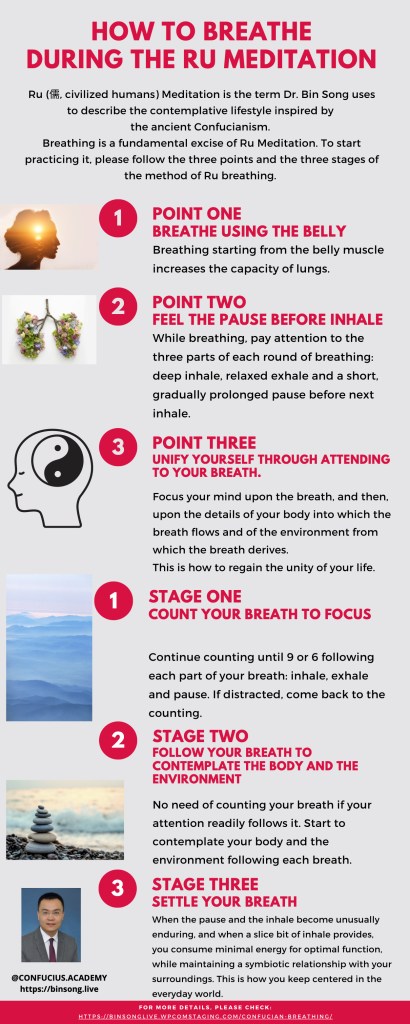
The breathing method comprises three major points and three major stages. Let me explain them one by one.
The first point is that you need to breathe using your belly muscles, rather than the chest ones. Belly muscles are stronger and larger, and they can stretch the expansion of diaphragm to a larger extent. As a result, your lungs will have larger room to expand when air is breathed in. This also means more oxygen will be inhaled in each round of breathing, which is good. Another benefit to breathe using belly muscles is that many organs are located in or surrounding our belly. When belly muscles are moving during our deep breathing, they will slightly move those organs as well. Because our belly is right at the center of our body, its movement can extend in a certain degree to other parts of our body. In this way, the contraction of belly muscles during deep breathing would be like letting them do a natural massage to our body, which will feel very good. Ok, let’s have a practice now. Please put your hands on the two sides of your lower abdomen, and let’s have a deep, slow, relaxing breath using our belly muscles. Breathe in, then, you feel the gradual rising of your belly; breathe out, then, you feel its gradual descent. Breathe in, use your full capacity to let oxygen sink in. Breathe out, and you feel comfortable, and relaxed.
Good, is it easy? Yes, it is easy. It only depends upon whether you consistently practice it. The Ru tradition believes wisdom shares three features: it is simple, consistent and adaptable to change. An appropriate method of breathing is definitely one very necessary component of the Ru wisdom.
The second point of Ru breathing is that while breathing, our mind needs to be aware of each part of each round of breathing.
There are three parts of each round of breathing. The first part is inhale.
When inhaled, oxygen smooths through nostrils into your lungs, and is furthermore carried over to cells all over your body. Make sure your inhale is slow, deep, and relaxed. While practicing deep breath, some people like to deliberately hold their breath for a long while after inhale. However, for beginning practitioners, I would not suggest you to do so; even if you naturally want to hold the breath for a while after inhale, I would not suggest you to make it too long. This is because after you hold your breath for some time, you will use more strength to exhale, and as a consequence, you will even need to immediately start the next inhale. In this way, a deliberate hold of breath will disrupt your natural pattern of breathing. But one of the most important principles to command an appropriate method of meditative breathing is to maintain the balance between discipline and spontaneity. Yes, we practice breathing so as to give us a little discipline; but the purpose of this discipline is to stimulate the natural reaction of human body inherent to our metabolic system. In a Ruist term, we would say the discipline of breathing is to rediscover our innately good human nature. If you discipline yourself too much, like if you hold your breath after inhale for too long, you will disrupt that innately good human nature, and thus, will slow down the process leading to ideal breathing. Therefore, when you start to practice breathing, please inhale deeply and slowly, feel how you utilize your belly muscles to the largest extent. When you get to the limit, then, exhale naturally. You do not need to deliberately hold your breath for too long.
After your deep, slow and relaxed inhale, the second part of each round of breathing is exhale. When oxygen is carried to cells of your body, together with nutritions digested from food, mainly sugar, it will be used to produce energy and carbon dioxide. Energy serves the functions of your body, while carbon dioxide, like a waste, will be released from your body. Since this is a process of release, we do not need much effort to do it. Therefore, while exhaling, the only thing you need to do is to naturally release the air in an even more relaxed way. Some friends once discussed with me whether we should use our mouth or nostrils to exhale when we practice meditative breathing. My view on this is that most of the time, let’s still use the nostrils to exhale. This is because if we use our nostrils to inhale, but our mouth to exhale, we have to add an extra intention and a corresponding extra act of “exhale through mouth” to our practice. This will let our attention a bit more difficult to get focused. However, for more mature practitioners, if they have gone through all the three stages of Ru breathing which I will discribe in the following, they can choose to use mouth-exhale according to their need. For instance, if you are practicing Eight Brocade Exercise, Taiji martial arts, or other moving forms of Ru meditation, you can choose to exhale through mouth since your body needs more energy input in a relatively shorter time in these cases. Or, as I will mention later, for adept practitioners, they can try practicing to prolong the time of one inhale before sleeping. In this case, it would not be a bad idea to exhale through mouth since it has been delayed for a long time. I will explain details of these mentioned practice in the following or in the future. In a word, for beginning practitioners of Ru breathing, the key is to use your nostrils to exhale naturally and effortlessly, so that the carbon dioxide can be released from your body to serve needs of other beings in your environment.
The third part of each round of breathing, which we do not normally pay attention to, is the short pause after exhale. Normally, people do not realize that there is a short pause between exhale and next inhale, because this pause is too short if we do not practice breathing. Our daily awake life is occupied by varying events, businesses, thoughts, feelings and random ideas, and because of this, our body needs a constant input of energy flow to maintain its basic functions. Therefore, after exhale, we will feel an immediate need of next inhale. We would not even notice the short pause in between. However, when we practice meditative breathing, we are becoming more calm and relaxed, and our body also needs less energy than usual. In this case, the pause between exhale and next inhale will become longer. This is similar to the state of our deep sleep. When we sleep deeply, our body is completely relaxed, and no thought occupies our brain. Our breathing is also very delicate, slow and effective. In this state, even if we do not immediately inhale after one exhale, the energy produced by the oxygen input is still enough for the use of our body. Similarly, when we practice Ru breathing, we pay attention to the short pause after exhale. This is how we keep mindful of the pace and efficiency of the breathing metabolism of our body. And This is very important for practicing the three stages of Ru breathing, especially its third stage, which I will explain in the following.
Good, now, let me summarize the second key point of Ru breathing. That is, We need to be aware of the three parts of each round of breathing: a deep inhale, a relaxed exhale, and a short and gradually extended pause in between.
The third key point of Ru breathing, which is also the most important point, is that during the process of meditative breathing, we shall try to achieve the unity between the heartmind, the air (which is one form of Qi, vital-energies), the body, and the surrounding environment. In other words, we need to put the direction of our heartmind (which is our attention) upon the breathed air, and furthermore, by means of the breathed air, our heartmind can pay attention to the whole body where the air flows through. By the same means, our heartmind can also attend to the entire outside environment from which the air originates and circulates. In this way, when we consistently practice meditative breathing for a time, we shall eventually be able to simultaneously put our attention to the air, the body and the environment. At this moment, we would experience the unity of harmony between our heartmind and our body, and furthermore, between our person and the environment. This unity of harmony is also the goal of our breathing practice.
Why is the harmonious unity between the human heartmind, the human body and the environment so significant? From a Ruist perspective, one major reason for diseases to arise is the disunity between heartmind and body. For instance, if our heartmind is not attending to our teeth, when we forget to brush them carefully or take care of their other needs, there will be cavities. Similarly, we are all prone to be emotional to certain people or events in our daily life. However, if we do not pay attention to why these emotions happen and how to have them be appropriate, and instead, if we indulge ourselves in whatever emotions arise non-reflectively, our inappropriate emotions will turn into bad habits, and these habits will eventually hurt our health and cause diseases. Therefore, through practicing breathing, we can make our heartmind stay close to the breathed air, and the breathed air stay close to the body. This is a foundational method for us to reach the unity of heartmind and body, which furthermore strengthens our health and general well-being.
From the perspective of the relationship between us and our environment, there are mainly two components of our outside environment: the other humans, and the nature. While practicing breathing, we will pay attention to the entire environment where we live through being mindful of how the air breathed in and out. In this way, we will realize the deep interconnection between us and environment, and this realization will be the basic condition for us to perfect human relationship, and to better the relationship between humans and nature.
In a word, while breathing, our heartmind pays a constant attention to the breathed air, and through the air, our attention clings to our body, and to the outside environment, so that we can achieve the harmonious unity between the heartmind, the air, the body and the environment. This is the third and most important point of Ru breathing.
But how can we achieve this unity of heartmind, air, body and environment? After explaining the three key points of the method of Ru breathing, I will start to describe the three stages of Ru breathing. If you follow the three points of the method, and experience all the three stages of Ru breathing one after another, you will understand how to discipline your breathing to achieve the aforementioned state of harmonious unity.
The first stage of breathing practice is to count the breath. The thrust of this stage of breathing is that at the beginning of practice, our mind is not so easy to focus upon breathing. Therefore, by means of counting, we force our attention to numbers, and furthermore, to the varying parts of each round of breathing that match the number. In this way, we can discipline our attention to follow the breathing eventually. As explained, there are three parts for each round of breathing, and therefore, we need a number which multiples three to count the varying parts of our breath. I suggest we use 9. So, when we breathe in, deeply, slowly, and follow all the major points of Ru breathing explained above, we count 1. When we exhale, slowly, naturally and even in a more relaxed way, we count 2. After that, for the short pause before next inhale, we count 3. After this, 4 for inhale, 5, for exhale, and 6 for the pause; again, 7 for inhale, 8 for exhale and 9 for the pause. After finishing this round of counting 9, we re-start to count from 1 to 9, again, again and again. Why do we need to count by 9? If we make a too big number, then, we will probably lose our attention, become a bit absent-minded, or even sleepy if one round of counting takes too long a time. However, if we make a too small number, then the force put upon our attention is not strong enough. Accordingly, we cannot sufficiently focus our attention upon breathing either. Of course, if you feel comfortable, you can surely count by six. After all, all these rules I explained about Ru breathing are heuristic, explorative, and practical. You can make your own adjustment following those general rules. On the other hand, since we are talking about Ru meditation, we can even use verses in Ru classics to count our breathing, to replace the numbers. For instance, we can turn the first several verses of the text “Stayed Centered in the Everyday World” or “Centrality and Commonality”, in Chinese, 中庸, into a mantra, and then, use this nine-character mantra to count our breath. And the mantra is 天命性,率性道,修道教. Let me say it again: 天命性,率性道,修道教. So, 天 is inhale, 命 is exhale, and 性 is the short pause. Then, we just continue and repeat the mantra. The meaning of these nine characters is that: what is endowed by the universe is called human nature; the Way for human living is to manifest this endowed nature; and to cultivate this Way is called education. We will mention this Ruist philosophy of humans vis-à-vis the universe in the future’s podcasts in more detail. However, for beginning practitioners, if they find it difficult to pronounce silently these characters during breathing, it will be fine and work equally well while we just count our breath using numbers.
While practicing counting your breath, one big challenge for beginning practitioner is that even forcing their thought upon the numbering process, their mind is still easy to get distracted by their random thoughts. When this happens, make sure yourself just to return to the count. Do not be distracted by your distraction, and regardless of what happened, whenever you realize have have been distracted, just go back to the method. This is how we deepen our practice, and nothing needs to be stressful during the process.
The second stage of Ru breathing is to follow the breath. After you practice counting breath for a certain amount of time, your breath will have become slower and deeper than normal. Now, it would be relatively easy for you to continue focusing upon your breath even if you do not count it any more. In this case, you can just have your attention “follow” your breath in the sense that, you would not need to use counting as an intermediary method to help focusing. In other words, you can focus your attention directly upon your breath. This is what I mean by “follow the breath.”
While following your breath, you are aware of the three necessary components of each round of breathing. Because your attention is already strong enough to remain close to the entire itinerary where you breath comes in and goes out, during the stage of following breath, you can start to use another method of “contemplation” to deepen your practice in order to reach another stage of Ru breathing. You can contemplate the varying parts of your body through which the breathed air flows, and the varying parts of your environment out of which the breathed air originates and circulates.
In each round of breathing, when we inhale, we contemplate one part of our body, and this is how we contemplate our body while following our breath. We can start from the tip of our nose. Inhale, and feel how air is breathed in, its temperature, and its delicacy. Then, in the next inhale, let’s contemplate our throat. Its importance, its fatigue, and how the breathed air can bring energy to it. Then, we can contemplate our chest cavity, the abdominal cavity, our arms, legs, feet, back, neck, head, etc. When we contemplate our body, we can also try to contract the muscles in varying parts of our body one by another, and then, release them, so as to feel the ease, comfort and relaxation that gradually pervade our body. We also need to remind us of the significance of each part of our body when we contemplate them. Western culture and philosophy in general is very much logic-and-intellect centric, so contemplating how air energizes and restores varying parts of our body so as to achieve the unity of mind and body would be a good practice to complement what this Western mindset lacks.
Similarly, after finishing contemplating our body, we can start to contemplate our outside environment. The method would be similar: in each round of breathing, when inhaling, we contemplate one part of that environment. We can start from the place where you are practicing: your chair, clock, laptop, the furniture, varying rooms in one building, your family, friends, your workplace, the city, your favorite park, your country, the earth, and eventually, the entire universe. While contemplating them and inhaling the air, our feelings would be to care, to remain attentive, and to be grateful. Stripped of each such component of our outside environment, our life cannot barely find its position. Therefore, keeping attentive to these details in our environment, and reminding us of the intimate position we obtain in the entire universe, are really the preconditions for us to improve our environment, and improve our life.
The third stage of Ru breathing is to settle the breath. After practicing counting and following the breath for a sufficient amount of time, during the practice, our mind would feel clamer and clamer, our body feels more and more relaxed, and the breathed air is even more delicate, slow and pervasive. When we continue to do so, at a certain point, our metabolic system will pass a threshold so that we will only need a minimal input of oxygen to be able to maintain the well-functioning of the entire body. Once passing this energy threshold, we will not feel an immediate need to inhale when we finish the last round of exhaling. In this case, the short pause between the last exhale and the next inhale will be extended for an unusually long period of time. Since our body right now does not need an immediate input of oxygen, even if we suspend our breath in this third part of our breathing for a while, we would not feel any dis-comfort. Instead, since we have already stored enough energy in our body, we would feel a joy and comfort even if we temporarily suspend our breath. At this moment, if we continue to practice breathing according to the above method and thus, to continue extending the length of the pause in-between, according to my own experience, our breath will undergo subsequently two states in this third stage of Ru breathing, the stage of settling our breath. You can also understand these two subsequent states as two signs which tell us our breathing already steps into the third stage.
Firstly, since the pause after exhale is extended, the time for one next inhale is also extended, to an unusually long length of time. It is not beyond expectation that the breathing pace becomes extremely slow at this stage, since we need a smaller input of oxygen to maintain the basic function of our body,. However, since the breathing becomes much slower, the adoption and carrying-through of those oxygen molecules in our body would also become more efficient. The process of oxygenation will pervade those cells of our body that are not so easy to be reached under normal circumstances of breathing, and because of this, we will have a deep feeling of “healing” when we realize this extremely slow, delicate and efficient pattern of inhale.
Secondly, when we continue to accumulate our experience of this extended, healing inhale, the stage of settling breath will enter its second state. That is, when our breath is naturally, joyfully and effortlessly suspended between the last exhale and next inhale, we only need to inhale a little bit slice of air, and then, after even unnoticeably exhaling it, we can still stay in the same state of suspension, and thus, prolong the time of the in-between pause. In other words, at this moment, we need a minimal amount of energy input to maintain an optimal function of life. At this moment, our feelings towards our own body, our heartmind and the environment will be dramatically different from ordinary ones. And our consciousness will also become extremely mindful, sensitive, translucent, and all-pervasive.
Good, let’s summarize what we have talked about the third stage of meditative breathing. After we continually practice counting and following our breath, if in a natural and relaxed way, we can obviously and extraordinarily extend the length of one inhale and the length of the in-between pause, we are entering the stage of “settling the breath”. In this stage, our experience is extremely joyful and comfortable, and it is also deeply healing. This is because we continually rely upon a minimal amount of energy input to maintain an optimal function of human body, while we can also simultaneously keep a peaceful, harmonious and symbiotic relationship with our environment. In a scientific term, our life achieves a certain state of energy equilibrium at this stage; and in a Ruist term, the state can be called “centrality”. It is also the state of a harmonious unity between our body, our heartmind, the air and our outside environment which we mentioned before.
Once we experience the third stage of meditative breathing, the goal of Ru breathing is realized. From the perspective of Ruist spirituality, nothing is more important than being able to deal with real issues in the human world. The described breathing process featured by a final settling stage of breath can re-energize ourselves quickly and effectively during our busy daily life; our heartmind is fuller of love, more humane, and our mind is also more aware and mindful. With all these benefits of the practice in hand, we will have a good foundation to deal with real life issues in the world. In other words, the goal of the practice of Ru breathing is to have us rediscover and maintain the pattern of settling breath so as to constantly get back the optimal function of our body, with a further result of more effectively engaging our daily life.
But how long a time do we need to reach the stage of settling breath from when we start our practice? According to my practicing and teaching experience, if we continue to practice breathing according to the aforementioned method, we practice about 10-15 minutes for at least three times a day. Especially, we practice it during our daytime nap or before we get to sleep at night. Then, using about half a month, most of people can reach the third stage of settling breath. However, the state of settling breath results from a combined effort of humans and nature. We provide our discipline to rediscover an inherent pattern of optimal breathing, and because of this, we cannot demand or predict exactly when the settling breath can take place. So, let my tone be a bit reserved. We can trustfully say, as long as we continue a daily practice of Ru breathing, we can always feel the benefits of it in time.
When our breath reaches its ideal state of settlement, there is a supplementary discipline that we can work on. That is, we can try to deliberately extend the length of one inhale, and the best time to do this is before sleeping. The method to do it will be like this: before sleeping, everything is quieted, and we have no further business to worry or even think about, we can start to practice breathing according to the aforementioned method. While feeling the obvious extension of the in-tween pause, and hence, entering the stage of settling breath, we can exert a bit further more effort to extend the time of our inhale. Since we use our belly muscles during the practice, we can do it in this way: we inhale slowly and delicately, just like we normally do during our breathing practice. However, at this stage of settling breath, we can inhale following the movement of our belly. When our belly rises a little bit, we breathe in a little bit more of the air, and then, hold it for a short while, observe the belly continues to rise; When the belly continues to rise a little bit further, then, we will breathe in another little bit more of air. Since our breathing already reaches the stage of settlement, a little bit more of oxygen input will be sufficient to maintain the function of our body. And since we deliberately slow down the breathing, the adoption of oxygen by our body also becomes more delicate and efficient. However, since the time for inhale is prolonged, the accumulated carbon dioxide will need to be exhaled after this prolonged inhale. Therefore, if you would like to use your mouth to exhale during this practice, that will be perfectly fine. In a word, the third stage of Ru breathing can be supplemented by this practice of deliberately prolonging our inhale. Since this is supplemental rather than essential, you can decide whether to practice it or not. For me, I do sometimes practice it, but not too harsh or restrictive on myself. I normally practice it during day naps or night sleeps, and its experience is very comforting and re-energizing.
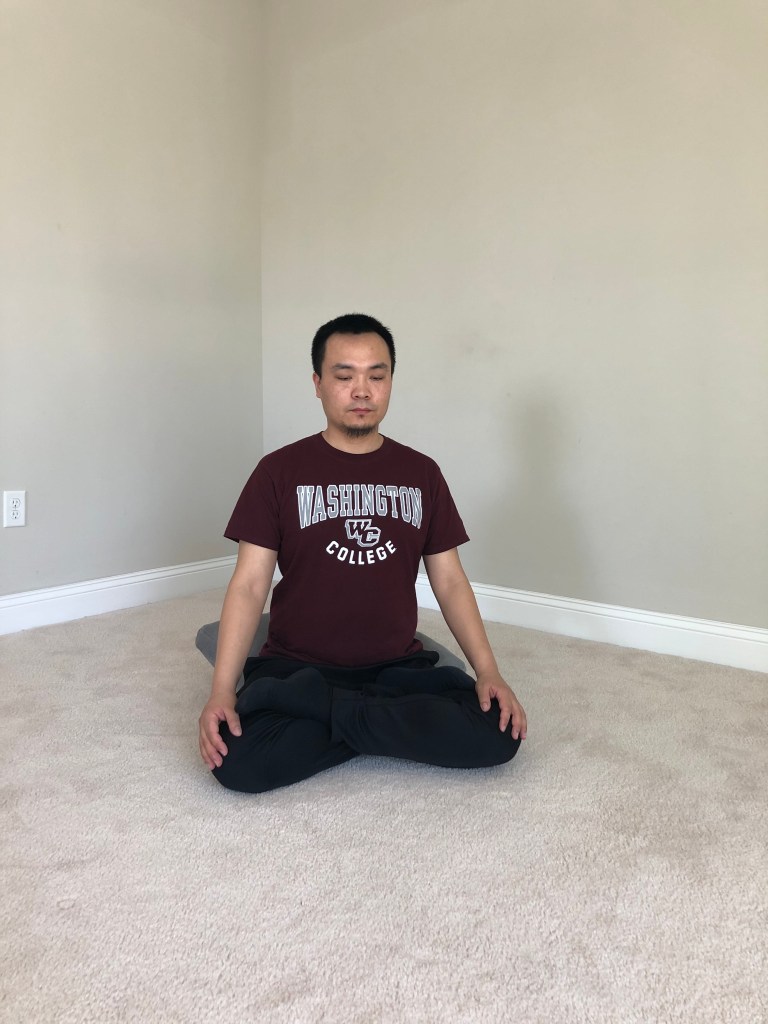
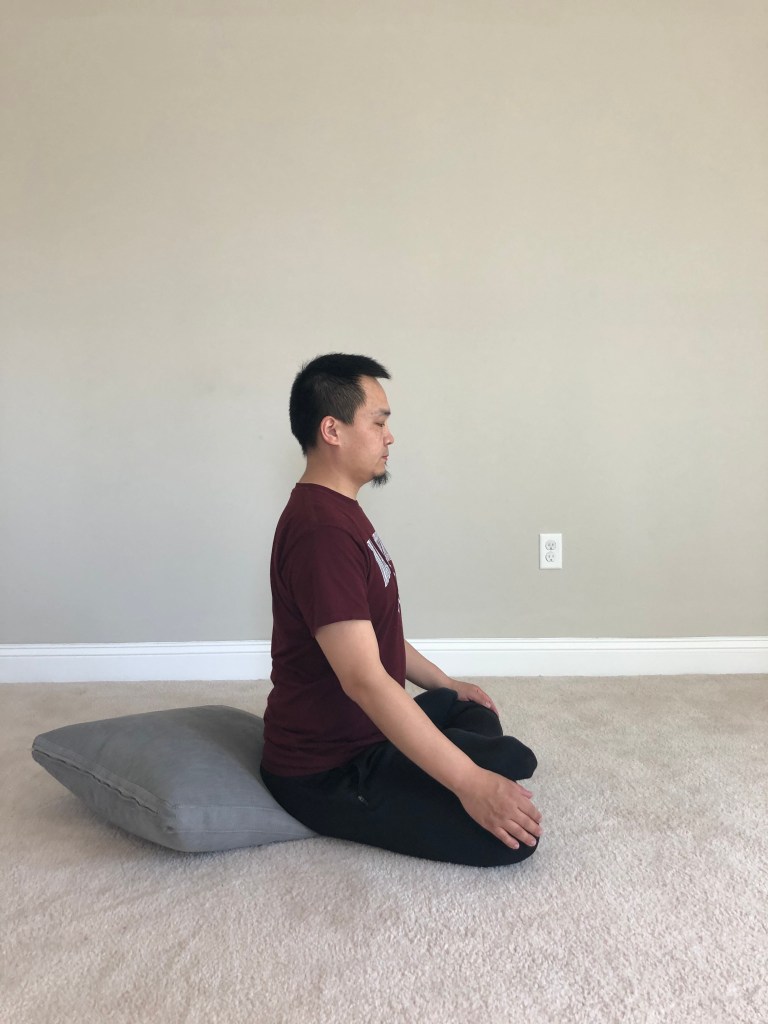
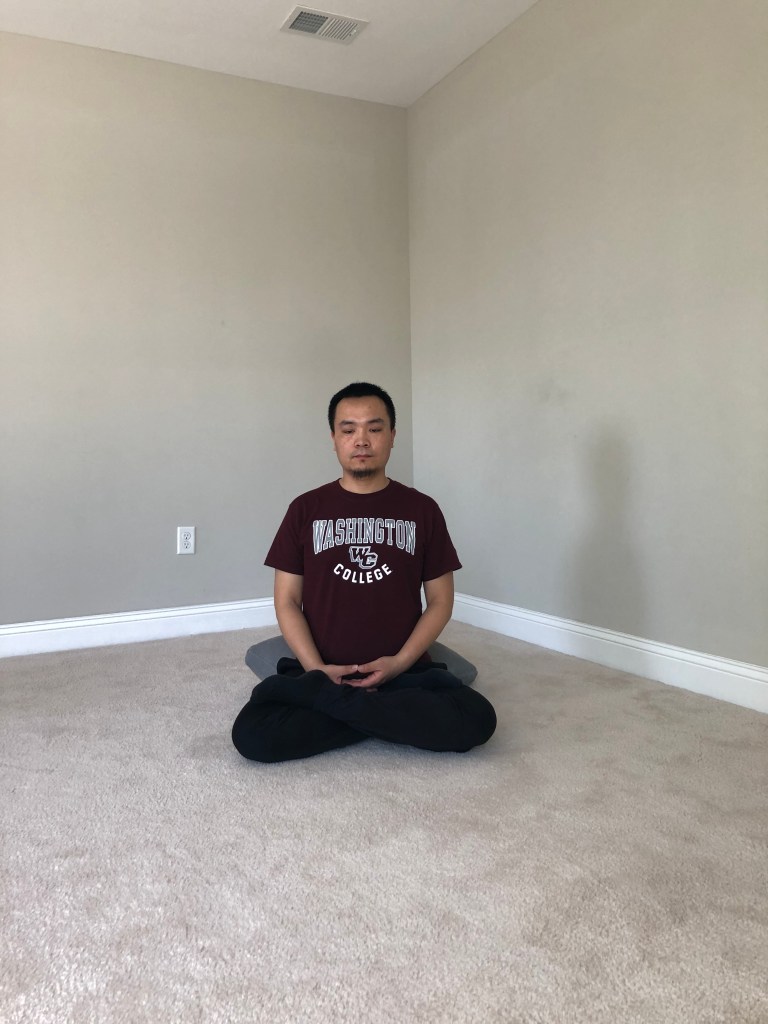
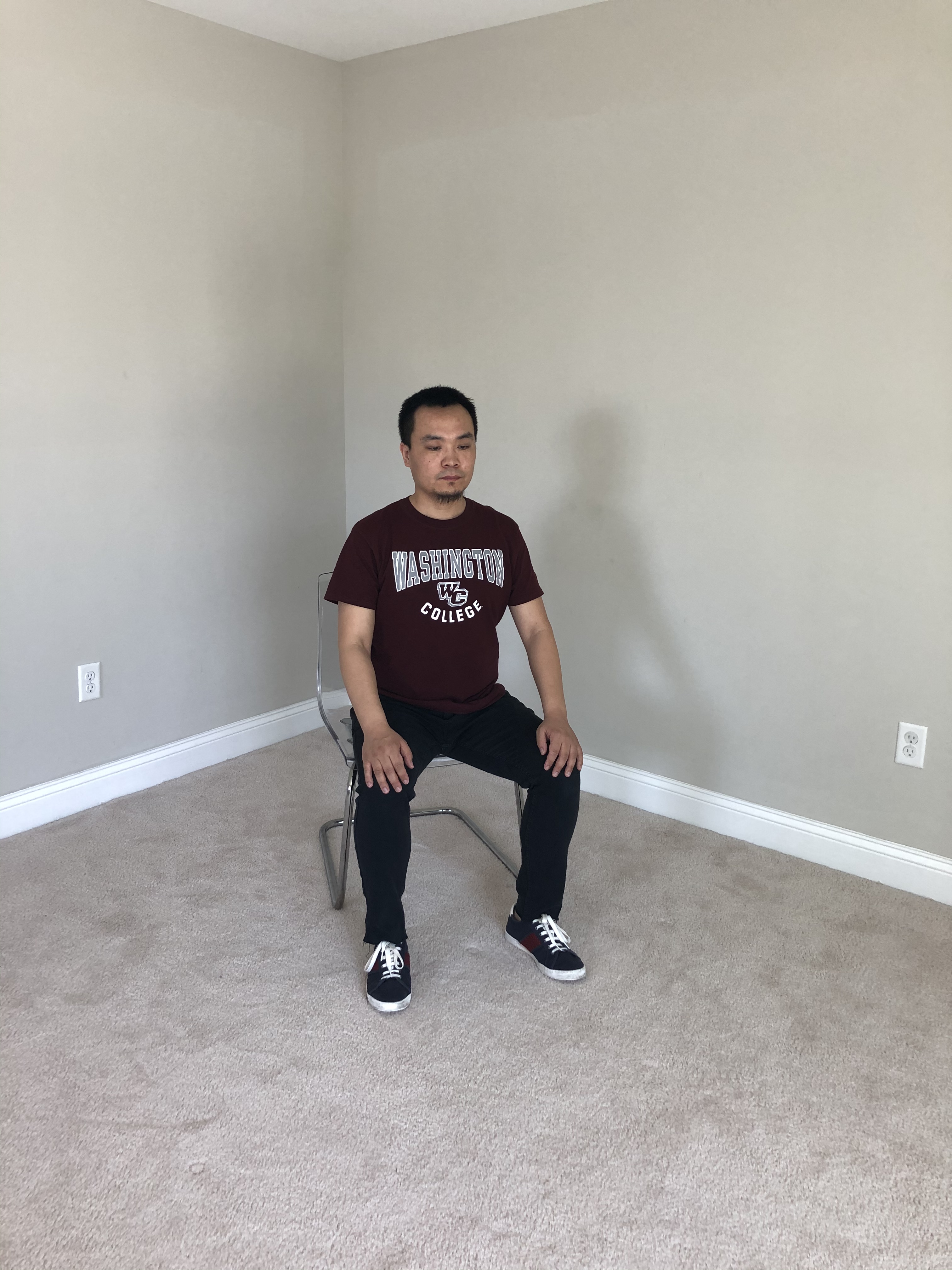
Before concluding our explanation of the method of Ru breathing, I will announce that for the purpose of Ru meditation, postures during meditative breathing are less important than the discipline of breathing itself. However, one very important aspect for Ru meditation is that we can achieve and maintain the state of energy equilibrium, or the one of centrality in varying postures, so that we can be in a consistent meditative mode no matter we are still, moving, or dealing with real issues in the human world. In the future, I will make audios to explain varying postures of Ru meditation, starting from its still form such as quiet-sitting, and gradually to its moving forms such as walking and martial arts.
I will use six sentences to summarize and conclude the three key points and the three major stages of Ru breathing for Ru meditation:
Point One: Breathe using belly.
Point Two: Feel the pause before inhale
Point Three: Attend to the breath for the unity between body, heartmind and environment.
Stage One: Count the breath to focus
Stage Two: Follow the breath to contemplate the body and the environment.
Stage Three: Settle the breath to stay centered in the everyday world.
Music used by the podcast is from Ambiment – The Ambient by Kevin MacLeod is licensed under a Creative Commons Attribution license (https://creativecommons.org/licenses/by/4.0/)
Source: http://incompetech.com/music/royalty-free/index.html?isrc=USUAN1100630
Artist: http://incompetech.com/




 Bin Song