
Category: Uncategorized
The Copernican Revolution
Hallo, This is Dr. Bin Song at Washington College to muse about the History of Modern Philosophy.
After having discussed some of modern philosophies and their predecessors such as the pre-modern Aristotelian scholasticism, let’s ask an important question for the course: what is the beginning of modern philosophy after all? If you open textbooks on the history of modern philosophy, quite often, it is the French philosopher, Rene Descartes (1596-1650 C.E.), who is titled by historians as the father of modern philosophy. Notwithstanding not willing to contest this title, I would like to put the beginning of modern thought much earlier, not in Rene Descartes’s systematic philosophy which we will study in details later, but in Nicolaus Copernicus’s much technical work in astronomy. Today, we have another title to honor the work: we call it “The Copernican Revolution.”
Therefore, in order to understand the nature of modern thought, it is actually very significant for us to grasp the intrinsic connection between Descartes and Copernicus. To put it in a simple way, I would say Descartes’s “I think, therefore I am” can be seen as a philosophical magnifier of Copernicus’s much earlier, yet revolutionary astronomical theory. And let me explain why this is so in the following.
In order to more neatly and effectively explain the visual movements of heavenly objects observed from the earth, Copernicus put the sun, rather than the earth at the center of the universe, and he did so in reliance upon neither any of advanced technologies (since Galileo’s telescope had not yet been invented at the time of Copernicus) nor any of newly observed data of the sky. Instead, Copernicus believes his heliocentric astronomy is correct merely because 1) it can make pieces of a single astronomical theory more coherent to each other, and 2) such a new astronomical theory can explain the available data in a simpler way. What makes the story of the Copernican revolution even more compelling is that we know in a hindsight that given Kepler’s later revised heliocentric model which describes planets in the solar system move in ellipse rather than in circle, Copernicus’s theory is actually inaccurate. It has no higher degree of exactness or certitude regarding its description of heavenly movements compared with its predecessor, the dominant Ptolemaic geocentric astronomy, and this also means that Copernicus’s new theory would necessarily fail to produce a more accurate calendar and thus could not obtain those practical benefits which people widely expected the value of an astronomer’s job mainly consists in.
What makes Copernicus’s case even more imposing is that out of the concern of the controversial nature of his work, only towards the very end of his life, the year of 1543, Copernicus decided to publish it. This implies that despite having spending decades on the painstaking, tedious, and sometimes even seemingly hopeless work to calculate all those minute details of astronomical data, Copernicus could not even garner any personal benefit from the work: no fame, no money, and no expected change of Copernicus’s daily life before his death. If we can find any word from Copernicus’s own writings to answer our concern why he was motivated to pursue the work, we knew Copernicus’s major job was a Catholic canon, and he wrote to the Pope Paul III in the preface to his book on the Revolutions as follows:
“For a long time, then, I reflected on this confusion in the astronomical traditions concerning the derivation of the motions of the universe’s spheres. I began to be annoyed that the movements of the world machine, created for our sake by the best and most systematic Artisan of all, were not understood with greater certainty by the philosophers, who otherwise examined so precisely the most insignificant trifles of this world. For this reason I undertook the task of rereading the works of all the philosophers which I could obtain to learn whether anyone had ever proposed other motions of the universe’s spheres than those expounded by the teachers of astronomy in the schools.” (Translation and Commentary by Edward Rosen)
Therefore, it was out of a deep feeling of religious piety towards his almighty God, Whom he believes must have created the world out of sheer order, harmony and beauty, that Copernicus dedicated most of his life to working on a bravely new astronomical theory. But given all our previous analyses, just imagine how hopeless and dead-ended Copernicus’s work could have appeared to all the people surrounding him! It could neither bring any personal benefit to the astronomer in question, nor be accurate enough to produce any immediate practical benefits to the public. If piety can explain how Copernicus himself could sustain his efforts so long to eventually complete such an impossible work, why did such a work become revolutionary in its nature? In other words, why did the most brilliant minds in early Modern Europe, such as Galileo, Kepler, Descartes and Newton believe that Copernicus’s new thought, despite being inaccurate, is promising, and thus, would like to continue to work on it so as to finally create the whole paradigmatic change of human knowledge about the natural world?
In my view, this question is crucial for us to understand the connection between Copernicus and Descartes, and to answer this question, we still need to go back to the two criteria by which Copernicus judges his new heliocentrism is truer than the old geo-centrism.
Firstly, Copernicus thinks parts of his new system are more coherent to each other. For instance, in order to explain the diurnal westward and the annual eastward movements of heavenly objects, the old geocentric astronomy puts each star and planet on a gigantic universal sphere which rotates daily in a very fast pace surrounding the earth; however, for each of these stars and planets, it is within an orbit circling around the earth which moves annually in a much slower pace. The entire picture is like putting ants into different points of a gigantic wheel which all move in a direction contrary to the rotation of the wheel. How cumbersome and incoherent this entire system looks! However, in Copernicus’s heliocentric model, the sun is in the center, and all other planets move in an annual circle surrounding it with the earth also moving around itself in a daily basis. All the stars are put in an infinitely further distance from the solar system, and seen as a whole, the entire solar system just shares one single, common type of annual movement with each planet moving themselves locally. If God was thought of as an omni-intelligent creator, we could bet which model he would like to create the world according to!
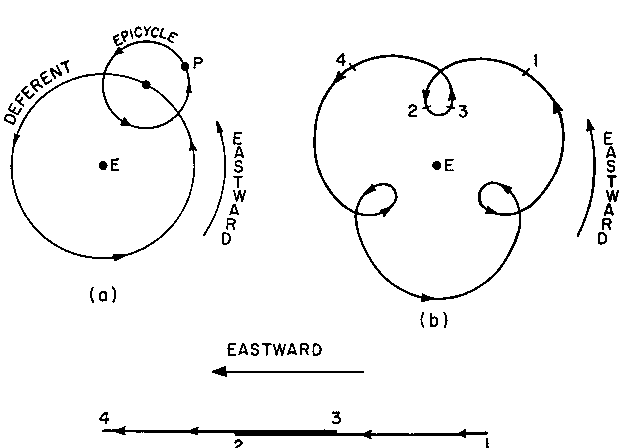
Secondly, Copernicus thinks the explanation made by his new system is simpler. For instance, the planets of the solar system wander in a strange way. During the overall annual eastward movement, they regress towards the west for a certain period of time and for several times during a year; this phenomenon is called “retrograde” of the solar planets. The solution by the old Ptolemaic model is to let planets move in an epicycle the center or one eccentric point of which moves on another circle called “deference,” and the center of the latter bigger, deference circle is the earth. In other words, seen from the perspective of the earth, Ptolemy’s geocentric model uses two circles to explain one phenomenon called the retrograde of planets. However, in Copernicus’s model, a planet moves on one singular big circle surrounding the sun in different velocities. Therefore, in some time of the year another planet will stay closer and closer to the earth, but in most of the time, two planets just constantly stay apart from each other. In other words, seen from the perspective of the earth, Copernicus’s heliocentric model uses only one circle to explain the same phenomenon, not even to need mentioning the complication of varying degrees of “eccentricity” of each epicycle in Ptolemy’s system. So, a simpler model is created by Copernicus to explain the same observed phenomenon.
However, let’s dwell in these two criteria for a while: coherence and simplicity. These two criteria of truth actually have nothing to do with perceived realities; rather, they are about the nature of human perceptions themselves. In other words, what drives Copernicus’s pursuit of an eventually inaccurate new astronomical model is not any practical result that his theory can bring to realities outside of human mind, which we know his theory can barely deliver according to our above analysis; rather, it is mainly about how human perceptions can get reorganized by themselves.
While refining Copernicus’s new perception of the solar world in a way more adequate to outside realities, modern scientists and philosophers had a long way to march. For instance, if the earth moves, how can we explain objects thrown upwards still fall upon the same place? If all planets move, what keeps them on their orbits? If the so-called sphere of stars is projected to be infinitely far away and therefore there is really no such a thing called the center of the universe, what is the position of human beings in this vast, seemingly entirely disoriented new world? As we will discuss later, all these triggered questions are continually answered by modern philosophers, and from the perspective of natural science, it is those scientists from Copernicus to Newton who have provided a somewhat complete system of modern science which utterly transformed human knowledge on the nature. From the perspective of social science and philosophy, it is philosophers from Descartes to Kant who have furnished a similarly somewhat complete system of enlightenment philosophy which functioned as an intellectual blueprint for all major aspects of modern society. However, at the very beginning of this chain reaction of modern thought lies the sheer desire of Copernicus to have human thought get organized by itself prior to demanding any practical consequence from it.
At this moment, I believe you are already being able to answer the connection between Copernicus and Descartes. Yes, “I think therefore I am” is actually a cartesian philosophical magnifier for the deeply transformative perspective brought by Copernicus’s astronomical work which manifests the nature of Modern Man as primarily the self-transforming power of individual human perceptions. Copernicus believes astronomy as “unquestionably the summit of the liberal arts and most worthy of a free man.” (Introduction, Book One, on the Revolution). As manifested by his work and life, such a transformation of human perceptions of the world, which is “revolutionary” by its very nature, requires the execution of human freedom, courage, disciplined and diligent use of human reason.
So, let’s let this conclusion of this lecture sink in our mind while we shall continually explore the history of modern philosophy: without any more empirical evidence to prove himself to be right, without any material benefits in vision to bring to either the public or himself, Copernicus spent his life inventing and perfecting a new theory which he believes to be true, and many of his followers also believe to be truer, just because the theory is more coherent and simple. Or should we conclude, Copernicus freely and rationally thinks, and therefore, the impact of his thought still exists during the centuries after his death.
Aristotle’s Physics: A Closed, Meaningful but Untrue World
Hallo, this is Dr. Bin Song in the course of the History of Modern Philosophy at Washington College.
The first section of this course studies the great accomplishment of modern Western philosophy, the Enlightenment, and its broad social, political and religious implications. How can modern philosophers get there? To find the origin of the Enlightenment within the European thought itself, we have to track back to another phenomenon which, ever since its inception, has never stopped shaping and transforming human society. This is the so-called modern scientific revolution.
However, to understand why such a change of the fundamental way how humans pursue science and knowledge is called a “revolution,” we need to firstly understand what it is revolutionary against. In this regard, it would be necessary for us to canvass the most dominant philosophical view in medieval Europe, and in particular, the Aristotelian natural philosophy. In the first assigned video of this week’s learning, I gave a general introduction to Aristotle’s thought, including topics such as why Aristotle became the most impactful philosopher in Medieval Europe, Aristotle’s general method of doing philosophy, the relationship between Aristotelianism and Christianity, Aristotle’s thought in ethics, politics, etc. After this general introduction of Aristotelianism, let’s more intensively see into the aspect of Natural Philosophy, which, in the time of medieval Europe, was the prevalent name of what we now call “natural science.”
Overall, the world depicted by Aristotle’s natural philosophy, as mainly represented by his two books, the Physics and the On the Heavens, is closed, meaningful, but untrue, or at least shall we say, less true in comparison to what we humanity currently know about the natural world according to more advanced natural sciences. Let’s parse these three attributive adjectives one after another.
It is very obvious that the Aristotelian world is closed. It has a center of the universe, the earth; a hierarchical partition of the universe, the super-lunar and sub-lunar spheres; and most importantly, it has a closed border, and thus, as Aristotle forcefully argued in on the Heavens, the world is not infinite. Within this closed, finite world, each physical position “matters” in the sense that each of them is qualitatively different from another, and hence, each natural object (which is defined as those objects who have a principle of movement intrinsic to themselves such as fire, water, earth and air all being able to move by themselves without human interference) occupies a natural position belonging to itself, and once leaving this natural position, these objects will automatically tend to return back. From the center to the periphery of the universe, these so-called natural elements are the earth in the center, divine element or ether in the super-lunar sphere, and water, fire, air lying in between.
This world is closed not only in the depicted sense of the outside real world; regarding the use of human intelligence, Aristotle famously argued that because mathematics is about things that cannot move, physicists would only use mathematical thinking to a limited extent in their job, viz., observing and studying the empirically visible shape which natural objects move into. In this way, Aristotle refused to employ the full span of human reason in the matters of knowing the natural world. Therefore, his physics can be seen as a “common-sensical” theory which relies upon observing via human sense, and then, categorizing thus observed natural phenomena using the Aristotelian logic of syllogism, which is a logic constituted by categories of humans’ everyday language. In other words, the free, pure, and in a certain sense, separated-from-realities construction of human reason about mathematical objects such as geometrical shapes and their numerical features has never played a central role in Aristotle’s natural philosophy. Therefore, the first distinctive feature of Aristotle’s natural philosophy, in comparison with modern ones, is its closed worldview in tandem with a tamed use of human intelligence.
Secondly, the world of Aristotle is utterly meaningful, because everyone who studies the natural world using the method of Aristotle will readily find a guidance of human life, and therefore, they would not feel lost, as modern people normally did, in such a natural world which is full of facts, but also thought of by Aristotle as having an intrinsic connection to the moral values of human life. Quite often, modern people need to figure out the meaning of their life individually, and they cannot easily find a common, “natural” platform to anchor and share their individual interpretations of the meaning of life with others. In this respect, we have to affirm comparatively that the Aristotelian world feels more secured for human beings.
In more concrete terms, the meaning of Aristotle’s world comprises three aspects:
- 1) The super-lunar world comprises divine elements that are thought of as being eternal, non-generated, and hence, absolutely perfect. Aristotle also thinks consequently that this is the part of world where gods and deities would like to dwell. Since there is a part of the world where gods reside, humans would become naturally a worshiper or believer whenever they raise their heads and gaze at the sky.
- 2) Every object in the sub-lunar world has an “end” to move into, viz. the natural position of each material element or the full-grown shape of a living being. This end is thought of as being the best that an object can acquire given all changes and vicissitudes that they may endure during the time of their preservation. And these first two points lead to the third most powerful one which answers in an Aristotelian way why and how human life can become meaningful.
- 3) The ultimate reality that constantly produces and renews the entire orderly world, in the final analysis of Aristotle’s thought, is Nous, an all-pervading, self-creating, and self-regulating energy field. Through contemplating the order and wonder in such a closed, yet magnificent world, Humans are trying to be Nous-like so as to fulfill the most flourished form of human life as distinguished from other species on the earth, which is called “Eudaimonia,” human happiness. Therefore, according to Aristotle, to be a natural scientist is to seek happiness, not only in the intellectual sense of fulfilling one’s curiosity, but also to realize the most noble and desirable way of human life so as to manifest the best of humanity.
Unfortunately, the third feature of Aristotle’s natural philosophy is that despite being orderly, closed and ultimately meaningful, it is by and large untrue.
Firstly, there are intrinsic problems that cannot be answered well by the system itself. For instance, how to explain an object thrown on the top of a mountain moves in the shape of a parabola is a very difficult issue for Aristotle. On the one hand, according to Aristotle’s general principles of physics, a heavy body is supposed to move straightly towards the center of the earth unless there is an external force to compel the object away from its natural trajectory; however, since the thrown object is moving in the air, it is just so hard for Aristotle and natural philosophers after him to discover, or even conceptualize the external force. This issue would be eventually solved by Galileo when he abandoned the qualitative framework of Aristotelian physics, and turned to the pure quantitative features of natural movement to say that the parabola is a just combination of two dimensions of the same thrown object’s movement, a horizontal one and a downward one. However, when Galileo did so, he is not to amend defects of Aristotelianism using Aristotle’s own terms; instead, it is a total abandon of the entire framework of Aristotle’s natural philosophy. Therefore, we characterize Galileo’s science as a revolution, rather than a reformation.
Secondly, new natural phenomena were continually observed by scientists towards the end of the medieval time, and this created two touchy problems for the old Aristotelian natural philosophy from outside.
- 1) More “natural positions” need to be assigned to these natural phenomena so as to mark their “orderliness” or normalcy within an already very ordered world. But this will inevitably increase terms and languages used to label and describe these new natural positions. Since Aristotle never intended to deduce diverse phenomena from limited numbers of physical principles just like Euclid did in his geometry, the Aristotelian natural philosophy became accordingly more and more wordy, burdensome, and eventually, tediously boring. As we will discuss in the future, the lack of aesthetic appeal of the old Aristotelian natural philosophy became a motivation for scientists’ new endeavors in early modern Europe.
- 2) New observations constantly defied against the descriptions given by Aristotle. For instance, Aristotle said the super-lunar world is eternal and perfect, but Galileo found black spots on the sun, and desolate crater mountains on the moon using his telescope which make the heavenly world look less likely to be a place for gods to dwell in.
However, even if the Aristotelian natural philosophy became less and less true towards the end of medieval Europe, its final defeat by modern scientists has taken more than 200 years from the time of Copernicus to Newton. After all, its closed nature of meaningfulness was so intertwined with the dominant Christian worldview that had furthermore broadly and minutely connected to every aspect of human life in that particular period of history. Humans felt safe, found comfort, and enjoyed the meaning of this old worldview for so long a time, that we can anticipate that any significant change of it would have generated a great amount of discomfort, agony, and even social turmoil. However, can we affirm with a 100% of confidence that the modern worldview that has completely replaced Aristotle’s old one is absolutely true? This modern worldview, as we shall closely examine later, is open, truer, but hardly said to be meaningful in comparison to Aristotle’s. If this is the case, isn’t it a secured vision that we can learn a great deal from the transformation of Aristotelianism to Newtonianism since perhaps, and just perhaps, we will experience similar transformations in the future of human history again? I hope my lecture on Aristotle so far has simulated your great thoughts on these questions.
Let’s Wish for a Perpetual Peace with Kant
Hallo, This is Dr. Bin Song in the course of History of Modern Philosophy at Washington College.
As having been indicated by my previous lectures and our former discussions in this course so far, I believe classical philosophers should neither be treated as intellectual idols to blindly follow, nor as punch bags to blame for everything by which we feel unsatisfied today. Human history is deeply ambiguous: progress made at a certain point may be reevaluated as regress, while one specific aspect of a philosopher’ thought may be simultaneously good and bad depending upon your interpretative perspectives. Based upon this deeply ambiguous nature of human history, we should be ultra-careful when we try to learn and analyze classical philosophers: when you agree with them, remember there may be something disagreeable hidden even in the same sentence of their writings; meanwhile, however disagreeable one point of the philosopher’s thought may be, we sometimes also need to sit back for a moment and understand that it may be already a progress compared to its historical predecessors. However, what I do hope from you, my students and readers, is the formation of a free, independent, and responsibly thinking mind so that through learning and discussing all these foundational classical modern philosophers, you can find some clues to conundrums in your own life, in your human relationship, and in the contemporary situations of human society at large. After all, this is what makes philosophical learning exciting.
The first section of the History of Modern Philosophy started from our account of the Thirty Year’s wars, which leads to the legal strategy of the separation of church and state, and we then spent time understanding the philosophical reason and consequence of this principle via Kant’s essay “what is enlightenment” and Locke’s “a letter on toleration.” At this last meeting of the first section, let’s read Kant’s another essay, which was written much later (1795) in his prolific philosophical career and thus represents some of Kant’s deep thought on the prospect of peace of the international human society.
The title of the essay is very self-explanatory: Toward Perpetual Peace – A Philosophical Sketch. What concerns Kant here is not to end any particular war, and hence, he didn’t use many words to discuss technical issues on how to avoid concrete wars of a state. Rather, he is concerned about how to end wars in general, or should we use his words, to end war perpetually. Therefore, while also discussing six “preliminary articles” which are all about technical prerequisites for perpetual peace such as that wars of conquest, secrete diplomacy and permanent armies should all be condemned, Kant laid out three “definitive articles” which Kant thinks to be of the most importance for the prospect of the perpetual peace among states, and these three articles also turn out to be the most influential for the later development of political philosophy, especially in the area of international relationship. Therefore, our lecture will focus upon these three definitive articles.
Kant’s philosophy on practical matters of human life starts from and is centered upon the undeniable existence of human freedom. For Kant, freedom is what distinguishes humans from animals and machines, and thus, a genuine “universal” for all philosophical thinking on the distinctive aspects of human life. Therefore, compared with the issues on how to respect and implement human freedom, happiness is never highlighted by Kant as a focus of ethics. By the same token, social welfare, understood as the collective happiness of citizens of a state, is never taken by Kant the central goal of politics, since happiness pertains to sentiments, desires and emotions which Kant think animals share as well, and thus, cannot be taken as premises of philosophical thinking uniquely universal to human life. (Be wary: this aspect of Kant’s thought can be problematic!) We already see Kant’s devotion to freedom in his formula about how one can become enlightened: think for yourself, argue in public, and obey in private. Similarly, in the area of international relationship, Kant believes that if humans really want a perpetual peace in the long run, every state must be free, they need to form a free association among each other, and then, citizens of these states must be able to freely visit each other.
That every state must be free is represented by the first definitive article of the essay, which means that a state needs to have a representative and check-balanced government so that the decision made by the government truly represents the will of its people. Kant called this form of government “republic,” and argued that republics are less inclined to wars because their people need to take a very careful consideration of the cost of wars before making a decision on whether to launch one. For Kant, this situation does not apply to other forms of governments since rulers otherwise can launch wars without much jeopardy on their personal life.
That free states need to form a free association means that “a federation of states” can be envisioned among states so as to prescribe a certain kind of international laws to prevent world wars.
That citizens have a right to visit foreign states mean that since humans share the same earth, they are essentially cosmopolitan, and therefore, each of them has a right to freely visit other states if without a hostile intention to do so.
Overall, these three articles establish three kinds of laws to guarantee the perpetual peace in Kant’s vision: civil law, international law and cosmopolitan law. So, the remaining question is: do they really work?
Firstly, are democracies (as defined in the form of republic by Kant) really less warlike? Not until the recent decades did scholars start to put Kant’s assertion into test. So far as I know, the majority view among scholars on this issue nowadays is that Kant’s view holds on to certain values, but we also need to revise it significantly. It is not the case the democracies are less warlike in general. The revised view is that only established democracies with their due and mature democratic institutions, such as universal suffrage, check-balance among governmental branches, and free press, are less warlike towards each other; however, regarding young democracies with immature democratic institutions, and regarding established democracies in face of non-democratic regimes, it is by no means the case that democracies are less warlike. So, given the condition that democracies are by no means everywhere in the earth today, the next question for us is that, how do we deal with those states that are either not democratic, or not democratic enough? Do established democracies need to launch wars to overthrow them or forcefully intervene in order to transform them? Isn’t this means of violence contrary to the very end of peace, and thus, doesn’t the violent means make the justification of this sort of intervening wars very difficult, if not entirely baseless? Unfortunately, we didn’t have much thought from Kant in his essay on these questions, who is, you know, arguably the most systematic and rigorous thinker in the history of modern philosophy.
Secondly, does the free association of free states work to prevent world wars? Kant clearly realized that it is far from reality that any international law agreed as such has any coercive power upon members of the so-called federation of states. He mainly envisioned two paths to a solid international union of states: firstly, the most powerful state(s) would like to act as an exemplar and thus, invite other states to join the union; secondly, the natural tendency of states towards wars would put them in a situation similar to Hobbes’s “state of nature,” and thus, Kant believes that in time, nature will propel states to have a rational calculation about the costs of wars, and thus, finally come together to expect the creation of certain international laws or contracts to prevent future wars. Honestly, I am somewhat heartened by these proposed two paths, since they indicate a practical commitment of Kant’s philosophy to how to implement noble philosophical ideals. However, as you may have already had a sense of, these two paths are, to say the most, projective and visionary, and they by no means solve the issue on how international laws agreed by the union of states can have any coercive power as domestic laws within a state have. In reality, the unstable status of the United Nations (which can be seen as an avatar of Kant’s idea), and wars launched by advanced democracies in a way of bypassing the Unites Nations (such as the devastating Iraq war launched by the U.S. and Britain) are more than substantial to confirm the fragile nature of Kant’s second article of perpetual peace. Give the vastly different languages, histories and peoples in different states, Kant does not believe that the entire humanity can form one singular super state, and this view undercuts any possibility of Kant’s philosophy to equip international laws with any solid coercive power. If this is the case, how is the perpetual peace possible per Kant’s projection? The United Nations may already have tried to do their best, yet far from being good.
Thirdly, among all the three articles, I love the third the most. The visiting of people to foreign countries for a variety of purposes increase communication of each other, and thus, is definitively conducive to the formation of a global awareness among the humanity towards the existence of “others.” This global awareness makes it possible to envision a form of “global governance,” rather than the current mode of governance solely based upon discrete, separate, and thus naturally guarded nation-states. As indicated by the above two points, the flaws of Kant’s liberal philosophy on international relationship, despite all its merits, consist mainly in his “atomic” mindset which grants the independent, sovereign, free existence of states as a premise, and then, universalizes it to a global scale. However, in order to effectively remedy these flaws without undermining the reasonable aspects of Kant’s philosophy, we need a more promising philosophical premise to think of states not only as atomic entities, but also as being intrinsically connected to each other despite the differences among them. In other words, philosophers today need to work up towards a genuine global philosophy, or a world philosophy, so as to continually find ways to realize Kant’s ideal of perpetual peace while addressing new global, societal and civilizational challenges. Hopefully, my students, readers and listeners, you can realize the urgency of this cause, and make your unique contribution to it in a due time.
Why can Locke’s Letter on Toleration Lead to Intoleration?
(1804 words)
Hallo, this is Dr. Bin Song in the course of History of Modern Philosophy at Washington College.
In the first unit of the course, we discussed Kant’s “What is Enlightenment,” and explained why religious matters lie at the center of the Enlightenment thinking. Using a few sentences of the essay, Kant argued that state and church should be separated, and the ruler of a state has no business to order what religion its citizens need to follow. In Kant’s word, “salvation is none of his business.”
In the lineage of Enlightenment thinking in early modern Europe, we find that Kant’s idea derives from John Locke, who, in the year of 1686, reflected upon the rampant phenomenon of religious persecution during the Thirty Years’ War (1618-1648), England Civil War (1642-1651), and also in other European states. He wrote “A Letter about Toleration,” which put forward a systemic argument about why the powers of church and state should be separated, and why disagreement on religious matters among citizens should be tolerated in order to secure a peaceful civic order of a state. In a certain sense, reading Locke’s work is like probing the very rocks upon which the American society was built, since his thought was so influential among the founding figures of the country. We can also readily find the collegiality of the first amendment of the American constitution on religious freedom with the ideas of tolerance expressed by Locke’s letter. So, in this second unit of the history of modern philosophy, let’s read Locke’s letter, and deepen our understanding on how our modern society is structured according to these enlightenment philosophers’ ideas.
The separation of church and state, per Locke’s argument, means the ruler of a state cannot use force to command faith upon its citizens. The business of the ruler, called the magistrate by Locke, is to secure a just legal environment for citizens to conserve their life, liberty and property, which interests can all be measured by materials and possessions in this world. However, the business of the church is to take care of people’s soul, and in particular, secure their salvation in their eternal afterlife. According to Locke, the salvation in question must be based upon people’s sincere belief in and practice of religious doctrines and rituals, and therefore, even if a ruler knows a true path towards salvation, the path cannot be imposed upon citizens by force, because once again, salvation is solely based upon faith, and faith cannot be generated by force.
Three major premises underlie Locke’s argument:
- Firstly, humans live in two worlds, a bodily this world, and a spiritual other world. Therefore, different authorities need to be obeyed in these two different worlds, viz., one is the state magistrate and another is one’s church.
- Secondly, Only God knows what is the genuine path to salvation for each human individual, and hence, the state magistrate is no more knowledgeable than any of the church leaders or church goers regarding their religious destiny. Therefore, no one can claim an absolute religious authority to impose faith upon human fellows using force. This also means if a church goer isn’t persuaded by a church’s doctrines any more, the most a church can do is to excommunicate her, expel her, yet with no legitimate ways to impose punishment to her physical life or property.
- Thirdly, salvation is out of faith, faith is out of persuasion, and persuasion cannot be forced.
Seen as a whole, these major moments of Locke’s argument for the separation of church and state are almost what a philosopher can do in his best at that very peculiar historical situation of rampant religious persecutions in early Modern Europe. Since the principle was engraved as part of the American constitution, and when the American government could indeed refuse to impose laws and restrictions on citizens’ private religious practices, religious freedom has been indeed by and large secured, and we didn’t witness similar religious persecutions as severe as in early Modern Europe. In this way, nowadays’ regular Americans need to give credit to Locke’s hard enlightenment thinking, and be grateful to the right they enjoy to practice religions freely.
However, just as we have done to Kant’s enlightenment philosophy, I have to point out that there are intrinsic flaws in Locke’s argument, and in time, these flaws may turn out to be unfit for new situations of human society, which also means if we do not adapt our understanding of religion and politics in time, the organizing principle of the separation of church and state may be proven not being robust enough to support the peaceful civil order of a state.
Firstly, Locke’s understanding of religion is premised upon the division of body and mind, this world and other word, this life and after life. Obviously, this conception is modeled upon Christianity, and its varying denominations such as Catholics and varying Protestants. However, among existing world religious traditions, it is not the case that all traditions share this binary mindset. A tradition, such as Greek stoicism or Asian Confucianism, may not put much thought on humans’ afterlife; instead, how to live a good human life here and now against the backdrop of the entire universe is the central spiritual concern of these traditions. On the other hand, even if it may have some ideas on humans’ after life or their life in another world, a tradition, such as Judaism or Mahayana Buddhism, may not prioritize it, and hence does not conceptualize the function of religious organizations as mainly consisting in taking care of humans’ other-worldly life. Even within Christianity, different theologians and denominations have very different ideas about afterlife and other mythical elements in the Christian scriptures. In other words, if a religion does not prioritize the other world over this world, and if it instead puts a civic, harmonious, and flourishing human society as the front and center of its religious concern, I do not think religious people of this kind would like to follow Locke’s logic. Today, multi-culturalism, religious pluralism, and globalization all become increasingly prominent in each human society, and therefore, the mentioned reluctance to follow Locke’s logic should become a problem to address, rather than a fact to disregard.
Secondly, Locke urges all church leaders to preach tolerance as a central religious tenet within their churches, and hence, anyone who does not preach it as such and thus undermines the very foundation of civil order should not be tolerated. However, since church and state are separated from each other, and especially the system of public education organized by the state is by default not involved in any serious learning or debate about religious matters, there is just no way to discern whether a church or other similar religious organization promotes tolerance and cherishes the very value of peaceful civil human life. The only thing a state can do is to punish religious people who fail to do so after they are evidenced to have committed serious civil crimes against their human fellows on the basis of religious reasons. In other word, the institutional structure designed by Locke’s thinking on the separation of church and state can only punish evil deeds after they happen, but cannot sow the seeds of genuine kindness towards religious others within people’s heart, viz., it cannot prevent evil deeds beforehand. Again, in an increasingly diverse human society, the consequence of this failure cannot be overestimated. An obvious question is that: if you belong to a religious minority, would you like to continue living in a society where a significant larger number of people, because of their different religious beliefs, curse you into hell in their heart, but just have to tolerate your being around in appearance? This would be simply like putting a fire near a gunpowder barrel, or sitting on a dormant volcano, hardly describable as a joyful way of human living.
Thirdly, which I believe as the most consequential flaw of Locke’s argument, is that the mentioned second premise implies that no one truly knows the genuine religious path except God. Therefore, each church is orthodox to itself, heterodox to others, and hence, there is no way for them to argue with each other on religious matters. In other words, religious matters are completely out of the reach of human reason, and whether to take this path or that would entirely depends upon individual persuasion, which basically means everyone is entitled with their own religious opinions among which there is no way to discern truth or falsity.
I say this is the most consequential flaw of Locke’s argument because given certain kind of institutional support such as the universal suffrage of a liberal democracy, it can undercut the very purpose of the separation of church and state, and thus, undermine the very essence of Locke’s philosophy on toleration. Let’s use a thought experiment to explain why this is so. Since there is no way to argue religious matters in public outside the walls of churches, there would be no hurdle either for any individual to choose to believe in one or another faith, and thus, to participate one or another church. For one church that happens to manipulate a higher persuasive power, it can become increasingly large, and thus, constitute the largest voting bloc of a democracy. For obvious reasons, we can imagine that voters affiliated in the church would succeed to elect a party or a supreme leader who advocate laws and public policies which comply with major interests of voters affiliated in that church on a variety of issues. If voters in that church happen to be intolerant towards religious minorities, and if the legitimacy of a government entirely rests upon the majority vote of “the people,” then, theocracy would be readily in vision.
To avoid this dire situation which is contrary to any institutional design of a democracy, enabling citizens to freely, frequently, and effectively debate religious matters using human reason, rather than to enforce religious beliefs among each other in resort to the sheer power dynamic of partisan politics and church authorities, remains crucial.
However, can Locke’s thought on toleration provide methods on how to nurture the very ability of citizens to rationally think and practice religions? Isn’t the case that his thought, if interpreted literally following the words of his letter, run contrary to the needed regime of nurturing and cultivation of the civil virtues on religious matters? Based upon this and above reasons, I would ask the following question to conclude my lecture: in the human society which indicates a vastly different nature from the one which puzzled Locke and other enlightenment thinkers centuries ago, shall we come up with a better philosophy to address the very fundamental issues on the relationship between religions, and on the one between religion and politics?
Reference:
John Locke, “A Letter about Toleration,” edited by Jonathan Bennett 2017.
 Bin Song