
Hallo, this is Dr. Bin Song in the course of introduction to philosophy at Washington College.
In this unit, let’s continue to discuss Plato.
One of the most ironic technologies that humans ever invented is social media. It is ironic because its original purpose runs so contrary to what this technology can actually bring into human life. What I am talking about is the effect of feedback loop in social media. Nowadays, anyone can find their group, any opinion can have an audience, and any information, including misinformation, can find its channel of circulation and proliferation, all because of social media. However, originally, we know social media was created for the purpose of increasing human connection, but now, it becomes a powerful tool to divide humanity into different echo chambers, and hence, put people into different caves. The cast of images, shadows and sounds from the outside real world on the walls of these caves would represent different realities to those people who consume them. Within a cave, people become so subservient to their majority view, while across these caves, people become so difficult to talk with each other. A notable instance in this regard is the well-studied role of social media in the 2016 presidential election of the U.S, when people on the two sides of the aisle seem to be particularly difficult to debate on policy issues in a civil and constructive way.
However, there is one way to break down the walls between echo chambers built by social media even if you are a consumer of social media. The function of feedback loop in social media is based upon people’s habit of thinking and information-consumption, and these habits can be revealed by the social-media machine which collects a gigantic amount of data from users’ past consumptive habits. For instance, if you’ve ever posted your opinion of one presidential candidate, then social media will recommend to you ads, friends, groups or simply news according to your preference. Since these recommendations are feeding your preference, it makes you very inclined to click them. Normally, the connection between your post and these ad. is patterned as it is indicated by a high correlation in the collected data. In a cognitive sense, these connections can be called a “habit of thinking,” “pattern of views” or even “stereotypes” about certain social or political issues. However, if you have a unique habit of critical, logical and independent thought, and particularly, if you always try to nurture an art of reasoning and persuasion which equips you with skills and a warm-heart to communicate with people who may disagree with you, then, your social-media presence can significantly break these correlative patterns which the machine detects solely based upon its collection of previous data.
For instance, I have been a long user of facebook. Ever since I studied in the U.S., I used facebook to find friends who are interested in what I am learning, and the everyday English used in the platform also helps the growth of my own English skill, since English is not my born language. However, I also happen to have some very different thought on a variety of political and social issues. For instance, I critique both authoritarian and democratic governments; I do not buy into any binary thinking to categorize the Western and Eastern cultures as essentially different; and I have way more FB friends who happen to be of different colors from me than Chinese or Asians. All of these make FB very hard to feed news and ads to me, since I guess, the machine cannot predict my habit of consuming information based upon how other people consume it in the past. You cannot fear criticism when you post something significant to your views of human life either; but when someone disagrees with you, debate with them nicely and constructively just as what you can do in a philosophy classroom. In this way, given time, I find my social media account is managed relatively well. Nasty comments and hostile personae appear less, and I can still use facebook for a source of needed information.
Believe me, raising my own use of facebook as an example about how to break the echo chambers does not mean that it is easy. No, it is not easy. I experienced exactly the same frustration and distress as many fb users did when I read rude comments or even attacks from online strangers during the past decade. As I mentioned, in order to have a good online environment, you cannot post in fear of criticism, you cannot consume information from one singular source, and you must always hold on to your principle and habit of thinking for yourself. These are anything but easy things to do. It needs energy, time, and a tremendous amount of willpower.
Nevertheless, I think all the above depictions about how the consumption of social media shaped human life can be understood in a very classical way in light of Plato’s Allegory of Cave, which is part of Plato’s book called The Republic, and also the required reading for this unit.
Careful students may already find that when I depict the situation of human life in the echo chambers of social media, I used the term ‘cave’ to hint at its connection to Plato’s Allegory of Cave. If you zoom into the details of Plato’s work, you will find even more illuminations on the situation. The competitive and aggressive manner by which prisoners chained in the cave communicate with each other; their hostility towards the freed prisoner who has seen the genuine light while being willing to come back to inform his fellow prisoners; for the liberated prisoner, he does not consume information, viz., images and sounds moving and echoing on the walls, from one singular source; but when he climbs up the cave, he needs a strong willpower to overcome his fear, frustration, and discomfort. All of these make Plato’s cave a great prophecy to human activities in social media.
Surely, the angle of social media is not the only one you can read Plato’s allegory of cave. You can read it as a story about how one gets education, in whatever area of human activities you can imagine. You can also read it as a story of political emancipation, about how oppressed people stand up and fight against their oppressors. You can even read it as a story of psychoanalysis, because the dark, sweaty and noisy cave is very much like people’s subconsciousness, while when one wakes up and enters into their consciousness, they are like climbing outside of the cave to breathe in fresh air and bask in the sunshine. However, the reason why the Allegory of Cave can be read in so many ways and has indeed generated its huge influence upon the intellectual history of human beings is that as primarily a philosophical allegory, it touches a pair of big issues that are so fundamental to human life. That is, what is real? And if something is real, how can humans know it? In philosophical terms, the first question is metaphysical while the second is epistemological.
In the assigned reading of this unit, there are two places where Plato elaborates his answers to these two questions before he told us the story of his cave.
In one place (479a-479c), Plato calls forms and mathematical objects as “reality” since they are eternal, unchanging, and always proportionate and perfect, and calls its opposite as “non-reality” which denotes nothing to exist. Meanwhile, he calls the visible physical world as something between “reality” and “non-reality,” because everything in this physical world are changing, becoming, succumbing to corruption, and more importantly, can be perceived differently from different angles. For instance, a tree can be both high and low, big and small, beautiful and ugly from different perspectives. Correspondingly, Plato calls human perception of reality as knowledge, the one of non-reality as incomprehension or nonsense, and the one of the in-between reality as belief or opinion.
In another place (510a-551e), Plato elaborated his hierarchy of realities and human perceptions as one allegory of four lines. In these four lines, on the left half, realities are in the physical world, and they are furthermore divided into images and objects, like a shadow of tree and the tree itself. The perception of images is called conjecture or illusion, and the one of physical objects is called belief. And these two kinds of perceptions comprise human opinions. On the right half, realities are in the intelligible, non-physical world, and they are also divided into mathematical objects and forms (or “ideas”). The perception of the former is called understanding, while the latter is called thought, and these two comprise the realm of human knowledge. For Plato, the knowledge of forms is higher than mathematical knowledge because mathematical systems start from premises taken by mathematicians as granted, and mathematical reasoning must rely upon the assistance of figures and images in human mind. However, for the knowledge of forms, such as philosophical discussions on justice, courage, goodness, etc., nothing is taken for granted. Also, philosophical discussions can critically think of each and everything, and do not use images or figures as an assistance. For Plato, realities on the right hand of the line are more real than the left hand, and their corresponding knowledge also enjoys a certain order in superiority.
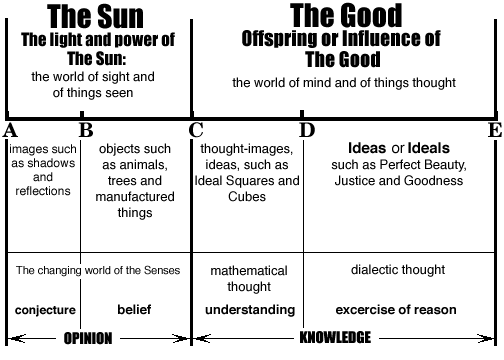
Eventually, Plato thinks the form of “goodness” is the highest reality that humans can ever imagine. The role of the form of goodness is like the one of “sun” in the physical world: it makes everything be what it is, and it also provides energy and vigor for everything to strive for their ideal, the ideal of what is uniquely good for themselves.
Understood in this way, the allegory of cave is a vivid depiction about how a prisoner trapped into lower levels of realities and perceptions strives for higher-level ones. It is a story of intellectual development, a story of personal transformation, and a story of human striving.
Frankly, Plato’s allegory of cave is among my favorite philosophical writings in the entire world and the entire history. You may disagree with Plato’s metaphysical and epistemological visions underlying this allegory; you may read this allegory from vastly different perspectives and angles. However, the unquenchable spirit of striving for what is truly real and good represents a deepest dimension of the motivation of human life, and believe me, you will always need to come back to this allegory to ponder a certain truth about human life when you learn more, have more, and experience more.
Required Reading:
Plato, The Republic, Book V, 475 e-518 d. (A reading guidance is provided in canvas)
Recommended Further Watch:
Quiz:
1, What perspectives can you take to read Plato’s allegory of cave?
A, social media
B, education
C, political struggle for emancipation
D, psychoanalysis
E, and others.
2, what are the two most questions that Plato asked before he told his story of the cave in The Republic?
A, What really exists in the world?
B, If something is real, how can humans know it?
C, what is beauty?
3, The reasons Plato characterized the physical world as lying in between “reality” and “non-reality” include:
A, physical objects are changing, becoming, and thus, not as eternal and unchanging as mathematical objects.
B, physical objects are not completely nothing.
C, physical objects can have contrary attributes depending upon the perspectives of human perception.
4, The reasons Plato thinks philosophical knowledge is higher than mathematical knowledge include:
A, philosophical knowledge takes nothing for granted.
B, philosophical knowledge does not need to be aided by images and figures.
C, philosophical knowledge is higher than human opinions on the changing objects in the physical world.
5, what is the simile Plato uses to depict the highest form of “goodness”?
A, sun
B, moon
C, star
6, In 477d, Plato uses one term to refer to the ability of human beings to perceive the outside world, and it can be imagination, sense, intelligence, or memory. What is this term?
A, faculty
B, capability
C, power
7, According to 518e of the assigned reading, what is the decisive factor of education for Plato?
A, one’s will to learn
B, having good teachers.
C, having good textbooks.
D, entering good schools.
8, In the past several semesters, your schoolmates drew beautiful pictures to illustrate the setting-up of the whole story of the allegory of cave. Can you try to draw it on paper by yourself? The more details in the picture, the better. (This is not an assignment, and no grade will be given. You can choose to do it by yourself, and to post your answer if you want.)
 Bin Song