Dr. Bin Song is referenced in a July 16, 2026, Washington Times article “AI companies paying philosophers $400K? Not so fast, excerpts say“. The piece investigates and downplays sensationalized reports that artificial intelligence companies are paying philosophy graduates up to $400,000 for their ethical expertise. Here is the quotation:
“Bin Song, a philosophy professor at private Washington College in Maryland, noted that undergraduate majors in his discipline have traditionally performed better on law school and graduate admissions exams than other undergraduates.
He said that better prepares them to work with AI as future lawyers and financial analysts, as long as they master leading moral traditions such as Aristotelian virtue ethics, Kantian deontology, consequentialism, Christian ethics, Buddhist ethics and Confucian ethics.
‘Philosophers serve as ethical gatekeepers, helping determine what kinds of information, values, and reasoning should shape AI systems,’ Mr. Song said.”
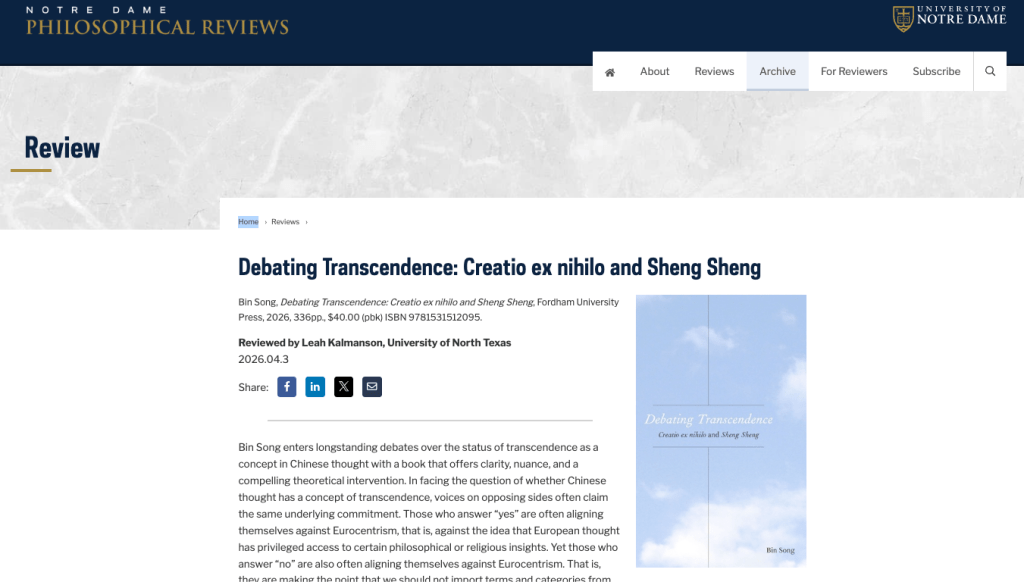
Dr. Leah Kalmanson (University of North Texas) has reviewed Debating Transcendence: Creatio ex nihilo and Sheng Sheng in Notre Dame Philosophical Reviews (April 3, 2026). The review offers an excellent overview of the book’s central arguments and highlights its major contributions. Readers may find it a helpful introduction before reading the book itself.
One particularly insightful observation concerns methodology. Dr. Kalmanson writes: “At this point, I would have been interested to hear some of Song’s methodological commitments articulated in the language of Ruist scholarly practices, although this dimension is implicit in Song’s overall approach to Ruism as a way of life in other chapters.” I appreciate this thoughtful question. In response, I would emphasize that the book operates with two complementary levels of comparative methodology.
The first is developed in the opening two chapters, which clarify what theology means within the Ru tradition and articulate the general Ruist attitude toward learning from other traditions. The second is presented in Chapter Four, where I propose a concrete method for constructing comparative categories that make cross-cultural comparison both meaningful and philosophically rigorous. Regarding the first level, I draw extensively on classical Ruist sources to develop what I call a “rooted and open inclusivism.” For the second, I build primarily upon Dr. Robert C. Neville’s pragmatist methodology—revised through Jonathan Z. Smith’ hermeneutical approach—and argue that Neville’s method provides an appropriate framework for this rooted, open inclusivism.
Dr. Kalmanson’s observation therefore raises an important question, and I hope the clarification above further explains the point she perceptively noted in the second half of her comment.
2. Harvard-Yenching Institute Announcement
The Harvard-Yenching Institute has also announced the publication of the book on its website. I was a Harvard-Yenching Visiting Fellow from 2011 to 2013. During those two years, I devoted myself to careful study of Liu Shu-hsien and Friedrich Schleiermacher. Looking back, that period planted some of the earliest intellectual seeds that eventually grew into Debating Transcendence. It is especially meaningful to see the Institute publicizing the book as it approaches its centennial in 2028. I extend my best wishes for the continued flourishing of Asian studies in the United States and across the globe under the Institute’s aegis.
3. Washington College Magazine Feature
The Spring 2026 issue of Washington College Magazineincludes an interview conducted by the College’s Director of Communications, Mark Jolly-Van Bodegraven, featuring both my new book and my colleague Dr. Peter Weigel’s Reading Aquinas’s Five Ways: The Arguments for God in Summa Theologiae (Cambridge University Press, 2025).
The interview situates Debating Transcendence within the liberal arts tradition inaugurated by Aristotle, suggesting that asking and attempting to answer the deepest human questions liberates the mind, and that such intellectual freedom forms one of the foundations of a robust democracy.
The interview also discusses my co-authored chapter, “When the Fire Came: A Retelling of the Confucian Sacred Story,“ written with Dr. Anna Sun (Duke University) and Dr. Pauline Lee (Saint Louis University). I am also delighted to share that this chapter has been adopted by colleagues at Washington College as a course reading for an environmental literature class co-taught by professors of English and Art History. They have told me that it has become one of the most relevant and engaging readings for the course.
4. American Academy of Religion Book Panel
The 2026 Annual Meeting of the American Academy of Religion in Denver will feature a book panel on Debating Transcendence, co-sponsored by the Confucian Traditions Unit and the Comparative Theology Unit. The official announcement can be found here.
I very much look forward to the thoughtful discussions and intellectual exchanges that this panel will foster among colleagues and friends.
5. American Philosophical Association Book Panel
The 2027 Eastern Division Meeting of the American Philosophical Association in Boston will also host a book panel on Debating Transcendence, sponsored by the International Society for Chinese Philosophy. This gathering will provide an opportunity to engage once again with my doctoral advisor, Dr. Robert C. Neville, my dissertation reader, Dr. Stephen Angle, and several close academic friends. I look forward to a stimulating and enjoyable exchange of ideas.
Overall, I am deeply grateful for the warm reception the book has received so far. Seeing it generate thoughtful reviews, public discussions, classroom use, and scholarly panels is both encouraging and humbling. I hope these conversations will continue to advance comparative theology, Confucian studies, and cross-cultural philosophy in the years ahead.
Governor Hogan delivered a speech that I found particularly meaningful. He mentioned that as a governor of Maryland, he once worked in the space directly above the original conference room where George Washington had worked. He also noted that Washington College was the first college chartered after the establishment of the United States, and that Washington himself was the founder of the college, personally granting his name to the school. Hogan, a notably bipartisan politician, also announced the formal establishment of the Larry Hogan Institute at Washington College for nurturing future generations of young leaders.
All of this made the workplace of students, faculty and staff feel meaningful, and meaning itself is a scarce resource in our time. During the late Qing dynasty, some Confucian/Ruist officials were sent to the United States to study its political institutions. After learning that George Washington relinquished power and declined kingship after winning the Revolutionary War, these Ru scholars compared him to ancient sage-kings such as Yao and Shun, who abdicated power to the most virtuous members of the next generation rather than keeping it within their own family. We often see a person’s true character when they possess power, and I still believe this historical resonance reveals something important.
What I most want to reflect upon, however, is the students whom I have taught and interacted with over the years. This year has been especially strong in terms of recommending students to graduate programs. I wrote four recommendation letters for Washington College undergraduates applying to graduate school: one to a university near Seattle for clinical psychology; another to a university in Pennsylvania for higher education management, particularly athlete management and coaching; a third to law school at Capital University in Ohio, after receiving multiple offers; and a fourth to the PhD program in education at the University of Hawai‘i. This fourth case involved a former Washington College undergraduate who applied after completing her master’s degree at another university.
In previous years, I have successfully recommended students to graduate programs in law, information science, psychology, and other fields. But this year, because there were four such students, and because several of them shared their decisions and news with me during the commencement ceremony itself, I felt especially joyful about both the timing and the number.
Whenever I receive a request for a recommendation letter, I return to the assignments students submitted, reread my feedback and their grades, and only then begin writing the letter with as much care and detail as possible. At a small liberal arts college like ours, my knowledge of students also tends to deepen through unhurried conversations both inside and outside the classroom. Honestly, this makes me happy, even happier than receiving a promotion or an award myself. This is probably the best part of being a teacher: seeing students with whom one has worked closely move toward success.
Another point worth noting is that, although most of these students are not pursuing graduate study in philosophy or religious studies, all of them took my philosophy and religion courses at different stages of their college education. Many also majored or minored in philosophy or religious studies. From my observation, these students possess remarkably clear visions of what they want to pursue in graduate school. Their chosen directions are highly specific, and when faced with multiple offers, they make decisions with a strong awareness of both their aspirations and their strengths. In most cases, these students choose professional programs as their direction of graduate study, and in America, this often provides a strong foundation for a stable middle-class life.
I believe this is one of the underappreciated achievements of liberal education at an American-style liberal arts college. Serious and hardworking students often develop a profound self-awareness that undergirds both their career choices and broader life development. This is not surprising, since small classrooms nurture depth of individuation, while the relatively abundant institutional resources available to each student allow them to explore and cultivate different intellectual and personal possibilities. Compared to technical skills alone, I believe this kind of self-awareness will accompany and benefit them throughout their lives.
Mencius once said: “A person of virtue has three central joys, and bringing the kingly way of governance to all under heaven is not among them.” A person of virtue (君子) remains cautious about political power because of the elevated position it confers. Instead, among the three joys, Mencius says: “To gain fine talents from all under heaven and educate them—this is the third joy” (7A20, my translation). Mencius’s thought resonates deeply with Hogan’s speech, and also with my own joyful feelings today. Perhaps this final quoted sentence should serve as the subtitle of today’s post.
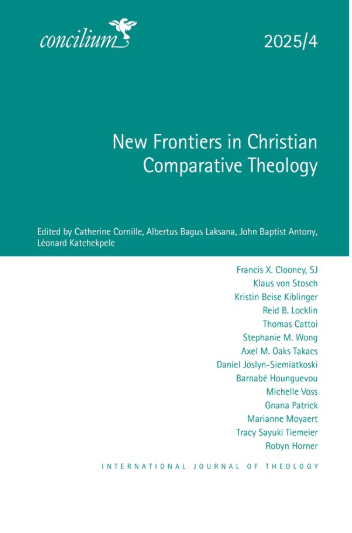
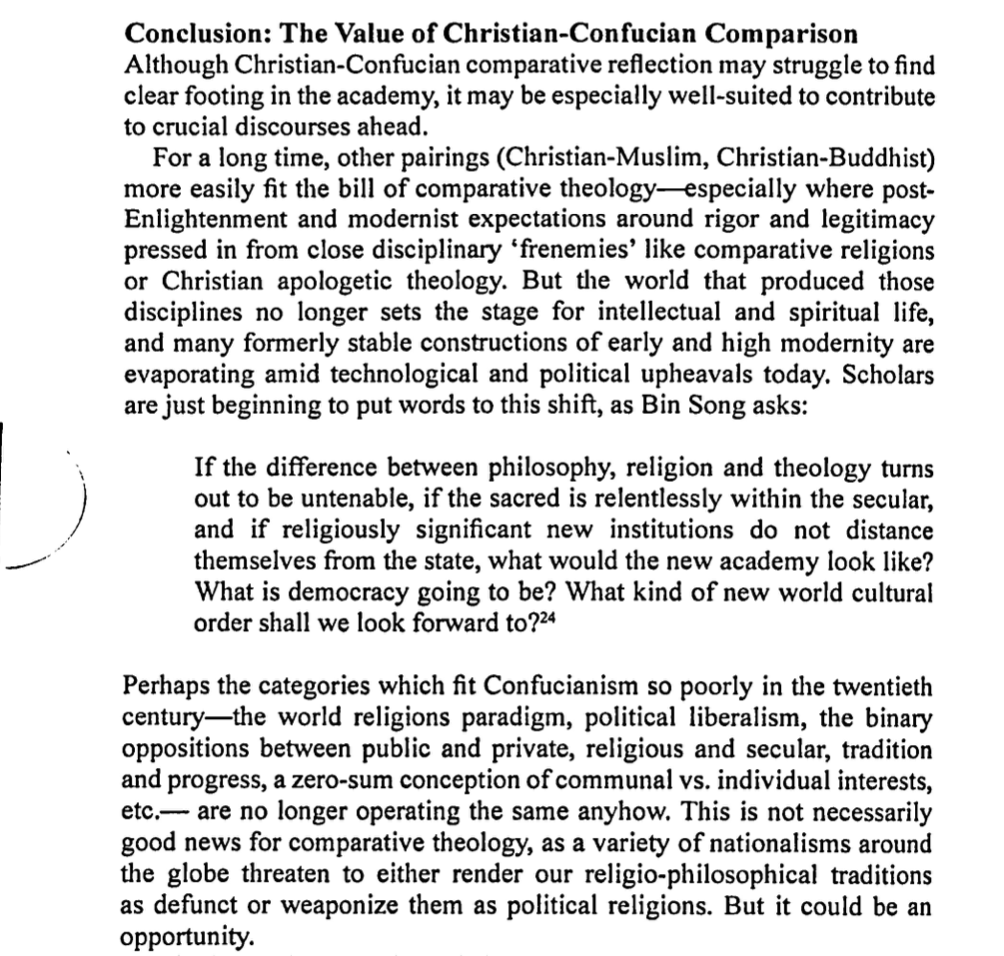
Dr. Stephanie M. Wong (Villanova University) publishes “Christian-Confucian Comparative Theology Today” in Concilium: International Journal for Theology (2025, Issue 4): pp.65-75; it summarizes and analyzes the current state of Christian-Confucian dialogue and comparison.
Abstract:
This paper situates Christian-Confucian comparative theology in a global context, making the case that comparative reflection can meaningfully inform the analysis of ritual innovations and political theologies today. First, I interrogate the possibility of Christian-Confucian comparative theology in the Western academy, noting how various attempts at comparative reflection have struggled amid disconnects of disciplinary terminology around religion, philosophy, and theology. Second, I consider survey two areas of Confucian revival in and extending from mainland China, namely the emergence of new Confucian practices within the state’s regulatory framework and a flurry of intellectual propositions to revive or reconstruct the Confucian theo-political ideal of tianxia. In this context, especially as secular nationalisms around the globe threaten to either render our religio-philosophical traditions as defunct or weaponize them as political religions, Christian-Confucian comparative theology can play a meaningful role in analyzing these developments and alternative sociospiritual aspirations.
The Routledge Companion to Chinese Philosophy (Routledge, 2026), edited by Brook Ziporyn and Stephen C. Walker, includes a chapter by Bin Song titled “Quiet-Sitting Meditation: A Philosophical Practice in the Cheng–Zhu Learning of Pattern-Principle” (Chapter 41, pp. 439–450).
Building on Song’s earlier work on Confucian meditation, the chapter offers a sustained philosophical account of quiet-sitting within the Cheng–Zhu lineage of Song-dynasty Ru learning. It identifies three distinctive Ruist exemplars of quiet-sitting, associated with Cheng Yi, Yang Shi, and Zhu Xi, and clarifies their philosophical structure and practical orientation.
A central contribution is the analysis of Zhu Xi’s understanding of quiet-sitting as unfolding in three stages, examined through their inner dynamics and intellectual lineage. The chapter concludes by engaging recent discussions in the philosophy of meditation, showing how, in the Cheng–Zhu tradition, philosophical inquiry and spiritual practice are inseparable.
Written for both specialists and interested general readers, the chapter presents Confucian meditation as a rigorous philosophical practice that integrates reflection with lived self-cultivation, contributing to contemporary cross-traditional conversations on meditation and philosophy.