Unit 5: Duke of Zhou for Confucianism

Title: Duke of Zhou Made Rituals and Composed Music.

Audio: Duke of Zhou Made Rituals and Composed Music, by Dr. Bin Song
Video: Duke of Zhou Made Rituals and Composed Music, by Dr. Bin Song.

Hallo! This is Dr. Bin Song in the course of “Ru and Confucianism” at Washington College.

The first unit of our course starts from explaining a key concept of Ruist philosophy, 禮, normally translated as ritual or ritual-propriety, and its significance for us to understand the name of the tradition, 儒.

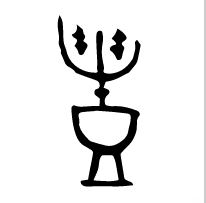
If we look into some earlier forms of the character 禮, it looks like a utensil holding jade or other rarities.

Quite visibly, the origin of the term 禮 pertains to religious ceremonies by which people follow customs and utilize facilities to express their pious feelings towards ancestors and other deities. Therefore, the normal translation of 禮, ritual or ritual-propriety, is quite literal. However, in the Ru school, the school that almost single-handedly took charge of inheriting, perfecting, and philosophizing ancient rituals in the context of ancient China, the meaning of 禮 greatly expands, and becomes a unique, hardly translatable, concept and perspective to ponder the overall nature of human civilization. Let’s read how the Classic of Rites describes this broad significance of 禮:

“The course of the Way, human excellence, benevolence, and righteousness cannot be fully carried out without the rules of ritual-propriety; nor are training and oral lessons for the rectification of manners complete; nor can the clearing up of quarrels and discriminating in disputes be accomplished; nor can the duties between ruler and minister, high and low, father and son, elder brother and younger, be determined; nor can students for office and other learners, in serving their teachers, have an attachment for them; nor can majesty and dignity be shown in assigning the different places at court, in the government of the armies, and in discharging the duties of office so as to secure the operation of the laws; nor can there be the proper sincerity and gravity in presenting the offerings to spiritual beings on occasions of supplication, thanksgiving, and the various sacrifices. Therefore an exemplary human is respectful and reverent, assiduous in their duties and not going beyond them, retiring and yielding – thus illustrating the principle of ritual-propriety.” (《禮記 曲禮》adapted from the translation of James Legge)

Here, any rule or convention that can lead to the re-ordering of an aspect of human civilization, such as individual moral self-cultivation, varying human interactions, education, the execution of law, the establishment of political institutions, leadership in army, court and other governmental offices, etc., can all be called 禮. In my frank opinion, there is really no singular English word which can capture this broad implication of 禮. Trying the best that I can, I would like to say 禮 is any “civilizational convention.” The philosophical reason why the Ru school came up with this concept to designate the essential nature of human beings is understandable: once having evolved with a capacity of using signs, symbols and languages to interact with the world, the relationship of humans to humans, and the one between humans and the nature are always mediated. In other words, humans interact with the realm of uncarved realities, the nature, through our interpretations of the meaning of these realities to us, and using a Ruist term, these human interpretations are constructed by our use of varying 禮. For instance, our mind reads people’s smiles in different ways, depending upon the cultural and societal environment we live in, and furthermore, we also interact with these smiles using postures and expressions fit for our purpose. Natural impulses such as those raw emotions of wonder, joy or anger, may play a certain role during this interaction, but they are all embedded in a much more complicated cognitive and emotional process mediated by our interpretations of the meanings of the world. Understood in this perspective, every means to mediate the relationships between humans and between humans and nature in a uniquely human way can all be called 禮. Therefore, my translation of it, civilizational convention.

In the Analects, the book that furnishes the most authentic record of Confucius’s deeds and sayings, there are plenty of scenarios where Confucius either talked of or actually performed ritual or ritual-propriety in the analyzed sense of civilizational conventions. He cared about any knowledge about the sacrificial rituals in temples, he talked of why people in his time needed to mourn for three years after their parents’ death, and other related topics, such as how to conduct human relationships, what are the best qualities of a state leader, what music is the most appropriate for a certain social occasion, and even how to stand, walk, speak, look, eat, etc. In fact, one of Confucius’s self-suggested missions is that because the system of ancient rituals in his time were collapsing, and music was decaying, so that he would try his best to learn, discover and even redesign the best rituals fit for his time, and then, he would teach and propagate these ideal rituals so as to recover social order and lay a solid foundation for the sustainable development of civilization. He called the entire body of these ancient rituals as “civilization” (文), and was quite confident to assert that the destiny of this civilization is on his shoulder. In extreme difficult situations, such as when he almost got murdered by political opponents during his exile, he relied upon this deep sense of mission and responsibility to strengthen his will of life, and eventually survive the distress.

However, a legitimate question for us to understand Confucius’s mission is that since he was a learner and advocate of ancient rituals, where were these ancient rituals come from? If he was the most respected teacher in the Ru tradition who has built the first private school to pass on ancient civilization to later generations, whom did he learn from? In the past several units of this course, we discussed Yao and Shun, these ancient sage-kings who had accomplished great deeds for Confucius to admire. But they lived thousands of years before Confucius, and Confucius’s admiration of them cannot be converted into the solid knowledge of their times. So, just like Americans who quite often evoke their founding fathers to make their contemporary moral and political cases, Confucius looked into the founding fathers of the dynasty he lived in, the Zhou dynasty, which had already endured about 500 years before Confucius. Among all these founding fathers of Zhou dynasty, one figure, the Duke of Zhou, whose name is Dan, stands prominently, and he turned out to be the most impactful figure on Confucius’s learning and teaching.

Let’s read several sayings in the Analects to understand this lineage of wisdom that Confucius tried to continue:

19.22 Gongsun Chao of Wei asked Zigong, saying, “From whom did Zhongni (Confucius) get his learning?”
Zi Gong replied, “The Way of Wen and Wu has not fallen to the ground. It is still there among the people. The worthy remember its major tenets, and the unworthy remember the minor ones, so the Way of Wen and Wu is nowhere not to be found. Where could not the Master learn from? Yet, what regular teacher did he have?”
7.5 The Master said, “Extreme is my decline! I have not dreamed of the Duke of Zhou for a long time!”
3.14 The Master said, “The Zhou sits on top of two previous dynasties. How rich and well developed is their civilization! I follow the Zhou.”
3.9 The Master said, “I could describe the rituals of the Xia dynasty, but the state of Qi cannot sufficiently attest to my words. I could describe the rituals of the Yin dynasty, but the state of Song cannot sufficiently attest to my words. This is because these states have inadequate records and worthies. If those were sufficient, I could adduce them in support of my words.”
2.23 The Master said: “the Yin (Shang) dynasty followed the rituals of the Xia, and wherein it took from or added to them may be known. The Zhou dynasty followed the rituals of the Yin, and wherein it took from or added to them may be known. Should there be a successor of the Zhou, even if it happens a hundred generations from now, its affairs may be known.” (Translation adapted from Ni, Peimin)

In the first two quotes, Confucius and his students indicated the origin of Confucius’s learning. It is the Way of Wen and Wu, and the teaching of the Duke of Zhou. These three mentioned figures, King Wen, who is the father of the other two, King Wu, the elder brother, and the Duke of Zhou are three most important founding fathers of the Zhou Dynasty. Among the three, Duke of Zhou’s role is the most significant since Confucius dreamed him all the time. And the last three quotes speak to the three major reasons why Confucius took the ritual system of Zhou as his primary masterpiece to learn and teach:

  • First, The ritual system of Zhou Dynasty synthesized previous ones, and thus, represented the gist of ancient Chinese civilization in Confucius’s time.
  • Second, Previous ritual systems are too remote to corroborate and study in details. But the Zhou rituals are well preserved in the state of Lu, which is the home state of Confucius, and also where the offspring of Duke of Zhou were enfeoffed.
  • Third, the ritual system of Zhou Dynasty represents principles of human civilization that Confucius believes are eternal and everlasting so that any future generations, as long as they aspire to a sustainable civilization, still need to learn them.

Since Duke of Zhou was so important for Confucius’s learning, in the remaining part of this unit, we will focus on his personality, deeds, and his accomplishment in making rituals and composing music to eventually lead to Confucius’s admiration.

《三才圖會》的周公像
An image of the Duke of Zhou, from 《三才圖會》

As indicated by the required readings, regarding the personality and the political accomplishments of Duke of Zhou, there were several major points to be honored by Confucius and later Ru scholars:

  • 1, He helped his father, King Wen, and his brother, King Wu, to overthrow the last king in Shang Dynasty, and justified the conquest using a very new political theory: the legitimacy of rulership consists in the virtues of the rulers, which are confirmed by the support of the people. If a ruler succeeds to be virtuous and earn the support of their people, they will have the Mandate of Heaven, and thus, be legitimate to govern.
  • 2, He helped his brother King Wu to govern the newly established state. In a crucial situation, he even would like to sacrifice his own life to secure his brother’s health. Also in light of his assistance to his father King Wen, Duke of Zhou represented the cherished family virtues such as filiality, and brotherly love in quite an eminent way.
  • 3, When King Wu died, his son King Cheng was too young, and thus, Duke of Zhou had to act as a regent. On the one hand, he was the teacher of King Cheng so as to prepare his enthronement. On the other hand, when King Cheng was mature enough, Duke of Zhou fulfilled his promise and resigned from his regency. In this part of his story, Duke of Zhou was an uncle, a teacher, and a supreme governor, and he performed superbly in all of these three roles. Mostly importantly, his attitude towards political power earned much kudos from later Ru scholars: firstly, he was not obsessed with political power; when time is right, he would step down and yield to King Cheng as a subject. Secondly, his ultimate goal was to teach King Cheng to be a good ruler during the time of his regency, and this ideal of being an educator to political leaders quite fits the self-identity of later Ru scholars.
  • 4, Duke of Zhou suppressed the rebellion in the eastern part of the country, punished its wicked leaders, appointed new leaders, and laid out a series of rules of government to stabilize the new dynasty.

In human history, I believe as long as any political figure succeeded to achieve similar deeds, they would be put on a pedestal to be memorized by later generations. However, the most important accomplishment of Duke of Zhou, from a Ruist perspective, still surpass the areas of self-cultivation, family-regulation, and governance. That took place in the form that Duke of Zhou established a whole system of rituals to reconstruct the entire Zhou civilization. This historical event was normally named by historians as “Duke of Zhou made rituals and composed music” (製禮作樂).

According to Wang Guowei (1877-1927), a prominent sinologist, there are three major breakthroughs that Duke of Zhou has made in this historic event:

  • Firstly, he established the institution that kingship must be passed down to the eldest son in the royal family;
  • Secondly, he re-organized the system of sacrificial rituals to one’s ancestors so that the relationship among different generations and branches of an extensive family is ordered;
  • Thirdly, he prohibited marriage within a family of the same surname.

All these three major points of the Zhou ritual system are extremely important because Zhou dynasty is a feudal society, and the King appointed local political leaders according to their merits and their closeness of pedigree to the royal family. So, an elaborated family ethic to distinguish the duty and role of varying family members is crucial to the well-functioning of the entire political system. On the other hand, Duke of Zhou designed other aspects of the ritual system such as about how to recruit able people to fit government posts, how to distinguish offices, and how to hold many civil and religious ceremonies, etc.

Underlying all these concrete ritual arrangements of the newly established dynasty, there are several major principles that Confucius admired, and believed can guide human civilization for future generations:

Firstly, the purpose of ritual-performance is to cultivate people’s virtues so as to bring order to society. Although the blessing of deities and the divine power of Heaven were thought of as important, Duke of Zhou prioritized the role of humans in securing the blessing. In other words, in order to earn the divine support, humans need to primarily dedicate themselves to cultivating virtues through performing rituals. This spirit of humanism was continually developed in later Ruist thought.

Secondly, each human needs to fulfill their duty required by their role in a specific human relationship, and this role ethics, so-to-speak, was thought of as the foundation of individual well-being, social order and good government.

In a more concrete term, this second principle consists of the following aspects:

  • First, 親親, that is to treat your family as your most close and important human fellows.
  • Second, 長長, that is, within a family, the order of seniority is respected.
  • Third, 男女有別, that is, men and women are different; marriage should not happen within the same family; and the right of a couple upon the management of their household must be fully respected.
  • Fourth, 賢賢, that is, to respect people of good education and moral excellence. Accordingly, a key principle of good governance is meritocracy, which implies that a good leader must appoint the right people in the right positions.

On top of all of these ritual principles and initiatives, Duke of Zhou also composed poems, lyrics and music, and utilized these arts to educate the people of all these important ethical and political principles.

In a word, Duke of Zhou has cultivated great virtues, governed his country well, and more importantly, made rituals and composed music to lay a foundation for sustainable human civilization. Because of this, he was treated by Confucius as the most significant founding father of Zhou civilization, and became Confucius’s teacher secondary to none.

Required Readings:

“The Story of The Duke of Zhou,” compiled by Robert Eno in https://chinatxt.sitehost.iu.edu/Resources.html.

“The Announcement to Kang”, in the Classic of Documents, adapted translations by Bin Song from multiple sources.

Quiz:

1, In light of the etymology of the character 禮, what is the literal meaning of it?
A, religious ceremony/ritual
B, social etiquette
C, political institutuion

2, 禮 represents the distinctive nature of human civilization because:
A, the relationship between humans, and the one between humans and the nature are mediated by 禮.
B, uncultivated raw emotions have no role to play in human interaction.

3, Confucius described his own mission as to teach ancient rituals to all the people in order to recover social harmony for his time. Is this statement true or false?

4, Among King Wen, King Wu, King Cheng and Duke of Zhou, who is the eldest?

A, King Wen
B, King Wu
C, King Cheng
D, Duke of Zhou

5, which of the following reasons does not belong to the ones why Confucius chose the Zhou system of ritual as his target of learning?

A, the Zhou system of ritual is synthetic.
B, the Zhou system of ritual can be studied in greater details.
C, the Zhou system of ritual represents principles of human and civilizational thriving.
D, none of the above.

6, “Yet each time I bathe, I am called away three times, wringing out my hair in haste; each time I dine, I rush off three times, spitting out my food in haste, in order to wait upon some gentleman. I do so because I am always fearful that I may otherwise fail to gain the service of a worthy man.” This quote describes one governor’s willingness to respect and appoint talented people to the right governmental positions. Which governor does this depiction refer to?

A, King Wen
B, King Wu
C, Duke of Zhou

7, “O Feng, such great criminals are greatly abhorred, and how much more (detestable) are the unfilial (不孝) and unbrotherly (不友)! – as the son who does not reverently discharge his duty to his father, but greatly wounds his father’s heart, and the father who can no longer love his son, but hates him; as the younger brother who does not think of the manifest will of Tian, and refuses to respect his elder brother, and the elder brother who does not think of the suffering of his junior, and is very unfriendly to his younger brother.” Which principle of the Zhou ritual system do these words of Duke of Zhou’s represent?

A, reciprocal role ethics: every human needs to shoulder their duty defined by their role in a human relationship.
B, utilitarianism
C, deontology.

8, What have you learned from the thought and deed of Duke of Zhou? Please share your critical thought on this unit’s teaching.
Self-Care and Resilience: How to Teach during the Pandemic

Lecture in the course of
“Liberal Arts during the Pandemic”
at Washington College
2020 Summer

Audio: How to Teach during the Pandemic, by Dr. Bin Song.
Video: How to Teach during the Pandemic, by Dr. Bin Song.

Hallo, This is Dr. Bin Song at Washington College.

Thanks for Ben and Sara to invite me to share my teaching experience to such a vibrant learning community which is formed during this very special summer, the summer of 2020, when, most of time, students and teachers do not know how we will teach and continue our life in the fall.

This uncertainty intruded very abruptly into our life in this past spring, and ever since, every human on the earth needs to learn how to adapt to it, and in particular, how to manifest the resilience of life in this particular time.

I have made several major adjustments to my previous teaching during this pandemic, and the theme of self-care and resilience stands prominently.

In the course of “Ru and Confucianism,” which is a 300-level course of philosophy and religion, I started to systematically teach meditation. I am personally a long-time practitioner of meditation, and have learned it from multiple traditions. However, it is only until recent years that I started to develop a curriculum to instruct students to practice meditation and contemplation in the classrooms of a college or university.

There are many pedagogical concerns to teach contemplation in a college setting. For instance, how not to proselytize a specific religion or ideology? After all, we are a secular liberal arts college, and do not prioritize any religion or tradition-based belief system. A related question is how to respect and harmonize students’ preestablished worldviews, and make them feel safe and inspired to practice meditation, the technique and philosophy of which may derive from cultures other than their own? In my classrooms, students may be Catholic, Muslims, Methodists, Atheists, Agnostics, Buddhists, etc. Then, the question for the instructor is: how can we organize discussions and conversations on topics of meditation that can make everyone feel included and benefited?

My general strategy to deal with these concerns is

  • 1) to contextualize, viz., to trace the origin of the history of any meditation practice so that I can present an authentic body of historical experience of meditation, rather than focusing upon my personal view, although I do express my personal views when they are needed.
  • 2) to diversify and compare, viz., to show the rich diversity within a taught tradition, such as Confucianism, regarding how Confucian practitioners may debate their different views and conceptualizations of meditation; and to compare one tradition with other traditions, such as Daoism or Buddhism. In this way, students will still utilize their ability of critical thinking to decide which approach makes the best sense, and thus, have a conversation with their peers to exchange their views.
  • and 3) to try to apply those traditional meditative skills in a modern context, which may mean bringing modern sciences such as brain science and evolutionary biology to account for the significance of meditation, or it may imply each individual student would be expected to create their own meditative method for the benefits of their own life.

In general, I embed the instruction of meditation and contemplation within the general pedagogy of liberal arts, try to use it as a major tool to regain the wholeness of students’ personal growth, and thus, manifest the holistic spirit of liberal arts education.

Once we have a pedagogical foundation to teach meditation, the benefits of teaching it will be very visible. And this is particularly so during the pandemic.

In the course of Ru and Confucianism, the final assignment is “Body Discipline and Video Production.” Students need to practice their favorite way of meditation inspired by philosophical concepts learned in the class, and make a video or powerpoint to demonstrate it. The examples of this assignment can be seen from my website (https://binsonglive.wordpress.com/2020/06/10/confucian-teaching/)

For instance, Theo explains one key concept of Qi (vital-energy) in Confucianism, and how he practiced meditation close to the ocean near his Californian home during the quarantine time.

Jason used his new knowledge of “harmony” or “harmonization” to re-describe his experience as a roller, and advocated the significance of this historically rooted, yet personalized practice of meditation for the contemporary world.

Christopher demonstrated superbly how he practiced archery to enhance focus and mental health during the quarantine. He was a senior to have written a joint thesis of philosophy and anthropology, and taken several courses in the final semester of his college; with the habit of meditative practice of archery deep in his heart, he seemed to navigate the busy, uncertain semester quite well. His thesis was actually awarded as an honor in the department of philosophy and religion.

In the following one, April used another philosophy we discussed in the class, Daoism, to reflect upon the seemingly over-development of human civilization. She believed Daoist ideas sincerely, and made a very nice video about it.

Finally, myself also made a series of videos to teach the breathing skills and varying postures of meditation such as cross-legged quiet-sitting, sitting on a chair, sleeping, walking, standing, martial arts, etc. Now, this is an established series in my youtube channel, and I can continue to use it for my future teaching. Let me remind the friends and students here that I continue to offer the course of Ru and Confucianism in the fall, and if you are interested in it, just give it a try.

Good, you now get a sense of how I teach meditation in a college class for the sake of self-care and personal development during the time of pandemic.

In the coming Fall, another adjustment I will make to my teaching is that, after being encouraged by students’ performance and evaluation of my spring online teaching, I decide to make my teaching of ethics in an even more timely and practical manner. I will teach the skill of philosophical practice and how to apply traditional philosophical and ethical wisdom to coping with self-defeating emotions such as anger, distress, anxiety etc.

The course is called “foundations of morality,” and it is a two hundred level of ethics course. I design the course according to the procedure of philosophical practice, which is a very new and promising development in the area of mental health and good human living. In general, the philosophical practice comprises six steps:

First, identity the emotional reasoning. Since most human emotions are accompanied by beliefs and a cognitive process of reasoning, the first step is to use logic, a crucial aspect of philosophical training, to uncover the hidden process of emotional reasoning. So, you need to know what you believe or what you think when you emote.

Second, if you think it wrongly when your emotions are inappropriate and self-defeating, find those fallacies of thinking.

Third, refute these fallacies.

Fourth, find a corresponding virtue to correct each fallacy. For instance, you may demand perfection about either yourself or the outside world. In this case, you commit a fallacy of thinking when you indicate a strong, disturbing emotion towards a certain life event. Then, we need to point out a virtue, a habit of thought and behavior, for you to correct your fallacy. In the case of demanding perfection, the corrective virtue is called “metaphysical security,” which is to feel safe and secure even in an uncertain and imperfect world. This is also a very timely virtue for the pandemic.

Fifth, find an uplifting philosophy to promote the virtue. For instance, you can use the knowledge of Aristotle’s ethics, Stoicism or Confucianism to promote the virtue of metaphysical security. In this case, the prescription for philosophical counseling may be a movie, a novel, a philosophical treatise, a book, or a piece of music. In the area of mental health counseling, this is called biblio-therapy.

Sixth, to design a plan of action and implement it.

The wonderful thing is that since I decide to focus upon self-care and good human living for my teaching during the pandemic, all the readings, skills, and techniques I discuss with my students can actually be connected to each other. For instance, in the sixth step of philosophical practice, students can visualize the plan of action during meditation, and thus, enhance the transformability of their emotions and behaviors during this uncertain time.

Good, I hope my lecture helps you understand how I work with my students to adapt our college teaching and learning of liberal arts into this very unique situation of pandemic. To conclude my lecture, I will re-emphasize the joy of teaching I get during the process: it is really among the most wonderful things in human life. As Confucius said in the first verse of the Analects: to learn, and to timely practice what you learn, isn’t this a joy?

Unit 6: Social Media as Plato’s Cave

Audio: Social Media as Plato’s Cave, by Dr. Bin Song
Video: Social Media as Plato’s Cave, by Dr. Bin Song.

Hallo, this is Dr. Bin Song in the course of introduction to philosophy at Washington College.

In this unit, let’s continue to discuss Plato.

One of the most ironic technologies that humans ever invented is social media. It is ironic because its original purpose runs so contrary to what this technology can actually bring into human life. What I am talking about is the effect of feedback loop in social media. Nowadays, anyone can find their group, any opinion can have an audience, and any information, including misinformation, can find its channel of circulation and proliferation, all because of social media. However, originally, we know social media was created for the purpose of increasing human connection, but now, it becomes a powerful tool to divide humanity into different echo chambers, and hence, put people into different caves. The cast of images, shadows and sounds from the outside real world on the walls of these caves would represent different realities to those people who consume them. Within a cave, people become so subservient to their majority view, while across these caves, people become so difficult to talk with each other. A notable instance in this regard is the well-studied role of social media in the 2016 presidential election of the U.S, when people on the two sides of the aisle seem to be particularly difficult to debate on policy issues in a civil and constructive way.

However, there is one way to break down the walls between echo chambers built by social media even if you are a consumer of social media. The function of feedback loop in social media is based upon people’s habit of thinking and information-consumption, and these habits can be revealed by the social-media machine which collects a gigantic amount of data from users’ past consumptive habits. For instance, if you’ve ever posted your opinion of one presidential candidate, then social media will recommend to you ads, friends, groups or simply news according to your preference. Since these recommendations are feeding your preference, it makes you very inclined to click them. Normally, the connection between your post and these ad. is patterned as it is indicated by a high correlation in the collected data. In a cognitive sense, these connections can be called a “habit of thinking,” “pattern of views” or even “stereotypes” about certain social or political issues. However, if you have a unique habit of critical, logical and independent thought, and particularly, if you always try to nurture an art of reasoning and persuasion which equips you with skills and a warm-heart to communicate with people who may disagree with you, then, your social-media presence can significantly break these correlative patterns which the machine detects solely based upon its collection of previous data.

For instance, I have been a long user of facebook. Ever since I studied in the U.S., I used facebook to find friends who are interested in what I am learning, and the everyday English used in the platform also helps the growth of my own English skill, since English is not my born language. However, I also happen to have some very different thought on a variety of political and social issues. For instance, I critique both authoritarian and democratic governments; I do not buy into any binary thinking to categorize the Western and Eastern cultures as essentially different; and I have way more FB friends who happen to be of different colors from me than Chinese or Asians. All of these make FB very hard to feed news and ads to me, since I guess, the machine cannot predict my habit of consuming information based upon how other people consume it in the past. You cannot fear criticism when you post something significant to your views of human life either; but when someone disagrees with you, debate with them nicely and constructively just as what you can do in a philosophy classroom. In this way, given time, I find my social media account is managed relatively well. Nasty comments and hostile personae appear less, and I can still use facebook for a source of needed information.

Believe me, raising my own use of facebook as an example about how to break the echo chambers does not mean that it is easy. No, it is not easy. I experienced exactly the same frustration and distress as many fb users did when I read rude comments or even attacks from online strangers during the past decade. As I mentioned, in order to have a good online environment, you cannot post in fear of criticism, you cannot consume information from one singular source, and you must always hold on to your principle and habit of thinking for yourself. These are anything but easy things to do. It needs energy, time, and a tremendous amount of willpower.

Nevertheless, I think all the above depictions about how the consumption of social media shaped human life can be understood in a very classical way in light of Plato’s Allegory of Cave, which is part of Plato’s book called The Republic, and also the required reading for this unit.

Careful students may already find that when I depict the situation of human life in the echo chambers of social media, I used the term ‘cave’ to hint at its connection to Plato’s Allegory of Cave. If you zoom into the details of Plato’s work, you will find even more illuminations on the situation. The competitive and aggressive manner by which prisoners chained in the cave communicate with each other; their hostility towards the freed prisoner who has seen the genuine light while being willing to come back to inform his fellow prisoners; for the liberated prisoner, he does not consume information, viz., images and sounds moving and echoing on the walls, from one singular source; but when he climbs up the cave, he needs a strong willpower to overcome his fear, frustration, and discomfort. All of these make Plato’s cave a great prophecy to human activities in social media.

Surely, the angle of social media is not the only one you can read Plato’s allegory of cave. You can read it as a story about how one gets education, in whatever area of human activities you can imagine. You can also read it as a story of political emancipation, about how oppressed people stand up and fight against their oppressors. You can even read it as a story of psychoanalysis, because the dark, sweaty and noisy cave is very much like people’s subconsciousness, while when one wakes up and enters into their consciousness, they are like climbing outside of the cave to breathe in fresh air and bask in the sunshine. However, the reason why the Allegory of Cave can be read in so many ways and has indeed generated its huge influence upon the intellectual history of human beings is that as primarily a philosophical allegory, it touches a pair of big issues that are so fundamental to human life. That is, what is real? And if something is real, how can humans know it? In philosophical terms, the first question is metaphysical while the second is epistemological.

In the assigned reading of this unit, there are two places where Plato elaborates his answers to these two questions before he told us the story of his cave.

In one place (479a-479c), Plato calls forms and mathematical objects as “reality” since they are eternal, unchanging, and always proportionate and perfect, and calls its opposite as “non-reality” which denotes nothing to exist. Meanwhile, he calls the visible physical world as something between “reality” and “non-reality,” because everything in this physical world are changing, becoming, succumbing to corruption, and more importantly, can be perceived differently from different angles. For instance, a tree can be both high and low, big and small, beautiful and ugly from different perspectives. Correspondingly, Plato calls human perception of reality as knowledge, the one of non-reality as incomprehension or nonsense, and the one of the in-between reality as belief or opinion.

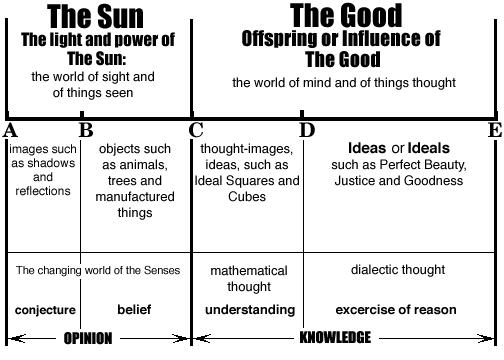
In another place (510a-551e), Plato elaborated his hierarchy of realities and human perceptions as one allegory of four lines. In these four lines, on the left half, realities are in the physical world, and they are furthermore divided into images and objects, like a shadow of tree and the tree itself. The perception of images is called conjecture or illusion, and the one of physical objects is called belief. And these two kinds of perceptions comprise human opinions. On the right half, realities are in the intelligible, non-physical world, and they are also divided into mathematical objects and forms (or “ideas”). The perception of the former is called understanding, while the latter is called thought, and these two comprise the realm of human knowledge. For Plato, the knowledge of forms is higher than mathematical knowledge because mathematical systems start from premises taken by mathematicians as granted, and mathematical reasoning must rely upon the assistance of figures and images in human mind. However, for the knowledge of forms, such as philosophical discussions on justice, courage, goodness, etc., nothing is taken for granted. Also, philosophical discussions can critically think of each and everything, and do not use images or figures as an assistance. For Plato, realities on the right hand of the line are more real than the left hand, and their corresponding knowledge also enjoys a certain order in superiority.

Plato’s Allegory of Four Lines (online source quoted here)

Eventually, Plato thinks the form of “goodness” is the highest reality that humans can ever imagine. The role of the form of goodness is like the one of “sun” in the physical world: it makes everything be what it is, and it also provides energy and vigor for everything to strive for their ideal, the ideal of what is uniquely good for themselves.

Understood in this way, the allegory of cave is a vivid depiction about how a prisoner trapped into lower levels of realities and perceptions strives for higher-level ones. It is a story of intellectual development, a story of personal transformation, and a story of human striving.

Frankly, Plato’s allegory of cave is among my favorite philosophical writings in the entire world and the entire history. You may disagree with Plato’s metaphysical and epistemological visions underlying this allegory; you may read this allegory from vastly different perspectives and angles. However, the unquenchable spirit of striving for what is truly real and good represents a deepest dimension of the motivation of human life, and believe me, you will always need to come back to this allegory to ponder a certain truth about human life when you learn more, have more, and experience more.

Required Reading:

Plato, The Republic, Book V, 475 e-518 d. (A reading guidance is provided in canvas)

Recommended Further Watch:

An animated narrative of Plato’s Allegory of the Cave.

Quiz:
1, What perspectives can you take to read Plato’s allegory of cave?

A, social media
B, education
C, political struggle for emancipation
D, psychoanalysis
E, and others.

2, what are the two most questions that Plato asked before he told his story of the cave in The Republic?

A, What really exists in the world?
B, If something is real, how can humans know it?
C, what is beauty?

3, The reasons Plato characterized the physical world as lying in between “reality” and “non-reality” include:

A, physical objects are changing, becoming, and thus, not as eternal and unchanging as mathematical objects.
B, physical objects are not completely nothing.
C, physical objects can have contrary attributes depending upon the perspectives of human perception.

4, The reasons Plato thinks philosophical knowledge is higher than mathematical knowledge include:

A, philosophical knowledge takes nothing for granted.
B, philosophical knowledge does not need to be aided by images and figures.
C, philosophical knowledge is higher than human opinions on the changing objects in the physical world.

5, what is the simile Plato uses to depict the highest form of “goodness”?

A, sun
B, moon
C, star

6, In 477d, Plato uses one term to refer to the ability of human beings to perceive the outside world, and it can be imagination, sense, intelligence, or memory. What is this term?

A, faculty
B, capability
C, power

7, According to 518e of the assigned reading, what is the decisive factor of education for Plato?

A, one’s will to learn
B, having good teachers.
C, having good textbooks.
D, entering good schools.

8, In the past several semesters, your schoolmates drew beautiful pictures to illustrate the setting-up of the whole story of the allegory of cave. Can you try to draw it on paper by yourself? The more details in the picture, the better. (This is not an assignment, and no grade will be given. You can choose to do it by yourself, and to post your answer if you want.)

Unit 5: Authority vs Freedom in Democracy

Audio: Authority vs Freedom in Democracy, by Dr. Bin Song.
Video: Authority vs Freedom in Democracy, by Dr. Bin Song.

Hallo, this is Dr. Bin Song in the course of introduction to philosophy at Washington College.

In light of the situation of the on-going global pandemic of Covid-19, and its seemingly unstoppable vigor in the U.S., we are witnessing a phenomenon in the American society which is very disturbing from a philosophical point of view. In the U.S., there is a strong trend of public opinion navigated by top politicians and pundits to be “anti-science,” and thus, to challenge the authority of scientists and experts during the process of policy makings in face of this public health crisis. This trend has contributed significantly to the direly high number of infection and death in the U.S.

This phenomenon looks particularly striking for me, and I also believe it looks so for people who share a similar personal experience with me. I grew up in a non-Western country, and have a memory on how in the colonial era, Western countries used their advanced science and technology to defeat our indigenous cultures, and ever since, to learn, pursue, and even transcend the scientific achievement of Western countries has become a national priority for many of these once-colonized non-Western countries. However, while non-Western countries are trying to imitate what the U.S has achieved in science, a large proportion of American citizens seem to not respect science at all, even if this would imply the tragical death of their fellow citizens!

So, the question is: why so? Why could it happen that in such a robust democracy as in the U.S., the country has the best scientists in the world and the strongest advocacy on freedom of speech, while voters can significantly defy against science so as to have irreversibly influenced the making of defective (to say the least) public policies?

This question, believe me, is very philosophical, because more than two thousand years ago, in ancient Greece, there was a giant philosopher who asked almost exactly the same question to the Athenian democracy, the very democracy which is often seen as the original model of the liberal democracies all over the world today. And this philosopher is Plato (c.a. 429-347 B.C).

Plato grew up during the Peloponnesian War, and learned with Socrates as his student for an extensive period of time in his youth. After Socrates was sent to death by the democratically elected Athenian court, Plato spent another 12 years travelling around, and studying with another philosopher, the mystic mathematician Pythagoras. During this time, he also began a lifelong relationship with the ruling family of Syracuse, and frequently gave advice on how to govern the city-state. After turning into his 40s, Plato returned to Athens, and founded his school named “Academy.” This is also allegedly the first liberal arts college in the Western civilization.

The question asked by Plato, which is extremely similar to the one that I just asked, is that: why did Athens kill Socrates? In other words, why did such a proud and powerful democracy kill its most intelligent citizen?

As discussed in last unit of this course, Socrates chose the sentence of death rather than being exiled because he had a faith in democracy. Despite being acutely aware of the fault of democracy, Socrates still believed that only in a democracy, can its citizens retain the right of questioning, and thus, sincerely believe what they do on the basis of vetting alternative answers to their questions. However, as Socrates’s most staunch and outspoken student, Plato understood his teacher’s death as more a sign of the stubborn and wicked ignorance of the Athenian mob, rather than as embodying any intrinsic strength or merit of the Athenian democracy. More importantly, in order to answer the question why Athens killed Socrates, Plato applied the Socratic method which he learned from Socrates to systematically tackle issues that the later development of philosophy was intensively focusing upon, such as the issue of metaphysics to explore what really exists in the world, the issue of epistemology to investigate, if some essential realities exist behind the appearance of the world, how humans can know them, the issue of ethics on how to differentiate good from bad human behaviors or habits, and the issue of political philosophy on who should be a ruler. In fact, Plato could be considered as the first systematic philosopher in human history, and because of this, some historian even claimed that the entire history of Western philosophy is just a long footnote to Plato.

Nevertheless, among all the writings of Plato’s, there is one work to stand prominently, and its title is The Republic. In The Republic, using the mouth of Socrates, Plato depicts a utopian state which is centered upon the supreme government of a philosopher-king, and thus represents his ideal of the best politics that humans can ever imagine. From this work, we select Book VI for this week’s required reading, and this excerpt also presents the most exemplary thinking of Plato to answer his question, why did Athens kill Socrates?

So, Why did Athens kill Socrates, its most intelligent citizen?

In the first part of the excerpt, Plato talks about who should be a ruler of a state. His view is that the person who affords to be a ruler should have genuine knowledge of rulership, viz., the knowledge about how to govern, how to organize, and how to put right persons into the right positions so as to realize the overall justice of their state. But what does genuine knowledge look like? Plato says that it would be like the knowledge of mathematics. In mathematics, once we have a definition of a triangle, for instance, and all its proven attributes, such as the sum of its three angles equal to a flat one, then, every particular triangular thing in the physical world, no matter how different they are from each other, must comply with the knowledge. By the same token, Plato thinks that genuine human knowledge is always about abstract objects in an intelligible world, and these intelligible objects are eternal, unchanging, always manifesting harmony and proportion. Plato has a great name for these intelligible objects, viz., this is a world of “forms.” After all, who can be a ruler? Plato’s answer is that only those people who have genuine knowledge of the forms of “rulership,” “governance,” “justice” and all others related to good government can rule, and accordingly, these people transcend limited opinions of human individuals and are able to claim “authority” over those public opinions. For Plato, this sort of people, who are definitely not many, have a proper name, “philosopher,” and his ideal state will be governed by a philosopher-king. In today’s context, particularly the one we just discussed above, these people would be those scientists and experts on public health, so that when a crisis of pandemic takes hold, ordinary citizens in a country can expect genuine knowledge from these scientists and experts about how to control it.

Since the difference between philosophers vs non-philosophers, between the authority of knowledge vs uninformed public opinions be understood as such, why did the Athenian democracy kill the best philosopher in its time? And why were the views of scientists and experts frequently overlooked and disregarded by the public during a crisis of public health?

Plato’s answer to this question is crystalized in his very famous “allegory of ship”. So, in the second part of the excerpt from The Republic, Plato tells a story about a mutiny among sailors against their captain. In this story, the owner of a ship, the captain, could not navigate the ship, so he has to appoint a leader among his sailors to hold the helm. Now, there were two people who can potentially be this leader. One is a demagogue who can do nothing but cater for the needs of those rebellious and greedy sailors; and another is a “star-gazer,” who knows genuinely how the season changes and how the wind blows on the seas, and thus, can really navigate the ship well. However, this star-gazer does not appeal to the needs of the sailors, since according to his best judgement, this star-gazer thought of those needs as largely irrelevant to the knowledge of seafaring, and what matters most for him is to get those authentic knowledge of seafaring. So, the result of the mutiny is quite expectable: since every sailor has the equal amount of freedom to vote, the demagogue is elected, and the star-gazer is disregarded, and what lies ahead of the crew would be just a complete disaster since no one in power really knows how to navigate the boat.

There is one sentence that summarizes the conclusion of Plato’s allegory of ship quite well, which is “the pilot should not humbly beg the sailors to be commanded by him – that is not the order of nature; neither are ‘the wise to go to the doors of the rich’ … but the truth is, that, when a man is ill, whether he be rich or poor, to the physician he must go, and he who wants to be governed, to him who is able to govern.” (The Republic, Book VI 490e)

So, in a word, why does it happen that in a democracy, philosophers were disregarded, Socrates got killed, while the authority of scientists and experts are distrusted and challenged? For Plato, this is because there is one intrinsic dimension to the existing political institution of democracy which can utilize the cruel power of the majority vote, viz., “the tyranny of the majority,” to defeat the authority of knowledge and merit. Because of the existence of this dimension of democracy, if the majority of voters remain uninformed, no institutional arrangement within such a democracy can guarantee an elected leader who has the needed knowledge and merit of leadership, and all policies can accordingly be made wisely for the genuine benefits of humanity.

My questions to you are that: do you agree with Plato’s answer? Do you have any better answer? Or, are you thinking about solutions to deal with this intrinsically self-defeating dimension of democracy?

Required Reading:

Plato, The Republic: Book VI (484a-490e), Trans. by Benjamin Jowett.

Recommended Further Reading:

About “freedom of speech and meritocracy,” please read Bryan W. Van Norden, “The Ignorant Do Not Have a Right to an Audience,” in The New York Times (June 25, 2018)

About an analysis of American politics about and during the pandemic, please read Jonathan Chait, “American Death Cult,” in New York magazine (July 20, 2020)

Recommended Further Watch:

The War on Science, CBS Full Decumentary
An illustration of Plato’s allegory of ship
A modern rendition of Plato’s Allegory of Ship

Quiz:

1, which philosophers have influenced Plato’s thought?

A, Socrates
B, Pythagoras
C, Aristotle

2, According to the required reading from The Republic Book VI, which of the following qualities belong to a philosopher?

A, Good memory
B, Having eternal, true knowledge
C, Being a lover of learning
D, Generosity
E, Being sociable and gracious rather than jealousy and covetous
F, Not fearing death and thus, being brave

3, According to the required reading from The Republic Book VI, Adeimantus critiques philosophers because he thinks philosophy is too abstract, and thus, useless for the public. Is this statement true or false?

4, Who is the analogy of “philosopher” in the allegory of the ship?

A, The star-gazer and able navigator.
B, The captain as the owner of the ship.
C, The elected leader of the sailors.

5, According to Plato, where should the authority of a leader come from?

A, the majority vote of the people
B, the needed knowledge and merit for genuine leadership.
C, the appointment of a monarch
C, the divine command of the God.

6, Plato calls abstract objects of genuine human knowledge as “forms,” and thinks that these forms are eternal, unchanging, and lies in an intelligible world which is different from the becoming and corruptible physical world. Is this statement true or false?

7, At the end of the lecture in this unit, Dr. Bin Song asked several questions. What’s your thought on them? Please choose some of these questions, and write a couple of sentences to answer it or them.

Unit 4: Be an Artist of Reasoning

Audio: the Art of Reasoning, by Dr. Bin Song
Video: the Art of Reasoning, by Dr. Bin Song

Hallo, this is Bin Song at the course of Introduction to Philosophy at Washington College.

Our course starts from telling my personal story on how I entered the study of philosophy, and then, we discussed ancient Greek philosophy as a tradition of rational criticism and debate. In last unit, we introduced the charismatic figure, Socrates, who would like to sacrifice his life to his belief in democracy and his practice of philosophy.

Now, it is a perfect time to introduce one of the central skills that a philosophy major is required to command: logic, and the art of Reasoning. Quite obviously, without the tool of good reasoning, those ancient Greek philosophers cannot rationally debate each other; and Socrates cannot apply his Socratic method to have extensive dialogues with his Athenian fellow citizens on varying topics either, such as what is justice, courage, goodness, etc. In other words, the birth of philosophy in ancient Greece is distinguished by its logical mindset, a mindset to use evidence, reasoning, and argument to collectively advance human knowledge.

I also linked two recent articles here to help you appreciate how important the skill of reasoning is. One is titled “Want a good job? Major in philosophy.” Its thrust is that the major of philosophy teaches students how to think critically, logically and independently, and it also teaches students how to find better solutions to problems with an open-minded awareness that real life problems normally do not have a singular, one-size-fit-for-all solution. And these skills of critical thinking and problem solving prepare philosophy students for a variety of jobs, and in particular, increase the needed momentum and adaptivity in their middle careers, no matter what job they would be pursuing. Another article is “how teaching philosophy could help combat extremism,” and its major claim is that the critical and independent thought to which a philosophy student is habituated is a powerful antidote to the simplistic, tribalist and extremist thinking that today’s extremely open yet dividing media environment is prone to inculcate. In other words, individually, learning how to think philosophically prepares one for jobs, while from the perspective of society, the consistent implementation of critical thinking, rational debate and free inquiry is absolutely vital to the well-functioning of a democracy.

Even if we do not quote any history or article, the significance of learning how to think makes a common sense. In the human society, if you look around, everything that humans have accomplished start from an idea. If you want to become rich, you need a business idea; if you want to speak a new language, live in a new country, and have new human relationships, you need an idea about how to do so. More importantly, when many ideas existing in your mind, how to differentiate good ideas from bad ones, how to connect these ideas to form a solid body of knowledge, and how to learn new ideas to complement the old, all of these lie rightly at the initial moment of any human activities. In this sense, we will find that the ability to think rigorously, creatively, and independently before delving into any depth of human activities is really what distinguishes humans from animals, humans from machines and more importantly, distinguishes human individuals from each other. In other words, this ability makes us not act from impulse, not act from old programming, but from our independent, autonomous, and creative center of human personality: reason.

Good, enough for the significance of the ability of thinking. Let’s move on to the basics of Logic, and the art of reasoning.

Regarding the art of reasoning, or how to make good argument, there are two aspects of it, one is technical and another is ethical. The technical side of it pertains to the basics of logic, and the ethical side of it is about how to rationally debate, persuade, and learn from your disputants. Let’s proceed following one aspect after another.

So, the first question is: what is logic?

Logic is the study of reasoning, which provides standards for distinguishing good reasoning from bad reasoning.

But, before we get to the standards part, the immediate second question is: what is reasoning?

All reasoning consists of two components: (1) at least one premise, and (2) one conclusion. The premise(s) of your reasoning provides the reasons or evidence that you are using to support your conclusion. Accordingly, the conclusion of your reasoning is a statement that you believe on the basis of your premise(s). For example, the following is reasoning: “I should stay quiet when others are studying in the library because that’s what I would expect of others.” Here, I am concluding that I should be quiet based on the premise that I would expect the same from others.

There are two general types of reasoning: Induction and deduction

Inductive reasoning is reasoning in which you base your conclusion on a premise(s) that supports your conclusion with some degree of probability. That is, the premise(s) gives you a strong reason for concluding something but doesn’t guarantee that this conclusion is true. For example, you might conclude that the courses in this fall semester (this refers to 2020 Fall) would end up in a few weeks after the Thanks Giving holiday so that you have booked a travel for that time, because in your mind, the school most often ended that way before. However, while this conclusion may be quite probable given your past experience, it is not automatic and certain. Indeed, something could happen abruptly so as to change the normal schedule. The current pandemic is one best example for this. So, all inductive reasoning is like this. Even if all your premises are true, your conclusion is at most probable, not certain.

Deductive reasoning is different. If the premise(s) of deductive reasoning is true, your conclusion will automatically be true too. In other words, there is an automatic transmission of truth value from the premises to the conclusion in deductive reasoning. In fact, we say that deductive reasoning is “valid” (viz., acceptable) only if the conclusion is automatically true when the premises are true. For example, the following is valid deductive reasoning: “If someone is a human then they will someday die; Socrates is a human; therefore Socrates will someday die.” Notice that, in the case of this reasoning, if the premises are true, the conclusion is automatically true. It’s guaranteed to be true. However, it is usually the case that the premises in valid deductive reasoning are not themselves certain. For example, the premise that if someone is a human then they will someday die is not certain because it is itself a conclusion drawn from inductive reasoning.

To see this, you need only consider how we can claim to know that all humans die. We believe this premise because we have concluded it from the further premise that all humans have always died in the past. But, it is still possible that in the future we might figure out how to make ourselves immortal. At least, the idea of immortal human beings is not self-contradictory, and hence, is possible in reality. So, we can’t conclude with certainty that if someone is a human, they will someday die. Of course, it’s very likely and for practical purposes we might not question it; but, strictly speaking, it is only probable and not automatically true.

So, even though the conclusions of deductive reasoning are automatically true given that their premises are true, the conclusions of such reasoning may still not be true. This can be the case when at least one of the premises is false. For example, consider this reasoning: “If you are a human then you will live forever; you are a human; therefore you will live forever.” Here one of the premises is probably false. So the conclusion that you will live forever is not automatically true. It would have to be true only if both of the premises were true.

From these discussions, we also find that deductive reasoning could be sound or valid. If all of the premises of a valid deductive argument are true then its conclusion will also be true. Such a deductive argument that has all true premises is called sound deductive reasoning. So, in valid deductive reasoning the conclusion is automatically true if all of its premises are true; and in sound deductive reasoning all of the premises are actually true.

In light of these discussions, since reasoning comprises of inductive one leading to probable conclusion, and of deductive one leading to certain conclusion as long as its premises are also certain, our standards to judge whether one’s reasoning is good or bad include the following points: whether they raise enough evidences to support the high probability of their conclusion, and whether they conform to the rules of deductive reasoning so that their arguments appear to be valid and sound. If not, we definitely can use two counter-arguments to refute them: that is, we can raise contrary evidence to refute that inductive conclusion, and we can also point out inconsistency of their deductive reasoning.

However, even if our own argument contains highly probable inductive reasoning, and sound deductive reasoning, we cannot guarantee that our arguments always sound persuasive to our audience. Why? That’s because as mentioned, apart from the technical side of reasoning, viz., the basics of logic that we just mentioned, there is another ethical side of argumentation and debate. In other words, for that sort of rational debate favored by ancient Greek philosophers which leads to the advancement of human knowledge, we do not only need the basics of logic, we also need a practical art of persuasion, one that could turn our audience into willing listeners even if we may disagree each other on certain points of views. Believe me, this side of the art of reasoning turns out to be more difficult than commanding the rules of good reasoning, although the latter is also utterly important. I also believe that this difficulty does not sound unfamiliar to you. An instinct of human beings which may be inherited from our aggressive animal nature is that we usually misunderstand disagreement of views as a sort of clash of persons, so that whenever someone refutes our view, our initial impulse tends to perceive it as a personal attack, and then, we will wield everything in our hand to fight back. In this case, debate may easily turn into being irrational, and the ideal of learning and advancing human knowledge through rational debate will be just thrown under the bus.

So, here, I will raise a six-step program for the art of persuasion, which is also the ethical part of the art of reasoning. And its central concern is how to criticize with kindness, and thus, realize the ideal of rational debate. Do remember, if you want to be a good artist of reasoning, you must practice both the technical side, and this ethical side of the art consistently. Neither of the two aspects can be dispensed with another.

So, how to deliver a successful critical response?

  1. You should attempt to re-express your target’s position so clearly, vividly, and fairly that your target says, “Thanks, I wish I’d thought of putting it that way.” This means you always understand your disputant accurately and thoroughly before criticizing their views. In an actual dialogue, this step could be said in a sentence like “Peter, let me try to grasp what you have said. … Is this what you mean?” or “Sarah, I do not fully understand the point you just mentioned … Can you clarify it a little bit before we’re moving forward? Did you say that …? Is this what you mean?”
  2. You should list any points of agreement (especially if they are not matters of general or widespread agreement). This is very important for the art of persuasion, which shows the existence of a common ground among disputants, and thus, would not turn the dialogue into overtly antagonistic or hostile.
  3. You should mention anything you have learned from your target. This point deepens the last point even further, isn’t it so? The necessity of rational debate consists in the limitedness of knowledge of any human individual. So we need to come together to debate, to analyze, and more importantly, to learn from each other. A highlight of what you have learned from your disputant is a must-do before moving the debate forward.
  4. Only then are you permitted to say so much as a word of rebuttal or criticism. Considering the standards of good reasoning we mentioned above, you can refute the view of your disputants through raising contrary evidences or pointing out their inconsistency. In the future, if you continue to sign up in philosophy courses, you will learn more methods of refutations and how to apply those methods into varying contexts. But overall, to raise contrary evidences and point out inconsistency are always a good start.
  5. If your refutation pertains to ethical issues, make sure you do before you say it. For instance, you may refute that your interlocutor’s view not to donate to a certain charity is too selfish. In order that this refutation is really persuasive, you need to do before you say it, which may mean that you must already have a such a record of donation, or you can make your interlocutor believe that you will make such a donation. Regarding ethical issues, humans are persuaded by examples and deeds more than by words.
  6. After all these five steps have been successfully conducted, you need to put yourselves into your disputants’ shoes, and explain from their perspective, how their pre-established views can accept your critique, and thus, how this critique can enlighten their own understanding on the addressed issue. In this way, you help your disputants realize that as a team, you are learning from each other, and collectively, you are contributing to the advancement of human knowledge, which is what rational debate is all about.

Ok, let me simplify these six steps in some pithy words so that you can memorize them:

To present persuasive criticism or refutation to others, you need to:

  • 1, Recapitulate others’ views.
  • 2, Find where you agree with them.
  • 3, Explain what you have learned from them.
  • 4, Present your criticism rationally, viz., following the basics of logic.
  • 5, If disputing ethical issues, do before you say.
  • 6, Explain how others can accept your criticism.

Recommended further reading:

Daniel Dennett, Intuition Pumps And Other Tools for Thinking (W. W. Norton & Company, 2013)

Recommended further watch:

Quiz

(1) When you arrive at your office, and find that the door has been opened; based upon your past experience, you conclude that the janitor is working inside right now. What type of reasoning are you utilizing to reach this conclusion?
A, Induction
B, Deduction

(2) A gym trainer is struggling to figure out whether he should quit the job he loves because he has the least clients among peer trainers. He thought that “All marketing strategies are to sell products that clients do not want, and I hate it. There is a specific way of marketing for gym trainers to promote their training programs. Therefore, I would not learn this marketing skill in my profession even if this means the decrease of the number of my clients.” What type of reasoning is this gym trainer using to reach his conclusion?
A, Induction
B, Deduction.

(3) If you get it correct on last question, how would you describe that gym trainer’s reasoning?
A, it is a valid and sound deductive reasoning.
B, It is a valid deductive reasoning because if the premises are true, the conclusion is true.
C, It is not a sound deductive reasoning because some premise of it is not true.

(4) There are two components for the art of reasoning. What are they?

A, the basics of logic which state the rule of good reasoning.
B, the art of persuasion which lays out the rules for the ethical practice of argumentation.

(5) There are six steps for the art of persuasion addressed by this meeting. Please find a topic to debate with your friends, family members, or peer-students following these steps, and then, submit a short report of the debate. In the report, you only need to state the topic of the debate, people’s views on the two sides, and what you have experienced or learned from the process. The report needs to be within 100 words.