Unit 1: The Name Controversy of Ru vs Confucianism

Audio: the Ru Tradition vs Confucianism
Video: the Ru Tradition vs Confucianism

Hallo! This is Bin Song, a philosophy and religion professor at Washington College. During the process of preparing this first unit of the course “Ru and Confucianism,” I ask myself: what do I want to say to students and friends who have never seriously learned Confucianism?


Think about how historically long-standing and geographically far-reaching the tradition of Confucianism has been, and we will find this is not an easy question to answer. And the situation to urge us to ask this question is also very unique: right now, Confucianism is generating global influences beyond what it has been traditionally in its pre-modern forms. In other words, it is entering a new era to migrate from East Asia to the north Atlantic and global world, and only in an area where the Confucian thought takes a minority role, the question just asked becomes especially urgent.

However, there is a convenient way to start the conversation. Just as what normally happens to people’s self-introduction to each other in a new meeting, the first thing we need to remember is their names. Therefore, why not let us talk about the English name of the tradition, Confucianism?

Throughout years, whenever allowable, I always try to push the conversations I was involved in about Confucianism to a realization that Confucianism is a wrong name. And my reason for this is very simple: Confucianism, this name, is not how the tradition historically called itself, and it was invented by Protestant Christian missionaries in around 19th century in a special period of western colonialism and with a very special purpose, the purpose of Christian mission, which is quite alien to the nature of the tradition those missionaries designated as such. However, a basic logic of respectfully naming is that the name we address people should sound agreeable to them; or at least, it should be recognizable by them as their name. None of these standards stands strongly in the case of “Confucianism,” and therefore, today, we should rectify our historical mistake, change it to how the tradition historically called itself, namely, the Ru tradition or Ruism. Meanwhile, what is more important is to understand what this term “Ru” means, and why the tradition chose this term as its name. I attached some articles, video and social media links below so that you can check the details if you want to know more about this sort of conversations.


While I made these efforts to explain the erroneous nature of the name of Confucianism, one of the most stimulating, or “provocative” should I say, push-back my interlocutors gave is that: who cares? It is just a name. Right or wrong, people use it to make reference; and as long as it is useful in the way that people understand it whenever it is mentioned, who cares that it is a wrong name?


Well, I think this push-back is particularly interesting because it can lead to an even richer conversation about almost everything related to the Ru tradition in the contemporary world. So I will try to respond to it here step by step.


Firstly, scholars in the discipline of philosophy indeed do not quite care whether “Confucianism” is a wrong name or not. This is because philosophy is normally understood as not pertaining to people’s religious identity. When philosophers study “Confucianism,” they think they are studying something similar to “Marxism,” “Platonism” or any other philosophical theory or doctrine that is named by a founding or major thinker.


However, if we look into how the Ru tradition starts, evolves and in particular, interacts with other traditions such as Buddhism, Daoism and Catholicism, we find that largely, Ruism is indeed not a membership tradition which has a clear-cut institutional boundary between insiders and outsiders. However, a person could still strongly identify him or herself as a Ru while conversing with other people who have their strong religious identities such as with a Buddhist, Daoist, or a Jesuit Catholic. A similar case to help you understand this situation is that today, a person may decide to practice Stoicism as her comprehensive way of living; clearly, in the West, Stoicism is not a church-based religious tradition, but if a person proclaims that she would like to be a Stoic, we still need to listen to this claim and address her spiritual identify in a careful way. So, understood similarly, despite not a membership tradition, because Ruism affords to be a comprehensive way of living, the practice of it can still engender a strong consciousness of spiritual self-identity in the contemporary world. If this is the case, I do think philosophers should be more sensitive to the right or wrong way of naming “Confucianism.”


A caveat about the last paragraph is that I used a crucial term “spiritual” to define the attitude of human life pertaining to one’s vision of the entire world, and in line with this vision, one would like to transform her whole personality. Understood in this way, a spiritually sharp and adept human can be philosophical or not, religious or not, theist or not, and therefore, the inclusiveness of the term “spiritual” will be very useful for us to talk about different belief systems or comprehensive ways of living without being confused by the ambiguous meanings of philosophy vs religion particularly when these terms are used across cultures and traditions.


Good, this is the case for philosophers. Then, secondly, scholars in the discipline of religious studies indeed care about the naming issue of religions or religion-like traditions more than philosophers. This is not surprising because from the beginning of the modern discipline of religious studies, scholars have tried to study religions objectively, and while doing this, one principle of terminology is that descriptions of religions ought to be recognized by religious insiders. A great example is that scholars have realized that “Muhammadanism,” a name prevalent in use around the same time when “Confucianism” was invented, is actually a wrong name. Muslims had their strong reasons to assert that this historical name of “Muhammadanism” is actually blasphemous. It was invented and imposed by religious outsiders, which is contrary to their own faith, since what the Islamic faith requires Muslims to “yield to” (the meaning of “Islam”) is Allah, the monotheistic singular God, not any human figure, even including their prophet. In face of this critique from religious insiders, scholars started to understand Islam more, and eventually eliminated the term “Muhammadanism” from contemporary English vocabulary.


By the same token, the strongest argument I read from scholars in the contemporary religious studies was from Dr. Wilfred C. Smith, who published the book “The Meaning and End of Religion” in 1963. His reasons to change the name of Confucianism to something like “the tradition of classicists” in order to match the Chinese term 儒 is very similar to my own, namely, Confucianism is an alien name to the spiritual self-identifiers with the Ru tradition.


However, since religious scholars typically pursue their studies in a detached and objective manner, a higher degree of advocacy on the change of the name will still depend upon how many spiritual advocates of Ruism and empathetic scholars would like to stand up to push the boundary of the public understanding of the Ru tradition.


For me, I spiritually identify myself as a Ru, but I am a cosmopolitan Ru who cherishes the values of impartial scientific researches, religious pluralism and critical thinking, since I believe all these values are intrinsically implied by the teaching of Ruism. For me, the most valuable reason to advocate the rectification of the name of Confucianism is that I believe people need to understand the meaning of the term “Ru” 儒, and why the Ru tradition chose this term as its name in tandem with a variety of schools of thought in the context of ancient East Asia.

According to the most influential commentary of the Classic of Rites, called the “Standard Meanings of the Classic of Rites” (禮記正義), which was compiled in Tang Dynasty (618-907 C.E) and later taken as a textbook for the system of civil examination, the term Ru has two meanings: firstly, “soft”, and secondly, “moisten.” The meaning of “soft” derives from the expectation that a Ru knows how to interact with humans and the nature in a civilized way, and these civilized human beings will intrinsically long for non-violence, peace and harmony. The meaning of “moisten” refers to the fact that the way a Ru can achieve non-violent transformation is through learning and practicing everything that distinguishes humans from other species. In Chinese, this distinctively human thing called 禮 is translated mostly as ritual, but actually refers to a cluster of civilized phenomena such as social etiquettes, moral conventions, civil and religious ceremonies, law and political institutions, etc. Overall, 禮 can be each and every possible manifestation of human civilization. But why is the idea of “moisten” related to this concept of 禮? This is because although 禮 civilizes human beings, if misused, 禮 can also be oppressive. Think about all those social etiquettes in a patriarchal, or a racially segregated society; they indeed set a rule for humans’ interaction, but they are also oppressive. Therefore, according to the Ru tradition, a Ru should learn and practice the right 禮 so that 禮 can continually benefit and nourish all people’s life, and therefore, the image of “moisten” or “watering” is invoked to indicate that the right purpose of ritual-performance is to nourish people’s life, rather than oppressing people in the name of order and hierarchy.


We will definitely spend more times to talk about 禮 in future episodes. However, seen from the naming issue of the Ru tradition, the central role of this concept 儒 to the Ru tradition speaks to several points which I think are uniquely valuable and thus, worth studying by all people around the world.


Firstly, the Ru tradition constantly operates its discourse upon a “civilizational” perspective. In other words, what distinguishes civilization from other worldly phenomena and how to sustain the civilization on the earth continuous with the non-human nature are two broadest questions that a Ru asks whenever they think about concrete minor issues. This civilizational orientation clearly distinguishes Ruism from other traditions in ancient Asia such as Daoism, which emphasizes the value of the non-human nature more than the complexity of human civilization, and Buddhism, which tends to deny the distinctive nature of any being including human beings. Today, this civilizational orientation of Ruism is very much needed since humanity today is facing unusual challenges, such as global warming, pandemic and destabilized international politics, and we need a genuinely global and civilizational perspective to guide human practices to tackle these challenges.

Secondly, despite aiming to sustain human civilization, Ruism perceives clearly the ambiguity of the phenomenon of “civilization.” Not everything in a civilization is worth commending, and some aspects of it, such as those undesirable rituals, can become seriously oppressive. In this way, Ruism’s attitude towards civilization is to perfect it, improve it in a process, rather than to celebrate it regardless. Clearly, this also fits the ambiguous nature of human civilization today. It is far from perfect, although it is also worth sustaining by its own right.


Thirdly, this civilizational perspective makes the Ru tradition unusually broad and deep, and thus, be very hard to be categorized. Is it a philosophy, a religion, a way of living, or an expression of the special civilization continually existing in the Eastern part of Eurasia continent? If we learn the tradition down the road, we will find that it is all of them, but not constrained by any of them. Therefore, it is an unusually demanding ideal to become a Ru, since everything about civilization will be concerned by them.


However, since life is short, limited, and lacks meanings for all of us, why not take on some ideal of human life that is genuinely sublime and noble? If the ideal makes any sense to you, from this moment on, let us remember the meaning of Ru 儒, and try to pronounce Ruism or the Ru tradition with the old name of “Confucianism” kept in mind.

Required further reading:

Bin Song, “Is Confucius a Confucian?

Recommended further watch and reading:

Dr. Bin Song on the Meaning of Ru for Confucianism

Quiz:

(1) By whom and When was the name of “Confucianism” invented, which has been prevalent in use ever since?

A, Catholic missionaries in 16th century.
B, Protestant missionaries in 19th century.
C, Confucian scholars since the beginning of common era.

(2) “Muhammadanism” was once used to refer to Islam. Why is it a wrong name that has been stopped using?

A, Muhammad is a prophet, rather than the God, in Islam. The Muslim faith centers upon one’s subordination to Allah, rather than to any human being.
B, Muhammadanism is not how Muslims called their religion.
C. Muhammadanism is an imposed name by religious outsiders.

(3) What is the meaning of the term Ru 儒 used by the Ru tradition as its name?

A, “being soft,” since a Ru is expected to learn “rituals” so as to interact with beings in a civilized way.
B, “to moisten,” since a Ru is expected to practice the right rituals to nourish people’s life, rather than oppressing or manipulating human inferiors in the name of ritualization.

(4) what does the Ru tradition mean by Li, 禮?

A, religious ceremonies
B, social etiquette
C, political institution
D, moral conventions
E, everything that distinguishes human civilization from other worldly phenomena.

(5) Can you raise an example of good, nourishing rituals, or 禮 understood in the Ruist sense, in your life? Can you justify it using what you learn from the Ru tradition?

(6) Can you raise an example of oppressive ritual, or 禮 understood in the Ruist sense, in your life? Can you condemn it using what you learn about the Ru tradition?
Unit 3: Did Socrates Give Us any Answer?

Audio: Socrates by Dr. Bin Song.
Video: Socrates by Dr. Bin Song.
  • Part I: Socrates by Dr. Bin Song

Hallo, this is Bin Song from Washington College. In this episode of the series of “Introduction to Philosophy,” I will pursue one of the most daunting, yet exciting tasks as a philosophical instructor. That is to explain my understanding of Socrates.

I said this is one of the most daunting tasks to do, not because Socrates’s philosophy is abstruse and difficult so as to require a higher intelligence for its analysis. Neither is it because his philosophy was written in a very old language so as to need a sophisticated level of text-reading for scholars to grasp it. No, none of these normal reasons to understand a difficult philosopher applies here.

The primal reason for reading Socrates to be so challenging and exciting is, instead, that Socrates did not write a damn thing! Yes, he did not write down anything, and all we can know about him derives from how other authors wrote about him, such as Plato, Aris’tophanes and Xenopon. Let’s pause a bit to ponder this phenomenon and think about how amazing it is.

Although I am not sure of many things, I am very sure of this: Today, none of philosophers does not write. More probably, the survival of a philosophical scholar in the academy today would almost entirely depend upon how they publish, how they present, and in other words, how they turn their thoughts into ink, paper, digits and other materials. However, the forefather of western philosophy, who single-handedly turned the entire direction of ancient Greek thought from nature to humanity ourselves, and thus, became a name that is indispensable to the concept of “philosophy” ever since, did not even write down a damn thing!

Of course, scholars provided many answers to the question why Socrates did not write down anything. And after reading the original materials from which we can find witnesses to Socrates’ life, I also happen to have my own answer to this question. For instance, I think this is mainly because Socrates preferred talking with real people in the marketplace to writing papers or books for the circle of philosophical elite. The latter form of philosophizing may be thought of by Socrates to be too pedantic, rigid, and quite often, pretending to know something that the authors did not really know, or about which the authors simply would like to change their views quite readily when time passed by. However, all these answers still hang in the air, because after all, Socrates did not write down a damn thing. Even if we have zillions of answers to parse out Socrates’s philosophy, we still have to conclude our answers with another final question, that is, are these answers correct?

The same degree of perplexity can be used to describe Socrates’s attitude towards democracy. According to what we know, Socrates’s life experienced the devastating period of Peloponnesian war (431-401 B.C.E) during which the democratic Athens drastically declined from a regional empire to a diffident and despondent oligarchy after being defeated by its long-standing deadly rival, the Spartans. During this war, Socrates may have participated several of its major battles, but the most zealous activity out of his own will is always to go to the market place of the Athens, and to question all sorts of people about their conventional understandings of the world, their time, and their own persons. After democracy resumed, Socrates was put to death by the democratically elected Athenian court. And Socrates’s self-defense in this trial, according to Plato’s writing the Apology, can be summarized in this following way, which is no less perplexing to modern readers: Socrates said that

First, the charges against me, namely, impiety and corruption of youth, are absolutely non-sense.

Second, however, because the judgement is delivered by a democracy, I will still obey it.

And third, if I choose to be exiled from the Athens, rather than being executed, I will lose my life of continually questioning and examining human life together with my city fellows for ever, and this is more unbearable than death.

So, in a word, according to Socrates’s view, he would like to die for a democracy that allows a life of questioning, rather than living to avoid a wrong judgment, a wrong answer. To put it in a more blunt way, Socrates would like to die for questioning, even if this questioning can lead to seriously wrong answers.

Nevertheless, I believe any one, as long as they once lived under different types of governments, especially an authoritarian in contrast with a democratic one, will find that Socrates’s argument in his self-defense, and his attitude towards democracy in general, actually make a lot of sense. The sense mainly derives from the fact that in non-democratic states, their citizens do not have much a right of questioning. They have all the answers given beforehand, and thus, have no need to challenge any answer, or even no need to ask any questions and think through them by themselves. However, in a democracy, even if the people may be very ill-informed, and they answer questions in a profoundly wrong and disappointing way, at least, individuals can still question those answers if they like to, right? In a democracy, even if you refuse to think for yourself, which is very unfortunate and even immoral, the right of vote implies that at least in paper, you should have already thought for yourself when you cast the vote. So, the criteria for us to evaluate an authoritarian government vis-a-vis a democratic one, according to Socrates’s heroic deed of philosophical martyrdom , should not be only about what correct answers these governments can give to resolve problems in a society, but more importantly, the standard should be also about whether the government can allow its people to continue asking questions, to express their dissatisfaction about given answers, and to pursue their curiosity and interest in a diverse and whole-hearted way.

So, understood as such, the seemingly perplexing nature of Socrate’s life and Socrates’s philosophy becomes highly understandable. Perhaps, for Socrates, continually asking questions and discussing questions in the right way are more important than having any ready-made answers. The following three examples will help you understand why this is so.

First, why does Socrates think that he is wise because he knows he knows nothing, whereas no one else knows that they know nothing? This is because in order for humans to continually ask questions, none of us can be so arrogant as to think we already have the absolute knowledge on any issue. If we think so, dialogue will become unnecessary, and questioning will be forbidden, and therefore, humans will become more foolish, rather than wiser.

Second, why does Socrates think that virtuous life is the best life of human beings, and virtue is the reward of practicing virtue itself? Obviously, Asking questions and discussing them in a logical and reasonable way requires lots of virtues: we must be patient, we must respect our interlocutors, we must be honest about what we know and what we do not know, we also need to be courageous to admit our own ignorance or to reveal others’ if necessary, and we also need to care about the well-being of others because we do not want them to be misguided by false knowledge, etc. See, there are so many virtues that we need to acquire in order that questioning can be continually conducted. However, do we need to be benefited from the consequence of these virtues in order that we can practice them? No, according to Socrates, even if questioning leads to seriously wrong answers, we still need, and even need more, to continue the questioning. So, the process of practicing virtues is far more rewarding than the consequences of them.

Finally, why does Socrates think that unexamined life is not worth living, and his divine mission is to be a gadfly to the Athenian democracy so as to make his Athenian fellows stay away from complacency and intellectual stagnancy? That’s because democracy represents a noble ideal of human life that humans can actually govern themselves, and choose their own way of life based upon their full and sincere intellectual assent. Quite obviously, this ideal is based upon the guarantee of the right of questioning, rather than upon any ready-made answer to any type of questions.

So, let’s go back to the original question of this episode, as a philosopher, did Socrates give us any answer to questions we can ask about his thought? I think the answer to this question is both no and yes. No, he does not give us any doctrine, any theory, or any ready-made answer to any question. However, the answer to this question can also be yes. Yes, Socrates’s answer, if any, would lie exactly in the fact that he just wants us to continually ask questions, think for ourselves, and discuss all questions in a logical, methodical and improvable way.

However, am I correct on understanding Socrates as such? Do you agree or not? Have you read materials about Socrates so that you can debate with me? Do I read all of them? This list of questions will continue, and I am extremely happy to conclude this lecture with this list.

  • Part II: Ten Key Points of Socrates’s Life
  • Part III: Plato’s Apology, Ten Key Points

Quiz:

(1) Socrates didn’t write down anything, and scholars have to use other authors’ writing on him to investigate what are the life and philosophy of the historical Socrates. This is called the “Socratic Problem” in the studies on Socrates. Is this statement true or false.

A) True.
B) False.

(2) Which part of Plato’s writing is the more reliable account of Socrates’s thought?

A) Earlier one, such as the Apology.
B) Middle-period one, such as the Republic.
C) Later one, such as the Timaeus.

(3) By what charges was Socrates sent to death?

A) Impiety
B) Dishonesty
C) Corruption of the Youth.

(4) Socrates was told by the Oracle of Delphi as the wisest human among the Athenians. This is because

A) Socrates was the teacher of Plato.
B) Socrates transforms ancient Greek philosophy
C) Socrates knows that he knows nothing, but others do not know that they know nothing.

(5) Socrates demands that philosophers are different from sophists, because sophists teach people how to win arguments in the democratic assembly and thus, gain power, while philosophers use their argumentative skills to pursue wisdom for the sake of wisdom. Is this statement true of false?

A) True
B) False.

(6) Socrates transformed ancient Greek philosophy because he utilized the same method of rational criticism and open inquiry to discuss issues of human life, rather than nature, and thus, turned the attention of philosophy from nature to humanity ourselves. Is this statement true or false?

A) True
B) False.

7) How does Socrates defend himself in the trial? Do you agree with his defense? Please answer these questions using a couple of sentences.

8) What is the relationship between Socrates and ancient Greek democracy? Please answer this question using a couple of sentences.

Recommended Watch:

A fine documentary on Socrates and the Athens in his time.

Recommended Reading:

Plato, the Apology . in Plato in Twelve Volumes, Vol. 1. Translated by Harold North Fowler; Introduction by W.R.M. Lamb. Cambridge, MA, Harvard University Press; London, William Heinemann Ltd. 1966.

Unit 2: What is Ancient Greek Philosophy?

Audio: What is Ancient Greek Philosophy? by Dr. Bin Song.
Video: What is Ancient Greek Philosophy? by Dr. Bin Song.

Hallo, I am Bin Song, a philosophy and religion professor from Washington College. In this episode, I will use examples of Pre-Socratic natural philosophers to explain what is ancient Greek Philosophy.

Let’s start from the topic of language. Language is a wonderful gift for human beings. That is what distinguishes us from other species, and also distinguishes each human individual. Coming to teach in this eldest American liberal arts college, I find one most evident change students undergo in their studies is that they can speak and write very differently when they are sophomores or juniors from when they are freshmen. And I am very happy to witness these changes.

In general, we expect that a student of liberal arts can achieve the following excellences regarding their linguistic skills:

Firstly, you can express yourself clearly, in both oral and written forms.

Secondly, you can talk to different people. This means people of different careers, different cultures/countries, different genders, different ages, etc.

Thirdly, you know how to argue. This means on the one hand, you can convincingly argue for your own case; but on the other hand, if you hear disagreement from your peers, you listen to it, know how to deal with it, and eventually, are good at learning from disagreement.

Fourthly, based upon all the above skills, you can work together within a group or community to resolve problems.

Among all these skills, the most crucial and difficult one, in my view, is the third one, that is, how to learn from disagreement. Normally, people’s attitude towards disagreement tends to be ill-tempered. You may easily get angered when you hear someone disagrees with your view, and you’ll see it as a personal attack. Then, you will try to attack back so that you see other people either as friends who share exactly the same view with you or as enemies who, in some extreme cases, are even treated as below humanity. However, there is another better attitude towards disagreement, which is more noble, more decent, and thus, more human. That is, you try your best to argue for your case. However, you are also open to different ideas. You know you can be wrong, and others may be right. Therefore, even if you hear disagreement from your peers, you listen to it, and prepare to change or revise you own pre-established views so that you can find a better solution to concerned problems. Most importantly, you will feel happy about the advancement of knowledge you get from the process, and you are ready to work with anyone who shares the same mentality to learn from disagreement. You also feel quite confident about your role in the process, because your confidence does not derive from your command of absolute knowledge, or absolute authority, which is impossible, but your confidence will be built upon your willingness and skills to learn, change, and make progress towards the goal you and your peers collectively set. Nowadays, we call this sort of collective human activity as “rational, open inquiry,” and described people who have this mentality as having some “scientific spirit.”

Confucius once said that a noble person can harmonize without uniformity; but a petty person can only strive for uniformity without harmony (Analects: 13.23). The former means that one can learn from disagreement, but the latter implies a failure to do so.

But in the west, where does “scientific spirit” come from? If we look at the entire history of western liberal arts education and scientific inquiry, can we find a point when humans started to be fond of or look at highly this sort of activities? The answer is ancient Greek philosophy in around 6 or 5th century B.C.E

In the following, I will tell a story of pre-Socratic philosophy to explain why the scientific spirit of rational and open inquiry starts from ancient Greek philosophy, and therefore, why any student of liberal arts today still needs to study it.

The first philosopher in the West is called Thales, who came from a coastline city of ancient Greece called Miletus. He had a wonderful proposition to declare to the entire world, which also turns out the first philosophical proposition in the history of western thought. He says, the world originates from water. In other words, water is the origin, the primal matter, from which everything else in the world is generated.

Since Thales thought so, he must have asked a question which, according to my view, is more important than the answer he gave us. The question is that: what is the world all about? Yes, we can imagine that at a certain point of human history, a man called Thales started to be confused about the so many things he observed about this existing world. The sun, the water, the tree, different people, who are traveling everywhere and see vastly different types of cultures and human lives. Some of these culture still existed, but some of them already disappeared. They have vastly different ideas about the world and values of human life. So, at a certain moment , all these manifold, colorful world phenomena did not look that real to Thales, or should we say, did not look equally real to Thales. He was trying to figure out whether there is a simple principle, a short-hand formula, a deeper and in a certain sense, more convenient way to perceive the colorful and multifold world phenomena. Yes, this is the origin of western philosophy: a deep curiosity of essence vs appearance, unchanging vs changing aspects, and what lies behind vs what lies at the front of the world. Arguably, this is also the origin of any “theoretical” attitude of humanity towards the world. Further, this sort of question “what is X, Y, Z all about” can be asked to any other more concrete world phenomena: such as, what is liberal arts education, what is language, what is ancient Greek philosophy, to name a few pertaining to our lecture. But, after all, when you get to ponder the entire history of philosophy derives from this simple question “what is it,” would you not feel amazed by the power of questioning?

So, in order to answer this question what the world is all about, Thales thinks the world originated from water. And he has his good reasons to think so: humans need water, animals need water, and every life needs water. And look at the geography of ancient Greece, it is water everywhere. More importantly, since water originates the world, it can explain natural phenomena in a more sensible manner such as earthquake. In Greek mythology, the earthquake is thought of being caused by the anger of a deity called, Po’seidon. In order to appease this irritable God, humans need to pay sacrifices to Him and maintain a great relationship just as with a willful dictator. However, we can imagine Thales responded differently to the natural phenomenon of earthquake in such a scenario: he will put several splinters of wood in a cup of water, and says that, earthquake is like the shake of the water causing the movement of these floating materials. In this way, in order to explain the natural phenomenon of earthquake, Thales uses both an evidence (that is the setting-up of the cup of water) and a logic (that is the water-shake causes the movement of floating material and we can think of earthquake in a similar manner since they are both nature). In this way, Thales made his theory accessible to other human beings, and wildly open to further debate and inquiry. This inquiry is very different from the mentioned mythological or magical way of thinking, because in the latter case, no one ever sees Poseidon and thus, no mythological account of earthquake can either be confirmed or refuted. You can either believe it or not, but in no way to argue for it or advance your knowledge about it. Evidently, this situation of human knowledge drastically changed after Thales proposed his first philosophical proposition, and decided to use debatable evidence and logic to study the world.

Once having this seed of rational inquiry sowed, the story of ancient Greek philosophy just follows in suite.

However, there are problems to use water to explain everything in the world, because the world is so colorful and diverse. How can you use water to explain some matter that has the direct opposite attribute, say, fire? This drives Thales’s follower in the same city, called Anaximander, to propose a different answer to the question asked by Thales. Anaximander says the primal matter is not water, but something called “boundless” (a’peiron), and his reason is that only something that is not bounded by any definite attribute can be the origin of the diverse and colorful world phenomena. Nevertheless, Anaximander’s answer still engenders new issues: first, we do not know the concrete process of how the boundless forms the world; second, if the boundless is the primal matter, how can something without any attribute generate things with attributes? This would be to assert nothing can generate something, which is really hard for human reason to grasp. To resolve these two issues, Anaximander’s follower Anaximenes, still from the same city of Miletus, proposes another answer: the primal matter is air, but through the rarefaction and condensation of air, all sorts of things are generated. For instance, the condensation of air forms stone, while rarefaction of it forms water.

All these proposed answers by theses earliest philosophers in ancient Greece seem to be quite outdated from today’s perspective. But what is at stake here is the earliest form of rational and open inquiry we have witnessed. The relationship between Thales, Anaximander and Anaximenes is similar to teachers and students, or different generations of scholars to tackle the same issue. Each of them advanced their contribution based upon the learning of their predecessors, while they were always trying to use evidence and logic to argue for their own cases which are furthermore vulnerable to critique and debate. In time, their answers accumulated human knowledge and made it progress towards something that makes more and more sense.

This spirit of rational and open inquiry continues to be played out in the thought of philosophers that lived outside the city of Miletus in the period of pre-Socratic ancient Greek philosophy. In the following, I will briefly summarize three related philosophers’ thought to let you get a handle on the rich possibilities that ancient Greek philosophy has offered to the treasure of human thought.

For Empedocles in the city of Sicily, using one single primal matter to explain so many things in the world is a too far-fetched approach. Instead of one element, Empedocles proposes four: fire, air, earth and water. Here, we already have the original form of modern molecular chemistry. But for Heraclitus, from the city of Ephesus, all these previous approaches have a fundamental flaw so that he must radically change the direction of thought to address the issue of the origin of the world. The flaw is that these previous philosophers divide the world reality into what is essential and what is on the surface, and take one or many fixed elements as essential to explaining the appearing natural phenomena. However, how can something fixed and unchanged explain the continually changing and self-diversifying world? In other words, In order to account for the perpetually becoming world, Heraclitus thinks if there is any essential element of the world, the element itself must change as well, and this element can only be “fire.” Heraclitus says, in a very beautiful language, that:

“This world, which is the same for all, no one of gods or men has made. But it always was and will be: an ever-living fire, with measures of it kindling, and measures going out.” (Clement, Miscellanies, 5.103.3)

Remember, this fire of Heraclitus is very different from the one among four elements in Empedocles’ thought. For Heraclitus, this foundational part of world phenomena is not separated from the latter, and it always changes, becomes and metamorphose without cease. Heraclitus also famously said that no man can step into the same river twice, to indicate the emphasis upon change, rather than non-change or stasis, in his philosophy.

However, an even more radical approach to answer the origin of the world was initiated by Pythagorus, the well-known mathematician who discovered the so-called Pythagorean theorem which we still use his name to designate today. The most salient feature of Pythagorus’s thought is that he thought none of the answers given by previous natural philosophers is right because they always wanted to use matter to explain matter, whether these elemental matters are one, many or intrinsically changing. For Pythagorus, the material world becomes, changes, vulnerable to corruption and decay, and thus, cannot be the real world for human beings to live in. So what is the real world? Pythagorus thinks that is the world of numbers, geometrical figures, and all objects that a mathematician addresses in their mind. These objects are eternal, unchanging, not succumbing to decay, and thus, they are the genuinely existing realities, and everything else are just copies, imitations or casts of shadow of this ideal world.

Therefore, Pythagorus’s basic insight derives from the practice of mathematicians: once we draw three lines and make them connect each other, many new attributes will be discovered from this figure no matter whether there is a real triangle that exists in the material world. So, rather than asking what is the foundation of the world, Pythagorus cares about what is the ideal of the world, what is the prototypical ideal state of the world that the existing material world tries to imitate. In the history of western philosophy, this idealist conception of an intelligible world vis-a-vis a less ideal material world is developed by Plato, and generated a huge influence upon the development of western civilization in general.

Ok, let’s summarize what is at stake in all the thoughts we mentioned in the pre-Socratic ancient Greek philosophy. There are two essential characters of ancient Greek philosophy in its earliest development:

First, we can call it “the birth of nature.” In other words, “nature” is demarcated as an independent realm of world phenomena, which obeys its own law, and can be studied objectively.

Second, we can call it “the birth of the spirit of rational criticism.” This means that while studying the nature, ancient Greek philosophers utilized evidence and logic to rationally argue for their own case, and the contributed knowledge succumbs to further debate and critique, so that human understanding about the concerned issues can accumulate and progress.

Quite evidently, all these two characters pertain to the origination of the modern scientific spirit of rational and open inquiry that we mentioned at the beginning of this episode. It is also highly relevant to our understanding of the spirit of liberal arts education regarding the expected skills of clearly expressing, broadly communicating, and mostly importantly, nicely debating and happily learning from disagreement.

But why did the ancient Greece acquire these characters? Why could the ancient Greek civilization accomplish so much that even today we still need to learn quite a deal from it on virtually all concerned issues in modern society? Here, I will enumerate four brief reasons for you to understand the causes of these two characters of pre-Socratic ancient Greek thought. A caveat needs to be stated in advance that these following reasons can by no means replace the genuine creativity of ancient Greek philosophers which is unique to their intelligence and personality. However, seen from a historical perspective, these reasons would help understand traits of ancient Greek philosophy as a whole.

First, ancient Greek is an alphabetic language. There is no natural connection between words and things they refer to, and thus, the syntax of Greek sentences will highly rely upon a grammar, which represents a logic of human mind, to communicate meanings. This feature of ancient Greek language is not universally shared by all other human languages in that time, such as ancient Chinese, and in this sense, the alphabetic and logical feature of the language must speak to the distinctively argumentative nature of ancient Greek thought.

Second, Greece lies rightly at the intersection of several major different types of civilizations: the ancient Egyptian and Hebrew world in the south, the ancient Babylonian world in the East, and the nomadic ancient European world in the north. And ancient Greece is a civilization based upon trade and seafare. So, the clash and exchange of ideas from all these diverse cultures and regions drove the best minds in ancient Greece to ask questions that went beyond the perceived world. While traveling around the Mediterranean region and conversing with different people, they asked what lies behind, what goes unchanged, and what is universal underneath changing particularities. Evidently, without such a diverse and vibrant environment, we cannot imagine how such a brilliant form of human intelligence, philosophy, can take place.

Third, ancient Greece, as represented by the city of Athens, enjoyed its democratic polity for quite a time. Democracy is built upon public debate and collective deliberation, and during the process, philosophical argumentation would definitely be flourished.

Fourth, the flourishing of trade brings in a surplus of products and wealth. Together with the subsisting institution of slavery, this economy created an abundance of leisure time for intellectual minds to ask transcendent and abstract questions about the world, and thus, contribute to the flourishing of philosophical human life.

Since this is the case, my question to you is that: in order to sustain the same spirit of rational and open inquiry in today’s society, do we need to create a similar set of “causes” so that the spirit can continue to flourish? What do you feel short of this spirit in today’s society? And what’s your goal in your learning of liberal arts to continue this rich legacy of ancient Greek thought?

Recommended Reading: G.E.R. Lloyd, Early Greek Science Thales to Aristotle (W.W. Norton & Company, 1974). pp. 1-23.

Unit 1: What is Philosophy?

  • Part I: Dr. Bin Song’s Explanation of “What is Philosophy”
Audio: What is Philosophy? by Dr. Bin Song.
Video: What is Philosophy? by Dr. Bin Song.

Hallo! I am a Philosophy and Religion professor at Washington College. My Name is Bin Song. You can call me Dr. Song or Prof. Song. If we get along really well in time, I would not mind you calling me Bin or any other name you want. I was born in China in early 1980s, had studied philosophy, theology and religion in China, France and the U.S. for about 20 years before I came to Chestertown of Maryland in 2018. During this long period of academic training, I also did non-academic jobs such as being a journalist, a copy-writer, a part-time chaplain in a university church, and making smoothies in a shop of Jamba Juice at Boston. With all these life-experiences restored in my body and soul, let me explain the question “what is philosophy” to absolutely beginning learners in this episode.

I entered my college in late 1990s, and students in China at that time could not freely choose their majors, particularly when they happened to come from a place where so many applicants competed for the limited educational resource. It turned out that I was forced to learn philosophy. Yes, you didn’t hear it wrong. I was forced to learn philosophy, and the reason I got from the university which made the forceful decision was that students of higher examination scores need to be equally distributed in varying departments. So, I indeed got a relatively high score, and thus, in order to support the flourishing of philosophy, I was forced to take it as a major.

You must feel this is a terrible story for a freshman going to college for the first time in his life. Yes, that was terrible. My original plan was to become a poet and novelist, writing great literary books and interacting with readers as my career. By the way, this is actually one reason why I would like to work at Washington College. It has its Sophie Kerr literary prize, the amount of which is the highest in the country, and Washington College is therefore literally a writing college. Anyway, so I had to give up my original plan, was forced to learn philosophy, and lived through an extremely terrible life in my early college years.

I think the most unpleasant part of that experience for me is that as a young man, with an immature mind, I tended to perceive everything surrounding me, everything in the world, as gray and gloomy just because of the one setback I had experienced in my life. For instances, I thought my parents were not kind, the government was not just, and none of my friends fully understood me, and so on. You know what I am talking about, right, since you are also in about the same age. I didn’t want to go to courses, I didn’t want to participate any student activities, and I just hid myself in the library to read everything that I can grab about poems, novels, and literature all days along.

One conclusion I can reach about that period of my life is that: when what you want cannot line up with what the world offers, life will become a shred of plastic bag twirling and twisting in the wind: it is ugly, random, meaningless and hopeless.

So, there must be an outlet. Oddly enough, as you may have already guessed, the outlet for me is philosophy.

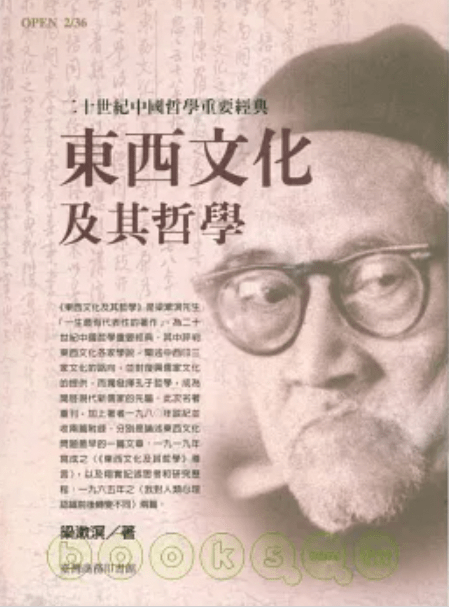
I clearly remember the changing event happened in the winter of 1999, which was also at the end of last century. After all courses were finished in the fall semester, I still did not want to go back home. For reasons I cannot explain even now, I went to the library and randomly picked up one book, since its title impressed me. The title of the book is “Cultures and Philosophies in the East and West” (東西文化及其哲學), which was written by Liang Shuming (1893-1988) in 1921. Then, I started to read it, mostly in a big auditorium classroom when very few students stayed there. Remember, that happened in a winter, cold, chilly, and my mood was no less gloomy because of reasons explained above.

Liang Shuming: Cultures and Philosophies in the East and West

I have to say a miracle happened to me. Without having a copy of the book in my hand now, I still clearly remember the major views of the book. So this is what the author told me at that time. He says,

The driving force of human life is called “will of life,” a will to live, a will to flourish, and a will to seek meaning and power for one’s given, yet limited and ambiguous human life. The best manifestation of this will of life is one’s desires. Desires of all sorts of objects: food, security, sex, fame, wealth, power, human relationship, meaning, etc. And there are three major different kinds of ways in the cultures of the world to deal with the relationship between one’s desire and its objects.

The first path is the western path. It tells that if you desire something but you cannot get it, then, the right way for you to deal with the situation is to step forward, advance yourself, and thus, try the best means to overcome any obstacle down the road so as to eventually get what you want, and satisfy your desire. But once your desire is fulfilled, this path will still urge you to seek more, grab more, and thus, be involved in a perpetual process of ego-expansion, self-aggrandization, and world-conquering.

The second path is the Chinese path, or using Liang Shuming’s term, the Confucian path. The path denies neither the legitimacy of human desire, nor the natural right of beings that are desired by human beings. For instance, if you ever ponder the issue of whether to be a vegetarian, a Confucian path would say: animals have their right of living, but humans also have their natural need to consume meat. Therefore, the right path to live through this apparent dilemma is that let’s keep both, but modify both so as to harmonize the needs of both in order to achieve a certain kind of co-thriving. In a more concrete term, this path will tell you, the human need to consume meat is natural, but it cannot go over its due measure. So let’s improve the meat industry to raise animals while treating them better, and also make sure not bring any other negative consequences to the environment such as global warming. So the Confucian path thinks human needs, desires, and emotions are natural. None of them are intrinsically bad, and all we need to do is to have them achieve the appropriate measure for the sake of harmony and co-thriving of all beings in the world.

The third path is the Indian way, the way best represented by a Buddhist ethic. According to Liang Shuming, when humans desire an object, the Buddhist ethic will deny the necessity of the desire all together. This is because firstly, unfulfilled desires always cause suffering, and secondly, even if we fulfill some of our desires, another desire will follow; once fulfilled, another desire will follow; and in the process, we would be never genuinely happy because there are always unfulfilled desires in our life. Therefore, the Buddhist solution is that, let us simply not desire. That means to eliminate human desires by all sorts of methods. For instance, Buddhist philosophy will teach you how illusory your understanding of the world is, and the Buddhist tradition also includes many skills of meditation so as to have you focus upon the right understanding of the world, and eliminate those desires that caused your suffering.

In a nutshell, according to Liang Shuming, when we desire any object to manifest the will of human life, the western path wants to overcome the obstacles of human desires so as to chase objects while fulfilling those desires. The Confucian path wants to harmonize the desires and the objects so as to achieve a certain degree of co-thriving. Meanwhile, the Buddhist path eliminates desires all together to avoid suffering. So, comparatively speaking, the western path is a path forward, the Buddhist path is a path backward, while the Confucian one lies in the middle. In the time of Liang Shuming’s life, the early 20th century, China was experiencing a profoundly dire situation of national disintegration triggered by the challenge of western colonial and imperial powers. According to Liang Shuming, the unique situation of China in the 20th century made it necessary for Chinese people to learn more about the western path, solidify its traditional Confucian path, and abandon the Buddhist path all-together.

I have to confess you that this book has made a huge impact upon my gloomy and grouchy life in my late adolescence. Firstly, it tells me what the world is. Secondly, it lays out varying paths of life so that I can envision a purpose of my own life. Thirdly, it also inspires me about what I can do for the world.

Apart from the philosophical knowledge I get about the world from the book, I feel a great therapeutic effect of its philosophy upon me. For the first time in my life, I realized that I have some natural tendencies in my body , the value of which I cannot deny. Instead, through cultivating these tendencies, I can get along with the world well, and make a contribution to its thriving while flourishing my own life. So, as you may have known, I was tending to choose the second path of human life explained by Liang Shuming, that is the Confucian, middle path, since it tells me I can get along with both myself and the world in a time when this message was so badly needed. However, I was also intrigued by Liang Shuming’s account of the western and Buddhist paths, and thus, became genuinely curious about the world in a philosophical sense.

After reading this book, all my life in the following 20 years seemed to lead naturally to the position where I am right now. Although I do not agree with everything that Liang Shuming said to me in the final winter of last century, his philosophy indeed sowed a seed of passion, a spark of inspiration to make me mindfully live my life and carefully plan my career. Right now, I am happily teaching philosophies and religions, both western and eastern ones, in an eldest liberal arts college of the U.S. Seen from this result, I am deeply grateful to that little small book which has tied my life to philosophy ever since.

So, dear friends, this is one central message I want to deliver in this first episode of introduction to philosophy: there are many paths to philosophy, and every human being has their own way to figure out how to live out their own life. However, regarding the thing called “philosophy,” according to my personal experience and learning, what it continually appeals to me is that it makes you think to answer all these most important questions for your life. These questions are:

What is the world surrounding me?

What is the purpose of my life? And,

What will I do for it?

Recommended Reading:

Thierry Meynard. “Liang Shuming’s Thought and Its Reception.” Contemporary Chinese Thought, Vol. 40, no. 3, Spring 2009, pp. 3-15.

Confucianism as Religion in Light of Indonesia

Dr. Bin Song: Prospects of Confucianism as Religion in light of Indonesia

[I deliver a speech “Prospects of Confucianism as Religion in light of Indonesia” to the Way of Wisdom (WOW) Confucian community in Indonesia on June 20/2020. Here is the audio record.]

Thanks a lot for inviting me to talk with Confucian friends in Indonesia. Liong, your passion inspires me, and thank you for organizing this wonderful forum! Mr. Budi Wijaya (姚平波), I know you may be here, your courage and persistence to fight for your right of marriage always remind me of what a genuine Confucian gentleman should do in a similar situation. So, thank you! And Mr. Kris Tan, I know you may also be here, thanks for teaching me of the life of a Confucian priest in Indonesia. I do hope there is a profession of Confucian priest in the U.S. as well, and that will be my No. 1 option for jobs outside the academy. And thanks also go to so many other people! Thank you for coming here. It is really a special honor for me to deliver this speech to such a special audience!

While learning the history of Confucianism in Indonesia, I get to know that Confucianism is one among six officially recognized religions, and normal people need to put your religious affiliation on your citizen ID card. If you do not have an identifiable religious affiliation, you will be disfavored by the society and the government in all sorts of visible or invisible manners that may bring unwanted consequences to your life. But Confucianism is not always so in Indonesia, I know that Indonesian Confucians fought very hard to obtain and maintain the status of official religion. The status is after all hard won, but not freely granted.

I will not get into too many details of the history about how Confucianism develops into an official religion in Indonesia in today’s talk. For friends who are interested in this topic, please go to my website, and I make a series of posters to explain this. I also share my screen of the posters here, you can get an initial look.

From the history of the Confucian religion in Indonesia, I get to know and admire how special Indonesian Confucianism is in comparison with other forms of Confucianism developed in other countries and in different periods of history. I will highlight three major features of Indonesian Confucianism in this speech.

First, the emigration of Confucianism to Indonesia happened in a very special time. That is in late 19th century, when most of East Asian Confucianisms were either declining or facing unprecedented challenges from the Western colonial powers such as in China, Korea, Japan and Vietnam. During that time, the Dutch colonial government in Indonesia took a racially stratified system, and labeled Chinese immigrants as the second tier of citizens called “Foreign Orientals”, which is lower than European White people, but slightly higher than indigenous Indonesians. In this system, race, religion, culture, and economic and politic statuses are all lined up together in order for the Dutch government to bring order to their colony. Obviously, in this situation, if all your fellow citizens have a religion, you have to develop one on a par as well. Otherwise, without a religion, you will be either converted to other racial groups and accordingly undermine the solidarity of your own community, or have to bear all undesirable consequences as a religionless person. And this term, “being religionless,” in the environment of colonial Indonesia and afterwards, is always a derogatory one. In a word, the initial impetus of Indonesian Confucianism as a religious movement pertains to an issue of survival, an issue of living, living better or worse, rich or poor, an issue whether your kids can go to good schools, and whether you can continually and safely bring food to the table to feed your family. It is a historical must-do, and it does not entirely derive from free deliberation or voluntary association of a group of believers to form a religious organization. That is the first point I need to highlight for understanding the very special Confucian religion in Indonesia.

Second, the political pressure from the Indonesian government to force Chinese Indonesians to choose and organize their own religion is even higher after Indonesia’s independence in 1950s. Since the Sukarno presidency of the independent Indonesia, the so-called old order regime, the Indonesian government adopts four criteria of religion, which are highly influenced by the country’s Muslim majority’s understanding of religion: 1) if some tradition is counted as religion, it must believe in “Almighty God,” 2) it must have its own bible or holy text, 3) having a prophet who delivered divine revelation, and 4) having laws and rituals to provide moral guidance for believers. Meanwhile, the Indonesian government also took the policy of “one person, one religion” by registering its citizens’ religions in their identity card. The darkest age of Indonesian Confucianism came under the New Order of Suharto presidency. The government at that time was highly suspicious towards the tie of Chinese Indonesians to Chinese communism, and repealed the official status of religion of Confucianism. At this time, indigenous people who happened to be hostile to Chinese Indonesians also found a way to release their resentment in violence. This situation lasted for about 30 years, and Indonesian Confucians underwent a massive number of conversions to other religions, most likely Christianity or Islam, because of the unsustainable lifestyle due to their Confucian identity. Even so, there were sparks of hope, persistence and strength in this pervasively difficult days and years for Indonesian Confucians. A widely reported case is that Mr. Budi Wijaya, one of my best Indonesian Confucian friends, and his wife Ms. Lanny Guito married through the Confucian ritual in a Confucian temple. However, the local government refused to certificate the marriage as it did not recognize the Confucian ceremony as legal. This would surely bring a number of harmful impacts upon Mr. Wijaya’s family and children. In 1996, the couple filed a suit against the government, and only after the Suharto presidency ended, the couple finally won their case in the year of 2000. In a word, the issue whether to sustain Confucianism as a religion after Indonesia’s independence for Indonesian Confucian believers is still primarily an issue of survival. It is about whether you can get married legally, whether your children would not be bullied in their schools, and whether you can continually live out a safe and decent human life in an overall unfriendly environment relying upon your deep spiritual power rooted in your faith. In this way, for discussing whether Confucianism is a religion, Indonesian Confucianism distinguishes itself from other forms of Confucianism in that it has a very solid political ground, and a very fixed conceptual framework to frame the debate. Even if scholars may disagree with answers given by Indonesian Confucian thinkers to the debated question, I am extremely sympathetic with the utterly real social situation that Indonesian Confucianism constantly faces, and I also genuinely admire its creativity, persistence, and hopefulness as a result.

Third, because of the special features of Indonesian Confucianism in its time of inauguration, its largely immigrative status, and its inevitable domestic and international geo-political involvement, it is also special in its third feature that I truly admire and appreciate. That is the creativity of thought and practice in its daily Confucian way of life. I will elaborate this using two major points:

Firstly, the textual and vocabulary base of Indonesian Confucianism is fairly unique. At the point of time when Chinese Indonesians were driven to organize their own religion, most of them could not speak or read Chinese. Therefore, they mainly relied upon European or Malay translations of Confucian classics. As we know, every translation is an interpretation. Together with the pressure of religionizing Confucianism due to the policy of the Dutch colonial government, these sources provided a fairly unique angle to look at traditional Confucian classics. For instance, Indonesian Confucianism highlights the religious terms and concepts in classical Confucian texts, such as 上帝 (upper-lord), 天命(divine command), that were once highlighted by the translations of early Christian missionaries. However, the purpose of these Christian missionaries to laser focus upon these terms in Confucian classics is to prove there are seeds of religious truth in classical Confucianism so that the spread of Christianity can fulfill them, can make them grow. In other words, the selection of Confucian terms for such a translation is actually the strategy of Christian missionaries to convert Chinese literati. However, the conversion to western religions is always the No.1 concern of Confucian believers in Indonesia, so, different from those Christian missionaries, Indonesian Confucianism also utilized European enlightenment thinkers’ writings on Confucianism to argue for the modern and advanced nature of Confucian thought. In combining these two apparently contradictory European interpretations of Confucianism, Indonesian Confucianism accomplished a mission impossible to fit its unique communal, racial and political needs. Let’s use an example to illustrate how special this is. My friend Kris Tan informs me that using English terms, the Indonesian translation of the first chapter of Zhong Yong, one of the Confucian four books, can be understood as such: “The Word of Tian is called the True Nature. Doing to follow the True Character is named after taking the Holy way. And Guidance to take the Holy way is called Religion.” Here, “word” “holy way” and “religion” all remind us of the need of religionizing Confucianism according to the Abrahamic definition of religion. However, the emphasis on “true nature” of humanity, or “true character” of human individuals also makes the intrinsic tension in Abrahamic religions between divine and human natures almost entirely disappear. When reading this translation, I cannot help asking myself: can it still be counted as a Confucian tenet? I think it is absolutely yes, but the translation looks familiar while being novel and fresh. I am also highly confident to say that it serves very well the needs of Indonesian Confucians. For me, all of these are signs of the genuine creativity of Indonesian Confucianism as a religious movement.

Secondly, not only in translation, the creativity of Indonesian Confucianism also consists in how it selects traditional sources throughout the entire history of Confucianism to make its case and serve its own distinctive needs. Per the four aforementioned criteria of religion established by the Indonesian government, we find there is actually no uniform expression of such a religion in the history of Confucianism. The tradition before Confucius was more religious, but it is less religious during the time between Confucius and Xunzi when humanism and practical rationality were rising; under the influence of Yin-Yang theory and folk religious practice, Confucianism in Han Dynasty became more religious again, but in Song-Ming Neo-Confucianism, the tradition went back to the less religious route as it claimed to continue the lineage of Dao initiated by Confucius and Mencius. In particular, the aforementioned criteria of religion require that Confucius is a prophet and delivers divine revelation. Throughout the entire history of Confucianism, we find only the New Text school of Confucianism in Han Dynasty furnishes a similar narrative to say that Confucius was born because of his mother’s divine encounter, and Confucius was therefore worshiped as an uncrowned king to prescribe laws and orders for later generations. This deified image of Confucius, the magical worldview, and the accordingly very progressive political philosophy in the New Text Learning of Confucianism were largely ignored after Han Dynasty, and only until Qing Dynasty, more than one millennium later, it revived again to become a major source for Confucian scholars’ reformative political thought. In 1903, Kang Youwei, a major voice of the New Text learning in late Qing Dynasty, visited Indonesia, and passed on his idea of the Confucian religion to Indonesian Confucians. Ever since, this New Text Learning becomes a foundational source for Indonesian Confucians to argue for their case and organize their institutions. However, as indicated in the case of translation, there are other forms of Confucian thought, or other forms of Confucian religiosity in the tradition. If we change the definition of religion, we will find the spiritual way of life that is constructed by the so-called Neo-Confucianism in mainly Song-Ming dynasty of China and other East Asian countries is actually the most prevalent and influential form of Confucian religion regarding the space it has reached and the time it has gone through. In this Confucian religion, Confucius is not a deified prophet any more, but a sage to inspire humans to live a fulfilled human life here and now. So, what does Indonesian Confucianism do with this dimension of Confucian religiosity? Again, while maintaining the basic framework of New Text learning as its major source to argue for Confucian religion per the criteria of Abrahamic religions, Indonesian Confucians incorporated Neo-Confucianism as much as they can to serve their distinctive needs. For instance, some Indonesian friends informed me that Mr. Tjhie Tjay Ing (1935-2016, forgive my pronunciation if it is wrong) was the best Confucian theologian in Indonesia in his generation. While debating with people dubious of the claim that Confucianism believes in afterlife in the highly oppressive period of Suharto presidency, Mr. Tjhie Tjay Ing, on the one hand, cites texts in the Classic of Rites to indicate that two sorts of souls were thought of as surviving the death of human body, and on the other hand, Mr. Ing also uses Wang Yangming’s thought in Neo-Confucianism to emphasize that for Confucianism, whether to abide by one’s conscience at each moment of human life determines whether one lives in a hell or a paradise here and now. See how creative this is! How convincing this is! As indicated by the example, we can say Indonesian Confucianism adapts to the need of folk religious practice in ancestor worship, but still keeps the very this-worldly, and deeply spiritual Confucian attitude towards human life here and now.

Good, at this moment, my speech covers three very special, and major features of Indonesian Confucianism: its initiative in the period of Dutch colonial government, its sustaining effort after Indonesia’s independence, and its creativity. The biggest lesson I learned from this very unique, on-going process of Confucian religion in Indonesia is that religion does not yield. Yes, let me repeat this, religion does not yield. Human activities are always constrained by varying objective forces such as politics, economy, geography, family history, etc.; however, the deep spiritual power of humanity rooted in their faith as it is articulated by a specific tradition never yields. It just makes use of whatever is available to create whatever is useful to make people’s life better and worth living. I am informed that when Indonesian Confucians travelled to the mainland of China nowadays, they found some mainland Confucian scholars dismissed the idea and the practice of Confucianism as a religion; this is highly understandable given the overall atheistic state ideology in the mainland of China now. However, if we learn the history of Indonesian Confucianism and actually talk with Indonesian Confucian friends, we will understand how perfect the sense is to make Confucianism a religion in their situation. They just have to do so. As I mentioned time and time again, for Indonesian Confucians, whether Confucianism is a religion is not primarily an issue of academic debate. It is an issue of survival, an issue of whether human life matters, and an issue as tangible and concrete as whether you can marry to someone you love. There is a Chinese idiom to say that only when forced into a corner of death, one can re-gain their life. (置之死地而後生) Yes, this is exactly what I found in the case of Indonesian Confucianism. Confucianism almost died out in late Qing Dynasty, but in Indonesia, it is the indomitable will of life of the people that make it alive again. So, as a Confucian scholar, I would say, thank you, Indonesian Friends, you, your family and your ancestors have done something extraordinary that is truly admirable.

Before ending my speech, I want to talk of briefly Confucianism in the U.S. and the contemporary world at large, since the title of this speech implies my prospects of Confucianism in the future.

When I learned the history of Indonesian Confucianism, I keep rethinking of my own experience of growing up to become a Confucian scholar and practitioner. Although there is no time for me to share with you my personal experience of Confucian practice in this speech, I hope there is further opportunity for me to do so in the future. However, one of my central foci in my work in the U.S. is indeed trying to increase the public awareness of the Confucian tradition in the English-speaking world. In the recent decades, I studied with the so-called school of Boston Confucianism, I organized the first college student Confucian group in the U.S., titled as Boston University Confucian Association. Right now, I am also helping to organize an educational organization called Ruist Association of America (RAA), and teach, research and speak on Confucianism in the academy.

As I commented above, religion does not yield. The will of life does not yield. This means no objective situation can eventually smother a tradition as long as its faith is kept and prevails. But it also means the way of religionzing one tradition in one situation may not be fit in another one. If we look into the situation of Confucianism in the U.S., we find those powerful factors that drive Confucianism into being organized as a religion in Indonesia do not apply. The emigration of Chinese or East Asian Americans into U.S. happened even later than the one into Indonesia, and it happened after when Confucianism was radically critiqued by Chinese intellectuals themselves in the early 20th century. This means there is no natural attachment to the so-called Confucian tradition in most of Chinese Americans. Also, there is no strict lining-up of race, culture and religion in America as it happens in Indonesia, and therefore, the life of faith for Chinese immigrates is actually very diverse and in a certain sense, de-centered. In particular, according to social surveys conducted in recent years, the traditional organized way of religious life in the U.S in general is declining. There is a growing percentage of people identifying themselves as religious “nones” or “being spiritual but not religious.” My friend, Ben Butina, and I, did a similar survey to clarify the perception of ordinary American people about Confucianism. We find that the majority of ordinary Americans do not see Confucianism as a religion, but as a philosophy or a way of life. All of these guide my own thinking, practice, and teaching on Confucianism in the U.S, which may be different from the one that is organized under the very strict criteria of “religion” explained above.

However, no matter what a concrete pattern of Confucian life that America could take in the future, one thing remains sure for me from my knowledge of Indonesian Confucianism: the Confucianism that could be counted as a possible, significant portion of American spiritual life must be down-to-earthly real. It must be as real as what Indonesian Confucianism has gone through. In other words, it needs to poke people’s nerves, go under their muscles, and sink in the depth of people’s heart, in whatever ways this can be imagined or expected.

The following is a preliminary list of potentials that Confucianism has, and which I also hope can help Confucianism to achieve this down-to-earthly real presence in the U.S. and in the contemporary world at large. This is not an easy list to do, but I do believe it is hopeful.

First, the Confucian wisdom on harmonization in the realm of government, social and business management can help to transform the highly polarized politics in the U.S. and other countries that are having a similar problem.

Second, the human-centered pedagogy of liberal arts in Confucianism can inspire unity for the highly compartmentalized institution of education, and thus, bring more integrity to students and scholars’ life.

Third, the spiritual practice of Confucianism to focus on meditation, arts, and minor ritual details of human daily life is that type of spiritual life which modern professionals are longing for.

Fourth, the Confucian wisdom on a balanced community life between authority and individual autonomy can enlighten how faith communities get organized in the contemporary world.

Of course, this list can go on, and people may have different prospects of Confucianism per their own judgment. But a bottom line is that, let me repeat it, human life is primarily about survival, subsisting, and participating the eternal meaning of life here and now. Whether Confucianism can prevail here and there in the world will be decisively dependent upon whether it can operate itself well along this bottom line, as it is so vividly indicated by the case of Indonesian Confucianism. In particular, since Indonesian Confucianism has its own very robust organized forms right now, I also hope the aforementioned four prospects of Confucianism can be vividly and continually manifested in Indonesia as well.

Good, this will be the end of my speech. Thanks for the invitation again! And I look forward to more conversations with you during the Q and A section.