Ancestor Devotion

(This article has been published in Huffpost, April 4th, 2016)

According to China’s Lunar Calendar, the Clear and Bright Day (清明節) will be on April 4 this year (2016). Traditionally, this is the time for families to visit their ancestors’ tombs to perform a ritual of ‘ancestor devotion’ (祭祖). For this reason, Clear and Bright Day is also translated into English as ‘Tomb Sweeping Day.’

If there is a single ritual which speaks to the resilience of the Ruist tradition, it is ‘ancestor devotion.’ Its history began long before the time of Confucius [551-479 BCE], although the role of Confucius and his Ruist school may be seen as having educated people about the spiritual and ethical importance of this ritual and thus to having transformed people’s minds in this regard. Even during the hardest times for Ruism, the early 20th century when Ruism was accused by China’s westernized intellectuals of being culpable for the backwardness of Chinese society, the performance of this ritual remained ubiquitous. This is the case, not only in China, but also for the greater part of South and East Asia which were influenced by Ruism, and also to a certain degree for the Chinese diaspora throughout Western societies. Today, some sociologists have even argued that if the performance of ‘ancestor devotion’ can be seen as a sign that the devotees have affiliated themselves to Ruism, Ruism may be counted as the largest religion in the world with the largest number of adherents.

So, why is this ritual so powerful? The reason is clearly related to ‘the Ruist view of death.’ In a succinct way, I can summarize this view as follows: a Ru lives every moment of life under the shadow of death and is continually trying his or her best to create a condition of dynamic harmony within evolving life situations. There is no doubt that, from a human perspective, disharmonious factors are always present in the world. But the ideal of continually realizing dynamic harmony always stands front and center. That’s the reason I use the phrase ‘continually trying one’s best.’ In this sense, the image of ‘a non-violent warrior’ who fights for harmony up until death may be seen as a portrait of the ‘vertical’ dimension of a Ru’s life, since it announces a sort of existential constant during each moment of life. In this vertical view, “If one hears the Dao in the morning, one can die at ease in the evening” (Analects, 4:8), since every moment of a Ru’s life is virtually the same as every other. However, in a horizontal view, the target of a Ru’s life is to achieve ‘cultural immortality.’ Through an arduous process of moral self-cultivation, a Ru tries to accumulate his or her merits in his or her words (立言), works (立功) and moral worths (立德) so that he or she will be able to make a great contribution to human civilization, and thus to yield cultural influences which after death do not decay over time. Understood in this horizontal way, the ritual of ‘ancestor devotion’ is a distinctly Ruist way for ordinary people in their households, in their family clans and in their local communities to practice the Ruist teaching concerning cultural immortality.

Three key points still need to be explained in order to avoid any possible misunderstanding about the purpose of this ritual. First, solidarity and order to be brought to one’s family, and agreeable effects to be brought to every individual’s moral self-cultivation, are the aspects of this ritual which are most emphasized by Ruism. For instance, during a performance of the ritual, certain rules must be followed, which demand appropriate reciprocal interactions among family members based upon their ages and status differences. One’s ancestors’ deeds and virtues must be memorialized and appreciated, as they will have set moral examples for their descendants to follow. The eldest in each family, especially, must perform the ritual sincerely so as to demonstrate the virtue of ‘filial piety’ (孝) toward the ancestors; doing so is essential if these elders intend that other family members continue to practice this virtue towards themselves. Furthermore, a cultural consciousness deep within the ritual performers is the hope that their own lives will also be memorialized by their offspring, generation after generation. Accordingly, everyone must try their best to become ‘good guys’ to protect against a case in which nothing about their life turns out to be worth memorializing.

Secondly, if we take these factors into consideration, we can understand that the ‘blessing’ which people hope to receive during the ritual is not from some kind of ‘petitionary prayer,’ which thereby must assume a certain degree of deification of the ancestors. Offering a petitionary prayer would indicate that people think that if they have provided outstanding offerings to the spirits or ghosts of the ancestors and have behaved well during the ritual, that then they will be rewarded; otherwise, the ancestors might punish them. This sort of ‘ancestor worship,’ which is not the same as ‘ancestor devotion,’ may have been prevalent before the time of Confucius and even among uneducated people today. However, by the time Confucius’ Ruist school had become the most powerful educational engine of ancient China, the ritual was no longer construed as ‘worship,’ but rather as ‘devotion.’ In this regard, the chapter, ‘Ji Tong’ (祭統, the regulation of sacrifice), in the Book of Rites (禮記) is edifying. It says,

“When a worthy (賢者) pursues the ritual of ancestor devotion (祭), he will be blessed. However, this blessing is not what the vulgar people call a blessing. Here, blessing means perfection. And perfection means the complete and natural discharge of all one’s duties.”

In other words, Ruists believe that people can be blessed through the ritual of ‘ancestor devotion’ because they have attuned themselves to all the patterns and principles which make an entire family fit together in the way in which it was historically understood: as following the virtues of the ancestors, expressing feelings of gratitude and filial piety, cultivating oneself well here and now, and expecting cultural immortality in the future. We can now understand that realizing ‘dynamic harmony’ within a household refers to performing this ritual par excellence.

Third, these insights remind us to clarify one important question which people usually ask when they read the Analects and begin to approach Ruism for the first time: Did early Ruists believe in ghosts, spirits, or any other sort of supernatural beings who possessed some disembodied form of consciousness? If we read the Analects along with other major Ruist classics compiled around the same period, the answer is a definite ‘No.’ For in Confucius’ time, people believed that human beings had two souls. When a human died, one soul called hun ascended to heaven, and the other soul called po descended to earth. Accordingly, a special ritual needed to be performed following a person’s death in order to call the ascending hun back to the buried body and bring final peace to the deceased. However, as described in the chapter called ‘Ji Yi’ (祭義) in the Book of Rites, when Confucius was asked his opinion of hun and po, he said these are just two different forms of the cosmic matter-energy called Qi (氣). The one is stretching and ascending, and the other is returning and descending. In other words, when people die, their life force was thought to be transformed into two portions of Qi and thereby merged into the entire natural process of cosmic changes. Accordingly, no supernatural being need be posited to exist.

Cognitively, then, Ruism does not believe in any sort of afterlife. Emotionally, however, Ruists acknowledge that people express intrinsic feelings of gratitude and devotion towards their ancestors. In this sense, the ritual of ‘ancestor devotion,’ as construed by Ruism, is to create a distinctive ‘subjunctive’ space in which people are able to express their feelings and cultivate their morals without being required to assume any ontological misconceptions about what these feelings and morals ought to be devoted to. In other words, the ritual harmonizes people’s emotional and moral needs along with their cognitive awareness in just the way described by Confucius: “When I perform the ritual of ‘ancestor devotion,’ I act as if the spirits of the ancestors were present” (Analects, 3:12). By the same token, Confucius also teaches us to “revere spirits and ghosts, but stay away from them” (Analects, 6:22). Both verses enlighten us by pointing out that we need to sincerely perform the ritual of ‘ancestor devotion’ as if these ancestors were alive for all the reasons mentioned above. Even so, we ought not to commit a cognitive error by allowing the idea of spirits and ghosts to interfere inappropriately with our lives.

In a word, although the Clear and Bright Day ritual is devoted to ancestors, it is mainly for the sake of living people and their futures. If we have correctly understood this ritual, we still have to wonder, especially in the case of Westerners, how should the ritual be performed in a contemporary context?

As for the more general question of how Westerners can adopt Eastern rituals in order to practice Ruism, I endorse a minimalist re-interpretive approach. This means that Westerners ought first to understand the Ruist teachings which underlie Eastern rituals, and then reformulate current Western rituals using the least effort which will yield an optimal Ruist meaning.

In this regard, my friend Benjamin Butina has done an unprecedented job of designing a ‘Tomb Sweeping Ritual’ (click here to see details) based upon Ruist philosophy as well as Western customs. Alternately, Westerners might choose some Western festival such as Father’s Day or Mother’s Day as their opportunity to perform the ritual. Different families could also design their own way to visit the tomb or burial site of their beloved ancestors on a regular basis. Or a national holiday, such as Veteran’s Day in the United States, could be used as a way for local communities to pay tribute to deceased public figures.

In a word, the overall message of the Ruist ritual of ancestor devotion is that humans ought not to forget their family history. Only through learning, remembering and re-forming history throughout all its interrelated levels (personal, family, community, state, etc.) can people become part of history, thereby allowing human society continue to flourish in the future. Thus, as long as Westerners are able to understand and practice this message in whatever form of ritual feels comfortable and convenient, then they will be Ruist.
A Ruist View of Death

2016-03-22-1458605552-5544715-peacewithdeath.jpg

(This article has been published in Huffpost, Mar 22, 2016)

(NOTE: ‘Confucianism’ is a misnomer, replaced in this essay by ‘Ruism,’ which refers to the tradition whose most famous practitioner was Confucius. The word ‘Ruist’ is both an adjective and a noun, either describing something about the tradition or referring to a practitioner of the tradition. ‘Ru’, however, because of its compliance with the pinyin form of the Chinese character 儒, is a more professional term solely denoting a practitioner of Ruism.)

Ruism is frequently introduced as a tradition which is too this-worldly to care much about what happens after death. To a certain degree, this is true. Ruism teaches that there is no afterlife, no final judgement, no Paradise or Hell, and no reincarnation. When people are born, this is only a contractive form of the movement of the cosmic matter-energy called Qi (氣); when people die, this energy dissipates, and accordingly people’s lives lose their agency. Accordingly, life and death is just one embodiment of the constantly contracting (yang) and dissipating (yin) natural processes of cosmic change. As a consequence, nothing is supernatural, nothing is uncanny.

However, this does not mean that Ruism does not have its own systematic view of death. Neither does it imply that a Ru cannot live a peaceful life up until his or her last moments. Let me relate some stories which will provide a glimpse of how a Ru dies:

When Wang Yang-ming turned 57, he retired from government because of disease. He went back to Nan-an, and one of his students, Zhou Ji, came to visit and then took care of him. One day Wang announced to his student: “I will pass away.” Zhou wept and asked: “Do you have any last words?” Wang smiled: “Since this heart of mine is bright and luminous, why do I need to say anything?” (此心光明,亦復何言). After these words, Wang closed his eyes and died (From The Complete Works of Wang Yang-ming).

Wang Gen, a prominent student of Wang Yang-ming, died at the age of 58. It was said that before his death, there had been a light dimly shining throughout his sickroom at night. Because of this, Wang Gen murmured to himself: “Will I die?” In the next morning, when gathering his students and sons, Wang Gen was asked about how to arrange his funeral. Wang Gen told his sons: “Since you know how to study, what additional concerns could I have?” (汝知學,吾復何憂). Then Wang Gen told his students: “You have brothers such as my sons who know how to study, do I need to have any further concerns? After my death, you only need to continue doing good deeds. Human beings suffer from the departure of their beloved. However, as long as you friends can continually meet and learn from each other, your lives will be benefited, and your learning will advance.” No other word was said. Wang Gen then closed his eyes and died. His tender and rosy complexion did not change until his internment (From The Collected Works of Wang Xin-zhai).

Luo Ru-fang, another prominent Neo-Ruist, died at the age of 73. On the first morning of September of that year, after Luo had washed his hands and face, and combed his hair, he walked out and sat in his appropriate position in the main room. He required his students and children to drink and toast one another, and after this, he cupped his hands and bowed to them: “Now I will leave.” People asked him to stay for another day, and Luo agreed. At noon on September 2nd, Luo dressed up, sat down in the proper position, and died.(From The Collected Works of Wang Jin-xi).

Although these events may have been recorded in a somewhat prettied-up way by the deceased’s students, we can nevertheless discern the key message: a Ru can continue to live an extremely peaceful life even in the face of his own death. So, how can this be possible? In my view, each of these Ruist deaths is a good exemplar of Confucius’ teaching: “If one hears the Dao in the morning, one can die at ease in the evening” (Analects, 4:8). In other words, if you know the truth of the Dao of Heaven (天道), as well as the truth of the Dao of Human Beings (人道), and furthermore, if you have tried to continually live out these truths in your everyday life, then at the end of your life, you will come to appreciate that you have in fact tried your very best to fulfill your most valuable potentiality: that of becoming fully human. At that point you can die without any regret, and at peace.

According to Ruism, the truth of the Dao of Heaven (天道) is that the entire universe is a constantly creative process called ‘Tian’ (天, Heaven). Tian creates a process of dynamic harmony, endowing energy and creativity to all creatures within Tian, in all places and at all times, by means of a method called ‘wu-wei’ (無為, effortless action). In this view, the movement of cosmic matter-energy is the manifestation of Tian’s creativity. However, Tian’s creation is neither anthropomorphic nor anthropocentric. For, natural disasters on this little blue planet can be considered ‘disasters’ only from a human perspective. From the perspective of Tian, a flood, as one of millions of processes within Tian, has its own beauty, a beauty which is not inferior to that of, for example, the human houses being destroyed. In the same way, from Tian’s point of view, the HIV virus has a value which is not less lovable than that of the human bodies which have been infected by the virus. Therefore, the axiologically transcendent and non-anthropomorphic character of Tian entails that human beings have their own intrinsic needs and particular responsibilities for the manifestation of Tian’s creation in their own human way. In a Ruist sense, this is called ‘making great the way of Tian by making great the way of Humans’ (以人道弘天道) (Analects 15:28). In concrete terms, it is an endless process leading to the realization of the conditions of dynamic harmony among all concerned cosmic beings, but based upon their particular diverse values measured primarily from a human perspective. For example, if floods bring disaster, let’s build dams, and also, let’s refrain from the excessive exploitation of forests whose loss leads to excessive flooding. This of course will not mean that we give up employing natural resources such as wood and coal used in maintaining human civilization. In this sense, the targeted harmony under human management is a humanistic and anthropo-cosmic harmony, which stands firmly upon the intrinsic needs, interests and values of humanity in general, but also of course maintains its distinctive cosmic extension.

If we examine the Dao which rendered Confucius willing to die in the evening after he had heard it in the morning, we will realize that there are, among all the world’s religions, not one which emphasizes ‘cultural immortality’ more powerfully than Ruism. This is because, for Ruism, to be human is not only a fact; it is even more a value, which can and must be continually realized human generation after human generation. Thus, one’s personal contribution to the continual flourishing of the entirety of human civilization against the cosmic backdrop of the constantly creative process of Tian, will become the ultimate criterion for giving an account to the meaning of an individual human life and for judging the value of a human person. The phrase, ‘To live a meaningful and valuable human life, and then, to die but not (to culturally) decay’ (生有價值,死而不朽), is a distinctly Ruist way of living in the shadow of one’s own death.

In particular, the Ruist tradition extols three ways for achieving cultural immortality: to establish moral worth (立德), to establish good works (立功), and to establish good words(立言). ‘To establish words’ means to say the right words and writing good books. This is how intellectuals succeed in preventing their deaths from cultural decay. ‘To establish works’ means to help resolve impending issues for human society at large. For example, President Obama succeeded in rescuing the American economy from ‘the Great Recession.’ Obama’s presidency will therefore, in my view, be remembered in a positive way by the American people. In contrast to words and works, ‘moral worth’ (de 德) is of utmost importance for human beings who are trying to avoid cultural decay at their death. De (德), usually translated by the word ‘virtue,’ is the practical moral influence or moral charisma of a virtuous, noble person (君子). A virtuous, noble person, by means of his or her well-cultivated deeds and words, sets a moral norm which will motivate other people to achieve the same Ruist moral ideal – the creation of the conditions for dynamic harmony – within different contexts. Among these three ways, establishing moral worth is foundational because, according to Ruism, without a solid moral underpinning, people’s works and words are ultimately groundless. On the other hand, Ruism promotes the ‘unity of knowledge and action’ so, saying the right words without actually doing good deeds, must be considered of lesser value than doing good deeds on the basis of right knowledge. In this way, human beings need to try to achieve cultural immortality in this order: firstly, try to say the right words, then, try to do good works, and finally, try to embody moral worth.

According to the tradition, only two Ruists throughout the entirety of Chinese history have accomplished these three ways of cultural immortality: Confucius and Wang Yang-ming. They both wrote great books, formed their own schools consisting of thousands of students, served in high governmental positions and helped to resolve impending issues for their states and, what is most important, they never stopped learning and cultivating themselves so as to set great moral examples. And by doing so, they exerted a huge influence upon future generations. Understood in this way, it will be no surprise to hear that Wang Yang-ming and his followers could die such peaceful deaths. In the words of another prominent Neo-Ruist philosopher, Zhang Zai, the death-consciousness of these Ruists could be stated as: ‘When I was alive, I was devoted to the mission of becoming fully human among humans; now that I am dying, I feel content with myself’ (存吾順事,歿吾寧也).

Zhang Zai

bajoo tree

芭蕉詩

芭蕉心盡展新枝,新卷新心暗已隨。

願學新心養新德,旋隨新葉起新知。

On the Basjoo Tree

The basjoo tree

perfects its core

to unfurl a new stem.

Unnoticed, a new curl of

a new core

is already emerging.

I love to learn

with a renewing mind-heart

to cultivate new virtues,

so that,

soon after a new leaf,

a new stem of knowledge

will arise.

Commentary:

Zhang Zai (1022-1077 CE) was a pioneering Ru philosopher of the so-called Dao Xue (Learning of the Way, 道學) movement, which is usually called Neo-Confucianism in English. Zhang is famous for his treatise, The Western Inscription (西铭), in which he grounds the Ru virtue of filiality (xiao, 孝) on the cosmic piety of human beings towards the heavens and the earth.

In this exquisite poem, On the Basjoo Tree, Zhang Zai uses the image of a Basjoo tree to express his Ruist thinking concerning the relationship between the world and human beings. For Ruists, the cosmos, called tian (天), is an all-encompassing process of continuous novelty and creativity. Correspondingly, the ethical commitment of human beings is thought of as a constant renewal process of learning such that a condition of dynamic harmony (he, 和) is continually being created in the evolving situations of human society.

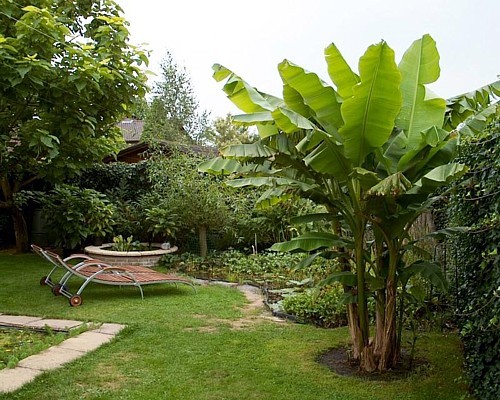
The biological peculiarity of the Basjoo tree is that what looks like its trunk is actually composed of curled-up stems packed together, so that when one curled stem becomes mature, a new leaf is unfurled and its stem then grows into a new branch of the plant. For Zhang Zai, this feature of the Basjoo tree represents perfectly the core of Ruist aesthetics: the world continually renewing itself. Thus, in the second half of the poem, Zhang Zai says he loves to learn with the Basjoo tree and in that way to continue to nurture and renew his virtues and to uncover new knowledge about the world.

Some use of puns or word-play in Chinese is crucial for the poem’s diction. In Chinese, 心 (xin) can mean “mind,” “heart” or “core.” It is used by Ruists to refer to the undivided central capacity of human consciousness and encompasses its intellectual, emotional and volitional dimensions. Therefore, a standard English translation of the Ruist idea of xin is “mind-heart.”  Because xin also means “core” in Chinese, the curled-up stems making up the trunk of the Basjoo tree is portrayed by Zhang Zai as its xin, and its continual unfolding symbolizes a renewing of the human mind-heart that longs for continual learning and self-cultivation. Also, the Chinese term for “stem” (zhi, 枝) has the same pronunciation as the Chinese term for knowledge (zhi, 知). So, as each new stem is unfurled, it symbolizes a virtuous Ruist learner who has garnered a new piece of knowledge. Please pay attention to the fact that for Zhang Zai, knowledge and virtue are intertwined in the self-cultivation of a human being, and so these renewals are manifestations of the transformation of one’s own mind-heart. This reminds us of the first three paragraphs of Great Learning (Daxue, 大学), which lays out a detailed procedure for Ruist self-cultivation based upon attaining knowledge (致知), rectifying one’s mind-heart (正心), and illuminating one’s bright virtues (明明德).

Another important lesson from Ruist poetry is that in the perspective of comparative literature, Ruists are fond of using the same image to express multiple meanings. For example, “lotus” is an image heavily used in Buddhist literature to express Buddhism’s commitment to eliminating desires and anxieties and thereby to search for release from the suffering process of reincarnation through Buddhist practice. However, in Zhou Dunyi’s “On Loving the Lotus,” the lotus is described as “Inside, it is open; outside, it is straight” “It neither sprawls nor branches,” and in this way the lotus becomes a Ruist image, symbolizing the Ruist moral ideal of an upright and honest noble-person (junzi, 君子). Similarly, the Basjoo tree is an icon also popular in Buddhist literature where its trunk is actually “empty” once you account for all the unfolding stems. But in Zhang Zai’s poetry, the Basjoo tree becomes an icon expressive of the Ruist metaphysical insight concerning the constant creativity of Tian (cosmos) and the Ruist ethical commitment to the constantly being renewed self-cultivation of human beings.

(Translated and Commented by Bin Song)