Liberal Arts as a Cosmopolitan Hope

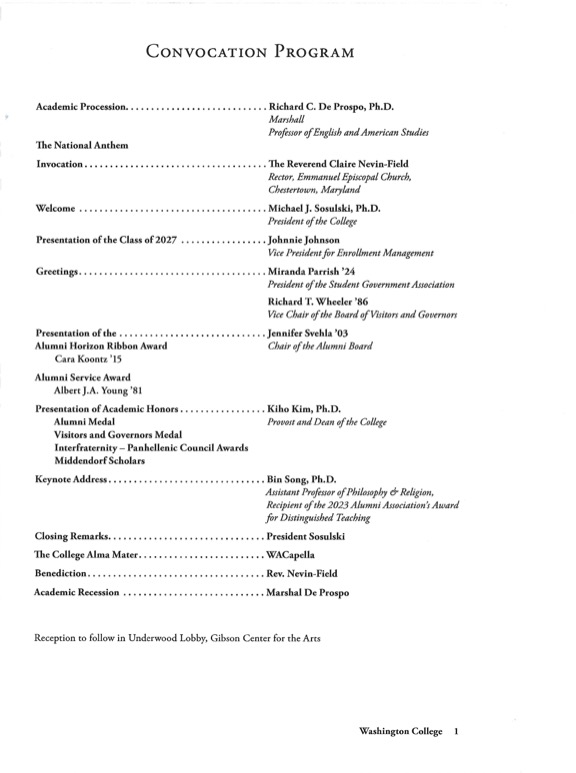
(Dr. Bin Song, as the recipient of Distinguished Teaching Award at Washington College, delivered a speech “Liberal Arts as a Cosmopolitan Hope” that cites Aristotle, Confucius and Benjamin Franklin to champion the value of liberal arts education, at the ceremony of 2023 Fall convocation.)

Liberal Arts as a Cosmopolitan Hope

Bin Song
Washington College

It’s an honor to address you all today. In this dynamic space, during this interesting time that challenges our hearts and minds, let’s contemplate the profound essence of a liberal arts education.

Back in 2018, when I became a part of Washington College, a dream I had held close to my heart was realized. Twenty years prior, as a young philosophy student in China, I found myself enchanted by the novels of Haruki Murakami, translated from Japanese to Chinese, which are also imbued with influences from iconic American writers like F. Scott Fitzgerald. Murakami’s evocative depictions of university life ignited a spark within me. It was then that I began to dream of teaching, reading, and writing with unbridled freedom, hopefully in the halls of a democratic college.

In our hallowed halls of Washington College, the dream has come alive. Each day unfolds as a chapter of discovery, brimming with fresh ideas, reaffirmed beliefs, and moments of unexpected joy. These experiences are surely amplified because of Washington College’s esteemed status as one of the most historic liberal arts institutions in the U.S. Yet, deep within my heart, I feel my journey is far from complete. Not simply because of my age and the countless collaborations I envision with my wonderful colleagues and the brilliant students who are joining our cause. But, more importantly, because I believe the noble ideal of liberal arts education faces immense challenges in today’s society. Given the very essence of this ideal, it is our duty, as educators of today and tomorrow, to champion and defend it, despite and indeed because of these challenges.

In my Introduction to Philosophy class, I strive to illuminate for our students the origin of the concept ‘liberal arts’ in ancient Greek philosophy. Think of Socrates — declared as the smartest human in Athens by the god Apollo, yet heartbreakingly sentenced to death by a democratic assembly. In a modern cartoon interpretation of the tragedy of Socrates’ death, we might envision it in this way: A mob, incited by democratic leaders and angered by Socrates’s steadfast loyalty to the law, gathers outside the Athenian supreme court, chanting “Hang Socrates! Hang Socrates!” In the end, Socrates successfully hanged himself.

This profound injustice plunged Socrates’s student, Plato, into despair. Plato came to view democracy as a mere rule of the uninformed masses, stifling the enlightened ideas of the truly educated. As an alternative Plato envisioned a society ruled by an all-knowing and supremely intelligent ‘philosopher king’. This king would take charge of guiding every facet of civic life — including which job you can take, whose poetry you should read, or read poetry at all, and even who you should marry and how you raise your kids. Trust me, when you read contemporary news articles about how authoritarian nations today defend their regimes against what they label as ‘Western liberal democracy’, you’ll realize Plato’s arguments are anything but antiquated.

While Plato had his convictions, his very own student, Aristotle, saw things differently. Aristotle asserted that no individual could ever achieve godlike infallibility; hence the dream of an all-knowing human ruler is just that—an illusion. However, acknowledging Plato’s critique of democracy, Aristotle’s advocacy for democracy is more sophisticated. He distinguishes two forms of democracy: one lower form of democracy, where the masses govern and since the electorate is uninformed, the elected officials can merely serve their own selfish interests. Then, another higher form of ‘democracy,’ termed as the ‘polity.’ Here, a knowledgeable and educated citizenry elects representatives who truly champion the common good of all citizens.

Therefore, at the heart of Aristotle’s vision was a delicate balance, weaving meritocracy into the fabric of democracy. And this is where the profound significance of a ‘liberal arts’ education shines forth. The word ‘liberal” implies the freeing of the human spirit. Authentic freedom isn’t limited to any particular sphere of knowledge. A liberal arts education is an invitation to expand our horizons, to think critically and rationally, propelling us on an insatiable quest for diverse knowledge. More than just a theoretical discipline, it’s an ‘art’ that cultivates virtues vital for a rich human experience—an experience Aristotle termed ‘eudaimonia,’ the Greek word for genuine fulfillment or happiness. Aristotle firmly believed that without such an education, we will risk becoming “mechanistic” in our thinking, surrendering our freedom and autonomy. Absent this foundation of liberal arts education, the heart-wrenching fate of intellectual luminaries like Socrates, judged by an uninformed majority, and the ascent of power-hungry authoritarian demagogues, both underscore the dire consequences of a democracy devoid of merit.

My fellow citizens in the Goose Nation, the societal and political challenges Aristotle confronted were strikingly akin to what we face today. And the remedy he proposed? It’s the very essence of what Washington College embodies in its daily pursuits as a bastion of liberal arts. I’ve often said to my students with immense pride that only in a vibrant setting like Washington College can a professor seamlessly traverse subjects as diverse as Descartes’ analytic geometry, Hobbes’ social contract theory, and Matso Basto’s Wabi-sabi haikus in the morning, only to delve into Simone de Bouvoir’s feminist existentialism, Nagajuna’s Mahayana Buddhism and lead a Yoga Sutra meditation by afternoon. While interdisciplinary teaching is an aspiration for many larger institutions, it is our starting point—a foundation we continuously seek to elevate.

In focusing on the “art” of our liberal arts commitment, our mission statement at Washington College explicitly emphasizes “moral courage.” The tight-knit nature of our community fosters a deep, personalized exchange of knowledge, instilling in each learner a robust ethical foundation and a sense of duty.

So, citizens of our beloved Goose Nation, when the weight of today’s societal challenges bears down upon you, remember Aristotle’s time-tested wisdom and embrace what Washington College has always been good at. Together, we’ll stand poised on the cusp of hope, flourishing, and eudaimonia.

For many of you, the tale I’ve just shared about the origins of liberal arts, rooted in its Western heritage, might feel familiar, especially considering the dedication of my co-educators to this grand Western tradition. Yet, with immense pleasure, I wish to enrich this narrative with a cosmopolitan dimension. It’s fascinating how the foundational principles of Western liberal arts resonate deeply with the visions of Confucius.

Many researchers have long recognized Confucius as the pioneer of the East Asian version of liberal arts education. To me, a particularly compelling piece of evidence is that Confucius established the very first private school in ancient China. He ardently championed the principle of “teaching without discrimination (有教無類)”. This was not merely a principle of pedagogy; it represented a revolutionary act. Confucius sought to dismantle the royal government’s monopoly over educational resources and embraced a democratic and inclusive approach. For Confucius, wealth was not the measure of a student’s worth; genuine intent to learn was. And in testament to this, if a student lacked money but showed a sincere desire to learn, Confucius accepted tuition in the humble form of a bunch of dried meat.

On the other hand, the democratic spirit of Confucius, deeply rooted in meritocracy, finds a remarkable echo in the teachings of Aristotle. Aristotle once warned against superficial education, cautioning that it could lead individuals to become “banausos”— which means being vulgar and mechanical in nature. Similarly, Confucius taught that a truly noble-minded human should broadly learn and be dedicated to self-cultivation, and thus, they should not be just a “utensil” with limited functions (君子不器). It’s noteworthy that one interpretation of the character 器 is “machine.” Thus, both philosophers believed that the core objective of liberal arts is to prevent the rise of individuals who are narrow-minded and mechanical, potentially jeopardizing the ideals of a meritocratic democracy.

In light of Confucius’ advocacy for liberal arts and its role in fostering democracy, my decision to join Washington College can be seen as a gigantic leap of faith—a vote by feet, if you will, as I find a place in America to embrace the ancient ideals of Confucius. Yet, I am far from the first to be influenced by this vision. It is astounding how principles of liberal arts from varied origins resonated with America’s founding figures, notably Benjamin Franklin. Franklin not only recognized these universal principles but actively bridged these worlds. He translated the Confucian classic, “The Great Learning,” from Latin to English, presenting it to the public in the Philadelphia Gazette in the 1740s. For Franklin, the heart of American democracy was a balance between rule by law and rule by virtue. Acknowledging that laws are best upheld by virtuous individuals, he and fellow founders drew insights from both East and West to shape our young Republic’s blueprint.

So, my fellow Goose citizens, allow me to offer this perspective: Washington College, the very first to be chartered in the sovereign United States, proudly bears the name of the founding president. This, to my mind, is a testament to our institution’s intrinsic connection to the universal essence of liberal arts, a vision championed alike by great minds such as Aristotle, Confucius and Ben Franklin. At the heart of this vision lies an enduring belief: that by fostering a robust democracy anchored in meritocracy, we pave the way for every individual to achieve their fullest potential, thereby ensuring the co-thriving harmony of human civilization.

As I conclude, I’ll offer an introspection. Amidst the immense challenges confronting American society and the wider crises of our civilization, it’s clear that the U.S. is still on its journey towards the ideal of a cosmopolitan, meritocratic, and harmonious democracy. The path isn’t always bright, and current events can be disheartening. Yet, history reminds us: it’s during the darkest times that hope shines its brightest. Let us embrace our true selves, ever aiming higher. With the steadfast support of each of you, my esteemed colleagues and cherished students, I am filled with hope. Let us stand together, undeterred, in our quest to realize our fullest human potential through the liberal arts.

Thank you.

The Stirring Ghost of Chen Duxiu (1879-1942 C.E) Needs a Rest

(This article was once published in Huffpost, November 2017: https://www.huffpost.com/entry/the-stirring-ghost-of-chen-duxiu-1879-1942-ce-needs_b_59fa0817e4b09afdf01c3fb0.)

Although Ruism (Confucianism) is experiencing a powerful revival in mainland China and is consequently radiating across Asia and other parts of the world, a suspicion towards it still haunts many people’s mind. This can be seen in frequent reports in English news cycles which either ignore or misrepresent the basics of Ruism. For example, these reports usually present profiles of Ruism containing ideas such as: the Ruist idea of “filial piety” (Xiao) requires blind obedience of children to their parents; Ruism is essentially an ideology of feudal society used by authoritarian governments to manipulate their political power; Ruism oppresses women and other gender minorities; Ruist education stifles creativity, etc.

These attacks, issued by people with limited knowledge of Ruism, are neither true nor new. They share one common point of origin: Chen Duxiu and the so-called May Fourth and New Cultural Movement in the 1910s of China. The movement was launched by radical anti-Ruism Chinese intellectuals who accused it of anything and everything wrong with traditional China. For these intellectuals, Chinese people needed to completely replace their Ruism-hardwired thought with Western thought in order to keep China from being conquered and eliminated by Western colonial powers. Therefore, I must conclude that the greatest obstacle to the contemporary revival of Ruism is that the ghost of Chen Duxiu still stirs in the world.

Chen Duxiu was by far the most impactful anti-Ruist intellectual in the May Fourth and New Cultural Movement. He created the movement’s leading journal of “New Youth 新青年” in the 1910s to champion and propagate the Western ideas of “democracy” and “science”, which he thought of as representing the apex of human civilization. He founded the first communist group in China in the 1920s, and acted as the most powerful political leader of the Chinese Communist Party in its early stage. Most importantly, unlike many contemporary intellectuals who regretted their anti-Ruism thoughts in their elder years, Chen Duxiu’s anti-Ruist stance remained unchanged until his death. As a result, Mao Zedong recognized that Chen Duxiu had played a decisive role in transforming Chinese society from backwards feudalism to modern capitalism and then, ultimately, to a coming “brave new world” of socialism. Mao, in 1919, stated: “May Master Chen Duxiu’s utterly firm and absolutely sublime spirit live for thousands of years!” and in 1942 recognized him as “the Commander-in-Chief of May Fourth Movement.”[1] In hindsight, it is not surprising why Mao had such a high evaluation of Chen Duxiu, which was a rare occurrence for Mao’s contemporary intellectuals at the time. It was Chen Duxiu who helped to introduce Mao to communist thought from the Soviet Union, and it was also Chen Duxiu who finally converted the young Mao (in his late 20s) into a staunch believer in communism.

Therefore, as seeded in Chen Duxiu’s provocative journal essays in the 1910s and approved by Mao, and as a central ideology of the Chinese Community Party until the 1980s, the radical anti-Ruist thought ran consistently throughout most of the history of China in the 20th century.

Nevertheless, for our understanding of Ruism’s contemporary revival, a crucial philosophical question remains to be asked: Is Chen Duxiu’s anti-Ruism correct?

Triggered by the deteriorating conditions of the late Qing dynasty (1644-1911 C.E), and also inspired by social Darwinism, Chen Duxiu held an extremely dualistic view between pre-modernity and modernity, between the East and the West. Chen viewed Ruism as essentially a pre-modern, feudal, system of thought which had nothing in common with “science” and “democracy”, the two central tenets of modern human civilization. Unfortunately, in the remaining part of this essay, we will see that Chen Duxiu’s anti-Ruist arguments were neither accurate nor self-coherent.

When Chen Duxiu talked about democracy, he mainly referred to the European Enlightenment philosophers, such as Rousseau and his theory of social contract, which inspired the French Revolution and led to the establishment of the modern French republic. According to Chen Duxiu, France’s great democratic achievement was based upon those Enlightenment philosophers’ unflinching defense of the autonomous and free use of human reason, and the accordingly inalienable political and social human rights of each individual.

In contrast, Chen Duxiu viewed the traditional Ruist ethical teaching of the “Three Bonds 三綱” (between rulers and ministers, fathers and sons, and husbands and wives) as incompatible with these democratic moral values. In Chen’s mind, the Ruist ethic of the “Three Bonds” requires that persons of a lower rank blindly obey those of a higher rank and, therefore, it is essentially an ethic designed to enslave, allowing the elite to misuse their authority and solidify an unjustifiable feudal hierarchy.

Chen Duxiu’s argument is wrong on at least two fronts. First, it is unwarranted to identify the ethic of the “Three Bonds” as representing the essence of Ruism. The doctrine of the “Three Bonds” was formulated in Dong Zhongshu’s Chunqiu fanlu (Luxuriant Dew of the Spring and Autumn Annals) and Ban Gu’s Baihutongyi (A General Discourse on the Meeting at White Dragon) in the Han Dynasty (202 B.C.E – 220 C.E). These Ruist thinkers distilled all relevant elements of pre-Han Chinese thought in an attempt to adjust Ruism to a new political and social situation. In other words, this ethic didn’t even exist in any pre-Qin classical Ruist text (including the well-known Analects of Confucius and Mencius). Since this is the case, it is impossible to use the ethic to epitomize Ruism. Second, even if we can take the “Three Bonds” as a sort of essential Ruist ethical teaching, neither of the texts mentioned above ever taught that ministers, children, or wives should “blindly obey” their counterparts. In actuality, the Ruist ethic of the “Three Bonds” requires that, although someone usually takes a leadership role, all persons have a particular role to play and a special responsibility to fulfill in order to maximize the benefits of everyone involved in a particular relationship. This includes moments when a person in a lower political or social rank sees someone of a higher rank do something wrong, the person is obliged to denounce and rectify it in an appropriate and efficient way. Accordingly, a great portion of the two aforementioned texts are dedicated to exploring effective ways for ministers, children, and wives to “remonstrate” (谏) against their counterparts’ wrong doing. From today’s perspective, it is indeed inappropriate to conceive of the relationship between husband and wife as hierarchical. However, if we focus on the social situation when the ethic was formulated and promoted, we will find that it conveys a perennial wisdom on how to deal with human relationships: no matter who we are, in whatever relationship, we need to follow rules, abide by virtue and, thus, fulfill a responsibility to bring maximum harmony to all parties involved. Quite obviously, the implementation of this ethic requires strong individuality in the sense that each individual needs to learn, manage, and discipline themselves in order to recognize and rectify potentially harmful behaviors in their counterparts, thus creating a sustainable condition of social harmony.

In this sense, Chen Yinque (1890-1969 C.E), a great historian and contemporary of Chen Duxiu, once acclaimed the ethic of the “Three Bonds” as representing the best of ancient Chinese ethical wisdom, as it champions individuals’ “independent spirit and free thought 獨立之精神,自由之思想” within varying human relationships. In other words, the “Three Bonds” ethic was not designed for slaves. Its Ruist kernel expresses a commitment of knowledgeable and conscientious individuals, i.e., the noble-minded Ruist persons (junzi), to moral autonomy and social harmony.

Chen Duxiu’s misunderstanding of the “Three Bonds” and his misjudgment on the incompatibility of Ru ethics with democratic values are also evidenced in his understanding of “science.” Chen’s idea of science as the second pillar of modern civilization was influenced by Auguste Comte’s positivism and Karl Marx’s materialist philosophy of history. He thought there are rules and laws governing natural and social phenomena, and in reliance upon scientific methods(such as the one of induction), Chen Duxiu believed that humans can generalize these rules and laws so as to make the subjective mind correspond to objective reality. This surely requires human individuals to freely use their reason to critically think of any established knowledge so that human science can be continually improved upon to become more and more able to map objective reality.

Ironically, although once lavishly lampooning traditional Ruist scientific naiveté towards the objective natural world in his early essays written in the 1910s, Chen Duxiu concluded his life-long anti-Ruism thinking in his last article on the theme of Confucius in 1937 in this way: because Confucius’ ethical teachings do not include any idea of ghosts, spirits or deities, his thought is in line with the spirit of critical thinking as embodied in the European Enlightenment which challenged the religious authority of the Roman Catholic church. Therefore, Chen acknowledged that Confucius’ thought may be helpful for Chinese people to accept Western science. However, because of the existence of the Ruist ethic of the “Three Bonds,” Chen Duxiu still thought Ruism was incompatible with “democracy” and, thus, Ru thought would be utterly useless in helping the Chinese people to embrace democratic values [2].

Nevertheless, the process of political negotiation in a modern democratic polity actually shares the same commitment to critical thinking and social collaboration as the process of rational criticism in any modern scientific project. In this sense, the values of “democracy” and “science” are generally closely tied together so that neither can function well apart from the other. In this way, Chen Duxiu’s final conclusion of Ruism’s compatibility with modern science and of its incompatibility with modern democratic values is incoherent in and of itself.

In brief, Chen Duxiu’s radical anti-Ruism attitude, which was emblematic of other key participants in the May Fourth and New Cultural Movement, was historically ungrounded and philosophically unwarranted. As a proponent of Ruism’s contemporary revival, I believe that Ruism, as a comprehensive and profound way of living, furnishes great wisdom to enable people around the world to positively engage modern life, and to perfect modern human civilization into a more desired form. In the face of all the “fake news” on Ruism, rooted in the radical anti-Ruist movement in the 1910s in China, we have to say: the ghost of Chen Duxiu needs to take a rest.

[1] 《毛泽东早期文稿》,长沙:湖南人民出版社,2008,279-282. 《毛泽东文集》(第3卷),北京:人民出版社,1996, 289.

[2] 陈独秀,“孔子与中国”,《陈独秀著作选》(第2卷),上海人民出版社,1993, 232.

(Editor: Don Li)

The Height of Ru Spirituality: Gao Panlong (1562-1626)

Video Lecture: Ru Meditation: Gao Panlong by Bin Song.

Hallo, this is Dr. Bin Song at Washington College, and I am talking of the Ru style of meditation for varying courses I am offering to the college on the topics of Asian and comparative philosophy, religion, theology and literature.

The ancient Chinese Ru tradition, also named Confucianism in English, experienced its second peak time in the second millennium of imperial China (which is approximately from 9th to 17th century C.E). This period of Ruism is termed as Neo-Confucianism in English. Using its original Chinese self-reference, I’d like to name this period of Ruism as the Daoxue movement (道學). Daoxue means the learning of Dao. Among many new traits of Ruism that the Daoxue movement embodied, the practice of quiet-sitting and other related forms of meditation stand out impressively. As influenced by the Daoist and Buddhist styles of meditation, the Daoxue movement developed its unique Ruist style. This style cares about the holistic well-being of human individuals, advocates social activism, cherishes a this-worldly oriented ethic, and is very friendly to intellectual analysis and integrative learning. In this talk, I’ll use the example of Gao Panlong to illustrate these distinctive traits of Ru Meditation.

In the introductory part of the assigned book “Ru Meditation: Gao Panlong,” I furnished a short biography of Gao Panlong. He was a typical Ru governmental-official who had dedicated his entire career to philosophy, community-building and politics. Among his many venerated philosophical accomplishments, Gao Panlong’s practice and contemplative writing of Ru meditation are particularly influential, and in my view, Gao is among the Ru scholars who has achieved the highest spiritual state of contemplative life in the Ru tradition.

Three traits highlight Gao Panlong (1562-1626)’s contemplative practice and writings:

Firstly, Gao’s understanding of the significance of quiet-sitting evolved throughout his life, and he also furnished rich phenomenological descriptions of his meditative experiences in varying genres of literature such as poetry and prose. For instance, his four five-character poems titled as “Chants for Quiet-Sitting” describes his sitting meditation in the mountains, on the river bank, among the flowers, and beneath the tree. These are really among the best contemplative poems we can find in the Ru tradition.

Secondly, living in the conclusive decades of the Daoxue movement, Gao sought to ritualize Ru meditation in a fixed format of time, place and agenda. For instance, his “A Syllabus for Living in the Mountains” and “Rule for a Seven-Day Renewal” (2018:19-26) describe how he conducts a meditative retreat respectively in a one-day and seven-day format. I once assigned my students at Washington College to come up with their own agendas if they had a chance to organize a spiritual retreat inspired by Gao’s, and the results are just lovely.

Thirdly, in the advanced stage of his contemplative practice, Gao conceived of the goal of Ru meditation as the achievement of “being normal-and-ordinary (pingchang 平常).” Resonating with the Centrality and Commonality (zhongyong 中庸), one of the four Ruist classics canonized by the Daoxue movement, the state of pingchang intends to execute the norm, viz., the varying pattern-principles (理, li) which indicate how diverse factors in a given situation dynamically and harmoniously fit together, in the ordinary moments of everyday life. In other words, a person of pingchang would try to realize the highest spiritual awareness within ordinary moments of their mundane life, such as how to conduct one’s morning routines, how to interact with human fellows in varying relationships, and how to be dedicated to one’s meaningful work for the benefits of oneself and others. In consideration of the prevalence of the emphasis by global traditions over the mysterious and extraordinary nature of meditative experience, the culmination of Gao’s contemplative philosophy in pingchang speaks to the this-worldly oriented spirituality of Ruism exquisitely.

Fourthly, regarding the method of achieving pingchang, Gao (2018:34) says, “in everyday life, whenever we don clothes, put on our hats, or see and meet with one another, we do so with order and decorum. Through this practice, our heartmind (xin 心) gradually trains itself over a long period, and then, just as gradually, it becomes normal-and-ordinary.” In other words, the sustaining practice of “reverence (jing 敬)” towards the appropriately ritualized details of everyday life leads to pingchang. More importantly, Gao thinks that one’s ability of discerning appropriate ritualizations depends upon the final and utmost endeavor of self-cultivation elaborated by the Daxue, viz., “investigation of things (gewu 格物),” since it is only via the investigation of things that the rationales of ritualization, viz., the pattern-principles of things, can be discerned.

The fourth trait highlights the distinction of Gao Panlong’s contemplative lifestyle from previous Ru meditators. In the Daoxue movement, there is a distinction of the lineage of pattern-principle led by Ru exemplars such as Cheng Yi (1033-1107) and Zhu Xi (1130-1200) from the lineage of heartmind led by Ru thinkers such as Wang Yangming (1472-1529). There would not be enough time here to elaborate their differences, about which I do encourage you to take on my more advanced level of courses such as the three hundred “Ru and Confucianism.” However, it suffices to say that Cheng-Zhu’s learning style is more externalist, since they predicate their Ru learning upon the investigation of pattern-principles of things in the world. Nevertheless, Wang Yangming’s learning style is more internalist, because Wang thinks the gist of Ru learning consists in recovering the pure moral intuitions which are already within the human heartmind. In Gao’s time, Wang Yangming’s influence was widely felt and kept rising. Gao Panlong, however, systematically refuted the critiques offered by Wang Yangming and Wang’s follows to Zhu Xi, and sought to strengthen the lineage of the Cheng-Zhu learning of pattern-principle. I will raise one instance as follows to illuminate such a distinctive role of Gao in the Daoxue movement. Once again, the following instance has a very dense philosophical context, and if some of my listening students feels it difficult to grasp the essentials of the addressed philosophy, please seek my other courses on Eastern Religions. So, the instance goes on like this:

As mentioned, Wang Yangming believes in the existence of an innate moral capacity of liangzhi, translatable as good knowing or conscientious knowing. In reliance upon the intuitive capacity of liangzhi to grasp pattern-principles of things in the world, Wang Yangming (Chuanxilu: 2) once employed the dictum “no pattern-principle exists outside the heartmind (xinwaiwuli 心外无理)” to repudiate the externalist and intellectualist tendency of Zhu Xi. For Zhu Xi (14 Zhuziyulei 3:298) once insisted that the knowledge of pattern-principles of realities ought to be obtained prior to one’s moral actions towards them. However, to refute Wang’s critique and clarify Zhu’s instruction, Gao Panlong (1773 8a:24) says, “Pattern-principles belong to the heartmind, and it is also up to the heartmind to scrutinize the pattern-principles. However, if the heartmind is not dedicated to scrutinizing (a pattern-principle), we cannot say that the heartmind has possessed the pattern-principle. If a pattern-principle has not been scrutinized, the pattern-principle cannot be deemed as belonging to the heartmind either. … Everything has its own norm endowed by Tian (heaven or the universe), and we humans just need to abstain ourselves so as to treat things as they are in our everyday life.” In other words, Gao agrees with Wang in principle that “no pattern-principle exists outside the heartmind.” However, Gao does not think that the pattern-principles are therefore able to be totally invented by the heartmind. Instead, only when the heartmind invests itself in scrutinizing the pattern-principles of existing things in the world, the ontological reference of “heartmind” can be deemed as equivalent to the one of “pattern-principle.” To highlight this outwardly oriented method of scrutinizing pattern-principles, Gao (1773 8a:3-8) insists that even the pattern-principles of seemingly trivial things such as a blade of grass or a piece of wood (yicaoyiwu 一草一物) ought to be investigated. This is because one would then be aware of how the life-generating power of the universe is concretely manifested in grasses and woods, and the awareness shall connect one to the power so as to nourish their own heartmind (yangxin 养心). This contemplative and self-nourishing attitude towards the investigation of outside things puts Gao’s thought in a direct opposition to Wang Yangming since Wang once famously told (Chuanxilu:120) that he turned into the inward learning of heartmind because he once failed so miserably to investigate the pattern-principle of bamboo trees using Zhu Xi’s method.

In a word, Gao Panlong exemplifies how a Ru meditator is able to do meticulous intellectual work and access the sublime experience of spiritual transcendence simultaneously. For students, scholars and professionals who are either working in or next to the environment of modern universities and colleges of liberal arts, I think such an approach to meditation of Gao Panlong would appear very appealing.

References:

Gao, Panlong 高攀龙. 1773. The Posthumous Works of Master Gao高子遗书. Qin Ding Si Ku Quan Shu Ben 欽定四庫全書本.
——. 2018. Ru Meditation: Gao Panlong (1562-1626). Translated by Bin Song. Boston: The Ru Media Company.

Wang, Yangming 王阳明. 1992. The Complete Works of Wang Yangming 王阳明全集. Shanghai: Shang Hai Gu Ji Chu Ban She.