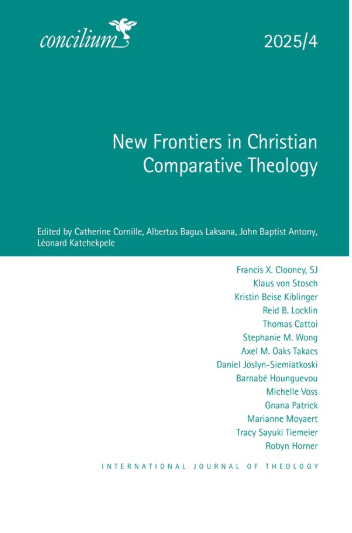
New Article “Christian-Confucian Comparative Theology Today” by Dr. Stephanie M. Wong

Dr. Stephanie M. Wong (Villanova University) publishes “Christian-Confucian Comparative Theology Today” in Concilium: International Journal for Theology (2025, Issue 4): pp.65-75; it summarizes and analyzes the current state of Christian-Confucian dialogue and comparison.

Abstract:

This paper situates Christian-Confucian comparative theology in a global context, making the case that comparative reflection can meaningfully inform the analysis of ritual innovations and political theologies today. First, I interrogate the possibility of Christian-Confucian comparative theology in the Western academy, noting how various attempts at comparative reflection have struggled amid disconnects of disciplinary terminology around religion, philosophy, and theology. Second, I consider survey two areas of Confucian revival in and extending from mainland China, namely the emergence of new Confucian practices within the state’s regulatory framework and a flurry of intellectual propositions to revive or reconstruct the Confucian theo-political ideal of tianxia. In this context, especially as secular nationalisms around the globe threaten to either render our religio-philosophical traditions as defunct or weaponize them as political religions, Christian-Confucian comparative theology can play a meaningful role in analyzing these developments and alternative sociospiritual aspirations.

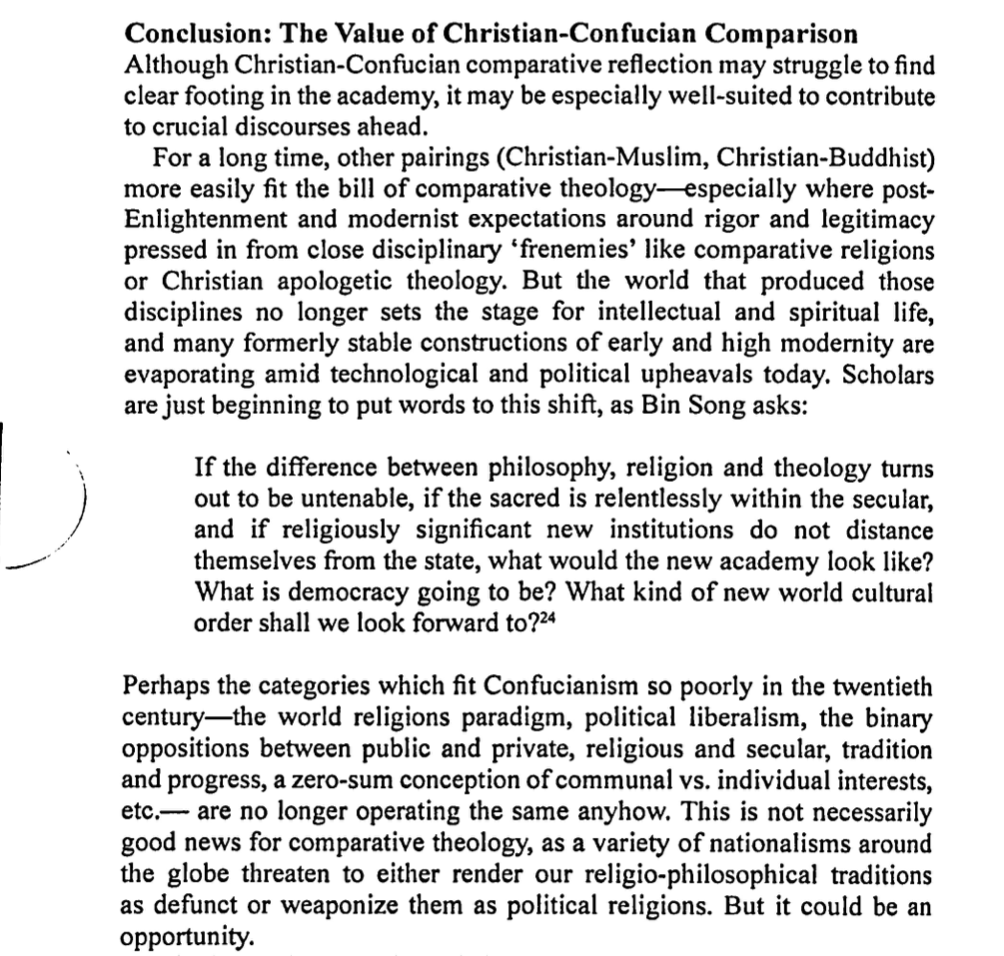
Conclusion:
Routledge Companion to Chinese Philosophy: New Chapter on Neo-Confucian Meditation

The Routledge Companion to Chinese Philosophy (Routledge, 2026), edited by Brook Ziporyn and Stephen C. Walker, includes a chapter by Bin Song titled “Quiet-Sitting Meditation: A Philosophical Practice in the Cheng–Zhu Learning of Pattern-Principle” (Chapter 41, pp. 439–450).

Building on Song’s earlier work on Confucian meditation, the chapter offers a sustained philosophical account of quiet-sitting within the Cheng–Zhu lineage of Song-dynasty Ru learning. It identifies three distinctive Ruist exemplars of quiet-sitting, associated with Cheng Yi, Yang Shi, and Zhu Xi, and clarifies their philosophical structure and practical orientation.

A central contribution is the analysis of Zhu Xi’s understanding of quiet-sitting as unfolding in three stages, examined through their inner dynamics and intellectual lineage. The chapter concludes by engaging recent discussions in the philosophy of meditation, showing how, in the Cheng–Zhu tradition, philosophical inquiry and spiritual practice are inseparable.

Written for both specialists and interested general readers, the chapter presents Confucian meditation as a rigorous philosophical practice that integrates reflection with lived self-cultivation, contributing to contemporary cross-traditional conversations on meditation and philosophy.