Dr. Stephanie M. Wong (Villanova University) publishes “Christian-Confucian Comparative Theology Today” in Concilium: International Journal for Theology (2025, Issue 4): pp.65-75; it summarizes and analyzes the current state of Christian-Confucian dialogue and comparison.
Abstract:
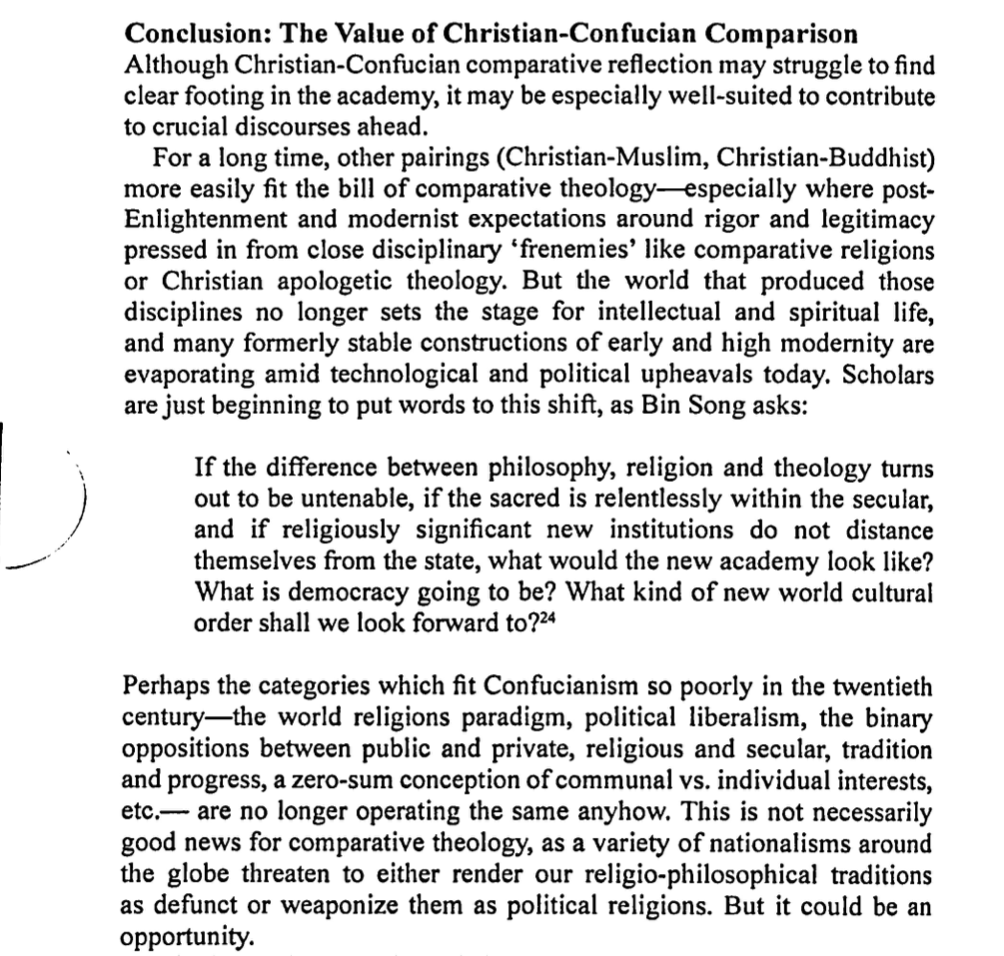
This paper situates Christian-Confucian comparative theology in a global context, making the case that comparative reflection can meaningfully inform the analysis of ritual innovations and political theologies today. First, I interrogate the possibility of Christian-Confucian comparative theology in the Western academy, noting how various attempts at comparative reflection have struggled amid disconnects of disciplinary terminology around religion, philosophy, and theology. Second, I consider survey two areas of Confucian revival in and extending from mainland China, namely the emergence of new Confucian practices within the state’s regulatory framework and a flurry of intellectual propositions to revive or reconstruct the Confucian theo-political ideal of tianxia. In this context, especially as secular nationalisms around the globe threaten to either render our religio-philosophical traditions as defunct or weaponize them as political religions, Christian-Confucian comparative theology can play a meaningful role in analyzing these developments and alternative sociospiritual aspirations.
The Routledge Companion to Chinese Philosophy (Routledge, 2026), edited by Brook Ziporyn and Stephen C. Walker, includes a chapter by Bin Song titled “Quiet-Sitting Meditation: A Philosophical Practice in the Cheng–Zhu Learning of Pattern-Principle” (Chapter 41, pp. 439–450).
Building on Song’s earlier work on Confucian meditation, the chapter offers a sustained philosophical account of quiet-sitting within the Cheng–Zhu lineage of Song-dynasty Ru learning. It identifies three distinctive Ruist exemplars of quiet-sitting, associated with Cheng Yi, Yang Shi, and Zhu Xi, and clarifies their philosophical structure and practical orientation.
A central contribution is the analysis of Zhu Xi’s understanding of quiet-sitting as unfolding in three stages, examined through their inner dynamics and intellectual lineage. The chapter concludes by engaging recent discussions in the philosophy of meditation, showing how, in the Cheng–Zhu tradition, philosophical inquiry and spiritual practice are inseparable.
Written for both specialists and interested general readers, the chapter presents Confucian meditation as a rigorous philosophical practice that integrates reflection with lived self-cultivation, contributing to contemporary cross-traditional conversations on meditation and philosophy.
In the lineage of Ru exemplars within the Daoxue movement, Zhou Dunyi (周敦颐, 1017-1073) was frequently was frequently regarded as the pioneering figure. Born into a family with a long tradition of passing the highest civil examinations and serving in government, Zhou was steeped in Ruist teachings from a young age. At the age of 24, he began his official career upon his uncle’s recommendation, holding various local governmental positions until his passing at 57.
Regarding Zhou Dunyi’s personality and governance style, his contemporary Huang Tingjian (1145-1105), a renowned calligrapher, poet, and scholar-official, once praised him as follows:
“Mr. Zhou Dunyi possessed a serene and open heart, akin to the sunlit breeze and luminous moon after a rainfall. He was humble in seeking recognition yet determined in pursuing his aspirations. Personal fortune held little value to him, as his dedication lay in serving others. He practiced restraint in his own pleasures but extended generosity to the widowed and lonely. While contemporary acclaim mattered little to him, he cherished enduring friendships that transcend time.” (Huang, et al., 1846, vol 12, p.26.)
Huang’s metaphorical description, “the sunlit breeze and luminous moon after a rainfall (光風霽月),” has been widely cited by later Ru scholars. Hence, it serves as the inspiration for the title of this collection of Neo-Confucian poetry.
A few notable points about Zhou’s thought, as expressed in the following translated poetry:
Firstly, Zhou’s attitude towards Buddhism and Daoism, two major contemporary spiritual traditions that had significant influence among Ru literati in his time, remained more open and appreciative than that of most translated Ru masters in this collection. He frequently visited Buddhist temples and Daoist shrines, interacting with practitioners of both traditions, and expressing a longing to live a hermetic life in mountains and forests. Several poems thematizing hermit life attest to Zhou’s enduring interest in this aspect.
Secondly, however, the Ru tradition, starting from Confucius, also emphasizes a hermetic life under necessary circumstances. As particularly indicated by “Passing the Ancient Temple,” Zhou Dunyi’s genuine intention in thematizing hermit life in his poetry was to incorporate Buddhist and Daoist influences into an overall Ruist framework. He displayed a unique Ruist lifestyle that simultaneously addressed worldly concerns and lofty spiritual aspirations. As we’ll explore further in the following chapters, Zhou’s approach to the multi-spiritual environment of his time is shared by many Ru poets and exemplars.
Thirdly, in “The Rang Stream Study Hall,” Zhou named a stream in Mount Lu as Lian (integrity), following a Ru predecessor who admired the name of another stream in the same region as Rang (deference). In “A Letter from My Governmental Post to Old Acquaintances in My Hometown,” Zhou sought to preempt corruption by emphasizing his modest lifestyle to his old acquaintances. And in “On Loving the Lotus,” Zhou expressed his love for the lotus as “the epitome of noble virtues,” contrasting it with the hermit’s love for the chrysanthemum. These poems reflect Zhou Dunyi’s commitment to the Ruist lifestyle focused on cultivating noble virtues, explaining why the Ru lineage of the Daoxue movement in the Song Dynasty regarded him as an initiator.
瀼溪書堂
元子溪曰瀼,詩傳到於今。
此俗良易化,不欺顧相钦。
廬山我久愛,買田山之陰。
田間有流水,清泚出山心。
山心無塵土,白石磷磷沈。
潺湲來數里,到此始澄深。
有龍不可測,岸木寒森森。
書堂構其上,隱几看雲岑。
倚梧或欹枕,風月盈中襟。
或吟或冥默,或酒或鳴琴。
數十黃卷軸,聖賢談無音。
窗前叩疇囿,囿外桑麻林。
芋蔬可卒歲,絹布足衣衾。
飽煖大富貴,康寧無價金。
吾樂蓋易足,名濂朝暮箴。
元子与周子,相邀风月寻。
The Rang Stream Study Hall
Master Yuan’s creek, called Rang, a humble stream,
Carries forth his poetic theme (i).
Here, customs shift with a gentle sway,
Honest folk nod with respect, day by day.
Mount Lu, steeped in longing and lore,
I acquired fields on its northern floor.
Another stream meanders through, crisp and pure,
Born from the mountain’s heart, steady and sure.
In the mountain’s heart, where no dust dwells,
White rocks, sturdy and jagged, clear the veil.
Winding its way, gaining depth and gleam,
The stream holds a hidden dragon, in waters unseen.
Around it, trees stand stark and pristine.
I built a study hall beside the stream, concealed behind a low table,
Gazing up at clouds, in peaks above.
Leaning against a parasol tree or on a tilted pillow, I find my rest,
Wind and moon come to fill the folds of my robe.
Sometimes chanting, or in silence deep,
Sometimes with wine, or a zither’s sweep.
Dozens of yellow scrolls lie beside,
Where sages and worthies converse without a sound.
By the window, tapping on the garden grounds;
Beyond, a grove of mulberry and hemp abounds.
Taro and vegetables suffice for the year,
Silk and cloth enough for clothes and quilts.
Warmth and fullness, the truest of riches,
Contentment worth more than gold’s entices.
My joy is easily fulfilled, naming the stream Lian, “Integrity,” (ii)
As my daily guide.
Master Yuan and I, inviting each other here,
Seek the company of the wind and moon.
Notes:
(i) Yuan Jie (719-772) was a Ru scholar and government official during the Tang Dynasty (618-907). Upon relocating his family to the region of Mount Lu (廬山), he discovered a local stream named Rang (瀼), which phonetically resembled the virtue of Rang (讓), meaning deference or humility. He composed poems to honor this stream and the life it nurtured.
(ii) Lian (濂), phonetically resembling the virtue of Lian (廉), signifying honesty or integrity. Zhou Dunyi’s choice to name and write poetry about this new stream demonstrated his admiration for his predecessor, Yuan Jie.
Commentary:
According to the “Biography of Zhou Dunyi (周敦頤年譜)” of Zhou (1990, p.99), Zhou Dunyi was appointed as a Circuit Judge (通判) in Qian Zhou of the Mount Lu region in 1061, at the age of 45. This poem was composed in the same year, depicting Zhou’s establishment of a residence near the newly named Lian stream. Zhou Dunyi, known by his pen name Lian Xi (濂溪), was often referred to as Master Stream of Integrity by Ru literati. This poem sheds light on the origin of his pen name.
Introduction to Philosophy (PHL 100 Washington College)
This course introduces the discipline of philosophy and its characteristic habits of thought and practice. Starting from the beginning of Western philosophy at ancient Greek, classical and contemporary readings are organized both chronically and thematically. Students will get familiar with major sub-disciplines and problems in philosophy such as metaphysics, ethics, logic, philosophy of science, hermeneutics, philosophy of religion, and political philosophy. Non-western philosophical traditions such as Ruism (Confucianism) and Buddhism will also be introduced in order to broaden conventional philosophical vistas. In general, the course is designed as reflecting philosophically and multi-culturally upon major divisions of human knowledge in modern university: religion, humanities, natural science, and social science.
History of Modern Philosophy (PHL 214 Washington College)
“History of Modern Philosophy” introduces major thinkers and schools of thought in the history of modern philosophy. Part I on “Enlightenment” investigates the major achievement, and the social and political background of modern philosophy. Part II on “Modern Scientific Revolution” introduces the scientific origin of the ideological transformations that define modern philosophy. Finally, Part III delves into the details of three representing modern philosophers’ thought: Descartes’ rationalism, Hume’s empiricism and the Kantian synthesis. Special acquired skills: students will learn how to make short videos to introduce their philosophical ideas to the public.
Ru and Confucianism (PHL/REL 394 Washington College)
This course introduces the philosophical concepts, sociological foundation, political implementation, and spiritual/religious practices of the Asian Ru (Confucian) tradition. While remaining sensitive to its varying characteristics through different historical periods, the course also presents Ruism’s development across Asian countries such as Korea, Japan, Vietnam and Indonesia, and studies its historical interaction with Western cultures. Students are encouraged to think over and practice Ruist insights in a broader context of philosophical and religious studies, while being able to compare it with other major Asian and Western philosophical and religious traditions. Special acquired skills: students will learn Meditation in Motion in its varying forms, such as breathing, sleeping, quiet-sitting and Taiji martial arts, to strengthen their mind-body general well-being and increase creativity and productivity.
For a 2018 teaching documentary, please click here.
For a 2020 Spring teaching documentary, please click here.
Introduction to Comparative Religion: Eastern (PHL/REL 112 Washington College)
This introductory course on Eastern religions aims to increase religious literacy by examining the philosophical, social, and spiritual–practical dimensions of four major traditions: Hinduism, Buddhism, Confucianism (Ruism), and Daoism. While focusing on these traditions, the course also attends to the historical and cultural distinctions among major Asian regions, including India, Nepal, Tibet, China, and Japan. Each unit studies a religious tradition in both chronological development and geographic-cultural diversity, while exploring shared themes such as meditation, the good life, and religious institutions.
Foundations of Morality (PHL 225, Fall 2020, Washington College)
This course offers theoretical and applied ethics, leveraging both Western and Eastern moral philosophies to address challenges inherent in leading a virtuous and good human life. Students will explore moral philosophies including virtue ethics, deontology, utilitarianism, stoicism, Buddhism, and Confucianism. Additionally, they will examine cognitive fallacies that can engender self-defeating emotional and behavioral patterns, such as perfectionism, damnation, bandwagon thinking, stereotyping, and lack of empathy. No prerequisites are required.
Global Wisdom and Literature (ENG/PHL/REL 294, 2022 Fall, Washington College, co-taught with Prof. Courtney Rydel from the English department.)
“Global Wisdom and Literature” (PHL/ENG 294, 2022 FALL) introduces and studies global wisdom traditions in an interdisciplinary endeavor of literary studies, philosophy, and religious studies. From the Mesopotamian mythology of Gilgamesh to the early modern Japanese Buddhist poetry of Matsuo Basho; from the rational self-defense of Socrates in the Apology to the passionate longing for the ineffable God mused by Sufis in Islamic mysticism; from the varying cities of the Roman Empire which signpost the Christian spiritual journey of Augustine in his Confessions to the downfall of the Confucian harmony of Tang Dynasty of China lamented by Du Fu’s Spring View, the great human tradition of global wisdom and literature will be explored to overcome the barriers of history, geography, ideology, genre, and academic disciplines. With the instruction and guidance of two WC professors (Prof. Courtney E. Rydel and Prof. Bin Song), students will be expected to acquire skills of intercultural and interdisciplinary competence which is pivotal to the real-world value of contemporary liberal arts education. This class counts for the distribution of Humanities and Fine Arts, the English major and minor, the Philosophy major and minor, the Religious Studies minor, the Humanities major, and the Medieval and Early Modern Studies minor. No Prerequisite.
Euro-Eccentrism: the Enlightenment and Confucianism (PHL/REL 494, 2023 Fall, Washington College) This course explores the ways how Western philosophy during the Enlightenment period (17th and 18th centuries) was developed under the influence of Confucianism with a focus on the works of Spinoza, Nicolas Malbranche, Leibniz, Christian Wolff, Voltaire, and Benjamin Franklin. It aims to provide a deeper understanding of the intertwining of Western and Non-Western Philosophies in history, and how the exchange and influence of different cultures and philosophies shape the development of human thought. The course examines the interactions between Asia and the West through trade, missionary activity, and cultural exchange, and how Confucianism was understood and adapted by these key Enlightenment thinkers. The larger context of the course is to diversify the philosophy curriculum currently taught in American universities and colleges. Through primary and secondary sources analysis, contemplative and reflective activities, and research paper, students will gain a fuller and critical understanding of modern philosophy, particularly regarding its Euro-Eccentric dimension.
Buddhism: Philosophy, Meditation and Ritual (PHL/REL 294, 2024 Fall, Washington College, co-taught with Prof. Jon McCollum at the Music department)
This course offers an in-depth introduction of Buddhism’s origins, evolution, and manifestations across various cultures. Co-taught by Professors Bin Song (Philosophy and Religion) and Jon McCollum (Music), it delves into Buddhism’s journey from its Hindu roots to its development into Theravada, Mahayana, and Vajrayana traditions in both Asian and Western contexts. Covered topics include philosophical principles, meditative practices, and cultural expressions such as rituals and monasticism, examining their interaction with society and politics. Leveraging interdisciplinary expertise in philosophy, theology, religious studies, ritual studies, ethnography, and musicology, this course aims to provide students with a comprehensive understanding of Buddhism’s societal and personal impacts. It motivates students to explore practical and philosophical insights that enhance their intercultural competency, leadership skills, and overall well-being. No prerequisites are required.
Free Will and the Foundations of Responsibility (First Year Seminar, 2025 Fall, Washington College)
Are we free? What does it mean to have free will, and why does it matter? This First-Year Seminar explores the timeless philosophical problem of free will, a question that connects deeply to moral responsibility, legal accountability, self-development, and well-being. Students will examine key positions in contemporary philosophy, such as compatibilism and incompatibilism, as well as concepts like determinism and the theory of alternative possibilities. Through analyzing arguments and counterarguments, students will develop critical thinking skills to understand, evaluate, and imagine solutions to these enduring questions. The course also explores contributions from science—quantum mechanics, neuroscience, and social psychology—to see how empirical findings inform this ongoing debate. By the end of the course, students will formulate their own views on free will and learn how to apply these ideas to personal growth, academic challenges, and future careers.
Courses under Preparation:
History of Contemporary Philosophy (19th centuries onward)
Fall 2025 has been a remarkably fruitful teaching season. I taught a First-Year Seminar on “Free Will and Responsibility” for the first time, with fifteen excellent first-year students. I also co-taught “Introduction to Buddhism” for the second time, which surveyed Buddhist thought from ancient India through all major historical and modern branches across different countries, regions, and continents. Most importantly, I taught “Foundations of Morality” for the third time, enrolling nineteen students.
The first half of “Foundations of Morality” is theoretical, covering major Western ethical traditions, including Aristotelian virtue ethics, Stoicism, medieval Christian ethics, Kantian deontology, Mill’s utilitarianism, and existentialism, as well as foundational elements of Buddhist and Confucian (Ruist) ethics. The second half of the course is entirely practical. I used Dr. Elliot Cohen’s The New Rational Therapy: Thinking Your Way to Serenity, Success, and Profound Happiness (Jason Aronson, 2006) and the framework of Logic-Based Therapy (LBT)—a philosophically sophisticated form of cognitive behavioral therapy—to apply ethical theory to practical questions of the good life, such as how to address self-defeating emotions and behaviors.
Throughout the semester, I experimented with a variety of hands-on, in-class practices, including contemplative listening, silent quiet-sitting meditation, ethical case studies, assignments involving the creation of fictional “cults,” and simulated philosophical counseling sessions. The final project required students to develop their own case using anonymous, fictional, or publicly known figures, and then apply philosophical and religious resources to address the case by following the structured method of LBT.
I am proud of the students’ final projects, and several stand out as particularly strong examples:
Isabella M. Sorhegui analyzes the case of Nick Kyrgios, a well-known professional tennis player. Her careful and nuanced use of Buddhist resources is especially admirable.
John Colby Andrews takes up the video game Skull Kid, beginning with humorous and satirical critiques of moralistic teaching and later developing a thoughtful and well-supported engagement with Confucian wisdom.
Chase Corley analyzes the case of Kevin Love, a prominent NBA player. As a student-athlete himself, Chase demonstrates a strong sensitivity to the psychological dimensions of athletic life and shows real potential as a future coach.
Kayla Noyala approached the project with exceptional seriousness. She conducted an interview with an anonymous family member and offered well-grounded and thoughtful philosophical guidance.
Stefanos L. Georgiou wrote a fictional case centered on a student football player and delivered a very strong final presentation. He took seriously the feedback I offered on his two earlier case-study essays and worked diligently to revise both his thinking and his writing style. The final presentation is detailed, well-balanced, and something of which I am very proud:
Daniel Poitevin’s role-play project is particularly impressive. He alternated between the roles of therapist and counselee with clarity, insight, and philosophical depth.
At a broader level, I advocate an integrated approach to mental health and the good life. In areas of human life where free will and responsibility continue to play a meaningful role, philosophy—and the humanities more generally—can and should make substantial contributions to healthy living. However, when psychological conditions are rooted primarily in physiology and free will plays little or no role, the traditional doctor–patient medical model of mental health must still be employed. This integrated framework underlies my approach to philosophical counseling in this course. By teaching it within a public liberal arts classroom, and in a manner appropriate to that setting, I also aim to experiment with ways of teaching “self-cultivation” inspired by the Confucian (Ruist) tradition.


 Bin Song