The Significance of Free Thought for Philosophical Therapy

Audio: How to Combat Con’stipation using Philosophies, by Dr. Bin Song.
Video: How to Combat Con’stipation using Philosophies, by Dr. Bin Song.

Hallo, This is Prof. Bin Song at Washington College.

As explained since the first unit of the course, one distinction of philosophical therapy, distinct from other types of therapeutic methods in mental health, is its emphasis upon free thought and autonomy. It believes most of issues of mental health start from fallacious thinking habits in our mind, then get translated into varying negative emotions, and eventually, embodied in one’s self-defeating behaviors. Therefore, in order to live a good and flourished human life, we need to work up ourselves starting from our mind, viz., from how we think.

Once again, the fallacy that this unit intends to deal with, the so-called one of can’stipation, confirms the magnificent significance of free thought for human beings. For instance, a young wife may say that she cannot help feeling angry when her in-law intrudes her home for an uninvited lunch; however, she may not say that she cannot even think of an alternative situation where she could have a constructive conversation with her in-law with a relatively calm mood. Similarly, a son under a constant verbal abuse of his father may say that he cannot help keeping silent whenever the abuse happens because he does not want to look bad to his father and other family members; but he may not say that he cannot even think of an alternative behavior through which he could speak up to his father in a rectifying and respectful way so as to change the self-defeating dynamic in his family. In all these and other similar instances, the concerned human beings may say that they cannot help feeling in a certain way (which is the fallacy of emotional can’stipation), behaving in a certain way (viz., behavioral can’stipation), or it may be the case that they say they cannot put up with a certain distressed situation so as to refuse to do anything about it (viz., volitional can’stipation). Nevertheless, in all these three different types of can’stipation, what our human fellows may not say is that they cannot even think of a certain alternative way of living, which, if carefully studied and cultivated, can lead to a brighter path to overcome their varying can’stipations, and hence, contribute positively to their wanted way of human living.

In other words, we may think it impossible to change a certain reactional pattern of our emotion, behavior, and volition to the world; however, under a deeper thought, we find that this impossibility is actually merely about the reality that we have presumed is predetermined in a certain way. Quite contrary to this presumption, if we close our eyes, remain silent, and start to freely employ our thought in our mind, we will find that whenever this impossibility is presented to our thought, we are able to start to think of an entirely alternative picture of the reality where it is OK for the presumably impossible thing to happen. One further instance we can give here is that if you are overwhelmed by the stress that you shall go through in an impending important examination, it is totally Ok for you to just sit down, take a breath, and think that due to the diligent work you invested in the process, you have already passed the examination and even started to celebrate it with your family and friends. And the beautiful thing in all these mentioned situations of human life is that there is literally nothing to preclude us from thinking of an alternative.

The use of free will to think alternatively has been documented in the history of philosophy for quite a long time. When Socrates says unexamined human life is not worth living, he means that without a careful consideration of alternatives, any chosen way of living, no matter how good it seems to be, cannot be sincerely pursued. Because only a democracy affords its citizens this opportunity of weighing in alternatives in order to live a sincerely desirable human life, Socrates would rather die for it, instead of fleeing Athens and living a wandering, safe, yet under-human life. In modern philosophy, Descartes answers the question in what sense he exists as a human being in the most striking and impactful way: he exists solely in so far as he thinks; and whenever he stops thinking, he stops being. In the first Meditation which is infused with a lavishly skeptical mode of thinking, Descartes doubts whether any object in the world can exist at all. For instance, our perception of the big tree before our eyes may be false, the hands using which we type words into the computer may just appear to be moving in a dream, and even our mathematical knowledge may be wrong since we may live in a world of simulation where things are coded in a way contrary to realities. However, after considering all these alternative perceptions of the world, Descartes concludes that the only thing he cannot doubt is the fact that he is doubting itself, and hence, he concludes: “I think, therefore I am.” In my view, there is really no more striking example than Descartes’s Meditations to indicate the principal discipline of philosophy as freely thinking of alternatives.

This discipline of thinking alternatively does not only prevail in western philosophy, non-western philosophies such as Confucianism also believes the change of thought constitutes the seminal seed for all needed changes in one’s life. Please just read how the classical Confucian philosopher, Xunzi, depicts the freely thinking ability of human consciousness, which is termed as “heartmind” (心, xin):

“The heartmind is the lord of the body and the master of one’s spirit and intelligence. It issues orders, but it takes orders from nothing: it restrains itself, it employs itself; it lets itself go, it takes in whatever it wants; it makes itself proceed, it makes itself stop. Thus, the mouth can be compelled either to be silent or to speak, and the body can be compelled either to contract or to extend, but the heartmind cannot be compelled to change its thoughts. What it considers right, one accepts. What it considers wrong, one rejects. And so I say: there is no restraint for the heartmind to make a choice among what it perceives; its attitude towards objects would always emerge by itself so that although objects of thought are varying, these objects appear to the heartmind without any duplicity.” (Xunzi, Chapter 21, adapted from the translation of Eric Hutton)

In other words, for Confucian thinkers such as Xunzi, it may be out of human control for objects and affairs in the world to be present in one’s life or not, but it is entirely up to the heartmind to assess and think of these objects in its own way.

All these mentioned western and non-western philosophies convey a crucial message for anyone who may think they cannot control their emotions and behaviors, and the message is: a good human life starts from a good habit of thinking; more importantly, it is an undeniable evidence for the transformability of human life that thank goodness, we human beings retain our full freedom on choosing how to think. We can choose to think rationally, which means to base our thinking on evidential and logical reasoning just as we have practiced it so many times in this course; or we can remain to think irrationally, which is quite often the deep root of varying self-defeating lifestyles and habits.

After we have the right of way of thinking intended by the practice of philosophical therapy, what remains to do is to learn “techniques” to transform these right thinking into the right emotions, and furthermore, into the right behaviors. The entire process would not be quite different from how we use those obvious everyday technologies such as cars, airplanes, refrigerators, computers, etc. In other words, existing laws of causality in the world indicate a highly probable sequence of events in the form of cause and effect; if human mind intends for certain effects to take place in order to fulfill certain human needs, then, humans would create technologies to make use of the causal sequence so as to produce or change causes to engender the intended effects. Similarly, in the area of philosophical therapy, once we make sure what is the right way of thinking, we will use all available knowledge revealed by varying human, social and natural sciences to utilize the causal sequences prevalent in human life, and hence, practice the right causes to eventually produce the intended effects. The process is truly “artistic” with a unique emphasis that now, as an artist of living (which is almost synonymous to the term “philosophical therapist”), we apply these living techniques upon ourselves so that we treat our own life as a continually perfectible artwork. 

In the assigned chapter on can’stipation, the author mentioned many “techniques” for the practice of philosophical therapy. For instance, we know that thoughts alone cannot be easily transformed into desirable emotions; however, we can utilize one emotion that is approved by the reason to counteract another undesirable one so as to eventually transform the latter. Also, behaviors can change our mood to a great extent, and thus, practices such as “shame attacking” would force our emotions to change as a consequence. By the same token, I also encourage philosophical therapists to learn broadly those empirical knowledge gathered by disciplines such as psychology, sociology, and neurosciences in order that we can find the needed techniques to transform clients’ behaviors. Besides, varying world philosophical and religious traditions also accumulated an amount of knowledge and techniques for the sake of human transformation. In the following, I will briefly enumerate four “techniques” of good human living that are consistently practiced by Ru scholars throughout the long tradition of Confucianism in East Asia.

  • Firstly, Meditation.  Similar to many spiritual traditions in human history, Confucianism develops its unique style of meditation called “quiet-sitting (静坐, jingzuo).” To practice this Confucian style of meditative quiet-sitting, we do not need to go to temples, churches or monasteries to double-cross our legs for a prolonged period of isolation. We can just choose whatever chair, stool, or any place to sit on, and then, straighten without stiffing our back, put our hands on the knees, and concentrate upon our breath. The greatest benefit philosophical therapists can get from practicing meditation as such is to create a space between thought and its connection to a certain pattern of emotions and behaviors. It is like cutting off temporarily the energy circuit of thought, emotion and behavior hardwired in our everyday life; obviously, for the sake of defeating self-defeating lifestyles, this deconstructive process of meditative reflection would be the condition for any intended reconstruction of one’s everyday life.
  • Secondly, “nourishing vital-energies (养气, yangqi).” The transformation of human life clearly needs energy. In the term of Confucian philosophy, the entire universe comprises an all-pervading field of vital-energies, and the well-functioning of human life in all its aspects will rest upon how much vital-energies are constantly restored and replenished within human body. Therefore, to cultivate a good human life, the Ru tradition since the time of Confucius, Mencius and Xuzni develops varying methods of “nourishing one’s vital-energies” such as healthy diet, somnology, and meditative breathing. As being quite distinct from some other contemplative traditions in East Asia, Confucianism emphasizes the significance of daily moral practice for nourishing one’s vital-energies. The idea is that if one is constantly dedicated to doing good, they will muster a great sense of moral self-confidence, and thus, their vital-energies would not be hurt by inappropriate behaviors. Eventually, their abundant life energies will radiate into the surrounding environment in the form of transformative impacts and influences.
  • Thirdly, “investigation of things (格物, gewu).” According to the eight steps of the Confucian program of self-cultivation elaborated by the text of Great Learning, everything good happening to human life starts from a comprehensive and thorough “investigation of things” by human heartmind. This investigation of things will try to find the way to harmonize varying interests of all involved beings, and thus, create the path of individual activities that would encounter the least resistance so that an ideal status of co-thriving can be created in evolving situations. More specifically, “investigation of things” includes approaches such as reading books, learning with exemplary humans, having dialogues with people, and also, practicing one’s knowledge in real life situations. All together, “investigation of things” will hardwire human mind in the right way so that expected outcomes of emotions and behaviors will follow en suite.
  • Fourthly, “Discussion and Practice (讲习,jiangxi).” The Classic of Rites once described that if one always studies alone without friends to learn together, then, their learning will remain shallow and ignorant. Therefore, in the Confucian tradition, it is an utterly important practice for students to find their companions so as to “discuss and practice” what they have learned. For the sake of philosophical therapy, this communal dimension is particularly important since different from the normally one-to-one type of psychotherapy, students can learn, discuss and practice varying philosophies in classrooms and study-groups. If all connected people strive for good human living in reliance upon their own initiative and mutual support, it would not be difficult for an individual in this environment to keep being uplifted by the synergy.

So, in a word, free thinking is the graceful endowment of the universe upon human being, which proves transformation as an utterly probable human achievement. While learning and practicing broadly varying techniques of good human living from different disciplines and traditions, humans can truly become their own masters of life, and then, grow into a specific kind of artist, an artist of good human living.

Quiz:
1, Which of the following belongs to the types of fallacy termed by philosophical therapy as “con’stipation”?

A, emotional con’stipation
B, behavioral con’stipation
C, volitional con’stipation

2, Socrates’s view “unexamined life is not worth living” advocates to investigate alternative ways of living in order to live a sincerely desirable life. Is this statement true or false?

3, In the practice of philosophical therapy, therapists take human life itself as an artwork, and use rational thinking and all techniques of good human living to perfect it. Is this statement true or false?

4, which of the following belongs to the arts of living practiced by the tradition of Confucianism?

A, meditation
B, nourish ones’ vital energies
C, investigation of things
D, discussion and practice.

5, “When you are in an emotional tizzy, change the focus of your consciousness to a different, less contentious object.” What kind of philosophy does this technique represent?

A, Husserl’s phenomenology.
B, Kant’s deontology.
C, Hume’s empiricism.

6, “The will to overcome an emotion, is ultimately only the will of another, or of several other, emotions.” Which philosopher’s view does this quote represent?

A, Nietzsche
B, Socrates
C, Confucius.
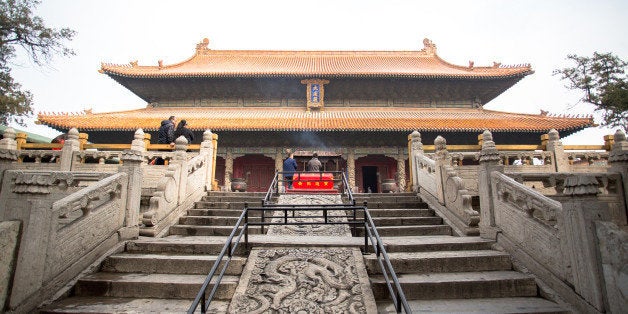
Confucianism as Not An Atheism

QUFU, SHANDONG PROVINCE, CHINA - 2015/03/19: Dragon carved stone steps leading to Dacheng Hall, also called the Hall of Great

One of the most perplexing aspects of Confucianism is that people easily misunderstand it as a 100% humanism. An example is that, when early Jesuit missionaries went to China and found Zhu Xi’s Neo-Confucianism of “Pattern-Principle” (理)and “Matter-Energy” (氣)was taken to be orthodox by Confucian elite, they categorized Confucianism as a form of “atheism” and thus, thought it deeply corrupted.

In Christianity, even love towards one’s neighbors is ultimately driven by divine grace. That means it is God who commands and makes us love our neighbors. However, because Confucianism lacks this kind of “divine agency” concept, it is very hard for Confucians to say when we love our parents and kids, it is ultimately and exclusively “Heaven” (天) who drives us towards this love.

The divergent situation is that Heaven in Confucianism is an all-encompassing constantly creative cosmic power. It lacks the Christian feature of “agency.” The Heavenly creation is spontaneous, natural, and if we use a term in modern control theory, it can also be self-organized in certain circumstances such as on the earth, but there is no guarantee that every creation of Heaven is ordered according to human expectation. Since Heaven is constantly creating, the essence of human beings, as an organic part of Heaven, is also constantly creating. This constantly creating human nature is named by “Ren” (仁) in Confucianism. An impressive allegory made by Neo-Confucianism is that this human nature “Ren” embodied in humans is like the “kernel” (果仁)contained in the nutshell (果壳), so represents the essential of life. But what is distinct in Confucianism is, Heaven provides the creative energy to human beings, but how humans, as an “agent”, use this energy is solely due to themselves.

As a matter of fact, when Confucians feel united with Heaven through an arduous process of self-cultivation, they would love a myriad of things under Heaven. But in this mystical situation, we can say, the great body of ours which we form with Heaven makes us want to love, but how to love concretely is still exclusively due to ourselves. In this way, the idea of “Heaven” as the divine reality in Confucianism provides ultimate axiological and aesthetic motives for humans’ universal love, but it can’t provide the “agency” which is the last crucial link leading to a concrete action of human love.

In this sense, it is wrong to characterize Confucianism as an “atheism”, since “Heaven” is indeed the divine reality which provides the ultimate axiological and aesthetic values to human deeds. But it is not a “theism” too, since “Heaven” is not a personal God and lacks the Christian-like “agency”. In fact, It is a non-theism. What Confucians worship about “Heaven” is a benevolent but wild cosmic creative power, without any anthropomorphic sort of purpose, will or plan. Correspondingly, the Confucian humanism is a non-theistic humanism, and in this strictly defined sense, it is a spiritual humanism.

How Much Empathy do We Need for the World?

Audio: How not to Demand the World to Revolve Around Me, by Dr. Bin Song.
Video: How not to Demand the World to Revolve Around Me, by Dr. Bin Song.

Hallo, this is Dr. Bin Song at the course of “Foundations of Morality” at Washington College.

Individualism, in terms of its emphasis upon the irrevocable worth of individual human life, is a great achievement of modern western civilization. Once each individual of the humanity feels validated about their whatever way of life fits their unique perception of the world and their preference of decision-making, there is really no other worldview which can compete. Think about the following quote from one of the classical modern writers on liberalism, Mr. John Stuart Mill (1806-1873 C.E), and ask yourself sincerely: who could possibly disagree with this?

“As it is useful that while mankind are imperfect there should be different opinions, so is it that there should be different experiments of living; that free scope should be given to varieties of character, short of injury to others; and that the worth of different modes of life should be proved practically, when anyone thinks fit to try them … Where, not the person’s own character, but the traditions or customs of other people are the rule of conduct, there is wanting one of the principal ingredients of human happiness, and quite the chief ingredient of individual and social progress.” (John S. Mill, On Liberty, Chapter Three)

There are two key words in this quote which represent quite well the mentality of modern mankind: “when anyone thinks fit to try them” and “short of injury to others”; in other words, as long as one’s free experiment of living, viz., one’s freely-chosen lifestyle, does not impede the execution of the freedom of others’, anything goes.

As affirmed above, individualism is a great progress achieved by human beings in the period of early modern Europe, especially when being considered in contrast with the religious monopoly by the Catholic church and the existence of varying monarchical authoritarian regimes in medieval Europe. However, as being similar to the fates of many other great philosophies in history, the progress achieved by individualism may turn into regress if being assessed from a more evolved perspective.

Let’s do a thought experiment to show why this is the case. My question concerning the mentality of individualism would be: is there any real life situation where the execution of my freedom does not impede others’? Here, by “real life situation,” I mean that nowadays, practically all human beings need to live with others in one way or another. So, our thought experiment can start from how I start my everyday life in my family.

As a writer who deliberately and freely choose writing as among the central interests of my life, I would prefer to go to bed not too late and get up relatively early. However, from the very moment I wake up, I need to be careful about not moving too loudly so as to disturb my wife’s sleep. This means that the execution of my freedom to get up early risks impeding the one of my wife to enjoy her sleep. After I get up, the first thing for me to do is normally to make and drink a cup of coffee. I normally store a bottle of Nestle instant coffee powder in my pantry, and make a delicious cup of it using hot water and milk. Employing all available criteria, I can say my choice of this early morning routine is free; however, even so, when I pour the powder into my cup, I need to consider at least two things: firstly, I should not pour too much of it since I believe my body can only consume a reasonable amount of coffee each day; and secondly, my wife also needs to drink coffee, and I am not fond of imagining a scenario where she found none powder left in the bottle when she needed it. This means that I need to consider the need of at least two beings when I execute my freedom of drinking the first cup of coffee: the need of my body, and the one of my wife. And this story about the daily practice of my freedom barely starts. When actually sitting down before the desk in my study, I still cannot start to do research or write as freely as I want. Because apart from being a writer, I am also a teacher, a scholar, a school administrator and hence, should take care of the need of every human being who remains connected to me in varying professional areas of my life. In particular, I need to check my calendar and reply to important emails before “my own thing” can get started. Sometimes, this may mean a radical change of my plan, and re-directing my energy and interest to things significantly different from writing, and these things, as anticipated, are not always pleasant.

So far, this thought experiment re-plays the first few minutes of one of my ordinary days. I find that none of my free decisions made to flourish my way of life per my own perception of the world and my own preference of living, if conducted inappropriately, does not injure or impede the execution of other people’s freedoms. But these are merely the first few minutes of one of my mornings! If we extend the timeline of the thought experiment to the entirety of our everyday life, you will find that in real life situations of human living today, it is very hard, if not entirely impossible, to find any of our free decisions which does not risk impeding the freedom of others. If we add the living rights of plants, animals and other natural beings who share the same planet with us into our consideration, we will find that our free decisions are even more consequential to the entire surrounding world!

Therefore, If none of my free decisions does not potentially impede the freedom of others in this brave, ultra-connected new world, what’s the value of a philosophy which advocates the mentality of “anything goes” for the execution of the freedom of each human individual? Indeed, there is a brake for “anything goes” in the classical expression of individualism to prohibit the impeding outcome of one person’s freedom upon others’. However, considering the reality that almost none of our free decisions does not potentially impede the living needs of others, shall not we re-assess the value of the classical philosophy of individualism, and ask ourselves, instead, whether the conception of human self as a free, autonomous, and isolatable moral agent is still viable in the contemporary human world”?

So, my conclusion is that in the ultra-connected human world today, the mentality of “anything goes” implied by early modern individualism does not and should not prevail. If individuals demand the world to revolve around their own selves, it will greatly sour their inter-personal relationships, and jeopardize the very good human living that each individualistic person longs for. Using the same thought experiment as above, I can imagine that in a totally alternative possible world, I may just get up very early, stomp the floor, rush into the coffee machine, pour as much powder as I like, and then, rush back to my study and start writing whatever I want to regardless of my email boxes and calendar marks. In other words, I may demand the world to revolve entirely upon my own preference of it, but unfortunately, I can also anticipate that my demand will lead to very distressful situation of my personal life particularly in the area of inter-personal relationships with my family, friends, and colleagues. Sometimes, this thinking fallacy of “demanding the world to revolve around me” can be realized in a very subtle way. For instance, a professional may be very considerate towards their clients, customers or colleague in their workplaces, because they know this is their job, and they need to do their job well. However, in the off-hours, a very successful professional may demand the world of their family life to revolve around their preferences. For instance, a lawyer may downplay the time spent with their family, and even start to calculate how much money they will lose just because of the couple of hours they need to spend on the family dinner table. Similarly, a college professor may keep ruminating over how to deliver a wonderful conference presentation even if they direly need to take a break to listen to their spouse or children who constantly and regularly need their attention. In both the instances, the professionals extend their workplace experience endlessly to other aspects of their life, and thus, demand the world revolve around them in a way very unpleasant to people surrounding them.

So, what should we do? Is the conception of human self implied by early modern individualism entirely valueless today? Do we need a more reasonable and viable philosophy of self to combat the fallacy of “demanding the world revolve around me”? Clearly, to get out of the undesirable situation, we need to develop a considerable degree of empathy towards the world. But how much empathy do we need for the world? Do we need to completely eliminate our selves so as to fulfill our concern to connect to the people surrounding us? Here, I will use a contemporary Chinese Confucian philosopher, Liang Shuming (1893-1988)’s thought, to share how I position my self in an empathetic relationship with the world.

The thought of Liang Shuming that I think is particularly relevant to the current topic derives from his book “Cultures and Philosophies in the East and West” published in 1921. In this book, he says the driving force of human life is called “will of life,” a will to live, a will to flourish, and a will to seek meaning and power for one’s given, yet limited and ambiguous human life. The best manifestation of this will of life is one’s desires. Desires of all sorts of objects: food, security, sex, fame, wealth, power, human relationship, meaning, etc. And there are three major different kinds of ways in the cultures of the world to deal with the relationship between one’s desire and its objects.

The first path is the western path. It tells that if you desire something but you cannot get it, then, the right way for you to deal with the situation is to step forward, advance yourself, and thus, try the best means to overcome any obstacle down the road so as to eventually get what you want, and satisfy your desire. But once your desire is fulfilled, this path will still urge you to seek more, grab more, and thus, be involved in a perpetual process of ego-expansion, self-aggrandization, and world-conquering.

The second path is the Chinese path, or using Liang Shuming’s term, the Confucian path. The path denies neither the legitimacy of human desire, nor the natural right of beings that are desired by human beings. For instance, if you ever ponder the issue of whether to be a vegetarian, a Confucian path would say: animals have their right of living, but humans also have their natural need to consume meat. Therefore, the right path to live through this apparent dilemma is that let’s keep both, but modify both so as to harmonize the needs of both in order to achieve a certain kind of co-thriving. In a more concrete term, this path will tell you, the human need to consume meat is natural, but it cannot go over its due measure. So let’s improve the meat industry to raise animals while treating them better, and also make sure not bring any other negative consequences to the environment such as global warming. So the Confucian path thinks human needs, desires, and emotions are natural. None of them are intrinsically bad, and all we need to do is to have them achieve the appropriate measure for the sake of harmony and co-thriving of all beings in the world.

The third path is the Indian way, the way best represented by a Buddhist ethic. According to Liang Shuming, when humans desire an object, the Buddhist ethic will deny the necessity of the desire all together. This is because firstly, unfulfilled desires always cause suffering, and secondly, even if we fulfill some of our desires, another desire will follow; once fulfilled, another desire will follow; and in the process, we would be never genuinely happy because there are always unfulfilled desires in our life. Therefore, the Buddhist solution is that, let us simply not desire. That means to eliminate human desires by all sorts of methods. For instance, Buddhist philosophy will teach you how illusory your understanding of the world is, and the Buddhist tradition also includes skills of meditation so as to have you focus upon the right understanding of the world, and eliminate those desires which cause your suffering.

In a nutshell, according to Liang Shuming, when we desire any object to manifest the will of human life, the western path wants to overcome the obstacles of desires so as to chase objects while fulfilling those desires. The Confucian path wants to harmonize the desires and the objects so as to achieve a certain degree of co-thriving. Meanwhile, the Buddhist path eliminates desires all together to avoid suffering. So, comparatively speaking, the western path is a path forward, the Buddhist path is a path backward, while the Confucian one lies in the middle.

So, how can we translate Liang Shuming’s thought to our understanding of human self in the context of the philosophical therapy needed to heal the thinking fallacy of demanding the world to revolve around me? Before I give my answer to the question, I have to caveat that I do not entirely agree with Liang Shuming’s typology on the world cultures and philosophies, since if being investigated in greater details, each mentioned culture by Liang Shuming actually contains a considerable amount of inner variations and diversities. However, this does not preclude us from using Liang’s concepts as an ideal model to think about a case of philosophical therapy in question.

In my view, the western path to conquer whatever impedes one’s desires represents the mentality of “anything goes” in early modern individualism quite vividly. This path of human thought can lead to the fallacy of “demanding the world revolve around me.” If it is put into one’s everyday practice of inter-personal relationship, I would imagine no people will feel pleasant if they are thought of as obstacles to be conquered for fulfilling other people’s desires and preferences. Therefore, for the sake of good human living, I would not recommend this path.

The Indian path illustrated by Liang Shuming lies opposite to the western path. In inter-personal human relationships, it would entail the elimination of human self in order that all strivings for one’s desired objects freeze their vigor. However, this also implies that once we enter into an empathetic relationship with other human beings, we should totally abandon our own individuality so that we put our feet completely in others’ shoes, viz., live our own life under the heteronomy of others. Honestly, I do not think the lack of individual authenticity in this ultra-empathetic way of life can bring much relief to human sufferings.

Eventually, the Confucian path lies in the middle between the two extremities of over- and under- distancing in varying human relationships. It requires each individual to keep their free, autonomous moral agency, while recommending the operation of this free agency upon varying human relationships. In other words, human self is conceived by this Confucian path as a free moral agent who acts as a manager of their own human relationships and networks. In their managerial relationship with other human beings, these free moral agents abandon neither their own lifestyles nor others’ preferences of way of living. Rather, with a continuous effort, each individual, as one independent relationship manager, tries to harmonize the needs of all involved beings in their world so as to create an evolving situation of co-thriving. If “autonomy” is a too individualistic word to refer to this way of co-thriving, “harmonomy,” which lies between the extremities of autonomy and heteronomy, would be my alternative term to recommend.

In a word, to combat the thinking fallacy of demanding the world to revolve around me, I would take the Confucian path illustrated by Liang Shuming to conceptualize my self as an evolving, all-interconnecting, and continually developing free moral agency who always operates itself in varying relationships. While empathizing with the world surrounding me, I would neither demand “autonomy” to envision a world to revolve around me, nor “heteronomy” to completely abandon my own independent thought. Instead, I want to achieve a certain kind of “harmonomy” to promote the co-thriving of all beings living in my own world.

Is Worry Part of the Solution?

Audio: How Not to Dutifully Worry, by Dr. Bin Song.
Video: How Not to Dutifully Worry, by Dr. Bin Song.


Hallo, this is Dr. Bin Song at Washington College.

While we fallaciously demand perfection, damn people, and awfulize imperfections in our life, our worldviews share some underlying philosophical assumptions, which, without a penetrating philosophical analysis, would be very hard to be exposed and examined. These assumptions include: firstly, we tend to think of life as consisting of discrete problems to solve, rather than of constantly renewing experiences to live. Under this assumption, if one problem does not or cannot get a perfect solution, we would rather take a stand-off, block the flow of life experience, and hence, torment ourselves under the seemingly invincible imperfections which are actually indispensable to human life. Secondly, since we are so ready to reify our life as a mumble-jumbo of sundry problems, we also tend to reify any person or event that is encountered on our life journey. For instance, if one problem has not yet been perfectly resolved, we may damn involved people, including ourselves, as a moron, a dope, a complete failure, to spew whatever words fit our anger and frustration; by the same token, if one bad situation takes place, we may be so terrified by it as to believe it is the worst thing which could ever happen to a human being, and hence, our life has to remain in an ossified state with little vigor to rejuvenate and rebound.

Clearly, these assumptions can be debunked if we take another more dynamic, perfectible and processual mindset. We can say No to these reifying, ossifying, and self-defeating thinking patterns, and instead, we can say Yes to fully accept imperfections as signs to grow and strengthen ourselves, and as gateways to emerging new possibilities of life. However, in order to enjoy this processual way of life, there is another thinking fallacy, which is closely related to all aforementioned ones, which we must see through and overcome. In the practice of psychotherapy, the fallacy is normally called “rumination”; but in the practice of philosophical therapy, we call it “dutiful worry.” In a definition, the fallacy of dutiful worry drives us to:

Think of it as a duty to constantly and multifacetedly upset ourselves or people close to us until a past problem receives a complete remedy or a future problem gets a certain and perfect solution.

In other words, a processual and forward-looking reaction towards problems in our life should be to muster all available resources to tackle the problems; however, while doing so, we neither demand a perfect remedy nor a certain solution. Rather, we see the process of wrestling with these problems as enriching moments of the constantly renewing life possibilities, and thus, we would have reasons not to hold off any moment of it since a problematic life is, after all, still our life which keeps changing, growing and advancing forward regardless.

Nevertheless, a person of dutiful worry does not perceive their life as such. As stated, they see the constant worry until a perfect solution as a duty, and thus, are obsessed with discovering, recollecting, or envisioning all negative possible aspects of their life up to a state of self-pity, self-doubt or sheer misery. In other words, I think a certain degree of worry is necessary to motivate us to resolve problems in our life; however, when remaining to be motivated, our major focus should be to employ our intelligence to think, move our limbs to act, and thus, to dedicate ourselves to solving problems seen as a necessary part of our processual life. However, the fallacy of dutiful worry urges us to worry over whether we have worried enough in order to get a perfect solution of problems. To put it bluntly, this fallacy makes us believe an intensive and repetitive worry is part of the solution; however, in a way completely contrary to the intention, the state of constant worry can undermine the very ability of rational deliberation and resolute action that is needed to solve any problem. In this way, dutiful worry may lead to a vicious cycle of negative moods, which sometimes engenders serious issues of mental health such as depression and anxiety disorder.

For instance, a man may feel a constant guilt of a mistake he made in the past, and ask himself “why I did such a thing” again and again without actually taking any action to objectively analyze the mistake, discover its causes, learn needed lessons, and hence, improve himself. A mother may worry over the underperformance of her son in math so much that no proposed solution by her husband is thought of as certain and adequate, and eventually, she may just never move a single step to either think differently or actually do something to change the situation. Similarly, a person having lived through a certain traumatic experience in their early age may habitually replay those cruel life scenarios again and again in their mind. This would seriously undermine their ability of normal communication and sociality with other people, and eventually undercut the very possibility of living a good human life. Throughout all these instances, we see the spector of “dutiful worry” haunting around, and for the sake of good life, it clearly needs to be rectified.

Therefore, if we see worry as a motivating emotion to find solutions to a problem, the worry over whether we have worried enough is clearly not part of the solution. Understood as such, the habit of dutiful worry is evidently a fallacy; it ties the state of constant worry unrealistically to the perfect solution of problems in our life, and furthermore, assumes that life is a series of problems to solve, rather than an enriching experience to live. To overcome the fallacy, we need philosophies that favor the aforementioned processual view of life, and actually practice them. Here, inspired by the philosophy that I am familiar with, the Ru tradition or Confucianism, I will share some of my experience about how to combat the habit of dutiful worry.

The Classic of Change once depicts the contrast between cosmic creativity and human creativity as such “(The constant creativity of the cosmos) energizes the myriad things, while not sharing a single worry with sages.” Here, since the ultimate creative power of the cosmos is normally not conceived by the Ru tradition as a person, the spontaneously and constantly renewing power is thought of as far surpassing what sages, viz., those most exemplary humans, can accomplish. In other words, just as Confucius once said, “a person who takes no concern about what is distant will surely have worries near at hand,” (Analects, 15.12) the proceeding of cosmic changes is by no means centered upon human interests, and if humans intend to create order within either the society or individual human life, we have to remain concerned while involving ourselves in an endless process of planning, organizing, learning, trying, and re-planning, re-organizing, etc. So, in a more accessible term, this means that humans are not God, and hence, it is just fine for us to worry about all sorts of things once we realize that imperfections are part of human life. However, using another verse, the Ru classic “Centrality and Commonality” also teaches

“In a position of wealth and honor, an exemplary human does what is proper to a position of wealth and honor. In a poor and low position, they do what is proper to a poor and low position. Situated among remote and foreign districts, they do what is proper to a situation among remote and foreign districts. In a position of sorrow and difficulty, they do what is proper to a position of sorrow and difficulty. The exemplary human remains to be content towards themselves in whatever situation they happen to enter.” ( “Centrality and Commonality,” translation adapted from James Legge)

In other words, although worry is ineluctable for the life of an exemplary human who always strives for order, peace and harmony of the society in a non-anthropocentric world, they can always find a state of self-contentedness, a deep and inner feeling of joy in whatever situation they happen to enter. So, how can they achieve this? Why, as indicated by the Ru classics, do humans need to worry over their life and society while simultaneously being able to feel content about themselves?

Firstly, let’s make sure that we are worrying over the right things. In other words, our worries cannot be so selfish as to be only concerned with the narrow interest of us or a certain group of people. If we think and behave thus selfishly, we could not find a synergy among all the surrounding human and cosmic beings whenever we need to muster resources to tackle our worries, and quite often, we would just pit ourselves against obstacles so as to enhance, rather than alleviate our worries. For instance, for the mother who constantly worries over the success of her son, a Ruist scholar would recommend that there are kids in other families who may share the same problems as well. Also, there are good cases to investigate why if not good at a certain subject, children can still flourish their life in the long run. So, rather than constantly worrying over the success of one’s own kid, why not worry about how to participate or organize a social process to deal with shared issues in various families? Once we see the problem of our life in the broader context of the society, then, the worry over it will be transformed into a motive to reform the society, and hence, generate very positive mental feedback for each worrying individual. In a Confucian term, this thinking process is described as “if you want to establish yourself, also establish the others.” (Analects 6:30)

Secondly, not only do we need to worry over the right thing, we also need to worry in the right way. Clearly, the worry over whether we can worry enough so as to demand a certain and perfect solution to a problem is not the right way of worrying given our previous analysis. In the terms of the Great Learning, the worry over their individual life, family, and the society motivates an exemplary human to investigate all “pattern-principles” (理) that dynamically and harmoniously fit things together in a particular situation, firm their heartmind (心) to execute what is required by the pattern-principle, and eventually, try their best to realize harmony in evolving situations. For instance, the mother in question needs to try best to obtain all necessary knowledge about how to deal with her son’s academic underperformance, and then, actually practice these knowledge so as to move the entire situation forward, rather than constantly upsetting herself without action. In other words, in order to worry in the right way, we need a forward-looking mindset to learn, grow and act, just as what the aforementioned processual attitude of life entails.

At this moment, it is very important to introduce one crucial feature of the Ru philosophy that can help to eliminate the self-defeating thinking habit of constant and dutiful worry. As analyzed in the previous unit, Mencius thinks every ordinary human will have a spontaneous feeling of alarm and fright when seeing a baby about to fall into a well, and for Mencius, this is the evidence for that there is a part of human nature which is innately good. However, when addressing the question that since human nature is good, why so many bad things are committed by humans, Mencius thinks that this is like asking why a once verdant mountain can one day become barren. Mencius explains further that if you continue to use axes and hatchets to destroy every sprout of plants naturally growing in the mountain, no matter how good the quality of soil is, the mountain still would not provide. (Mencius 6A) By the same token, as long as one has a good sleep during a night, in the morning, they will naturally feel a clearer mind and a more sensitive heart to connect to beings in the world. In this case, people will be easier to feel their sympathy and co-existence with the world so that their innately good human nature is well kept.

Understood in this way, the process of personal growth for Mencius would be similar to the industry of farming, by which a farmer plows the field, sows the seeds, and grows the sprouts according to their best knowledge of seasons, lands and other factors in agriculture. However, after every due human effort is implemented, it would be up to the nature to take charge of everything else. Similarly, when problems arise in our life, on the one hand, we indeed need to worry appropriately so as to investigate, plan and act, viz., do everything that we can as a human to confront the problems; however, on the other hand, even if no perfect solution can be found to these problems, let’s not forget to have a good sleep, take a nice walk, have a sincere conversation with our family and close friends, or do other positive things to continually nurture our inborn vital energy that was endowed by the nature. In the eyes of a Ru scholar, days come after nights; the sun rises following its setting; and the four seasons just change and renew themselves without any cease on this planet. Therefore, as long as we remain connected to the entire cosmos, know how to nurture the life-generating cosmic energy innate to our body, and try best to fulfill our potential to be a fully human, we would never lack a foundation to eventually live through a certain situation, move forward, and remain content towards ourselves. For me, no matter how stressful and tiring a life situation may be, I still hold a faith towards the fact that even with just a short nap, I can breathe in the fresh air-energy deeply and thoroughly into the depth of my heart. When opening my eyes, there would be new energy there, and I can still try my best to do the right thing in whatever situation I happen to enter.

So, even if worry is inevitable for human life, let’s sleep well, take care of ourselves, and worry over the right things in the right way. As a result, we would remain content to ourselves in every new situation of life experience we are about to savor.

Ming (命) – Mandate, Talent, Fate and Mission

(This article is originally published in Huffpost, 12/06/2017)

When early Catholic and Protestant missionaries came to China in the 16th through the 19th centuries, they found that something called the “Mandate of Heaven” (天命) was frequently mentioned in the early Confucian classics (such as the Book of Documents and the Classic of Odes). Consequently, some of them thought that Confucians believed in the same god as the God of Christianity. It is hardly necessary to say that they made a terrible mistake.

The Chinese character 命 is a combination of 口, mouth and 令, command. The literal meaning of 天命, often translated in English as the “Mandate of Heaven,” is thus premised upon a certain degree of personification of Heaven. After all, if Heaven is not a person, how could it announce any commands to its people? However, as virtually every religious comparativist inevitably tends to be, these early missionaries were biased in their understanding of ‘God.’ They thus tried to grasp Confucianism through a Christian lens, and so it is not surprising that they tried to find a monotheistic element in Confucianism and remained blind to the fact that Confucianism, during the process of its formation, was actually moving away from monotheism to mono-non-theism. This means that ‘Heaven,’ in the mainstream understanding of Confucianism as it was molded by Confucius, Mencius and Xunzi all the way up to the Song-Ming neo-Confucians, is not a person, but an all-encompassing, constantly creative cosmic acting without any actor who is behind the scenes.

One important reason which propelled Confucianism away from a monotheistic type of religiousness was theodicy. The religion of the early Zhou dynasty (approximately 1046-256 B.C.E) was pretty much similar to the Abrahamic religions, especially the stories from the Hebrew Bible. Heaven is Lord, and kings ought to obey moral laws enacted by Him. Obeisance will be awarded and violations will be punished. If an immoral king did not continue to take good care of his people, he would lose his Mandate of Heaven, and his dynasty would then be overthrown. This theology was employed by the Zhou dynasty to explain and vindicate their succession over the prior Shang dynasty. However, this theology is dramatically undermined if, no matter how diligently kings pursue moral self-cultivation, their dynasty still continues to decline. This happened to the Zhou dynasty and its kings after 771 B.C.E, when an ethnic minority invaded and plundered Zhou’s capital, killed King You (幽王), and forced the royal court to relocate in another city far to the East. In this period, which is replete with political turmoil and unattended natural disasters, we find plenty of verses in the Classics of Odes (詩經) expressing individual laments in the face of divine injustice. These are very similar to Psalms in the Hebrew Bible, as, for example, when the text quotes complaints such as, “Since I have not been immoral, why has Heaven punished me?”

There are two solutions to this conundrum of theodicy, and they generally are what demarcate the three Abrahamic religions from Confucianism. The seemingly unjust divine punishment can be conceived to be a temporary ‘test’ of the people’s righteousness and faithfulness: if righteous people cannot be rewarded immediately, they will be rewarded in the afterlife, the final Day of Divine Judgement. Alternately, Heaven was no longer to be conceived as a personal God: Although there are values and attractions in Heaven which are worthy of human worship, the Heavenly creation in this case is not conceived of as having any anthropomorphic sort of plan, purpose or agency. In this case, good and evil are defined primarily from the perspective of human beings and not from the perspective of God. Thus, if human beings themselves do not reward goodness, then good in its reciprocal form will remain unrewarded. By the same token, if humans do not punish evil behavior, then evil will remain unpunished.

This type of human religiousness may be expressed as ‘religious naturalism + humanistic ethics’ and replaced the pre-Confucian monotheism of the early Zhou dynasty. This process began with Confucius, garnered its mature form in Mencius and Xunzi, and finally achieved a systematic elucidation in Song-Ming Neo-Confucianism.

At the same time, a re-formulation of the concept of ming (命) was underway. In general, Confucianism employs three meanings for the term ming. The first meaning of ming is talent (稟賦). Everyone is talented, one way or the other. It is primarily manifested by the deep, even uncanny, interest a person often shows toward a particular realm of human life. It is also illuminated by the ease, passion, and happiness that a person feels when he or she consistently pursues his or her interest without any concern for reward. In Confucian terms, everybody is born in a specific place and time, and thus their mental and physical conditions are formed by a specific portion of the cosmic matter-energy (qi, 气). That’s the reason, in this view, that people are talented in different ways. Understood as such, one cardinal function of education is to help people find their own special talents. Confucius is quite excellent at mentoring his apprentices in discovering and fostering a variety of talents (Analects 11.3). In addition, Confucius teaches that we ought to use our talents to serve multiple purposes and to offer good to all human beings, rather than behaving like a utensil, merely serving a fixed range of purposes and thereby being unable to broaden the value of their talents (Analects 2:12).


The second meaning of ming is fate (命運). No matter how talented a person may be, he or she can only be talented in certain ways. Also, no matter how consistently a person pursues his or her talent, the degree of his or her accomplishment is restricted by the time, the environment and by his or her personality. In other words, the portion of cosmic matter-energy that Heaven gifts to each person also limits them. Consequently, humans have to accept the radical contingency of human existence, and to find ways to reconcile their always finite life-situations with their ideals, many of which may be of infinite extension. In this regard, Confucianism teaches us to begin with what is nearby. We need to begin by trying to promote and harmonize the growth of our own persons, our own families, our own communities, and then gradually expand outwards to the world so as to enrich the value of all human lives. In other words, Confucianism acknowledges the realities that constrain human life.

Nevertheless, these constraints can never determine human life. This leads to the most important third meaning of ming as mission (使命). Among all the talents with which Heaven endows human beings, the most valuable one is an irresistible capacity to persist in creativity, situated in the human mind-heart (心). Confucians believe that no matter how constraining the situation is, the human mind-heart can always find ways to transform it in some degree for the better. In the terms of the early Confucian text, Zhong Yong, the mission of human life is to assist in the cosmic creation that remains uncompleted by Heaven and Earth, and thus human beings are seen to form a triad with Heaven and Earth. This means that humans have a responsibility to manifest the One principle of the Heavenly creation in a specific humane (仁) way. Therefore, when we feel deeply frustrated about our lives, the best way to rebound from distress is to exert our unique talent to promote the well-being of other people who are near at hand: our families, our communities and our friends. For Confucianism, the personal creativity which is to be infused into the universal well-being, defined by a widening range of human-human and human-cosmic relationships, is the ultimate meaning and power of human life.

In a word, Confucianism is neither voluntarism, extolling the infinite compass of human free will, nor is it fatalism, denying any possibility for human creativity. In the Confucian view, human beings are endowed with various talents. We learn, interact, fulfill and finally improve our ‘fate,’ expressed as a series of constraining realities. During this process, the human mission to assist in the cosmic creation of Heaven and Earth is an ideal which stands as an eternal allurement, always going beyond any fixed form of human creativity. Understood in this way, to be a Confucian is to be ‘destined’ and ‘commissioned’ as a non-violent warrior and fighter for the realization of dynamic harmony in the world. Relying upon our various unique talents, let us continue to fight against and break through any constraining life-situation, and thereby to create new forms of dynamic harmony to serve the common good of all human and cosmic beings!