“…I define patience as a radical acceptance of obstacles or burdens we face on the path to any meaningful goal. Imperfection is an inevitable part of human experience. Recognizing this, especially when navigating challenges related to faith, has become invaluable in my teaching. Patience allows me — and my students — to embrace our differences and cultivate deeper, more meaningful cross-cultural and interfaith understanding. I’ve had three key teaching experiences that illustrate the profound impact of patience in the classroom …”
I created these posters to present a brief history of Confucianism in China. It includes major figures, events, and periods of history for beginning learners of Confucianism to understand its history in China.
In my effort to promote Ruism among ordinary American people I have encountered a major push-back from, of all people, Chinese Americans. Most of them are either indifferent or hostile to their own tradition. But regardless of the reason, an unvarnished ignorance underlies this opposition. A recent example took place this summer when I gave a talk to the largest Chinese evangelical Christian church in the Boston area about ‘The Three Guides’ and ‘The Five Constant Virtues.’ After I finished my talk, a pious Chinese woman, around 40 years old, came up and whispered to me: “I know Ruism was the dominant tradition of ancient China, but I had never heard anything like what you were saying during your talk. After hearing what you have explained about Ruism, I find that it is actually quite good (挺好的).” Anecdotes like this tell us that in comparison with other traditions such as Judaism, Hinduism or Roman Catholicism, most Chinese immigrants to the United States are actually an obstacle, rather than an aid, to introducing and advancing their supposed ‘home tradition’ to other Americans.
So, why is this happening? Where does this ignorance come from? As a scholar of the humanities, I have to assign the major reason to the May Fourth Movement and the radical anti-Ruist rhetoric which, in the 1910s, this movement created and afterwards was used in governing most of modern China’s public education. What happened was that, facing a national defeat by the Western colonial powers, some radically westernized Chinese intellectuals such as Lu Xun or Chen Duxiu, whom I call ‘The May Fourthers,’ invented a dualistic mindset separating East from West, and old from new. In order, they said, to surpass the West, China must give up its own culture and re-learn everything Western. For this reason, Ruist teachings such as ‘The Three Guides’ and ‘The Five Constant Virtues’ were condemned by the May Fourthers as representing the backward morals of a feudal society. They said that these ideas were hopelessly authoritarian, enslaved the independent will and spiritual freedom of individual people, and weakened Chinese cultural vitality. As a consequence, they thought, Chinese tradition must be completely jettisoned so that the Chinese people can learn the new morality of the West.
Although I appreciate the apparent sincerity of the May Fourthers’ intentions (they, after all, hoped to make China better and stronger), I nevertheless see that their racial, anti-Ruist rhetoric is as ridiculous as to say, for example, “A wise old man, punched in the face by an impetuous young guy, has to totally give up his own wisdom and identify spiritually with the young guy.” In fact, most of the May Fourthers’ criticisms of Ruism are simply wrong! In my view, in order to practice ‘The Three Guides’ and ‘The Five Constant Virtues,’ nothing more is needed than the independent spirit of individuals! In the remaining sections of this essay, I will demonstrate how this is the case.
First, a little history:
The first time that the single phrase ‘the Three Guides and the Five Constant Virtues’ (三綱五常) is mentioned in the Ruist classics was when Ma Rong (馬融, 79-166 CE) in the Eastern Han Dynasty used this phrase to comment on Analects 2:23 in order to explain the unchanging aspect of a harmonious human society. According to Ma, regardless of what happens on the outside, people must still practice Ruist ethics inwardly for human society to remain on the right track. Before Ma, it was Dong Zhongshu’s (董仲舒, 179-104 BCE) works and a later text entitled, ‘A Comprehensive Exposition in White Tiger Hall’ (白虎通義, compiled in 79 CE) that provided a separate philosophical exposition to each of the terms ‘The Three Guides’ and ‘The Five Constant Virtues’. As perhaps will be well known, the Han Dynasty (202 BCE-220 CE) was a very special period for Ruism. After other teachings, such as Legalism and Daoism, had proved not to be robust enough for maintaining a unified dynasty and an harmonious human society, Ruism was established as the state ideology. Accordingly, we can see that all those expositions about ‘the Three Guides’ and ‘the Five Constant Virtues’ which were provided by the Han Dynasty Ruists are actually a distillation of previous Ruist ethical teachings such as ‘The Five Cardinal Human Relationships‘ (五倫) and ‘The Ten Reciprocal Duties‘ (十義) from Ruism’s Pre-Qin classical period. These teachings were intended to function, and they actually did function, as a textbook version of Ruist ethics, and thus were perennially influential. In this sense, the May Fourthers were right to select these Guides and Virtues [三綱 and 五常] as representative of Ruist ethics, even though their understanding of these ideas was quite wrong.
Second, the philosophy:
The standard expression for ‘The Three Guides’ is that ‘The ruler is the guide for subjects, the father is the guide for the son, and the husband is the guide for the wife’ (君為臣綱, 父為子綱, 夫為妻綱).
The original meaning of the Chinese character, written 綱 gang, refers to the lead rope of a fishing net, and thus, by extension, it means guide, guideline, bond, or guiding principle, etc. In Ruist ethics, if X is said to be the guide (綱) for Y, it primarily connotes, first, that the relationship of X to Y is a major human relationship, and secondly, that this X-Y relationship is, in a practical sense, hierarchical, in which X takes the major and leading role while Y takes a minor and subordinate role. Therefore, both X and Y must fulfill those distinct duties which are entailed by their differing roles.
So, if X guides (綱 ) Y, it means that X must act as a moral model for Y. In other words, X has a great responsibility for instructing Y about right human behavior. In the subordinate role of Y, he or she needs to show consistent deference towards and thus, discreetly and responsibly follow X as long as a normal X-Y relationship is being maintained. Even so, to what extent can an X-Y relationship be seen as ‘normal’? The answer depends. The tradition tells us that for the ruler-subjects relationship, if a ruler continues to act badly, a minister ought to leave the state or resign after remonstration has failed three times. In more extreme cases, such as when a ruler proves to be a ruthless tyrant, revolt is urged. In the father-son relationship, if a father commits misdeeds and refuses to correct himself after his son has remonstrated three times, his son should ‘follow his father while crying and weeping’ (號泣而隨之, 禮記). This implies a persistent duty of the son to remonstrate since the father-son relationship can’t be abandoned as easily as that of ruler-subjects. For the husband-wife relationship, if a husband’s wrongdoing concerns only minor issues, the wife ought to tolerate while continuing to remonstrate, but if the misbehavior is really brutal such as killing the wife’s parents and other similar deeds that violate basic principles of human relationships, the wife has the right to a divorce (誖逆人倫,殺妻父母,廢絕綱紀,亂之大者。義絕,乃得去也”, 白虎通義).
Therefore, if there is anything that the teaching of ‘The Three Guides’ suggests to which a human being must be subordinated, it is only to one’s duties and to the universal moral principles that are entailed by each person’s distinct roles within various human relationships, rather than to any capricious human person who unjustly happens to hold authority. In relation to this, Xunzi taught us to “follow the Dao, rather than the ruler; to follow what is right, rather than the father.” If a person’s will is not firm, or if a person’s spirituality is not independent and principled, I want to ask the May Fourthers, “How could anyone be a Ruist who follows such teachings?”
The ethics of ‘The Five Constant Virtues’ is higher than those which concern ‘The Three Guides’, ‘The Five Cardinal Relationships’, or ‘The Ten Reciprocal Duties’. This is because these latter terms refer to concrete human relationships and their related duties, but meanwhile, human society is far more complex than what these terms refer to. Even when we know how to behave ourselves within three (or five) major human relationships, we still feel the need for a higher principle that can guide all human relationships. Therefore, the purpose of teaching ‘The Five Constant Virtues’ is to provide that ‘single’ principle which will apply in various occasions. These ‘Five Constant Virtues’ are Humaneness (仁, ren), Righteousness (義, yi), Ritual-Propriety (禮, li), Wisdom (智, zhi) and Trustworthiness (信, xin). I will explain these terms one by one.
The basic meaning of ‘Humaneness’ (仁, ren) is love. Ruism’s conception of love is all-encompassing. It can be as close by as one’s parents and one’s children, or in its incipient form, in the reaction one has when, seeing a baby about to fall into a well, one feels a sense of ‘commiseration’ (惻隱之心, Mencius) and is hardly able to prevent oneself from saving the baby. It can also be as distant as when tiles and stones are crushed and one feels concern and empathy for their reordering (Wang Yangming). In a word, the Ruist conception of human love is so universal that a person of humaneness is said to be able to ‘form one body with a myriad of things between Heaven and Earth.’
Nevertheless, even though human love is universal, Ruism also urges its particularization, so here we are with the virtue of ‘Righteousness’ (義, yi). The basic meaning of 義 refers to something that ‘ought’ to be done, that is, to what is right. In relation to ‘Humaneness,’ this virtue requires human beings to love appropriately in relation to particular people and in concrete situations. For example, as human beings, our love towards our own parents and children is naturally and understandably more intense than towards other people’s parents and children. However, love should not end with one’s own family. We must love other people’s parents and their children by extending our love outward from our own. In this regard, Ruism teaches us to correctly determine the value of one’s various relationships, and thus to bring about a graded form of dynamic harmony in one’s performance of various duties through a reasonable distribution of time and energy.
‘Ritual-Propriety’ (禮, li) refers to the audible and visible ways of human behavior, through which what the virtues of ‘Humaneness’ and ‘Righteousness’ require are practiced. For example, if one has good intentions to appropriately love one’s parents but does not actually practice the respectful ways for speaking, looking, hugging, or taking good care, it is hard to say that one has internalized the virtues of humaneness and righteousness in his or her person.
The virtue of Wisdom (智, zhi) balances the virtue of ‘Ritual-Propriety’ since it refers to knowledge. To know how to appropriately love is to possess wisdom. In line with the Ruist idea of dynamic harmony, the central task of human wisdom is to be thought of as knowing both the facts and values of things, and thus, of understanding how things in concrete situations can fit together based upon appropriate human reactions to that situation.
The virtue of Trustworthiness (信, xin) is mainly about one’s attitude, and thus, has no additional content compared to the other four. It requires that one sincerely practice the four aforementioned virtues, and thus really possess them (實有其德).
In a word, ‘Humaneness’ is universal human love, ‘Righteousness’ refers to how to love appropriately in concrete terms, ‘Ritual-Propriety’ is the audible and visible ways of human behavior in which ‘Humaneness’ and ‘Righteousness’ are practiced, ‘Wisdom’ is to know how to be humane, righteous, and ritually-proper using one’s deep axiological reasoning, while ‘Trustworthiness’ urges one to be sincere in the practice of these virtues, and thus, to truly own them. Overall, ‘The Five Constant Virtues’ is the principle that governs one’s behavior within various human relationships. For example, if a minister can be humane, righteous, ritually-proper, wise, and trustworthy in his or her behavior within the ruler-subjects relationship, he or she will be seen as fulfilling his or her duty of ‘loyalty’, as specified in the teaching of ‘Ten Reciprocal Duties’.
Based on this discussion, I have to ask one final question: Can we still believe, as the May Fourthers did, that the Ruist teachings of ‘The Three Guides’ and ‘The Five Constant Virtues’ represent the backward morals of a feudal society and thus are totally irrelevant to modern society? Absolutely not. In my view, every virtue listed in ‘The Five Constant Virtues’ continues to be extremely valuable for our time. Nothing need be changed in order to practice this teaching today. For ‘The Three Guides,’ we only need to make minor changes in order to adjust its social context. As I have argued in a previous essay, the ruler-subjects relationship ought to be understood as that of government-citizens, or any other hierarchical relationship in public life; the father-son relationship needs to be reformulated as that of parents-children; and the teaching about the husband-wife relationship ought to be reconsidered as one of a husband and wife who are guides for each other depending upon their differing levels of expertise. In my view, each of these adjustments is what the Ruist ethical principle of ‘The Five Constant Virtues’ requires for today’s human relationships.
In a word, I believe the teachings of ‘The Three Guides’ and ‘The Five Constant Virtues’ are still key for the realization of social harmony in every time period. May Fourthers, I have to say again, “Sorry, you were wrong. It is the Ruist tradition which is the antidote for our modern malaise!”
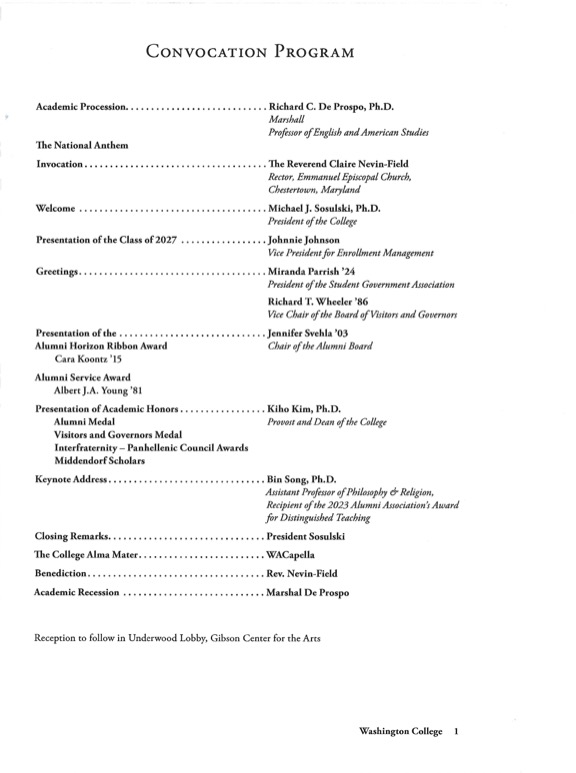
(Dr. Bin Song, as the recipient of Distinguished Teaching Award at Washington College, delivered a speech “Liberal Arts as a Cosmopolitan Hope” that cites Aristotle, Confucius and Benjamin Franklin to champion the value of liberal arts education, at the ceremony of 2023 Fall convocation.)
Liberal Arts as a Cosmopolitan Hope
Bin Song Washington College
It’s an honor to address you all today. In this dynamic space, during this interesting time that challenges our hearts and minds, let’s contemplate the profound essence of a liberal arts education.
Back in 2018, when I became a part of Washington College, a dream I had held close to my heart was realized. Twenty years prior, as a young philosophy student in China, I found myself enchanted by the novels of Haruki Murakami, translated from Japanese to Chinese, which are also imbued with influences from iconic American writers like F. Scott Fitzgerald. Murakami’s evocative depictions of university life ignited a spark within me. It was then that I began to dream of teaching, reading, and writing with unbridled freedom, hopefully in the halls of a democratic college.
In our hallowed halls of Washington College, the dream has come alive. Each day unfolds as a chapter of discovery, brimming with fresh ideas, reaffirmed beliefs, and moments of unexpected joy. These experiences are surely amplified because of Washington College’s esteemed status as one of the most historic liberal arts institutions in the U.S. Yet, deep within my heart, I feel my journey is far from complete. Not simply because of my age and the countless collaborations I envision with my wonderful colleagues and the brilliant students who are joining our cause. But, more importantly, because I believe the noble ideal of liberal arts education faces immense challenges in today’s society. Given the very essence of this ideal, it is our duty, as educators of today and tomorrow, to champion and defend it, despite and indeed because of these challenges.
In my Introduction to Philosophy class, I strive to illuminate for our students the origin of the concept ‘liberal arts’ in ancient Greek philosophy. Think of Socrates — declared as the smartest human in Athens by the god Apollo, yet heartbreakingly sentenced to death by a democratic assembly. In a modern cartoon interpretation of the tragedy of Socrates’ death, we might envision it in this way: A mob, incited by democratic leaders and angered by Socrates’s steadfast loyalty to the law, gathers outside the Athenian supreme court, chanting “Hang Socrates! Hang Socrates!” In the end, Socrates successfully hanged himself.
This profound injustice plunged Socrates’s student, Plato, into despair. Plato came to view democracy as a mere rule of the uninformed masses, stifling the enlightened ideas of the truly educated. As an alternative Plato envisioned a society ruled by an all-knowing and supremely intelligent ‘philosopher king’. This king would take charge of guiding every facet of civic life — including which job you can take, whose poetry you should read, or read poetry at all, and even who you should marry and how you raise your kids. Trust me, when you read contemporary news articles about how authoritarian nations today defend their regimes against what they label as ‘Western liberal democracy’, you’ll realize Plato’s arguments are anything but antiquated.
While Plato had his convictions, his very own student, Aristotle, saw things differently. Aristotle asserted that no individual could ever achieve godlike infallibility; hence the dream of an all-knowing human ruler is just that—an illusion. However, acknowledging Plato’s critique of democracy, Aristotle’s advocacy for democracy is more sophisticated. He distinguishes two forms of democracy: one lower form of democracy, where the masses govern and since the electorate is uninformed, the elected officials can merely serve their own selfish interests. Then, another higher form of ‘democracy,’ termed as the ‘polity.’ Here, a knowledgeable and educated citizenry elects representatives who truly champion the common good of all citizens.
Therefore, at the heart of Aristotle’s vision was a delicate balance, weaving meritocracy into the fabric of democracy. And this is where the profound significance of a ‘liberal arts’ education shines forth. The word ‘liberal” implies the freeing of the human spirit. Authentic freedom isn’t limited to any particular sphere of knowledge. A liberal arts education is an invitation to expand our horizons, to think critically and rationally, propelling us on an insatiable quest for diverse knowledge. More than just a theoretical discipline, it’s an ‘art’ that cultivates virtues vital for a rich human experience—an experience Aristotle termed ‘eudaimonia,’ the Greek word for genuine fulfillment or happiness. Aristotle firmly believed that without such an education, we will risk becoming “mechanistic” in our thinking, surrendering our freedom and autonomy. Absent this foundation of liberal arts education, the heart-wrenching fate of intellectual luminaries like Socrates, judged by an uninformed majority, and the ascent of power-hungry authoritarian demagogues, both underscore the dire consequences of a democracy devoid of merit.
My fellow citizens in the Goose Nation, the societal and political challenges Aristotle confronted were strikingly akin to what we face today. And the remedy he proposed? It’s the very essence of what Washington College embodies in its daily pursuits as a bastion of liberal arts. I’ve often said to my students with immense pride that only in a vibrant setting like Washington College can a professor seamlessly traverse subjects as diverse as Descartes’ analytic geometry, Hobbes’ social contract theory, and Matso Basto’s Wabi-sabi haikus in the morning, only to delve into Simone de Bouvoir’s feminist existentialism, Nagajuna’s Mahayana Buddhism and lead a Yoga Sutra meditation by afternoon. While interdisciplinary teaching is an aspiration for many larger institutions, it is our starting point—a foundation we continuously seek to elevate.
In focusing on the “art” of our liberal arts commitment, our mission statement at Washington College explicitly emphasizes “moral courage.” The tight-knit nature of our community fosters a deep, personalized exchange of knowledge, instilling in each learner a robust ethical foundation and a sense of duty.
So, citizens of our beloved Goose Nation, when the weight of today’s societal challenges bears down upon you, remember Aristotle’s time-tested wisdom and embrace what Washington College has always been good at. Together, we’ll stand poised on the cusp of hope, flourishing, and eudaimonia.
For many of you, the tale I’ve just shared about the origins of liberal arts, rooted in its Western heritage, might feel familiar, especially considering the dedication of my co-educators to this grand Western tradition. Yet, with immense pleasure, I wish to enrich this narrative with a cosmopolitan dimension. It’s fascinating how the foundational principles of Western liberal arts resonate deeply with the visions of Confucius.
Many researchers have long recognized Confucius as the pioneer of the East Asian version of liberal arts education. To me, a particularly compelling piece of evidence is that Confucius established the very first private school in ancient China. He ardently championed the principle of “teaching without discrimination (有教無類)”. This was not merely a principle of pedagogy; it represented a revolutionary act. Confucius sought to dismantle the royal government’s monopoly over educational resources and embraced a democratic and inclusive approach. For Confucius, wealth was not the measure of a student’s worth; genuine intent to learn was. And in testament to this, if a student lacked money but showed a sincere desire to learn, Confucius accepted tuition in the humble form of a bunch of dried meat.
On the other hand, the democratic spirit of Confucius, deeply rooted in meritocracy, finds a remarkable echo in the teachings of Aristotle. Aristotle once warned against superficial education, cautioning that it could lead individuals to become “banausos”— which means being vulgar and mechanical in nature. Similarly, Confucius taught that a truly noble-minded human should broadly learn and be dedicated to self-cultivation, and thus, they should not be just a “utensil” with limited functions (君子不器). It’s noteworthy that one interpretation of the character 器 is “machine.” Thus, both philosophers believed that the core objective of liberal arts is to prevent the rise of individuals who are narrow-minded and mechanical, potentially jeopardizing the ideals of a meritocratic democracy.
In light of Confucius’ advocacy for liberal arts and its role in fostering democracy, my decision to join Washington College can be seen as a gigantic leap of faith—a vote by feet, if you will, as I find a place in America to embrace the ancient ideals of Confucius. Yet, I am far from the first to be influenced by this vision. It is astounding how principles of liberal arts from varied origins resonated with America’s founding figures, notably Benjamin Franklin. Franklin not only recognized these universal principles but actively bridged these worlds. He translated the Confucian classic, “The Great Learning,” from Latin to English, presenting it to the public in the Philadelphia Gazette in the 1740s. For Franklin, the heart of American democracy was a balance between rule by law and rule by virtue. Acknowledging that laws are best upheld by virtuous individuals, he and fellow founders drew insights from both East and West to shape our young Republic’s blueprint.
So, my fellow Goose citizens, allow me to offer this perspective: Washington College, the very first to be chartered in the sovereign United States, proudly bears the name of the founding president. This, to my mind, is a testament to our institution’s intrinsic connection to the universal essence of liberal arts, a vision championed alike by great minds such as Aristotle, Confucius and Ben Franklin. At the heart of this vision lies an enduring belief: that by fostering a robust democracy anchored in meritocracy, we pave the way for every individual to achieve their fullest potential, thereby ensuring the co-thriving harmony of human civilization.
As I conclude, I’ll offer an introspection. Amidst the immense challenges confronting American society and the wider crises of our civilization, it’s clear that the U.S. is still on its journey towards the ideal of a cosmopolitan, meritocratic, and harmonious democracy. The path isn’t always bright, and current events can be disheartening. Yet, history reminds us: it’s during the darkest times that hope shines its brightest. Let us embrace our true selves, ever aiming higher. With the steadfast support of each of you, my esteemed colleagues and cherished students, I am filled with hope. Let us stand together, undeterred, in our quest to realize our fullest human potential through the liberal arts.
Although Ruism (Confucianism) is experiencing a powerful revival in mainland China and is consequently radiating across Asia and other parts of the world, a suspicion towards it still haunts many people’s mind. This can be seen in frequent reports in English news cycles which either ignore or misrepresent the basics of Ruism. For example, these reports usually present profiles of Ruism containing ideas such as: the Ruist idea of “filial piety” (Xiao) requires blind obedience of children to their parents; Ruism is essentially an ideology of feudal society used by authoritarian governments to manipulate their political power; Ruism oppresses women and other gender minorities; Ruist education stifles creativity, etc.
These attacks, issued by people with limited knowledge of Ruism, are neither true nor new. They share one common point of origin: Chen Duxiu and the so-called May Fourth and New Cultural Movement in the 1910s of China. The movement was launched by radical anti-Ruism Chinese intellectuals who accused it of anything and everything wrong with traditional China. For these intellectuals, Chinese people needed to completely replace their Ruism-hardwired thought with Western thought in order to keep China from being conquered and eliminated by Western colonial powers. Therefore, I must conclude that the greatest obstacle to the contemporary revival of Ruism is that the ghost of Chen Duxiu still stirs in the world.
Chen Duxiu was by far the most impactful anti-Ruist intellectual in the May Fourth and New Cultural Movement. He created the movement’s leading journal of “New Youth 新青年” in the 1910s to champion and propagate the Western ideas of “democracy” and “science”, which he thought of as representing the apex of human civilization. He founded the first communist group in China in the 1920s, and acted as the most powerful political leader of the Chinese Communist Party in its early stage. Most importantly, unlike many contemporary intellectuals who regretted their anti-Ruism thoughts in their elder years, Chen Duxiu’s anti-Ruist stance remained unchanged until his death. As a result, Mao Zedong recognized that Chen Duxiu had played a decisive role in transforming Chinese society from backwards feudalism to modern capitalism and then, ultimately, to a coming “brave new world” of socialism. Mao, in 1919, stated: “May Master Chen Duxiu’s utterly firm and absolutely sublime spirit live for thousands of years!” and in 1942 recognized him as “the Commander-in-Chief of May Fourth Movement.”[1] In hindsight, it is not surprising why Mao had such a high evaluation of Chen Duxiu, which was a rare occurrence for Mao’s contemporary intellectuals at the time. It was Chen Duxiu who helped to introduce Mao to communist thought from the Soviet Union, and it was also Chen Duxiu who finally converted the young Mao (in his late 20s) into a staunch believer in communism.
Therefore, as seeded in Chen Duxiu’s provocative journal essays in the 1910s and approved by Mao, and as a central ideology of the Chinese Community Party until the 1980s, the radical anti-Ruist thought ran consistently throughout most of the history of China in the 20th century.
Nevertheless, for our understanding of Ruism’s contemporary revival, a crucial philosophical question remains to be asked: Is Chen Duxiu’s anti-Ruism correct?
Triggered by the deteriorating conditions of the late Qing dynasty (1644-1911 C.E), and also inspired by social Darwinism, Chen Duxiu held an extremely dualistic view between pre-modernity and modernity, between the East and the West. Chen viewed Ruism as essentially a pre-modern, feudal, system of thought which had nothing in common with “science” and “democracy”, the two central tenets of modern human civilization. Unfortunately, in the remaining part of this essay, we will see that Chen Duxiu’s anti-Ruist arguments were neither accurate nor self-coherent.
When Chen Duxiu talked about democracy, he mainly referred to the European Enlightenment philosophers, such as Rousseau and his theory of social contract, which inspired the French Revolution and led to the establishment of the modern French republic. According to Chen Duxiu, France’s great democratic achievement was based upon those Enlightenment philosophers’ unflinching defense of the autonomous and free use of human reason, and the accordingly inalienable political and social human rights of each individual.
In contrast, Chen Duxiu viewed the traditional Ruist ethical teaching of the “Three Bonds 三綱” (between rulers and ministers, fathers and sons, and husbands and wives) as incompatible with these democratic moral values. In Chen’s mind, the Ruist ethic of the “Three Bonds” requires that persons of a lower rank blindly obey those of a higher rank and, therefore, it is essentially an ethic designed to enslave, allowing the elite to misuse their authority and solidify an unjustifiable feudal hierarchy.
Chen Duxiu’s argument is wrong on at least two fronts. First, it is unwarranted to identify the ethic of the “Three Bonds” as representing the essence of Ruism. The doctrine of the “Three Bonds” was formulated in Dong Zhongshu’s Chunqiu fanlu (Luxuriant Dew of the Spring and Autumn Annals) and Ban Gu’s Baihutongyi (A General Discourse on the Meeting at White Dragon) in the Han Dynasty (202 B.C.E – 220 C.E). These Ruist thinkers distilled all relevant elements of pre-Han Chinese thought in an attempt to adjust Ruism to a new political and social situation. In other words, this ethic didn’t even exist in any pre-Qin classical Ruist text (including the well-known Analects of Confucius and Mencius). Since this is the case, it is impossible to use the ethic to epitomize Ruism. Second, even if we can take the “Three Bonds” as a sort of essential Ruist ethical teaching, neither of the texts mentioned above ever taught that ministers, children, or wives should “blindly obey” their counterparts. In actuality, the Ruist ethic of the “Three Bonds” requires that, although someone usually takes a leadership role, all persons have a particular role to play and a special responsibility to fulfill in order to maximize the benefits of everyone involved in a particular relationship. This includes moments when a person in a lower political or social rank sees someone of a higher rank do something wrong, the person is obliged to denounce and rectify it in an appropriate and efficient way. Accordingly, a great portion of the two aforementioned texts are dedicated to exploring effective ways for ministers, children, and wives to “remonstrate” (谏) against their counterparts’ wrong doing. From today’s perspective, it is indeed inappropriate to conceive of the relationship between husband and wife as hierarchical. However, if we focus on the social situation when the ethic was formulated and promoted, we will find that it conveys a perennial wisdom on how to deal with human relationships: no matter who we are, in whatever relationship, we need to follow rules, abide by virtue and, thus, fulfill a responsibility to bring maximum harmony to all parties involved. Quite obviously, the implementation of this ethic requires strong individuality in the sense that each individual needs to learn, manage, and discipline themselves in order to recognize and rectify potentially harmful behaviors in their counterparts, thus creating a sustainable condition of social harmony.
In this sense, Chen Yinque (1890-1969 C.E), a great historian and contemporary of Chen Duxiu, once acclaimed the ethic of the “Three Bonds” as representing the best of ancient Chinese ethical wisdom, as it champions individuals’ “independent spirit and free thought 獨立之精神,自由之思想” within varying human relationships. In other words, the “Three Bonds” ethic was not designed for slaves. Its Ruist kernel expresses a commitment of knowledgeable and conscientious individuals, i.e., the noble-minded Ruist persons (junzi), to moral autonomy and social harmony.
Chen Duxiu’s misunderstanding of the “Three Bonds” and his misjudgment on the incompatibility of Ru ethics with democratic values are also evidenced in his understanding of “science.” Chen’s idea of science as the second pillar of modern civilization was influenced by Auguste Comte’s positivism and Karl Marx’s materialist philosophy of history. He thought there are rules and laws governing natural and social phenomena, and in reliance upon scientific methods(such as the one of induction), Chen Duxiu believed that humans can generalize these rules and laws so as to make the subjective mind correspond to objective reality. This surely requires human individuals to freely use their reason to critically think of any established knowledge so that human science can be continually improved upon to become more and more able to map objective reality.
Ironically, although once lavishly lampooning traditional Ruist scientific naiveté towards the objective natural world in his early essays written in the 1910s, Chen Duxiu concluded his life-long anti-Ruism thinking in his last article on the theme of Confucius in 1937 in this way: because Confucius’ ethical teachings do not include any idea of ghosts, spirits or deities, his thought is in line with the spirit of critical thinking as embodied in the European Enlightenment which challenged the religious authority of the Roman Catholic church. Therefore, Chen acknowledged that Confucius’ thought may be helpful for Chinese people to accept Western science. However, because of the existence of the Ruist ethic of the “Three Bonds,” Chen Duxiu still thought Ruism was incompatible with “democracy” and, thus, Ru thought would be utterly useless in helping the Chinese people to embrace democratic values [2].
Nevertheless, the process of political negotiation in a modern democratic polity actually shares the same commitment to critical thinking and social collaboration as the process of rational criticism in any modern scientific project. In this sense, the values of “democracy” and “science” are generally closely tied together so that neither can function well apart from the other. In this way, Chen Duxiu’s final conclusion of Ruism’s compatibility with modern science and of its incompatibility with modern democratic values is incoherent in and of itself.
In brief, Chen Duxiu’s radical anti-Ruism attitude, which was emblematic of other key participants in the May Fourth and New Cultural Movement, was historically ungrounded and philosophically unwarranted. As a proponent of Ruism’s contemporary revival, I believe that Ruism, as a comprehensive and profound way of living, furnishes great wisdom to enable people around the world to positively engage modern life, and to perfect modern human civilization into a more desired form. In the face of all the “fake news” on Ruism, rooted in the radical anti-Ruist movement in the 1910s in China, we have to say: the ghost of Chen Duxiu needs to take a rest.