A Ruist View of Death

2016-03-22-1458605552-5544715-peacewithdeath.jpg

(This article has been published in Huffpost, Mar 22, 2016)

(NOTE: ‘Confucianism’ is a misnomer, replaced in this essay by ‘Ruism,’ which refers to the tradition whose most famous practitioner was Confucius. The word ‘Ruist’ is both an adjective and a noun, either describing something about the tradition or referring to a practitioner of the tradition. ‘Ru’, however, because of its compliance with the pinyin form of the Chinese character 儒, is a more professional term solely denoting a practitioner of Ruism.)

Ruism is frequently introduced as a tradition which is too this-worldly to care much about what happens after death. To a certain degree, this is true. Ruism teaches that there is no afterlife, no final judgement, no Paradise or Hell, and no reincarnation. When people are born, this is only a contractive form of the movement of the cosmic matter-energy called Qi (氣); when people die, this energy dissipates, and accordingly people’s lives lose their agency. Accordingly, life and death is just one embodiment of the constantly contracting (yang) and dissipating (yin) natural processes of cosmic change. As a consequence, nothing is supernatural, nothing is uncanny.

However, this does not mean that Ruism does not have its own systematic view of death. Neither does it imply that a Ru cannot live a peaceful life up until his or her last moments. Let me relate some stories which will provide a glimpse of how a Ru dies:

When Wang Yang-ming turned 57, he retired from government because of disease. He went back to Nan-an, and one of his students, Zhou Ji, came to visit and then took care of him. One day Wang announced to his student: “I will pass away.” Zhou wept and asked: “Do you have any last words?” Wang smiled: “Since this heart of mine is bright and luminous, why do I need to say anything?” (此心光明,亦復何言). After these words, Wang closed his eyes and died (From The Complete Works of Wang Yang-ming).

Wang Gen, a prominent student of Wang Yang-ming, died at the age of 58. It was said that before his death, there had been a light dimly shining throughout his sickroom at night. Because of this, Wang Gen murmured to himself: “Will I die?” In the next morning, when gathering his students and sons, Wang Gen was asked about how to arrange his funeral. Wang Gen told his sons: “Since you know how to study, what additional concerns could I have?” (汝知學,吾復何憂). Then Wang Gen told his students: “You have brothers such as my sons who know how to study, do I need to have any further concerns? After my death, you only need to continue doing good deeds. Human beings suffer from the departure of their beloved. However, as long as you friends can continually meet and learn from each other, your lives will be benefited, and your learning will advance.” No other word was said. Wang Gen then closed his eyes and died. His tender and rosy complexion did not change until his internment (From The Collected Works of Wang Xin-zhai).

Luo Ru-fang, another prominent Neo-Ruist, died at the age of 73. On the first morning of September of that year, after Luo had washed his hands and face, and combed his hair, he walked out and sat in his appropriate position in the main room. He required his students and children to drink and toast one another, and after this, he cupped his hands and bowed to them: “Now I will leave.” People asked him to stay for another day, and Luo agreed. At noon on September 2nd, Luo dressed up, sat down in the proper position, and died.(From The Collected Works of Wang Jin-xi).

Although these events may have been recorded in a somewhat prettied-up way by the deceased’s students, we can nevertheless discern the key message: a Ru can continue to live an extremely peaceful life even in the face of his own death. So, how can this be possible? In my view, each of these Ruist deaths is a good exemplar of Confucius’ teaching: “If one hears the Dao in the morning, one can die at ease in the evening” (Analects, 4:8). In other words, if you know the truth of the Dao of Heaven (天道), as well as the truth of the Dao of Human Beings (人道), and furthermore, if you have tried to continually live out these truths in your everyday life, then at the end of your life, you will come to appreciate that you have in fact tried your very best to fulfill your most valuable potentiality: that of becoming fully human. At that point you can die without any regret, and at peace.

According to Ruism, the truth of the Dao of Heaven (天道) is that the entire universe is a constantly creative process called ‘Tian’ (天, Heaven). Tian creates a process of dynamic harmony, endowing energy and creativity to all creatures within Tian, in all places and at all times, by means of a method called ‘wu-wei’ (無為, effortless action). In this view, the movement of cosmic matter-energy is the manifestation of Tian’s creativity. However, Tian’s creation is neither anthropomorphic nor anthropocentric. For, natural disasters on this little blue planet can be considered ‘disasters’ only from a human perspective. From the perspective of Tian, a flood, as one of millions of processes within Tian, has its own beauty, a beauty which is not inferior to that of, for example, the human houses being destroyed. In the same way, from Tian’s point of view, the HIV virus has a value which is not less lovable than that of the human bodies which have been infected by the virus. Therefore, the axiologically transcendent and non-anthropomorphic character of Tian entails that human beings have their own intrinsic needs and particular responsibilities for the manifestation of Tian’s creation in their own human way. In a Ruist sense, this is called ‘making great the way of Tian by making great the way of Humans’ (以人道弘天道) (Analects 15:28). In concrete terms, it is an endless process leading to the realization of the conditions of dynamic harmony among all concerned cosmic beings, but based upon their particular diverse values measured primarily from a human perspective. For example, if floods bring disaster, let’s build dams, and also, let’s refrain from the excessive exploitation of forests whose loss leads to excessive flooding. This of course will not mean that we give up employing natural resources such as wood and coal used in maintaining human civilization. In this sense, the targeted harmony under human management is a humanistic and anthropo-cosmic harmony, which stands firmly upon the intrinsic needs, interests and values of humanity in general, but also of course maintains its distinctive cosmic extension.

If we examine the Dao which rendered Confucius willing to die in the evening after he had heard it in the morning, we will realize that there are, among all the world’s religions, not one which emphasizes ‘cultural immortality’ more powerfully than Ruism. This is because, for Ruism, to be human is not only a fact; it is even more a value, which can and must be continually realized human generation after human generation. Thus, one’s personal contribution to the continual flourishing of the entirety of human civilization against the cosmic backdrop of the constantly creative process of Tian, will become the ultimate criterion for giving an account to the meaning of an individual human life and for judging the value of a human person. The phrase, ‘To live a meaningful and valuable human life, and then, to die but not (to culturally) decay’ (生有價值,死而不朽), is a distinctly Ruist way of living in the shadow of one’s own death.

In particular, the Ruist tradition extols three ways for achieving cultural immortality: to establish moral worth (立德), to establish good works (立功), and to establish good words(立言). ‘To establish words’ means to say the right words and writing good books. This is how intellectuals succeed in preventing their deaths from cultural decay. ‘To establish works’ means to help resolve impending issues for human society at large. For example, President Obama succeeded in rescuing the American economy from ‘the Great Recession.’ Obama’s presidency will therefore, in my view, be remembered in a positive way by the American people. In contrast to words and works, ‘moral worth’ (de 德) is of utmost importance for human beings who are trying to avoid cultural decay at their death. De (德), usually translated by the word ‘virtue,’ is the practical moral influence or moral charisma of a virtuous, noble person (君子). A virtuous, noble person, by means of his or her well-cultivated deeds and words, sets a moral norm which will motivate other people to achieve the same Ruist moral ideal – the creation of the conditions for dynamic harmony – within different contexts. Among these three ways, establishing moral worth is foundational because, according to Ruism, without a solid moral underpinning, people’s works and words are ultimately groundless. On the other hand, Ruism promotes the ‘unity of knowledge and action’ so, saying the right words without actually doing good deeds, must be considered of lesser value than doing good deeds on the basis of right knowledge. In this way, human beings need to try to achieve cultural immortality in this order: firstly, try to say the right words, then, try to do good works, and finally, try to embody moral worth.

According to the tradition, only two Ruists throughout the entirety of Chinese history have accomplished these three ways of cultural immortality: Confucius and Wang Yang-ming. They both wrote great books, formed their own schools consisting of thousands of students, served in high governmental positions and helped to resolve impending issues for their states and, what is most important, they never stopped learning and cultivating themselves so as to set great moral examples. And by doing so, they exerted a huge influence upon future generations. Understood in this way, it will be no surprise to hear that Wang Yang-ming and his followers could die such peaceful deaths. In the words of another prominent Neo-Ruist philosopher, Zhang Zai, the death-consciousness of these Ruists could be stated as: ‘When I was alive, I was devoted to the mission of becoming fully human among humans; now that I am dying, I feel content with myself’ (存吾順事,歿吾寧也).
Zhang Zai

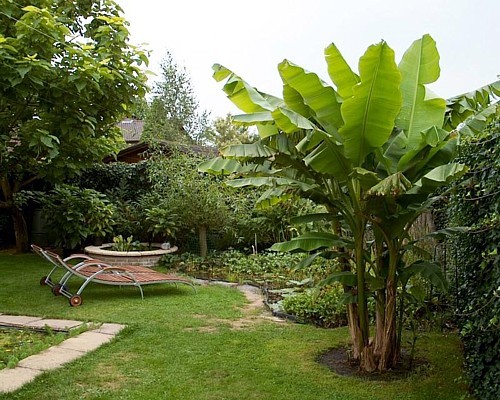
bajoo tree

芭蕉詩

芭蕉心盡展新枝,新卷新心暗已隨。

願學新心養新德,旋隨新葉起新知。

On the Basjoo Tree

The basjoo tree

perfects its core

to unfurl a new stem.

Unnoticed, a new curl of

a new core

is already emerging.

I love to learn

with a renewing mind-heart

to cultivate new virtues,

so that,

soon after a new leaf,

a new stem of knowledge

will arise.

Commentary:

Zhang Zai (1022-1077 CE) was a pioneering Ru philosopher of the so-called Dao Xue (Learning of the Way, 道學) movement, which is usually called Neo-Confucianism in English. Zhang is famous for his treatise, The Western Inscription (西铭), in which he grounds the Ru virtue of filiality (xiao, 孝) on the cosmic piety of human beings towards the heavens and the earth.

In this exquisite poem, On the Basjoo Tree, Zhang Zai uses the image of a Basjoo tree to express his Ruist thinking concerning the relationship between the world and human beings. For Ruists, the cosmos, called tian (天), is an all-encompassing process of continuous novelty and creativity. Correspondingly, the ethical commitment of human beings is thought of as a constant renewal process of learning such that a condition of dynamic harmony (he, 和) is continually being created in the evolving situations of human society.

The biological peculiarity of the Basjoo tree is that what looks like its trunk is actually composed of curled-up stems packed together, so that when one curled stem becomes mature, a new leaf is unfurled and its stem then grows into a new branch of the plant. For Zhang Zai, this feature of the Basjoo tree represents perfectly the core of Ruist aesthetics: the world continually renewing itself. Thus, in the second half of the poem, Zhang Zai says he loves to learn with the Basjoo tree and in that way to continue to nurture and renew his virtues and to uncover new knowledge about the world.

Some use of puns or word-play in Chinese is crucial for the poem’s diction. In Chinese, 心 (xin) can mean “mind,” “heart” or “core.” It is used by Ruists to refer to the undivided central capacity of human consciousness and encompasses its intellectual, emotional and volitional dimensions. Therefore, a standard English translation of the Ruist idea of xin is “mind-heart.”  Because xin also means “core” in Chinese, the curled-up stems making up the trunk of the Basjoo tree is portrayed by Zhang Zai as its xin, and its continual unfolding symbolizes a renewing of the human mind-heart that longs for continual learning and self-cultivation. Also, the Chinese term for “stem” (zhi, 枝) has the same pronunciation as the Chinese term for knowledge (zhi, 知). So, as each new stem is unfurled, it symbolizes a virtuous Ruist learner who has garnered a new piece of knowledge. Please pay attention to the fact that for Zhang Zai, knowledge and virtue are intertwined in the self-cultivation of a human being, and so these renewals are manifestations of the transformation of one’s own mind-heart. This reminds us of the first three paragraphs of Great Learning (Daxue, 大学), which lays out a detailed procedure for Ruist self-cultivation based upon attaining knowledge (致知), rectifying one’s mind-heart (正心), and illuminating one’s bright virtues (明明德).

Another important lesson from Ruist poetry is that in the perspective of comparative literature, Ruists are fond of using the same image to express multiple meanings. For example, “lotus” is an image heavily used in Buddhist literature to express Buddhism’s commitment to eliminating desires and anxieties and thereby to search for release from the suffering process of reincarnation through Buddhist practice. However, in Zhou Dunyi’s “On Loving the Lotus,” the lotus is described as “Inside, it is open; outside, it is straight” “It neither sprawls nor branches,” and in this way the lotus becomes a Ruist image, symbolizing the Ruist moral ideal of an upright and honest noble-person (junzi, 君子). Similarly, the Basjoo tree is an icon also popular in Buddhist literature where its trunk is actually “empty” once you account for all the unfolding stems. But in Zhang Zai’s poetry, the Basjoo tree becomes an icon expressive of the Ruist metaphysical insight concerning the constant creativity of Tian (cosmos) and the Ruist ethical commitment to the constantly being renewed self-cultivation of human beings.

(Translated and Commented by Bin Song)

Introducing a New Ruist (Confucian) Ritual: Tian-worship and Confucius-veneration (敬天尊孔)

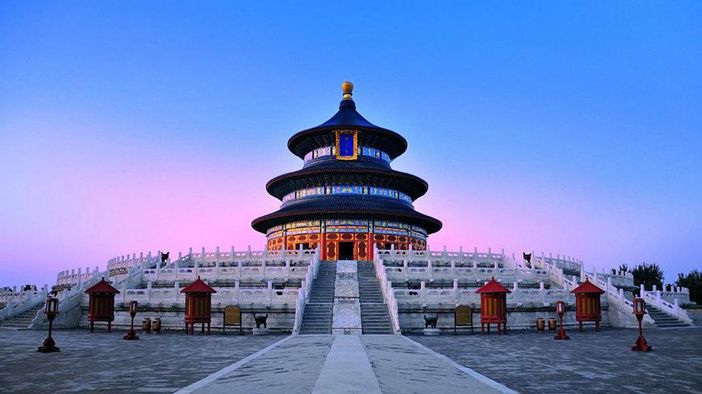
There is a religious ritual system in Ruism which has been translated as ‘The Three Sacrifices’ (三祭, sanji): Sacrifice in celebration of Tian (Heaven), sacrifice in celebration of distinguished teachers such as Confucius, and sacrifice in celebration of one’s ancestors. Traditionally, the sacrificial ritual in celebration of Tian could only be performed by an emperor, the so-called Son of Tian (天子). This ritual used to take place in the suburb of a capital such as this:

The 'Platform of Tian' (天壇) in Beijing
The ‘Platform of Tian’ (天壇) in Beijing

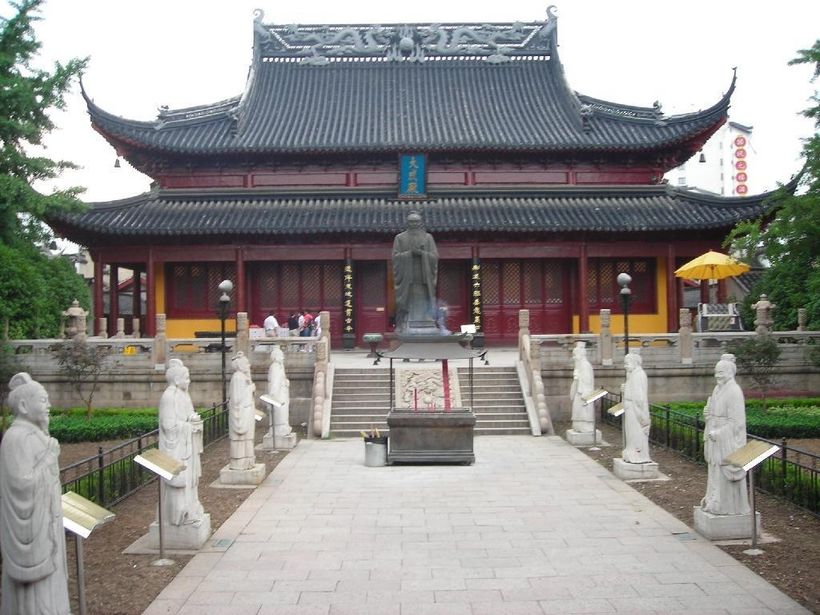
The sacrificial ritual in celebration of Confucius was performed in Confucian temples such as this:

Confucius Temple in Nanjing

Everyone is allowed to perform this ritual. However, because Confucius is taken to be the common teacher of everyone in the Ru tradition, the main participators in this ritual were the Ruist literati.

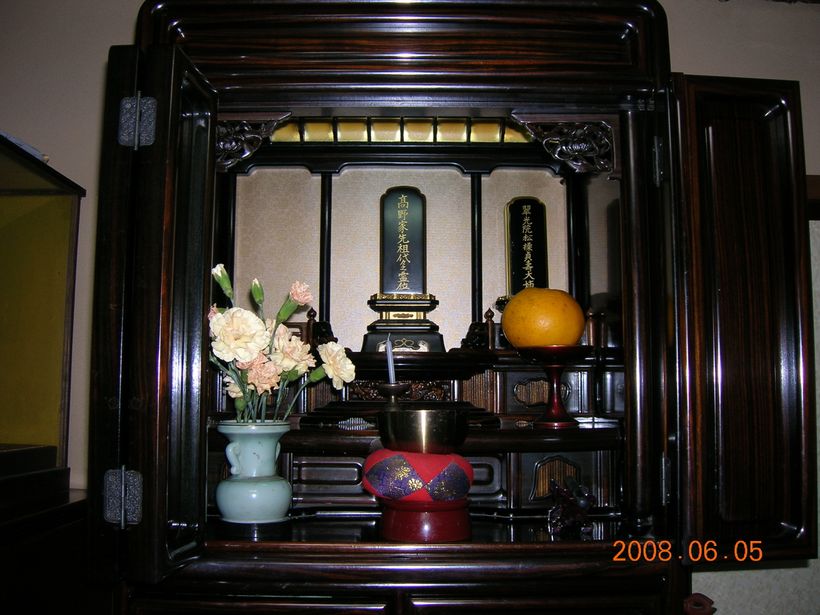
By comparison, the ritual of sacrifice to one’s ancestors is more private. It is either performed before an ancestral altar in each individual household, in cemeteries, or in an ancestral temple shared by an extended family. It looks like this:

An ancestor altar in household

At this time, I would like to introduce a new ritual which combines the first two rituals, which I am calling a ritual of Tian-worship and Confucius-veneration(敬天尊孔).

The major reason that such a combination is needed is that in a contemporary context, the celebration of Tian can no longer be performed by an emperor alone. As a Ru committed and connected to the all-encompassing transcendent power of Tian, not just an emperor but every person has the need and right to celebrate it. Actually, traditional Ru literati also realized the egalitarian power of the idea of Tian, since each individual Ru was free to interpret this idea in his or her own particular way in order to counteract the ideologies and political policies which may have been endorsed by his or her emperor. This was a distinctive Ruist check and balance system within the traditional Chinese dynastic polity. However, because the polity was imperial, the ritual aspect of Tian-worship could not be decoupled from the monopoly power of the emperor. Nowadays, the political context of emperor has died out, and every Ru has accordingly recovered the right to perform a ritual of Tian-worship.

The reason I suggest combining the ritual of Tian-worship and the ritual of Confucius-veneration is that the relationship among Ru, as students of Confucius, is egalitarian. They are friends (友, you), committed to the Dao of Tian (天道, tiandao), who are trying to realize dynamic harmony at all levels of human existence in accordance with Confucius’ teachings. Therefore, when an occasion arises for Ruist friends “who are coming from afar” [Analects, 1:1] to join each other and to advance their Ruist learning, they will be able to perform the ritual of Confucius-veneration and the ritual of Tian-worship at the same time. This will remind the Ruist community that when studying the tradition, each Ru is not only a student of Confucius, but also a citizen of Tian (天民, tianmin). In this way, each Ru will continually nurture the feeling of gratitude towards the ultimate origin of their personal lives and personal energy; simultaneously, they will enhance their devotion to a life of manifesting Tian’s creativity in a distinctively human way in accordance with Confucius’s teaching about ‘humaneness’ (仁, ren).

Based upon these reasonable considerations which encourage the creation of an updated ritual (“to create rituals according to what is right,” – “以義起禮”, 禮記∙禮運), during the first ‘Ruist Friends From Afar’ Retreat in North America, held at Marsh Chapel, Boston University, on July 1-3rd, 2016, and before any formal readings and discussions even began, Ru friends performed a new Ruist ritual of Tian-worship and Confucius-veneration.

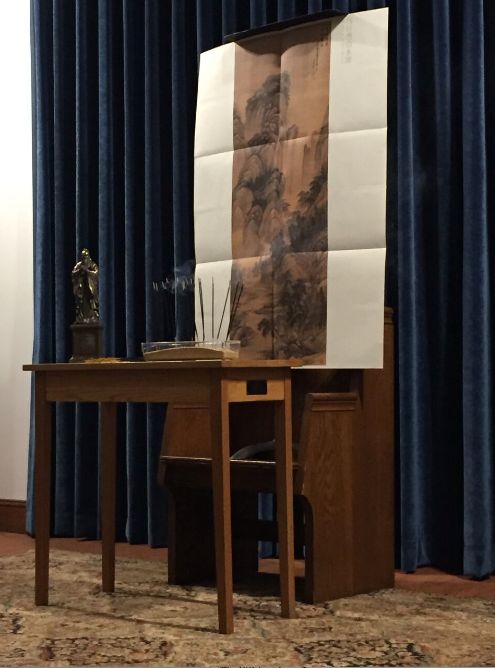
We tried to make the set-up of the ritual simple, since simplicity and authenticity are a consistent concern which traditional Ruist rituals convey. The set-up of the ritual looked like this:

We used a Chinese landscape painting to symbolize Tian. It was hung out in front. Then, we placed a Confucius statue on a small table in front of it, and an altar in the middle for holding incense. The painting we chose was drawn by Wang Hui (王翚, 1632-1717 CE) during the early Qing dynasty. A digital version of it looks like this:

This painting was selected by courtesy of Yair Lior, as Yair, among all the friends who attended the retreat, is a Ru versed in Chinese art history. The ‘Tian’ which this painting depicts feels solemn and energetic. In choosing the painting, we made sure that it was one which included Heaven, Earth, and Human Beings, since these three are the constitutive co-creators (三才) within Tian. In future, we have a plan to choose some western landscape paintings to symbolize the same Tian. This is because Tian’s creativity is all-encompassing, whether in the East or in the West, and one major concern of the participants of the retreat was how to share the Ru tradition’s wisdom and experience with fellow Americans.

The performative act of the ritual was also simple. At the beginning of the ritual, a Presider held two sticks of incense, bowed to Tian three times, and then stepped aside a bit, and bowed to Confucius once. After this, the Presider placed the incense in the altar, and then handed another couple of sticks to a second Ruist friend. After all friends had completed their celebrations, we stood in a line facing the altar, meditated for a while, and then completed the ritual.

There is no strict meaning for the numbers mentioned above. Neither does any step in the sequence have to be rigorously followed. After the Presider has performed the ritual, each friend can follow it in his or her favorite way: bowing to Tian but not bowing to Confucius, or as we elected to do during the retreat when some friends didn’t feel comfortable performing a religious-seeming ritual, giving them the option to wait in the reading room during the entire event. In a word, the performance of this suggested ritual is entirely voluntary.

However, because I was lucky enough to be supported by friends to act as Presider of the ritual, I tried to endow a Ruist meaning in my mind at each step of the ritual. Once again, these meanings were my own interpretation, and they are heuristic, and not in any way prescriptive. Future practitioners will surely choose whether to follow my interpretation or not according to their own understanding of the Ruist tradition. Here was my thinking:

I used two sticks of incense to symbolize Yin and Yang, the two most basic forms of cosmic reality in the Ruist cosmology. In this way, holding two sticks of incense while bowing to Tian symbolized that Tian is an even higher cosmological concept than Yin and Yang, since the power it refers to creates everything in the universe including these two realities. I bowed three times to Tian because, as I mentioned earlier, Tian includes three parts: Heaven, Earth and Human Beings. This trinitarian idea of Tian in Ruism underpins the Ruist commitment to Tian as both ecological and humanistic.

We all bowed to Tian in front of the statue of Confucius because we wanted our celebration of Tian to witness to our common teacher Confucius, who taught us to treat Tian as what is ultimately meaningful and powerful, that is, what is transcendent for human life. Each friend may also choose whether or not to bow to Confucius after bowing to Tian depending upon how comfortable he or she feels about bowing to a statue of a human being.

In conclusion, what I have set out in this essay is the totality of the new Ruist ritual of Tian-worship and Confucius-veneration performed during the first retreat. The effect of the performance, I have to say, felt good and appropriate. Friends told me that it was simple and felt authentic. Their feelings toward Tian and toward Confucius were expressed and enhanced. In this way, they also felt more at home in this beloved Ru community and in the more than 2,500 year-old living Ru tradition.

Zhuangzi’s Butterfly Dream

Zhuangzi’s Butterfly Dream, by the team of Hans-Georg Moeller.

Texts and Translations: (please refer to Ctext.org; translations are adapted by me)

昔者莊周夢為胡蝶,栩栩然胡蝶也,自喻適志與!不知周也。俄然覺,則蘧蘧然周也。不知周之夢為胡蝶與,胡蝶之夢為周與?周與胡蝶,則必有分矣。此之謂物化。(《齊物論》內篇)

Formerly, Zhuang Zhou dreamt that Zhou was a butterfly, a butterfly flying about, feeling that it was enjoying itself. Zhou did not know that it was Zhou. Suddenly Zhou awoke, and was Zhou again. Zhou did not know whether it had formerly been Zhou dreaming that he was a butterfly, or it was now a butterfly dreaming that it was Zhou. But between Zhou and a butterfly there must be a difference. This is a case of what is called the Transformation of Things. (Qi Wu Lun)

莊子將死,弟子欲厚葬之。莊子曰:「吾以天地為棺槨,以日月為連璧,星辰為珠璣,萬物為齎送。吾葬具豈不備邪?何以加此!」弟子曰:「吾恐烏鳶之食夫子也。」莊子曰:「在上為烏鳶食,在下為螻蟻食,奪彼與此,何其偏也!」(《列禦寇》雜篇)

When Zhuangzi was about to die, his disciples signified their wish to give him a grand burial. ‘I shall have heaven and earth,’ said he, ‘for my coffin and its shell; the sun and moon for my two round symbols of jade; the stars and constellations for my pearls and jewels; and all things assisting as the mourners. Will not the provisions for my burial be complete? What could you add to them?’ The disciples replied, ‘We are afraid that the crows and kites will eat our master.’ Zhuangzi rejoined, ‘Above, the crows and kites will eat me; below, the mole-crickets and ants will eat me: to take from those and give to these would only show your partiality.’ (Lie Yu Kou)

莊子妻死,惠子弔之,莊子則方箕踞鼓盆而歌。惠子曰:「與人居長子,老身死,不哭亦足矣,又鼓盆而歌,不亦甚乎!」莊子曰:「不然。是其始死也,我獨何能無概然!察其始而本無生,非徒無生也,而本無形,非徒無形也,而本無氣。雜乎芒芴之間,變而有氣,氣變而有形,形變而有生,今又變而之死,是相與為春秋冬夏四時行也。人且偃然寢於巨室,而我噭噭然隨而哭之,自以為不通乎命,故止也。」(《至樂》外篇)

When Zhuangzi’s wife died, Huizi went to condole with him, and, finding him squatted on the ground, drumming on the basin, and singing, said to him, ‘When a wife has lived with her husband, and brought up children, and then dies in her old age, not to wail for her is enough. When you go on to drum on this basin and sing, is it not an excessive (and strange) demonstration?’ Zhuangzi replied, ‘It is not so. When she first died, was it possible for me to be singular and not affected by the event? But I reflected on the commencement of her being.There was once a time when she had not yet been born to life; not only had she no life, but she had no bodily form; not only had she no bodily form, but she had no vital-energy. During the intermingling of the undifferentiated and dark chaos, there ensued a change, and there was vital-energy; another change, and there was the bodily form; another change, and there came birth and life. There is now a change again, and she is dead. The relation between these things is like the procession of the four seasons from spring to autumn, from winter to summer. There now she lies with her face up, sleeping in the Great Chamber; and if I were to fall sobbing and going on to wall for her, I should think that I did not understand what was destined (for all). I therefore restrained myself!’ (Zhi Le)

Commentary by Bin Song

In a Daoist view, nothing needs to be particularly proud of about being a human. Humans are just an equal part to all other beings in the all-encompassing natural process of cosmic changes and transformations. The process of life to death of a human individual is just similar to the one from dreaming to waking-up. It is an example of how things transform. Although there are differences between these two transitioned states, neither of them needs to be prioritized. Therefore, why do we need to organize grandiose rituals to mourn our teacher’s death? Why do we need to wail over our wife’s death? Their deaths are also mere examples about how things transform in nature. Instead, we should be happy over the passing-away of our most intimate human fellows, since this is the occasion when they come back to the Dao, and hence, enjoy their pre-destined dwelling places.

Nothing is more further away from this Daoist attitude towards death than Ruism (Confucianism). In the texts of Confucius, Mencius and Xunzi, which are largely contemporaneous with the Zhuangzi, we find ample elaborations on why humans need to perform mourning rituals when our intimate family members die. Some prominent reasons are listed, but not limited to the following:

(1) Ritual performance is a “sincere,” and thus, natural expression of our grieving feeling.

(2) Rituals also refine these feelings so that the deaths become bearable.

(3) People who are still alive will expect that their children and grandchildren can also treat them well in an ancestor ritual as long as they are dedicated to nourishing the good life of their descendants. Hence, these mourning rituals furnish a motivation for living humans to live their good human life.

So, the critique made by the video to Confucian mourning rituals is indeed ungrounded: Confucius and later Ru scholars rarely, if not never, advocate “firm obedience of the younger to the older generation.” This is because 1) as stated above, rituals furnish rationales for living elder people (who will become ancestors in time) to be nourishing and moral towards the younger, and 2) “remonstration” against one’s wrong-doing parents and ancestors is championed as a necessary component of the virtue of “filiality.” More importantly, regarding the “sincere” expression of people’s mourning feeling, one great Ru scholar, Wang Yangming, in 15th century even said that only if we grieve to the utmost and appropriate measure, we can be very happy deep in our heart. In other words, to be happy about his wife’s death, one does not need to drum a basin and sing a song just like Zhuangzi did. From a Ruist perspective, he just needs to conduct a ritual and mourn sincerely so as to be joyful and content in the depth of his heart.

So, in a word, from a Ruist perspective, it is good to envision human death as constituting a natural process of cosmic changes and transformations. However, it is also natural for human beings to organize rituals to mourn our human fellows’ death.

After all, before sleeping, I routinely kiss and say good night to my wife lying in the same bed, despite the fact that I may feel quite at ease when I dream myself to be a fluttering butterfly in a few hours.