Ancestor Devotion

(This article has been published in Huffpost, April 4th, 2016)

According to China’s Lunar Calendar, the Clear and Bright Day (清明節) will be on April 4 this year (2016). Traditionally, this is the time for families to visit their ancestors’ tombs to perform a ritual of ‘ancestor devotion’ (祭祖). For this reason, Clear and Bright Day is also translated into English as ‘Tomb Sweeping Day.’

If there is a single ritual which speaks to the resilience of the Ruist tradition, it is ‘ancestor devotion.’ Its history began long before the time of Confucius [551-479 BCE], although the role of Confucius and his Ruist school may be seen as having educated people about the spiritual and ethical importance of this ritual and thus to having transformed people’s minds in this regard. Even during the hardest times for Ruism, the early 20th century when Ruism was accused by China’s westernized intellectuals of being culpable for the backwardness of Chinese society, the performance of this ritual remained ubiquitous. This is the case, not only in China, but also for the greater part of South and East Asia which were influenced by Ruism, and also to a certain degree for the Chinese diaspora throughout Western societies. Today, some sociologists have even argued that if the performance of ‘ancestor devotion’ can be seen as a sign that the devotees have affiliated themselves to Ruism, Ruism may be counted as the largest religion in the world with the largest number of adherents.

So, why is this ritual so powerful? The reason is clearly related to ‘the Ruist view of death.’ In a succinct way, I can summarize this view as follows: a Ru lives every moment of life under the shadow of death and is continually trying his or her best to create a condition of dynamic harmony within evolving life situations. There is no doubt that, from a human perspective, disharmonious factors are always present in the world. But the ideal of continually realizing dynamic harmony always stands front and center. That’s the reason I use the phrase ‘continually trying one’s best.’ In this sense, the image of ‘a non-violent warrior’ who fights for harmony up until death may be seen as a portrait of the ‘vertical’ dimension of a Ru’s life, since it announces a sort of existential constant during each moment of life. In this vertical view, “If one hears the Dao in the morning, one can die at ease in the evening” (Analects, 4:8), since every moment of a Ru’s life is virtually the same as every other. However, in a horizontal view, the target of a Ru’s life is to achieve ‘cultural immortality.’ Through an arduous process of moral self-cultivation, a Ru tries to accumulate his or her merits in his or her words (立言), works (立功) and moral worths (立德) so that he or she will be able to make a great contribution to human civilization, and thus to yield cultural influences which after death do not decay over time. Understood in this horizontal way, the ritual of ‘ancestor devotion’ is a distinctly Ruist way for ordinary people in their households, in their family clans and in their local communities to practice the Ruist teaching concerning cultural immortality.

Three key points still need to be explained in order to avoid any possible misunderstanding about the purpose of this ritual. First, solidarity and order to be brought to one’s family, and agreeable effects to be brought to every individual’s moral self-cultivation, are the aspects of this ritual which are most emphasized by Ruism. For instance, during a performance of the ritual, certain rules must be followed, which demand appropriate reciprocal interactions among family members based upon their ages and status differences. One’s ancestors’ deeds and virtues must be memorialized and appreciated, as they will have set moral examples for their descendants to follow. The eldest in each family, especially, must perform the ritual sincerely so as to demonstrate the virtue of ‘filial piety’ (孝) toward the ancestors; doing so is essential if these elders intend that other family members continue to practice this virtue towards themselves. Furthermore, a cultural consciousness deep within the ritual performers is the hope that their own lives will also be memorialized by their offspring, generation after generation. Accordingly, everyone must try their best to become ‘good guys’ to protect against a case in which nothing about their life turns out to be worth memorializing.

Secondly, if we take these factors into consideration, we can understand that the ‘blessing’ which people hope to receive during the ritual is not from some kind of ‘petitionary prayer,’ which thereby must assume a certain degree of deification of the ancestors. Offering a petitionary prayer would indicate that people think that if they have provided outstanding offerings to the spirits or ghosts of the ancestors and have behaved well during the ritual, that then they will be rewarded; otherwise, the ancestors might punish them. This sort of ‘ancestor worship,’ which is not the same as ‘ancestor devotion,’ may have been prevalent before the time of Confucius and even among uneducated people today. However, by the time Confucius’ Ruist school had become the most powerful educational engine of ancient China, the ritual was no longer construed as ‘worship,’ but rather as ‘devotion.’ In this regard, the chapter, ‘Ji Tong’ (祭統, the regulation of sacrifice), in the Book of Rites (禮記) is edifying. It says,

“When a worthy (賢者) pursues the ritual of ancestor devotion (祭), he will be blessed. However, this blessing is not what the vulgar people call a blessing. Here, blessing means perfection. And perfection means the complete and natural discharge of all one’s duties.”

In other words, Ruists believe that people can be blessed through the ritual of ‘ancestor devotion’ because they have attuned themselves to all the patterns and principles which make an entire family fit together in the way in which it was historically understood: as following the virtues of the ancestors, expressing feelings of gratitude and filial piety, cultivating oneself well here and now, and expecting cultural immortality in the future. We can now understand that realizing ‘dynamic harmony’ within a household refers to performing this ritual par excellence.

Third, these insights remind us to clarify one important question which people usually ask when they read the Analects and begin to approach Ruism for the first time: Did early Ruists believe in ghosts, spirits, or any other sort of supernatural beings who possessed some disembodied form of consciousness? If we read the Analects along with other major Ruist classics compiled around the same period, the answer is a definite ‘No.’ For in Confucius’ time, people believed that human beings had two souls. When a human died, one soul called hun ascended to heaven, and the other soul called po descended to earth. Accordingly, a special ritual needed to be performed following a person’s death in order to call the ascending hun back to the buried body and bring final peace to the deceased. However, as described in the chapter called ‘Ji Yi’ (祭義) in the Book of Rites, when Confucius was asked his opinion of hun and po, he said these are just two different forms of the cosmic matter-energy called Qi (氣). The one is stretching and ascending, and the other is returning and descending. In other words, when people die, their life force was thought to be transformed into two portions of Qi and thereby merged into the entire natural process of cosmic changes. Accordingly, no supernatural being need be posited to exist.

Cognitively, then, Ruism does not believe in any sort of afterlife. Emotionally, however, Ruists acknowledge that people express intrinsic feelings of gratitude and devotion towards their ancestors. In this sense, the ritual of ‘ancestor devotion,’ as construed by Ruism, is to create a distinctive ‘subjunctive’ space in which people are able to express their feelings and cultivate their morals without being required to assume any ontological misconceptions about what these feelings and morals ought to be devoted to. In other words, the ritual harmonizes people’s emotional and moral needs along with their cognitive awareness in just the way described by Confucius: “When I perform the ritual of ‘ancestor devotion,’ I act as if the spirits of the ancestors were present” (Analects, 3:12). By the same token, Confucius also teaches us to “revere spirits and ghosts, but stay away from them” (Analects, 6:22). Both verses enlighten us by pointing out that we need to sincerely perform the ritual of ‘ancestor devotion’ as if these ancestors were alive for all the reasons mentioned above. Even so, we ought not to commit a cognitive error by allowing the idea of spirits and ghosts to interfere inappropriately with our lives.

In a word, although the Clear and Bright Day ritual is devoted to ancestors, it is mainly for the sake of living people and their futures. If we have correctly understood this ritual, we still have to wonder, especially in the case of Westerners, how should the ritual be performed in a contemporary context?

As for the more general question of how Westerners can adopt Eastern rituals in order to practice Ruism, I endorse a minimalist re-interpretive approach. This means that Westerners ought first to understand the Ruist teachings which underlie Eastern rituals, and then reformulate current Western rituals using the least effort which will yield an optimal Ruist meaning.

In this regard, my friend Benjamin Butina has done an unprecedented job of designing a ‘Tomb Sweeping Ritual’ (click here to see details) based upon Ruist philosophy as well as Western customs. Alternately, Westerners might choose some Western festival such as Father’s Day or Mother’s Day as their opportunity to perform the ritual. Different families could also design their own way to visit the tomb or burial site of their beloved ancestors on a regular basis. Or a national holiday, such as Veteran’s Day in the United States, could be used as a way for local communities to pay tribute to deceased public figures.

In a word, the overall message of the Ruist ritual of ancestor devotion is that humans ought not to forget their family history. Only through learning, remembering and re-forming history throughout all its interrelated levels (personal, family, community, state, etc.) can people become part of history, thereby allowing human society continue to flourish in the future. Thus, as long as Westerners are able to understand and practice this message in whatever form of ritual feels comfortable and convenient, then they will be Ruist.

A Ruist View of Death

2016-03-22-1458605552-5544715-peacewithdeath.jpg

(This article has been published in Huffpost, Mar 22, 2016)

(NOTE: ‘Confucianism’ is a misnomer, replaced in this essay by ‘Ruism,’ which refers to the tradition whose most famous practitioner was Confucius. The word ‘Ruist’ is both an adjective and a noun, either describing something about the tradition or referring to a practitioner of the tradition. ‘Ru’, however, because of its compliance with the pinyin form of the Chinese character 儒, is a more professional term solely denoting a practitioner of Ruism.)

Ruism is frequently introduced as a tradition which is too this-worldly to care much about what happens after death. To a certain degree, this is true. Ruism teaches that there is no afterlife, no final judgement, no Paradise or Hell, and no reincarnation. When people are born, this is only a contractive form of the movement of the cosmic matter-energy called Qi (氣); when people die, this energy dissipates, and accordingly people’s lives lose their agency. Accordingly, life and death is just one embodiment of the constantly contracting (yang) and dissipating (yin) natural processes of cosmic change. As a consequence, nothing is supernatural, nothing is uncanny.

However, this does not mean that Ruism does not have its own systematic view of death. Neither does it imply that a Ru cannot live a peaceful life up until his or her last moments. Let me relate some stories which will provide a glimpse of how a Ru dies:

When Wang Yang-ming turned 57, he retired from government because of disease. He went back to Nan-an, and one of his students, Zhou Ji, came to visit and then took care of him. One day Wang announced to his student: “I will pass away.” Zhou wept and asked: “Do you have any last words?” Wang smiled: “Since this heart of mine is bright and luminous, why do I need to say anything?” (此心光明,亦復何言). After these words, Wang closed his eyes and died (From The Complete Works of Wang Yang-ming).

Wang Gen, a prominent student of Wang Yang-ming, died at the age of 58. It was said that before his death, there had been a light dimly shining throughout his sickroom at night. Because of this, Wang Gen murmured to himself: “Will I die?” In the next morning, when gathering his students and sons, Wang Gen was asked about how to arrange his funeral. Wang Gen told his sons: “Since you know how to study, what additional concerns could I have?” (汝知學,吾復何憂). Then Wang Gen told his students: “You have brothers such as my sons who know how to study, do I need to have any further concerns? After my death, you only need to continue doing good deeds. Human beings suffer from the departure of their beloved. However, as long as you friends can continually meet and learn from each other, your lives will be benefited, and your learning will advance.” No other word was said. Wang Gen then closed his eyes and died. His tender and rosy complexion did not change until his internment (From The Collected Works of Wang Xin-zhai).

Luo Ru-fang, another prominent Neo-Ruist, died at the age of 73. On the first morning of September of that year, after Luo had washed his hands and face, and combed his hair, he walked out and sat in his appropriate position in the main room. He required his students and children to drink and toast one another, and after this, he cupped his hands and bowed to them: “Now I will leave.” People asked him to stay for another day, and Luo agreed. At noon on September 2nd, Luo dressed up, sat down in the proper position, and died.(From The Collected Works of Wang Jin-xi).

Although these events may have been recorded in a somewhat prettied-up way by the deceased’s students, we can nevertheless discern the key message: a Ru can continue to live an extremely peaceful life even in the face of his own death. So, how can this be possible? In my view, each of these Ruist deaths is a good exemplar of Confucius’ teaching: “If one hears the Dao in the morning, one can die at ease in the evening” (Analects, 4:8). In other words, if you know the truth of the Dao of Heaven (天道), as well as the truth of the Dao of Human Beings (人道), and furthermore, if you have tried to continually live out these truths in your everyday life, then at the end of your life, you will come to appreciate that you have in fact tried your very best to fulfill your most valuable potentiality: that of becoming fully human. At that point you can die without any regret, and at peace.

According to Ruism, the truth of the Dao of Heaven (天道) is that the entire universe is a constantly creative process called ‘Tian’ (天, Heaven). Tian creates a process of dynamic harmony, endowing energy and creativity to all creatures within Tian, in all places and at all times, by means of a method called ‘wu-wei’ (無為, effortless action). In this view, the movement of cosmic matter-energy is the manifestation of Tian’s creativity. However, Tian’s creation is neither anthropomorphic nor anthropocentric. For, natural disasters on this little blue planet can be considered ‘disasters’ only from a human perspective. From the perspective of Tian, a flood, as one of millions of processes within Tian, has its own beauty, a beauty which is not inferior to that of, for example, the human houses being destroyed. In the same way, from Tian’s point of view, the HIV virus has a value which is not less lovable than that of the human bodies which have been infected by the virus. Therefore, the axiologically transcendent and non-anthropomorphic character of Tian entails that human beings have their own intrinsic needs and particular responsibilities for the manifestation of Tian’s creation in their own human way. In a Ruist sense, this is called ‘making great the way of Tian by making great the way of Humans’ (以人道弘天道) (Analects 15:28). In concrete terms, it is an endless process leading to the realization of the conditions of dynamic harmony among all concerned cosmic beings, but based upon their particular diverse values measured primarily from a human perspective. For example, if floods bring disaster, let’s build dams, and also, let’s refrain from the excessive exploitation of forests whose loss leads to excessive flooding. This of course will not mean that we give up employing natural resources such as wood and coal used in maintaining human civilization. In this sense, the targeted harmony under human management is a humanistic and anthropo-cosmic harmony, which stands firmly upon the intrinsic needs, interests and values of humanity in general, but also of course maintains its distinctive cosmic extension.

If we examine the Dao which rendered Confucius willing to die in the evening after he had heard it in the morning, we will realize that there are, among all the world’s religions, not one which emphasizes ‘cultural immortality’ more powerfully than Ruism. This is because, for Ruism, to be human is not only a fact; it is even more a value, which can and must be continually realized human generation after human generation. Thus, one’s personal contribution to the continual flourishing of the entirety of human civilization against the cosmic backdrop of the constantly creative process of Tian, will become the ultimate criterion for giving an account to the meaning of an individual human life and for judging the value of a human person. The phrase, ‘To live a meaningful and valuable human life, and then, to die but not (to culturally) decay’ (生有價值,死而不朽), is a distinctly Ruist way of living in the shadow of one’s own death.

In particular, the Ruist tradition extols three ways for achieving cultural immortality: to establish moral worth (立德), to establish good works (立功), and to establish good words(立言). ‘To establish words’ means to say the right words and writing good books. This is how intellectuals succeed in preventing their deaths from cultural decay. ‘To establish works’ means to help resolve impending issues for human society at large. For example, President Obama succeeded in rescuing the American economy from ‘the Great Recession.’ Obama’s presidency will therefore, in my view, be remembered in a positive way by the American people. In contrast to words and works, ‘moral worth’ (de 德) is of utmost importance for human beings who are trying to avoid cultural decay at their death. De (德), usually translated by the word ‘virtue,’ is the practical moral influence or moral charisma of a virtuous, noble person (君子). A virtuous, noble person, by means of his or her well-cultivated deeds and words, sets a moral norm which will motivate other people to achieve the same Ruist moral ideal – the creation of the conditions for dynamic harmony – within different contexts. Among these three ways, establishing moral worth is foundational because, according to Ruism, without a solid moral underpinning, people’s works and words are ultimately groundless. On the other hand, Ruism promotes the ‘unity of knowledge and action’ so, saying the right words without actually doing good deeds, must be considered of lesser value than doing good deeds on the basis of right knowledge. In this way, human beings need to try to achieve cultural immortality in this order: firstly, try to say the right words, then, try to do good works, and finally, try to embody moral worth.

According to the tradition, only two Ruists throughout the entirety of Chinese history have accomplished these three ways of cultural immortality: Confucius and Wang Yang-ming. They both wrote great books, formed their own schools consisting of thousands of students, served in high governmental positions and helped to resolve impending issues for their states and, what is most important, they never stopped learning and cultivating themselves so as to set great moral examples. And by doing so, they exerted a huge influence upon future generations. Understood in this way, it will be no surprise to hear that Wang Yang-ming and his followers could die such peaceful deaths. In the words of another prominent Neo-Ruist philosopher, Zhang Zai, the death-consciousness of these Ruists could be stated as: ‘When I was alive, I was devoted to the mission of becoming fully human among humans; now that I am dying, I feel content with myself’ (存吾順事,歿吾寧也).

Introducing a New Ruist (Confucian) Ritual: Tian-worship and Confucius-veneration (敬天尊孔)

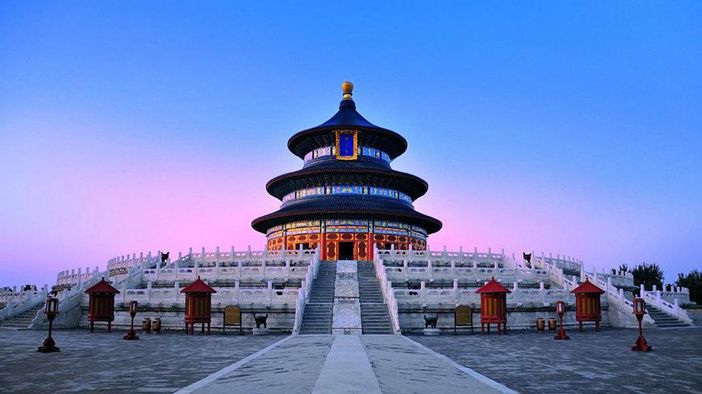
There is a religious ritual system in Ruism which has been translated as ‘The Three Sacrifices’ (三祭, sanji): Sacrifice in celebration of Tian (Heaven), sacrifice in celebration of distinguished teachers such as Confucius, and sacrifice in celebration of one’s ancestors. Traditionally, the sacrificial ritual in celebration of Tian could only be performed by an emperor, the so-called Son of Tian (天子). This ritual used to take place in the suburb of a capital such as this:

The 'Platform of Tian' (天壇) in Beijing
The ‘Platform of Tian’ (天壇) in Beijing

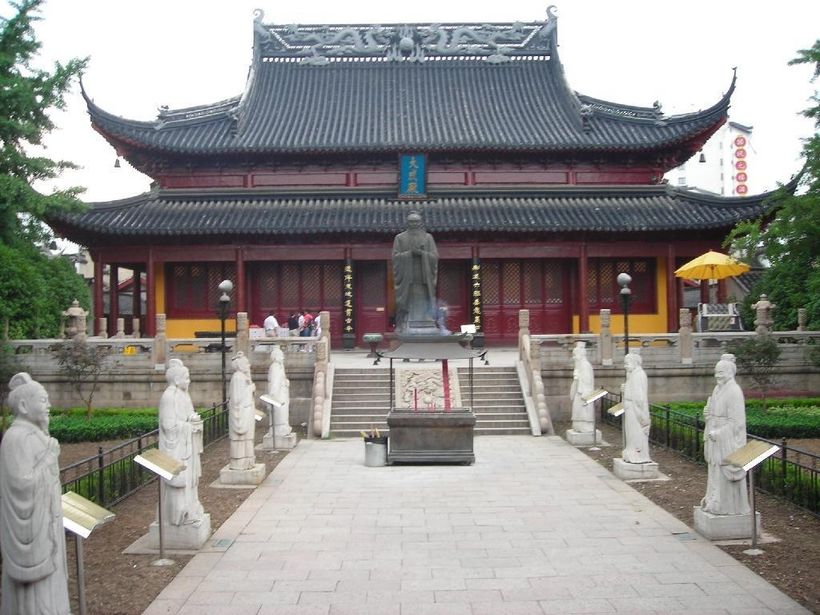
The sacrificial ritual in celebration of Confucius was performed in Confucian temples such as this:

Confucius Temple in Nanjing

Everyone is allowed to perform this ritual. However, because Confucius is taken to be the common teacher of everyone in the Ru tradition, the main participators in this ritual were the Ruist literati.

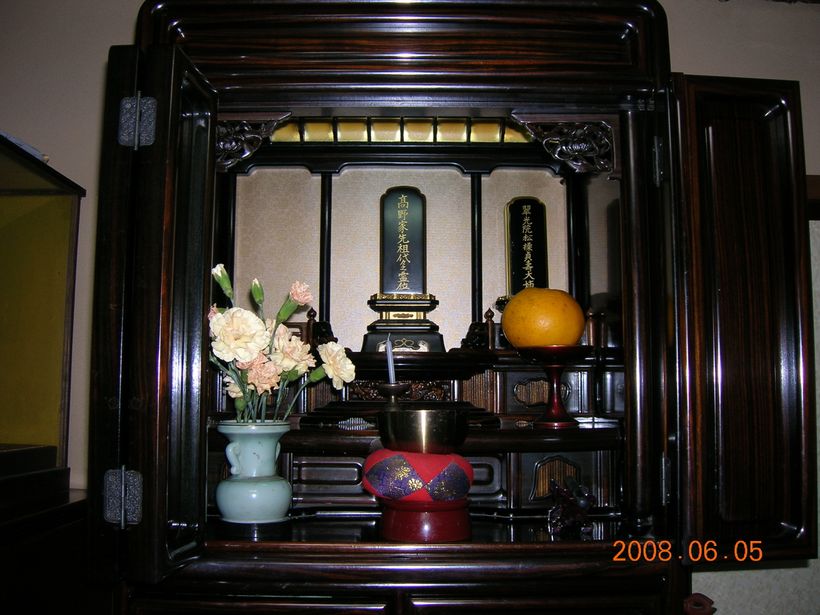
By comparison, the ritual of sacrifice to one’s ancestors is more private. It is either performed before an ancestral altar in each individual household, in cemeteries, or in an ancestral temple shared by an extended family. It looks like this:

An ancestor altar in household

At this time, I would like to introduce a new ritual which combines the first two rituals, which I am calling a ritual of Tian-worship and Confucius-veneration(敬天尊孔).

The major reason that such a combination is needed is that in a contemporary context, the celebration of Tian can no longer be performed by an emperor alone. As a Ru committed and connected to the all-encompassing transcendent power of Tian, not just an emperor but every person has the need and right to celebrate it. Actually, traditional Ru literati also realized the egalitarian power of the idea of Tian, since each individual Ru was free to interpret this idea in his or her own particular way in order to counteract the ideologies and political policies which may have been endorsed by his or her emperor. This was a distinctive Ruist check and balance system within the traditional Chinese dynastic polity. However, because the polity was imperial, the ritual aspect of Tian-worship could not be decoupled from the monopoly power of the emperor. Nowadays, the political context of emperor has died out, and every Ru has accordingly recovered the right to perform a ritual of Tian-worship.

The reason I suggest combining the ritual of Tian-worship and the ritual of Confucius-veneration is that the relationship among Ru, as students of Confucius, is egalitarian. They are friends (友, you), committed to the Dao of Tian (天道, tiandao), who are trying to realize dynamic harmony at all levels of human existence in accordance with Confucius’ teachings. Therefore, when an occasion arises for Ruist friends “who are coming from afar” [Analects, 1:1] to join each other and to advance their Ruist learning, they will be able to perform the ritual of Confucius-veneration and the ritual of Tian-worship at the same time. This will remind the Ruist community that when studying the tradition, each Ru is not only a student of Confucius, but also a citizen of Tian (天民, tianmin). In this way, each Ru will continually nurture the feeling of gratitude towards the ultimate origin of their personal lives and personal energy; simultaneously, they will enhance their devotion to a life of manifesting Tian’s creativity in a distinctively human way in accordance with Confucius’s teaching about ‘humaneness’ (仁, ren).

Based upon these reasonable considerations which encourage the creation of an updated ritual (“to create rituals according to what is right,” – “以義起禮”, 禮記∙禮運), during the first ‘Ruist Friends From Afar’ Retreat in North America, held at Marsh Chapel, Boston University, on July 1-3rd, 2016, and before any formal readings and discussions even began, Ru friends performed a new Ruist ritual of Tian-worship and Confucius-veneration.

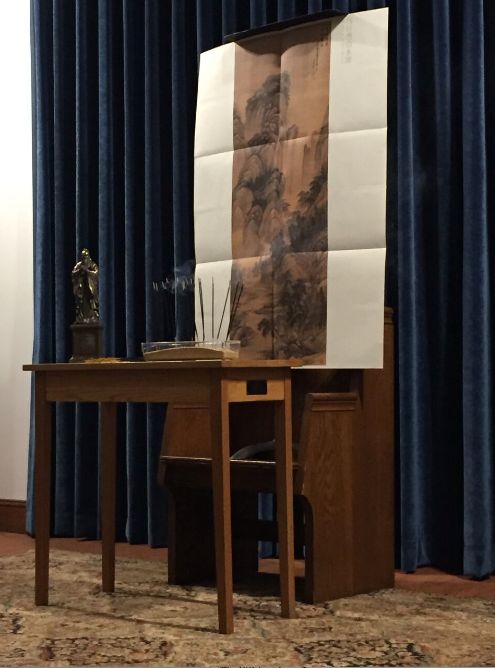
We tried to make the set-up of the ritual simple, since simplicity and authenticity are a consistent concern which traditional Ruist rituals convey. The set-up of the ritual looked like this:

We used a Chinese landscape painting to symbolize Tian. It was hung out in front. Then, we placed a Confucius statue on a small table in front of it, and an altar in the middle for holding incense. The painting we chose was drawn by Wang Hui (王翚, 1632-1717 CE) during the early Qing dynasty. A digital version of it looks like this:

This painting was selected by courtesy of Yair Lior, as Yair, among all the friends who attended the retreat, is a Ru versed in Chinese art history. The ‘Tian’ which this painting depicts feels solemn and energetic. In choosing the painting, we made sure that it was one which included Heaven, Earth, and Human Beings, since these three are the constitutive co-creators (三才) within Tian. In future, we have a plan to choose some western landscape paintings to symbolize the same Tian. This is because Tian’s creativity is all-encompassing, whether in the East or in the West, and one major concern of the participants of the retreat was how to share the Ru tradition’s wisdom and experience with fellow Americans.

The performative act of the ritual was also simple. At the beginning of the ritual, a Presider held two sticks of incense, bowed to Tian three times, and then stepped aside a bit, and bowed to Confucius once. After this, the Presider placed the incense in the altar, and then handed another couple of sticks to a second Ruist friend. After all friends had completed their celebrations, we stood in a line facing the altar, meditated for a while, and then completed the ritual.

There is no strict meaning for the numbers mentioned above. Neither does any step in the sequence have to be rigorously followed. After the Presider has performed the ritual, each friend can follow it in his or her favorite way: bowing to Tian but not bowing to Confucius, or as we elected to do during the retreat when some friends didn’t feel comfortable performing a religious-seeming ritual, giving them the option to wait in the reading room during the entire event. In a word, the performance of this suggested ritual is entirely voluntary.

However, because I was lucky enough to be supported by friends to act as Presider of the ritual, I tried to endow a Ruist meaning in my mind at each step of the ritual. Once again, these meanings were my own interpretation, and they are heuristic, and not in any way prescriptive. Future practitioners will surely choose whether to follow my interpretation or not according to their own understanding of the Ruist tradition. Here was my thinking:

I used two sticks of incense to symbolize Yin and Yang, the two most basic forms of cosmic reality in the Ruist cosmology. In this way, holding two sticks of incense while bowing to Tian symbolized that Tian is an even higher cosmological concept than Yin and Yang, since the power it refers to creates everything in the universe including these two realities. I bowed three times to Tian because, as I mentioned earlier, Tian includes three parts: Heaven, Earth and Human Beings. This trinitarian idea of Tian in Ruism underpins the Ruist commitment to Tian as both ecological and humanistic.

We all bowed to Tian in front of the statue of Confucius because we wanted our celebration of Tian to witness to our common teacher Confucius, who taught us to treat Tian as what is ultimately meaningful and powerful, that is, what is transcendent for human life. Each friend may also choose whether or not to bow to Confucius after bowing to Tian depending upon how comfortable he or she feels about bowing to a statue of a human being.

In conclusion, what I have set out in this essay is the totality of the new Ruist ritual of Tian-worship and Confucius-veneration performed during the first retreat. The effect of the performance, I have to say, felt good and appropriate. Friends told me that it was simple and felt authentic. Their feelings toward Tian and toward Confucius were expressed and enhanced. In this way, they also felt more at home in this beloved Ru community and in the more than 2,500 year-old living Ru tradition.

Laozi and Kongzi on Cosmology

Audio: Laozi and Kongzi on Cosmology, by Dr. Bin Song.
Video: Laozi and Kongzi on Cosmology, by Dr. Bin Song.

(2200 words)

Hallo, this is Dr. Bin Song at Washington College for the course of “Introduction to Comparative Religion: Eastern.”

After giving a brief introduction to Daoism, let’s read its foundational text, the famous Dao De Jing (the Classic of Way and Virtue) written by Laozi.

For scholars, given all the historical evidences we can gather, it is hard to proclaim with the same degree of certainty as the case of Kongzi (Confucius) that Laozi is indeed a real historical figure, and he single-authored a foundational text of Chinese religion called Dao De Jing. An earliest, popular version of the story of Laozi and Kongzi was told by Si Maqian’s “Record of Grand Historian” written in around 90s B.C.E, when it had been already hundreds of years later than the estimated actual time of Laozi’s and Kongzi’s lives. According to this story, Laozi was a grand archivist in late Zhou Dynasty, and Kongzi, since being a dedicated learner of Zhou rituals, went to the capital of Zhou to learn with Laozi on rituals. However, Laozi dismissed Kongzi’s interest in rituals, and thought focusing upon the learning of rituals is a misguided path to the cosmic Way, the Dao. After the meeting, on the side of Kongzi, according to the story, Kongzi praised Laozi and thought Laozi’s thought is mysterious and admirable. However, on the side of Laozi, he was so disillusioned by the social and political realities of his time, and decided to ride on a cow towards the western border of Zhou Dynasty so as to flee as a hermit. However, before being about to depart from the border, a gatekeeper convinced Laozi to leave some words for later generations, and this became the ultimate occasion for Laozi to write down his thought in five thousand words, which become the received text of Dao De Jing.

Both Ruists and Daoists, viz., the respective followers of Kongzi and Laozi, have interest to promote the told story. For Ruists, it indicates the virtues of intellectual humbleness and independence of Kongzi, since Kongzi constantly learned from varying teachers and eventually came up with his own systematic thought. For Daoists, the story was frequently told to prove the superiority of Laozi’s thought upon Kongzi’s, and hence, spoke very well for the dissenting nature of Daoist thought we analyzed in our previous unit.

Not only the story itself was worth doubting regarding its historical authenticity; according to the best knowledge we have today, whether the 5000-word text of Dao De Jing is a single-authored book which was written earlier than the major texts in the Ru school such as the Analects is also highly controversial. As stated above, Daoists may have an interest to believe that Dao De Jing was much earlier than the Analects, but there are varying versions of the text which were recently excavated by archeologists, and these versions are sometimes quite different from each other and dated in varying periods of time. Therefore, it is basically safe for today’s scholars to conclude that the received Dao De Jing is a stabilized version which results from a time-consuming process of compositions and compilation, which may start from the 5th until 3rd century B.C.E. More importantly, if you read the entire body of the varying versions of Dao De Jing, the dissenting nature of Daoist thought from the Ru thought is obvious. Because a dissenting philosophy must come after the one which it dissents against, we have reasons to aver that at least a significant portion of Dao De Jing (DDJ) was written after the flourishing of Kongzi’s school, and its sedimented nature of compilation also derives from the fact that the debate between the two schools was continual in a long period of time.

As briefly discussed in last unit, if we treat Laozi and Kongzi as the representative, somewhat symbolic figures of the schools of thought they helped to initiate, Daoists and Ruists have very different reactions to the social chaos created by the disintegration of Zhou Dynasty: one we summarized as being short on civilization, while another as being long on civilization. Actually, to compare two thinkers, no better means can be furnished than juxtaposing the best society they are dreaming for during one worst time of human history.

This is what Laozi dreams for:

“Let the state be small and the people few. Even if there be techniques replacing tens of hundreds’ of people’s labor, they would not be used. Let the people look upon death as a grievous thing and renounce traveling afar. Though there be boats and carriages, yet nobody rides in them. Though there be armors and weapons, yet nobody takes them out. Let people go back to the old days when knots in ropes were still used. People relish their food, like their dresses, find ease in their homes, and are happy with their customs and ways of life. People in neighboring settlements behold one another from afar. They can hear the barking of dogs and the crowing of cocks from the neighborhood. Yet they age to death without meeting or communicating with each other.” (DDJ, version of Wang Bi’s, chapter 80, my own translation)

Instead, This is what Kongzi dreams for:

“When the Great Way is followed intentionally, all under Heaven is distributed appropriately. People with virtues and merits are selected for public office, trust is cherished, and courtesy is cultivated. The people not only love their own parents and children, they properly love other people’s parents and children as well. The elderly are attended until death; adults are employed; children are raised. Concerning widowers, widows, orphans, the aged with no children, the disabled, and the ailing: they are all nourished. Males and females are bonded in marriage; their talents and jobs are matched. It is detestable for possessions and resources to be thrown away upon the ground. However, when gathering them, people would not store them solely for selfish use. It is detestable that people refrain from using their strength to fulfill their duties. However, when people do use their strength, it is not solely for personal gain. Therefore, intrigues and deceptions can gain no foothold. There are neither robbers nor thieves; neither is there any mob nor rebellious bandits. The doors of households appear to be closed, but they are never locked. This is a society of great harmony.” (The Classic of Ritual, the Chapter of Liyun, my own translation.)

So, in a nutshell, Laozi dreamed for a minimalist human society where life is simple, people are few, technology is disregarded, sociality is undesirable, and in a word, humans barely depart from nature. Instead, the idyllic picture depicted by Kongzi is one of all-encompassing social harmony by which fruits of civilization are continually generated and fairly distributed, while every human being is willing to keep their robust moral compass, and hence, can co-thrive based upon the most ideal measure of governance and social co-ordination.

This juxtaposition of social dreams will become more interesting if we furthermore explore how these dreams are argued and legitimized in a cosmological scale. Normally, popular readers of ancient Chinese thought think cosmology is unique to Daoism, while Ruism just focuses upon ethics and politics. Unfortunately, this is one entrenched misconception which we need to dismantle. As discussed in last unit, there is a continual process of debate, critique, and mutual influence on virtually all topics of philosophy and religion between the named two schools of thought in the period of Warring States, which means if a Daoist text uses a cosmology to refute, or doubt the social activism advocated by the Ru school, Ruists would very probably come up with their own cosmology to contrast and counterbalance. In the following, I will illustrate how this happens using two texts which are respected by each of the named traditions as its own cosmological foundation: one is still Dao De Jing (DDJ), and another is called the Great Commentary (or the Appended Texts) of the Classic of Change (GC). For the purpose of comparison, I will still call the views in Dao De Jing as belonging to Laozi and the latter as to Kongzi.

Regarding how humans should comport themselves in face of society and nature, Laozi says: “humans follow the earth, the earth follows the heaven, the heaven follows the Dao, while the Dao proceeds out of its own.” (DDJ, chapter 25). However, Kongzi says: “Without humans, the Dao would not proceed automatically in the human world.” (GC, part II, chapter 8). Obviously, these two thinkers have a very different view towards how the Dao functions in human society.

Then, my question is: how the Dao proceeds in general in the cosmological scale? Why does Laozi think humans just need to imitate the cosmic Dao while Kongzi thinks humans need to manifest the cosmic Dao in a specifically human way?

There is a sequence of the cosmic creation of the Dao argued by Laozi. He says: “Out of Dao, One is generated. Out of One, Two is generated. Out of Two, Three is generated. Out of Three, the myriad things are generated.” (DDj, Chapter 42). According to my best knowledge, the sequence can be illustrated as the following chart:

“Non-being” (Dao) ➡ One (the undifferentiated whole of “being,”) ➡ Two (Yin/Yang vital-energy; Heaven and Earth) ➡ Three (Heaven, Earth, and Human Beings) ➡ the myriad things.

Chart I: Laozi’s Cosmology

The most important feature of this cosmological sequence are that 1) this is a temporally unfolding process which indicates how the Dao generates everything in the universe from the earliest stage of a gigantic vacuum of non-being, to an undifferentiated whole of being, via the differentiation and interaction of yin/yang vital energy, and then, comes up with a myriad concrete things. 2) Laozi cherishes the idea of “temporal priority” in this cosmological sequence such that one temporally earlier stage is always thought of as being more powerful and ideal than a later one, since the earlier one generates the later and thus, better manifests the power of the Dao. 3) Laozi actually thinks the cosmological sequence is cyclical, so that when any being, including plants, animals, and human society, comes to its mature shape, they will start to decay, degenerate, and hence, come back to the Dao, and then, the cosmic process will be regenerated again.

Given Laozi’s cosmology, it will be easy for us to understand why he dreams the minimalist human society where human conditions barely depart from nature: this is because the earlier stage of the cosmic generation where a human can be, the more powerful, ideal, and in a word, closer to the Dao we can become.

Now, let’s see how Kongzi envisions the cosmic generation of the Dao. He says in the Great Commentary that: “Thus, there is Ultimate Limit in the Change. Ultimate Limit creates two modes. Two modes create four images. Four images create eight trigrams. The eight trigrams define good and ill fortune. Good and ill fortune give rise to the great enterprise.” (GC, part I, chapter 11). Here, Ultimate Limit was the signifier to the Cosmic Dao which creates the entire universe in an ontologically layered process, and the process can be illustrated as follows:

Ultimate Limit (Dao)

… ➡ Two Modes (Yin/Yang Vital-Energies, or Heaven and Earth) ➡ …

… ➡ Four Images (Four Seasons) ➡ …

… ➡ Eight Trigrams (Thunder, Lightning, Wind, Rain, Sun, Moon, etc.) ➡ …

… ➡ Human Beings and a Myriad of things ➡ …

Chart II: Kongzi’s Cosmology

Here, what matters is not to seek any historical, temporal origin of the cosmos. Rather, Kongzi thinks that regardless of the origin of the universe, human beings just need to understand their conditions of living in the endlessly changing cosmos here and now, and hence, try their best to fulfill their potentiality of being a human so as to manifest the cosmic Dao in a uniquely human, and thus, humane way. Understood as such, the vertical arrows illustrated in the chart explain the varying layers of patterns and principles that regulate cosmic changes. Human life, on the one hand, is conditioned by these patterns and principles so that humans need to organize a society and civilization within the non-human nature. However, on the other hand, since these patterns and principles are just conditions, rather than cosmic causes, humans can still adapt to , or utilize them for creating new ways to manifest the cosmic Dao in a uniquely human way, viz., the way of humaneness and harmony as indicated by his social dream.

Yes, that’s it. This is how we read the Dao De Jing from the original historical context it arises and evolves. This cosmological and comparative angle I bring here is just one among many we can read the text, which succumbs to your judgment of its soundness, and surely the contrasting views of the two schools can be compatible with each other. But in order to furnish a compatible interpretation, we must know each of them in their own terms at first. When you delve into the text, you’ll find many other themes such as statecraft, meditation, military strategy, aesthetics, etc., which are no less riveting and worth of pondering. Since Dao De Jing is frequently touted as the second most translated book in the world, I guess, we should at least find one time in our life to read it. And I hope our course is just this time.