Dynamic Harmony (和, he) as a Principle of Civil Disobedience

(An earlier version of the article was firstly published in Huffington Post: https://www.huffpost.com/entry/a-catechism-of-ruism-conf_2_b_10449592)

Hallo, this is Dr. Bin Song teaching and researching at Washington College. As we have learned from previous units of the course, students may already have a sense of the significance of “harmony” or “harmonization” for the Ru tradition. As the character of Ru implies, being a Ru is to utilize one’s cultural knowledge and skills to harmonize all involved beings in a civilization. But what does the Ru tradition mean by “harmony”? Is there any distinction of the Ru conception of “harmony” from other traditions? In this unit, we’ll focus upon these questions. As a conversation starter, I’ll use political philosophy as an example, but please do keep it in mind that the implications of harmony is far-reaching in the Ru lifestyle, and we’ll discuss these implications later.

By all commonsense standards, which may of course be lacking in academic sophistication, the mainland of China is not democratic. The appointment of the General Secretary for the Chinese Communist Party is similar to the selection of the Pope in Roman Catholicism: a small circle of high bishops hold a closed meeting, white smoke rises up, and a new Pope marches out. Accordingly, everyone begins to cheer! In China, the people can’t vote for local magistrates beyond the village level. People can’t openly criticize any governmental malfunction unless ‘the criticisms are of good will.’ I am here quoting the words recently used by China’s foreign minister to berate a Canadian journalist after she had challenged the lack of essential human rights available to people in mainland China ( please click here). There are no television debates, there are no campaigns; often people even know who will be the No.1 political leader, and sometimes also the No.2, almost a decade before he or she actually steps ‘unto the throne.’

Primarily for this reason, I am infinitely sympathetic with the protest carried out by Hong Kong’s young people in 2014, the so-called ‘umbrella revolution,’ when they realized their right of universal suffrage could be ‘cashed out’ by being required to vote only for candidates for chief executive who have been either approved or assigned in advance by China’s central government. This reminds me of my own experience of voting for a ‘deputy of the people’s congress’ (人大代表) when I was in college. China has the strangest ‘congress’ in the world. Although it is called ‘the people’s congress,’ and its main functions are, like other congresses around the world, to pass laws and oversee the functioning of the government, the deputies making up the congress are almost all elitists from various areas of the country: they are city or province magistrates, high governmental officials, directors of giant corporations, presidents of universities, famous entertainers such as singers, film stars or presenters on TV talk-shows, etc. As I said, what is most ludicrous is that citizens can only vote for those representatives who have already been assigned from ‘above.’ I can never forget that in 2000, my sophomore year in college, I was called up to vote for the deputies of congress on behalf of my university. There was only one candidate and I didn’t even know who she was, what her political beliefs were, or how or whether she would fight for the people’s rights and interests. Even so, a label with her name was stuck to a voting box waiting for everyone’s ballots. When I realized how ridiculous this was, I quit, and never voted again.

This gloomy picture of contemporary Chinese politics poses a special challenge for Ruism, the most political of the traditions of ancient China, which always strives to realize ‘humane government’ (仁 政). The question for modern Ruists is: where does the tradition stand today? Actually, a western political observer has noticed a discouraging phenomenon in China’s various democratic movements, such as the umbrella revolution in Hong Kong: a Ruist voice is lacking (click here). When people search for ideological resources to back up any appeal to democracy, they are more than likely to appropriate ideas and slogans from the West, such as Victo Hugo’s, ‘When dictatorship is a fact, revolution is a duty.’ Nevertheless, in my view, Ruism is a tradition deep enough to provide an indigenous ideological resource to back up the contemporary Chinese people’s appeal to democracy, and the only remaining job for contemporary Ruists is to let people know what these ideas are, and then to try to help put these ideas into practice. In the remainder of this essay, I will argue that the spiritual, ethical and political goal of Ruism, ‘dynamic harmony’ (和, he), is the sort of democratic idea that can point to the correct direction for political reformation so badly needed in China and in all other related places in the world.

The basic meaning of ‘harmony’ is ‘being together,’ and the etymology of both its Chinese character, 和, and its English translation, harmony [Gr. άρμονία], relates to music. However, there is a significant difference between the ancient Greek philosophers and the ancient Ruist thinkers in regard to their understanding of musical harmony. For the Pythagoreans, musical performances furnish great occasions to ponder those perfect mathematical laws, such as the calculable proportions among notes and pitches within instrumental performances. In this way, playing music is a way of applying universal laws to particular performances so that an intended harmony is produced. For Ruists, I think they would not disagree with Pythagoreans’ conception of harmony, since being harmonious in general requests a certain set of rules to follow in order to counteract disharmonies. However, the tendency of embodying and practicing abstract ideas makes the Ru tradition distinctively more emphasize the bodily and participatory dimensions of harmonization. For Ruists, playing music (樂, yue) is like joining a magnificent banquet comprised of a variety of factors: performing instruments, singing, dancing, reading, ritual-playing, drinking, eating and so on. In this way, the pattern-principle (理, li) governing the performance of one single element, such as how to correctly play a harp, will be analogically adopted by the other elements even though it may be manifested in completely different ways, such as by the dancers who must translate musical notes into body language in order for the dance performance to unfold together with the playing of the instruments. Here, the key to harmony is not one of pondering universal mathematical laws beyond particular performances, but the creative inter-play among each human participant in accordance with each different situation. Understood in this way, playing music is a dynamic process leading to endless novelty while simultaneously manifesting a recognizable set of pattern-principles. It is not a matter of applying static, universal mathematical laws onto concrete instrumental performances, but rather one of engendering novel expressions of recognizable pattern-principles which have been played out by other co-players or earlier exemplary musicians. Because of this dynamic and diversifying essence of the Ruist idea of ‘harmony,’ I always suggest translating 和 as ‘dynamic harmony’ in order to distance it from its Pythagorean cousin. In Ruism, this distinct understanding of ‘dynamic harmony’ is nicely summarized by Confucius in Analects, 13:23: ‘The exemplary person searches for harmony without uniformity, but the petty-person searches for uniformity without harmony’ (君子和而不同,小人同而不和).

Clearly, this idea of ‘dynamic harmony’ is what sets the foundation for the peoples’ conception of good politics. It requires a humane government that does not do what the current Chinese government has done to the people of Hong Kong and the citizens of mainland China, that is, to ignore appeals from minorities and other under-represented groups of people, and then to impose uniform laws from above. An harmonious process of governance ought to be based upon an all-encompassing process of negotiation and compromise, participated in by all relevant groups of people, which then allows all the people to live and flourish together in the same society. We find references that this is the Ruist understanding of humane governance in some of the earliest Ruist classics.

In the Zuozhuan (Zhaogong 20 昭公二十年), a scholar-minister, Yanzi 晏子 (?-500 B.C.E), whose later thought had a great influence on the Ruist tradition, is recorded to have remonstrated with the Duke of Qi when the duke praised a minister whose ideas always coincided with his own. First, said Yanzi, the process leading to dynamic harmony in governance is like cooking a delicious soup using diverse ingredients, or playing pleasing music using varying instruments. Additionally, Yanzi argued that a harmonious and good government must also be based upon a creative tension within diverse factors:

“When the duke says, ‘Yes,’ Ju (據, the minister whom the duke of Lu had praised) also says ‘Yes’; when the duke says ‘No’, Ju also says ‘No’. This is like mixing water with water. Who can eat such a soup? This is like using the same kind of instruments to produce music. Who can enjoy such music? This is why it is not all right to be uniform (同, tong).”

According to this passage, when the current Chinese government only allows candidates for chief-executive or deputy to the people’s congress who have been assigned from above, they are doing exactly what Yanzi criticized: they are mixing water with water and using the same kind of instruments to produce music—and who enjoys that? From this and other similar Ruist texts, we also find that the Ruist idea of ‘dynamic harmony’ does not mean that there should be no conflict during the process of harmonization. The diversity of interests expressed by different groups of people on which any form of dynamic harmony is based almost inevitably leads to conflict. But it does mean that people do not see such conflict as a source of eliminating antagonism, but rather as a great opportunity leading to change and growth. This requires that people with different interests need to listen to each other, become educated about their topic, and negotiate with one another. Furthermore, doing so constrains personal interest and requires accommodation to the ideas of others, and then, necessitates finding sustainable solutions which allow each inter-connected group to complement the others, and to thrive together in the same society.

Understood in this way, in a case in which unjustified uniform laws have been imposed from above, the Ruist idea of ‘dynamic harmony’ can be seen as a principle of civil disobedience. It urges citizen disobedience because harmony must be based upon an integrated diversity. Ruists believe that a dominant voice cannot be accepted from any authority unless it succeeds in harmonizing appeals voiced by varying groups of people all the way from bottom to top. It is ‘civil’ because the essential Ruist method for dealing with conflict is non-violent and ought ultimately to be oriented toward the establishment of a new harmony. This requires the human co-participators in this conflict-resolution process to creatively invent new forms of ritual-proprieties (禮, li), making the necessary negotiations and compromises practicable and sustainable. In a certain perspective, what Hong Kong’s young people have done in their peaceful demonstrations is a perfect example of how ‘dynamic harmony’ can be practiced in a modern situation: “I protest, I disobey, but I do this as a responsible and educated citizen. Therefore, I will respect the dignity of all involved humans, including my political enemies, using peaceful and civil manners, but I will fight for my basic human right to the death, since without taking account of other people’s diverse democratic views, there can be no humane government, and neither can there be true ‘dynamic harmony’ in human society.”

Confucianism as Not An Atheism

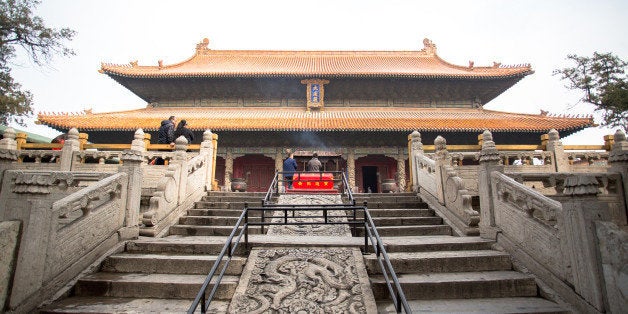
QUFU, SHANDONG PROVINCE, CHINA - 2015/03/19: Dragon carved stone steps leading to Dacheng Hall, also called the Hall of Great

One of the most perplexing aspects of Confucianism is that people easily misunderstand it as a 100% humanism. An example is that, when early Jesuit missionaries went to China and found Zhu Xi’s Neo-Confucianism of “Pattern-Principle” (理)and “Matter-Energy” (氣)was taken to be orthodox by Confucian elite, they categorized Confucianism as a form of “atheism” and thus, thought it deeply corrupted.

In Christianity, even love towards one’s neighbors is ultimately driven by divine grace. That means it is God who commands and makes us love our neighbors. However, because Confucianism lacks this kind of “divine agency” concept, it is very hard for Confucians to say when we love our parents and kids, it is ultimately and exclusively “Heaven” (天) who drives us towards this love.

The divergent situation is that Heaven in Confucianism is an all-encompassing constantly creative cosmic power. It lacks the Christian feature of “agency.” The Heavenly creation is spontaneous, natural, and if we use a term in modern control theory, it can also be self-organized in certain circumstances such as on the earth, but there is no guarantee that every creation of Heaven is ordered according to human expectation. Since Heaven is constantly creating, the essence of human beings, as an organic part of Heaven, is also constantly creating. This constantly creating human nature is named by “Ren” (仁) in Confucianism. An impressive allegory made by Neo-Confucianism is that this human nature “Ren” embodied in humans is like the “kernel” (果仁)contained in the nutshell (果壳), so represents the essential of life. But what is distinct in Confucianism is, Heaven provides the creative energy to human beings, but how humans, as an “agent”, use this energy is solely due to themselves.

As a matter of fact, when Confucians feel united with Heaven through an arduous process of self-cultivation, they would love a myriad of things under Heaven. But in this mystical situation, we can say, the great body of ours which we form with Heaven makes us want to love, but how to love concretely is still exclusively due to ourselves. In this way, the idea of “Heaven” as the divine reality in Confucianism provides ultimate axiological and aesthetic motives for humans’ universal love, but it can’t provide the “agency” which is the last crucial link leading to a concrete action of human love.

In this sense, it is wrong to characterize Confucianism as an “atheism”, since “Heaven” is indeed the divine reality which provides the ultimate axiological and aesthetic values to human deeds. But it is not a “theism” too, since “Heaven” is not a personal God and lacks the Christian-like “agency”. In fact, It is a non-theism. What Confucians worship about “Heaven” is a benevolent but wild cosmic creative power, without any anthropomorphic sort of purpose, will or plan. Correspondingly, the Confucian humanism is a non-theistic humanism, and in this strictly defined sense, it is a spiritual humanism.

Ming (命) – Mandate, Talent, Fate and Mission

(This article is originally published in Huffpost, 12/06/2017)

When early Catholic and Protestant missionaries came to China in the 16th through the 19th centuries, they found that something called the “Mandate of Heaven” (天命) was frequently mentioned in the early Confucian classics (such as the Book of Documents and the Classic of Odes). Consequently, some of them thought that Confucians believed in the same god as the God of Christianity. It is hardly necessary to say that they made a terrible mistake.

The Chinese character 命 is a combination of 口, mouth and 令, command. The literal meaning of 天命, often translated in English as the “Mandate of Heaven,” is thus premised upon a certain degree of personification of Heaven. After all, if Heaven is not a person, how could it announce any commands to its people? However, as virtually every religious comparativist inevitably tends to be, these early missionaries were biased in their understanding of ‘God.’ They thus tried to grasp Confucianism through a Christian lens, and so it is not surprising that they tried to find a monotheistic element in Confucianism and remained blind to the fact that Confucianism, during the process of its formation, was actually moving away from monotheism to mono-non-theism. This means that ‘Heaven,’ in the mainstream understanding of Confucianism as it was molded by Confucius, Mencius and Xunzi all the way up to the Song-Ming neo-Confucians, is not a person, but an all-encompassing, constantly creative cosmic acting without any actor who is behind the scenes.

One important reason which propelled Confucianism away from a monotheistic type of religiousness was theodicy. The religion of the early Zhou dynasty (approximately 1046-256 B.C.E) was pretty much similar to the Abrahamic religions, especially the stories from the Hebrew Bible. Heaven is Lord, and kings ought to obey moral laws enacted by Him. Obeisance will be awarded and violations will be punished. If an immoral king did not continue to take good care of his people, he would lose his Mandate of Heaven, and his dynasty would then be overthrown. This theology was employed by the Zhou dynasty to explain and vindicate their succession over the prior Shang dynasty. However, this theology is dramatically undermined if, no matter how diligently kings pursue moral self-cultivation, their dynasty still continues to decline. This happened to the Zhou dynasty and its kings after 771 B.C.E, when an ethnic minority invaded and plundered Zhou’s capital, killed King You (幽王), and forced the royal court to relocate in another city far to the East. In this period, which is replete with political turmoil and unattended natural disasters, we find plenty of verses in the Classics of Odes (詩經) expressing individual laments in the face of divine injustice. These are very similar to Psalms in the Hebrew Bible, as, for example, when the text quotes complaints such as, “Since I have not been immoral, why has Heaven punished me?”

There are two solutions to this conundrum of theodicy, and they generally are what demarcate the three Abrahamic religions from Confucianism. The seemingly unjust divine punishment can be conceived to be a temporary ‘test’ of the people’s righteousness and faithfulness: if righteous people cannot be rewarded immediately, they will be rewarded in the afterlife, the final Day of Divine Judgement. Alternately, Heaven was no longer to be conceived as a personal God: Although there are values and attractions in Heaven which are worthy of human worship, the Heavenly creation in this case is not conceived of as having any anthropomorphic sort of plan, purpose or agency. In this case, good and evil are defined primarily from the perspective of human beings and not from the perspective of God. Thus, if human beings themselves do not reward goodness, then good in its reciprocal form will remain unrewarded. By the same token, if humans do not punish evil behavior, then evil will remain unpunished.

This type of human religiousness may be expressed as ‘religious naturalism + humanistic ethics’ and replaced the pre-Confucian monotheism of the early Zhou dynasty. This process began with Confucius, garnered its mature form in Mencius and Xunzi, and finally achieved a systematic elucidation in Song-Ming Neo-Confucianism.

At the same time, a re-formulation of the concept of ming (命) was underway. In general, Confucianism employs three meanings for the term ming. The first meaning of ming is talent (稟賦). Everyone is talented, one way or the other. It is primarily manifested by the deep, even uncanny, interest a person often shows toward a particular realm of human life. It is also illuminated by the ease, passion, and happiness that a person feels when he or she consistently pursues his or her interest without any concern for reward. In Confucian terms, everybody is born in a specific place and time, and thus their mental and physical conditions are formed by a specific portion of the cosmic matter-energy (qi, 气). That’s the reason, in this view, that people are talented in different ways. Understood as such, one cardinal function of education is to help people find their own special talents. Confucius is quite excellent at mentoring his apprentices in discovering and fostering a variety of talents (Analects 11.3). In addition, Confucius teaches that we ought to use our talents to serve multiple purposes and to offer good to all human beings, rather than behaving like a utensil, merely serving a fixed range of purposes and thereby being unable to broaden the value of their talents (Analects 2:12).


The second meaning of ming is fate (命運). No matter how talented a person may be, he or she can only be talented in certain ways. Also, no matter how consistently a person pursues his or her talent, the degree of his or her accomplishment is restricted by the time, the environment and by his or her personality. In other words, the portion of cosmic matter-energy that Heaven gifts to each person also limits them. Consequently, humans have to accept the radical contingency of human existence, and to find ways to reconcile their always finite life-situations with their ideals, many of which may be of infinite extension. In this regard, Confucianism teaches us to begin with what is nearby. We need to begin by trying to promote and harmonize the growth of our own persons, our own families, our own communities, and then gradually expand outwards to the world so as to enrich the value of all human lives. In other words, Confucianism acknowledges the realities that constrain human life.

Nevertheless, these constraints can never determine human life. This leads to the most important third meaning of ming as mission (使命). Among all the talents with which Heaven endows human beings, the most valuable one is an irresistible capacity to persist in creativity, situated in the human mind-heart (心). Confucians believe that no matter how constraining the situation is, the human mind-heart can always find ways to transform it in some degree for the better. In the terms of the early Confucian text, Zhong Yong, the mission of human life is to assist in the cosmic creation that remains uncompleted by Heaven and Earth, and thus human beings are seen to form a triad with Heaven and Earth. This means that humans have a responsibility to manifest the One principle of the Heavenly creation in a specific humane (仁) way. Therefore, when we feel deeply frustrated about our lives, the best way to rebound from distress is to exert our unique talent to promote the well-being of other people who are near at hand: our families, our communities and our friends. For Confucianism, the personal creativity which is to be infused into the universal well-being, defined by a widening range of human-human and human-cosmic relationships, is the ultimate meaning and power of human life.

In a word, Confucianism is neither voluntarism, extolling the infinite compass of human free will, nor is it fatalism, denying any possibility for human creativity. In the Confucian view, human beings are endowed with various talents. We learn, interact, fulfill and finally improve our ‘fate,’ expressed as a series of constraining realities. During this process, the human mission to assist in the cosmic creation of Heaven and Earth is an ideal which stands as an eternal allurement, always going beyond any fixed form of human creativity. Understood in this way, to be a Confucian is to be ‘destined’ and ‘commissioned’ as a non-violent warrior and fighter for the realization of dynamic harmony in the world. Relying upon our various unique talents, let us continue to fight against and break through any constraining life-situation, and thereby to create new forms of dynamic harmony to serve the common good of all human and cosmic beings!

Xunzi: A Short Introduction

Audio: A short introduction to Xunzi, by Dr. Bin Song.
Video: A short introduction to Xunzi, by Dr. Bin Song.

Hallo, this is Dr. Bin Song in the course of “Ru and Confucianism” at Washington College.

In this unit, we will discuss Xunzi, the last major Ru philosopher in the pre-Qin period of the tradition.

As indicated by my teaching experience, beginning readers of the Ru tradition in the west normally find Xunzi (circa. 310-235 B.C.E)’s thought quite congenial. This is mainly because in a way blatantly contrary to Mencius, Xunzi thinks human nature is bad, and hence, the process of education and self-cultivation should not be envisioned as a course of re-discovering and nurturing something that is already within us. Rather, for Xunzi, to be a fully human is to find a teacher of authority to inculcate rituals and rules from without, so as to transform one’s uncultivated inborn dispositions to something different. While presenting his moral philosophy, Mencius likes to use metaphors from the industry of farming to describe that moral development is like the process to prepare soil, sow seeds, grow sprouts and therefore, after all human efforts are duly executed, it would be up to the nature to take care of everything else. However, in a very contrastive way, Xunzi thinks the process of being humanized is like one to straighten a piece of shapeless wood using knife and file or to temper a chunk of metal stone using fire and water. In these cases, the craftsmen have to input their blueprints into raw materials so as to transform them into something with form and order. Emphatically, the power of transformation by no means belongs to those raw materials themselves.

Since Mencius thinks education is to rediscover and enlarge something that is innate to each human individual, the role of teachers, books, and all other pedagogical measures is best to be thought of as being facilitative and heuristic, rather than being deterministic. Therefore, regarding the Classic of Documents which was looked at highly by the Ru school, Mencius said that “I would rather have no such a book called ‘documents’ if I have to believe everything in it.” (Mencius 7B) Similarly, the most honored teachers in the Ru traditions are called “sages” or “sage-kings”; however, since the role of teachers for one’s education was thought of by Mencius as being facilitative and heuristic, he did not believe sages were flawless, perfect and semi-divine beings. Instead, he commented that sages actually share the same innately good part of human nature with every other human being, and the excellence of sages consists in their persistent will to perfect themselves once they make mistakes. (Mencius 2B). Most importantly, since he thinks the nature plays a significant role in the process of one’s humanization, Mencius is pious towards the all-encompassing “heaven” (天, cosmos), and describes the process of education as one of “preserving one’s heartmind, nourishing one’s human nature, and ultimately, serving heaven.” (Mencius 7 A)

Because Xunzi holds a fundamentally different view from Mencius on the point of human nature, he disagrees with Mencius on all the points mentioned in last paragraph as well. Firstly, since the process of humanization does not involve the facilitating role of the nature, the Ruist term, Tian (天), lost its religious connotation in Xunzi’s thought. Instead, Tian was understood by Xunzi as a purely natural process of life-generating; it provides the raw materials for human civilization to thrive. However, whether humans can manage and utilize these materials for their own purposes entirely depend upon human efforts. Xunzi claims that “Rather than following heaven and praising it, why not manage the mandate of heaven, and then, utilize it!” (Xunzi, chapter 17) Secondly, in Xunzi’s pedagogical and political visions, it is up to the teacher with an absolute authority who relies upon their extraordinary intelligence to perceive principles which harmonize the relationships among human and comic being. Therefore, it is also these teachers who design civilizing rituals and rules to transform ordinary human beings’ under-human, inborn dispositions. Accordingly, Xunzi thinks sage-kings, as the most honorable teachers in the Ru tradition, are impeccable, semi-divine figures, and people should never challenge their authority. For instance, when explaining why Yao and Shun did not need to abdicate their thrones, Xunzi denies that these sage-kings could be too old to retain their strength fit for a ruler. He says that:


“As for the Son of Heaven (such as Yao or Shun), his power has the utmost weight, and his body has the utmost ease. His heart has the utmost happiness, and nowhere his intentions suffer being turned back. …. Thus, when he inhabits the palace, he is like a supreme spirit, and when on the move, he is like a heavenly deity … And so I say: there is such things as old age for the feudal lords, but there is no such things as old age for the Son of Heaven.” (Xunzi, Chapter 18, translation adapted from Eric L. Hutton.)


In other words, since the entire country provides the best for their supreme leaders to preserve their life and execute their heavenly intelligence, none of them needs to relinquish their political power to others, and the country would be always governed in a superb way under their leadership.

After I sketch the differences between Mencius and Xunzi as such, I believe you would understand better why, at the beginning of my lecture, I reported that starting readers of the Ru tradition in the west normally feel congenial to Xunzi’s thought. This is because Xunzi’s conception of bad human nature and his related thought on human transformation and government are not only similar to the Christian narrative of human fate as deriving from original sins, but also to the fundamental tenet of liberal philosophy that the state of nature of human beings always involves problems, and thus, it needs a contractual process of sociality and governance to rectify them. Nevertheless, seen from the emic perspective of the Ru tradition, Xunzi’s view that rituals derive from the source of a super-human intelligence alien to ordinary human beings’ inborn dispositions is a significant deviation from his Ruist predecessors. Although it is a good philosophical question to ask which of the contrasting views of Mencius’s and Xunzi’s is the right one from a non-temporal perspective, we still need to contextualize Xunzi’s thought in its historical situation, and thus, ask ourselves: how did this deviation of Xunzi’s thought come about at the first hand?

In order to answer this question, it is helpful for us to recall all the major figures that our course has focused upon so far in the timeline since the beginning of the Ru tradition. They are the sage-kings Yao and Shun, the Duke of Zhou, the philosophers Kongzi (Confucius), Mengzi (Mencius), and Xunzi. From an institutional perspective, there were three different kinds of political regimes each of these figures lived in, and thus, the difference surely influenced how these Ru masters envisioned and articulated their Ruist ideals of human society.

In the time of Yao and Shun, the political institution is called the one of abdication, by which a supreme leader, while taking into consideration recommendations made by an assembly of tribal leaders, relinquished their power to a worthy human who normally did not share the same family name with them. The principle of Ru philosophy to embody in this institution is particularly “to treat worthies as worthy” (贤贤), or “to respect worthies” (尊贤).

However, the institution of abdication cannot be sustained for long since if one tribe becomes much more powerful than others, it may just refuse to abdicate their political powers and instead, take on patrilineal inheritance as the new standard of power transition. This was exactly what happened after the time of Yao and Shun, and Duke of Zhou had furnished the best philosophical articulation of this new feudal system. In the ritual system designed by Duke of Zhou to fit the feudal society, members in the same royal family are enfeoffed; as local leaders, they need to pay regular tributes to the king, and in the time of war and other national businesses, they must follow their king as a supreme leader as well. However, on issues pertaining to the organization of their own states such as economy, taxation, hiring officials, policing, etc., these enfeoffed lords enjoyed a great degree of sovereignty and autonomy. As analyzed in the section on Duke of Zhou, two principles of Ru philosophy were represented in this feudal system: “to treat family as family” (亲亲) and “to treat worthies as worthy.” The implication of the latter principle in the feudal system is easy to understand since local lords and the king need to employ able men to staff their courts; however, the principle of “treating family as family” is particularly important since the power was distributed according to the order of seniority in varying familial lineages, and thus, it would be crucial for maintaining a peaceful political order of a feudal system to abide by a strict family ethic.

The elaborate ritual system designed by Duke of Zhou sustained Zhou Dynasty for quite a while. However, after several hundreds of years, the system was collapsing due to the same reason which once lead to the end of the institution of abdication, viz., in a feudal system, if local lords became too powerful, the king just could not control them. The time of Kongzi and Mengzi was such a period of war when those local lords once enfeoffed by the Zhou kings constantly fought each other. In face of the rampant social and political disintegration, the ideal of Kongzi, as it was followed by Mengzi, was to recover the original ritual system designed by Duke of Zhou. More distinctively, while transmitting ancient cultures, Kongzi and Mengzi distilled a philosophical kernel, viz., the transcendent virtue of Humaneness, from the Zhou ritual system, and hence, created new possibilities for the future development of the Ru thought.

Nevertheless, in the late stage of the so-called Warring State period when Xunzi lived his life, there was a new political institution created by the belligerent states located in the northwestern periphery of the Zhou dynasty. In order to understand the deviation of Xunzi from his Ruist predecessors, the impact of this new institution upon Xunzi’s thought cannot be underestimated. This is the institution of prefecture, by which the administrative power of a state is divided vertically, and the supreme leader retains their ultimate power to appoint officials in varying governmental tiers and to prescribe laws to manage varying offices. The system was designed solely for the purpose of centralizing authority, which turned out to be very effective to militarize a society so as to combat its external enemies.

In a strict sense, this system needs neither to “treat family as family” nor to “respect worthies,” since its political power is distributed among governmental tiers according to neither the pedigree nor the virtue of a governmental official. Rather, as indicated by the most powerful state structured by this institution of prefecture, viz. the state of Qin, which also became the first unified imperial dynasty after the collapse of Zhou, commoners were either rewarded or punished by a set of laws designed for the singular purpose of assisting the central authority to build the domestic order, provide supplies, and win battles against other states in the field. In the intellectual history of ancient China, the philosophy to articulate the rationale of this new system of prefecture is called “legalism,” and it became one most important trend of political thought contemporaneous to Xunzi’s Ruism.

When Xunzi visited the state of Qin, he was impressed by the order of its society and the effectivity of its government. He praised it as “to be at ease, yet bring about order; to act with restraint, yet take care of all details; to be free of worry, yet achieve meritorious accomplishment – such is the ultimate in good government!” (Xunzi, chapter 16). However, being aware of that such an effective governmental system of Qin was based upon an overtly military state ideology, and thus, lacked a moral foundation advocated by the Ru tradition, Xunzi also predicted Qin’s eventual perish.

Therefore, the overall intention of Xunzi’s thought becomes clearer to us after its historical situation gets clarified: in a time of unstoppable political crisis and social disintegration, Xunzi could by no means hold on to the original feudal system which once flourished in the time of Duke of Zhou. In this regard, he welcomed the creation of the system of centralized authority in the institution of prefecture with his full-heart, and saw it as a hopeful means to regain the unity and peace of civilization. However, while judging the prefecture system to have lacked a moral foundation, Xunzi tried to infuse the moral teaching of Ruism with the system so as to create a new type of institution to embody Ruism. While doing so, Xunzi modified the traditional Ruist conception of “rituals” according to the legalist standard of laws, and advocated that it is entirely up to the process of ritualization to transform the innately bad human nature. In other words, what Xunzi intended was to create a state ideology of Ruism to sustain the legalist institution of prefecture.

Since Xunzi’s thought can be understood as such, it will be of no surprise for us to re-read those deified depictions of Ruist sage-kings by Xunzi. Yes, in this Ruist system of prefecture, the central authority can only be envisioned as a supremely intelligent and virtuous human being who design the best rituals and laws to make the entire system revolve around their flawless political gravitas and moral charisma.

However, one final question we ask to Xunzi would be similar to how we would respond to Plato’s idea of philosopher king: is it ever realistic to expect that such a political and moral superhuman can ever be born throughout the entire history of humanity?