Ru Meditation: Gao Panlong(1562-1626 C.E) (Boston MA: The Ru Media Company, 2017) is an annotated translation of the major works of Gao Panlong on Ruist (Confucian) quiet-sitting. Its major themes include poetic descriptions of the meditative experience, practical guidelines, philosophical reflections, and biographical accounts. The translation not only aims to facilitate an understanding of Gao Panlong’s thoughts on quiet-sitting but, more importantly, it also hopes to serve as a practical guide for meditation in the Ruist manner.
Scholar Reviews:
“Bin Song’s accessible, thought-provoking translation and commentary brings these writings on Ruist (or Neo-Confucian) meditation alive for the modern reader. Students of Chinese culture and philosophy, as well as aspiring practitioners of East Asia’s great tradition of Ruism, now readily can enjoy and learn from Gao Panlong.” -Stephen C. Angle, Professor of Philosophy and East Asian Studies, Wesleyan University
“Bin Song’s translation and commentary on Gao Panlong’s work on Ruist quiet-sitting is a critical first step in elucidating Ruism as a living spiritual tradition to English-language readers. Moving beyond academic scholarship on Ruist thought, Song’s translation and commentary places Gao’s seminal work on Ruist quiet-sitting in the larger context of meditation and spiritual practice. Contemporary readers will find it a helpful guide to understanding what Ruist quiet-sitting shares with other traditions of contemplative practice, and what sets it apart.” -Matthew Duperon, Assistant Professor of Religious Studies, Susquehanna University
Tai Chi and Eight-Brocade Exercise in Confucianism (Ruism)
Hallo, I am Bin Song. I am Ru scholar, therapist and college professor. This audio is written and recorded by me to introduce you to the practice of Tai Chi and Eight-Brocade Exercise in light of the philosophy and practice of Ru Meditation.
I once described the spirit of Ru meditation as Meditation in Motion, which aims to extend the state of energy equilibrium across both static and moving forms of meditation. For doing this, I explained that breathing practice is a foundation. On the basis of this, we can start to practice meditation in its static forms such as sleeping, cross-legged quiet-sitting, quiet-sitting on a chair, and standing. After this, we add three moving forms of Ru meditation into our list: walking meditation, eight-brocade exercise, and Tai Chi (or Taiji in pinyin) martial arts.
Eight-Brocade Exercise and Tai Chi martial arts should be counted as two most popular physical exercises that were created in ancient China and are still practiced by people all over the world. They are on the must-do list in many Qi Gong clubs, and through internet, you can also find abundant instructions in both video and word forms. I include links under the video to help you find these instructions; in Maryland and the greater Washington D.C area, I would also like to find friends to teach and practice these moving forms of meditation together. Nevertheless, I would not include a point-to-point instruction on how to do these two moving forms of Ru meditation here.
However, since we are talking about Ru meditation, it would be interesting to discuss the meaning of these practices to the tradition of Ruism. Using short videos (which are embedded in the above youtube video, starts from around 10:00 ), I will also demonstrate shortly how I do these moving forms of meditation in person.
First, I need to remind you that there are three major spiritual traditions in ancient China, Ruism, Daoism, and Buddhism, and in reality, all these three traditions played a significant role in originating, documenting, and spreading varying forms of physical exercises and martial arts.
For instance, focusing on the Ruist side, I will tell you that the first person who gave the name “eight-brocade exercise” and documented its practice is called Hong Mai (1123-1202 C.E) in Southern Song dynasty. Mr. Hong Mai grew up in a Ruist family, participated in civil examination, got the highest degree, and appointed as a scholar-official for varying governmental posts. Therefore, we can discern the deep Ruist background of Hong Mai’s scholarship. Another great example is Chen Wang-ting (1600-1680), the founder of the Chen-Style Tai Chi martial arts. He passed both the martial and civilian branches of civil examination, and his practice and scholarship on Tai Chi was versed deeply in the spirit of Ruist metaphysics and ethics. On top of these two examples, let’s remember that martial arts is a very important component of civil examination, and for examinees that finally succeeded to be appointed as a military official in the army, they can be seen as the martial side of the Ru tradition, vis-à-vis the civilian side of Ruism which people today may be mostly familiar with. But some greatest Ru scholars, such as Wang Yang-ming and Zeng Guofan, were also great military leaders. And for the sake of indicating loyalty, wisdom, and courage, all Ruist virtues, to their own country and people, and for the sake of self-cultivation, physical exercises and varying martials arts are very much integral to the life of those Ruist military officials.
In a word, what I tried to convey through these examples is that Ruism, Buddhism and Daoism, seen from their own philosophies and histories, are three self-organizing, yet mutually interacting comprehensive systems. A person can broadly learn all these three traditions, form their own philosophical views, and practice martial arts with these views. Or, a person can be a very staunch advocate devoted solely to one of these three traditions, and then, embed the practice of martials arts in it. For me, I understand Ruism as a tradition of liberal arts, and advocate a version of “anchored pluralism.” In other words, I take Ruism, its philosophy, history, and practice, as a major anchor of my personal life, but simultaneously, I also try to learn broadly from other Eastern and Western, scientific and humanistic traditions, so as to enrich my own life, and enrich the Ru tradition that I am advocating.
Therefore, in the following, I will mainly show how I understand and practice these two moving forms of meditation in a Ruist manner.
What I like the eight-brocade exercise the most is its coordination of breathing with body movements. For instance, this first move is called “ Two Hands Carry the Heavens while Regulating the Three Stoves,” (两手托天理三焦) and “Three stoves” means the three major parts of our inner organs from our heart to our lower abdomen. When doing this move, our hands start from crossing each other while rising. At this moment, we inhale. When we top our hands above our heads, we look upward, and reach the limit of inhale. Then, we look forward while holding the breath for a short moment. After that, our two hands fall down from the two sides of our body; during this process, we slowly exhale until a short pause to back to our commencing posture. Look, the principle of doing this exercise is almost exactly the same as our other practices of Ru meditation. For instance, In the breathing practice, the first stage is to use a series of numbers, or a mantra to help our attention focus upon our breath. In the walking meditation, we match our steps to our breathing, and contemplate varying parts of our body’s movement while walking. Here, in the eight-brocade exercise, we coordinate our breath with our body movements which are designed to exercise varying parts of our body, and during the process, our attention needs to follow each detail of the body movements while feeling our person united as a whole with the environment. See how consistent the practice of Ru meditation is. Because of this consistency, one of my most favorite moving practices of Ru meditation is actually to combine breathing, walking and the eight-brocade exercise. So I will take a deep breath, walk for some steps, and then, do a move of the eight-brocade exercise. How wonderful the feeling is after this!
Another point I particularly like this eight-brocade exercise is that each of its movement has a title, and combined all together, these titles read as a poem, and the spirit of this poem represents very well the holistic well-being that Ru meditation aims for. For instance, the seventh title reads as “clench your fist, show angry eyes, and then, increase your vital energies and strength” (攒拳怒目增气力). According to Ruist ethics, no emotion is essentially bad, and it all depends upon whether you can have the appropriate emotion in the right measure and at the right situation, including the one of Anger. For instance, Zhu Xi once said that “Anger caused by one’s hardened temper should not exist. Anger caused by one’s moral sense should not vanish.” (《朱子语类》) Therefore, when facing obvious social injustice, our social engagement needs to be supported by a deeply non-relativistic moral sense of right and wrong. In this sense, the practice of eight-brocade exercise, especially in this seventh move, can nurture our rooted moral feelings, and prepare us for substantial social engagement while nurturing an undisrupted inner state of tranquility and self-contentedness.
Clench your Fist and Show Angry Eyes.
Good, let’s move on to the practice of Tai Chi (or Taiji in pinyin) martial arts. What I demonstrate in the video is part of the yang-style 24 move of Tai Chi martial arts, which is also one most popular for beginning practitioners of Tai Chi. Regarding the practice of Meditation in Motion in a Ruist manner by a human individual, nothing is more exemplary than Tai Chi martial arts.
Firstly, the harmonious unity of heart-mind, air, body and environment, which I mentioned as a goal of Ru meditation, is vividly embodied by this practice. You need to match your attention to your breath, and then, your breath to the details of each move, and furthermore, feel your intimate and solid position between heaven and earth in a very holistic worldview. In particular, similar to the eight-brocade exercise, each move of Tai Chi has a name, and by pondering the name and its embodied move, we can furthermore appreciate the connection between us and the human civilization continuous to the nature. For instance, one move is called “a white crane spreads the wing”, and another move is called “hands embrace a Zither”. How beautiful these moves are!
White Crane Spreads the Wing.
Secondly, each detail of each move, and their mutual connection, is all about the subtle and smooth interaction between Yin and Yang aspects of the cosmic and human vital-energies, and thus, captures the spirit of dynamic harmony and meditation in motion very well. For instance, for the starting posture, you inhale, rise your hands, that is yang; but your palms need to face inwards, and this is yin. When your hands rise to the limit, you exhale and move the hands down, which is yin. But simultaneously, you palms need to face outwards, which is another form of Yang. Also, there are many circular or half-circular movements, representing the holistic commitment in this practice. Some move is solid, like standing solidly or closing your hands, while some is thought of as vacuous such as making the hand position like holding a ball. You see, these are a number of minor movements to embody the subtle interaction between yin and yang, which is a careful unfolding of the process of dynamic harmonization.
Hands Embrace a Zither
Thirdly, despite all these subtleties and varieties, all movements actually pivot upon our lower abdomen and its related belly and back. This part of our body is like the “ultimate pole”, the original meaning of Tai Chi, around which all our movements are pivoting. Impressively, this is a distinctively Ruist idea. First, the term of Tai Chi is from the Ruist Classic of Change, and it is used to describe the ultimate creative power of the entire universe; second, one central purpose of Ru meditation is to extend the state of energy equilibrium, or the one of centrality, to both static and moving forms of human activities. That means, despite changes and vicissitudes, our life is always centered upon a principle, and the principle is simple, consistent, and adaptable to change. You see? This is another great example of Ru wisdom.
Great! I hope you can find your own ways to practice these moving forms of meditation, and take care!
References:
A youtube video I like about Eight-Brocade Exercise
An English explanation of the each move of the Yang-style 24-move Tai Chi
Hallo, my name is Bin Song. I am a Ru scholar, therapist and college professor in the disciplines of philosophy, religion and theology. This audio is written and recorded by me to guide your Ru (Confucian) meditation using the postures of standing and walking.
The posture of standing meditation is fairly straightforward, since you already know the posture of the upper body when you do quiet-sitting on a chair or cross-legged quiet-sitting. While standing, your upper body remains the same as those postures.
Standing posture is very fit for moments when you need to stand for a longer while. For instance, when you ride a bus, a train, or other vehicle, especially when the vehicle is crowded, you need a space for yourself to go through the stress created by unhappy travels. In these moments, you can simply stand straight, or lean on something, focus upon your breath, and start to do Ru meditation according to the method I told you before. Or, another instance is that, before you enter into an auditorium for public speaking, you can simply stand up straightly, take a deep breath, and start to gather all the surrounding energy for courage, composure and confidence. In a deep meditative state, you can even start to visualize your speech in front of those dedicated audience so as to prepare yourself well for the speech.
In the spiritual level, the standing posture is very fit for the description given by the Ru tradition to an upright and outstanding junzi: they are “carrying the heaven, and standing on the earth.” In the terms of the Classic of Change, a junzi would combine the virtue of heaven as they work diligently towards daily renewal and self-strengthening, and the virtue of earth as they are all-caring and nurturing towards the other living beings. So, while standing up and meditating, please feel the unique position you take between the heaven and the earth as an upright Junzi who is dedicated to daily renewal and all-encompassing universal love.
Many postures I introduced in the past can be practiced as a package. For instance, before sleeping, you can do cross-legged quiet-sitting first, and then, sleeping meditation second. And another best package of practice is that, first, you do quiet-sitting on a chair, then, you stand up for a while, and finally, you start to walk. Therefore, in the following, I will start to introduce the first moving posture of Ru meditation in this series of broadcast: that is to meditate while walking.
There are beautiful passages in the Analects that record Confucius’s saying while he was walking with his students. One of my favorites is the last verse of Chapter 10. No interpreter in the commentarial history of this verse exactly knows what happened here, including me. But I will try my best to render it in accessible English, and in my own way. It says, when Confucius was walking in a mountain, he saw several beautiful hen-pheasants. While he looked at them, those pheasants flew away, and after circling around for a while, they settled down again. At this moment, Confucius said: “The hen-pheasant on the hill bridge – How timely! How timely!” Then, Zi Lu, one of Confucius’s close students, cupped his hands to greet those pheasants. These pheasants flapped their wings for several times, and then, took to the air. And this is the end of the scenario.
The fact that this verse is located at the end of one Chapter which talks about how Confucius sleeps, sits, stands, walks, looks, expresses his face, speaks, eats, cooks, and does all other details following his sense of ritual-propriety at evolving situations of life is very telling. In the context of Ru meditation, what this seemingly very obscure verse speaks to exactly what I tried to convey in previous podcasts of Ru meditation; that is, Confucius acclaims that a continually self-cultivating junzi, like those beautiful hen-pheasants, can timely move, and timely settle, so as to extend an inner state of energy equilibrium or centrality, to both static and moving moments of human life. This is actually what the Ruist idea “ritual-propriety” 禮 is all about: a properly ritualized human deed would let involved living beings in a specific situation harmoniously and dynamically fit together.
Understood in this perspective, the simplest moving posture of Ru meditation, the one of walking while meditating, is of crucial significance. This is because, for meditation practitioners, they may have formed a bad habit of enjoying stillness, while disliking movement. For instance, whenever they close their eyes, sit quietly, and focus upon their breathing, they feel great. However, whenever they need to deal with real human issues, or simply start to move, they will feel disturbed, distracted, and cannot bundle themselves up. Because of this, a discipline of moving meditation using the same method of Ru breathing will greatly balance our sense of body kinematics, and thus, integrate our life as a dedicated and functional whole. On the other hand, professionals in today’s world are usually sitting for too long a time, and routinely straining their eyes and bodies before screens too. In this case, sitting meditation may cause further harm to their body if they cannot command an alternative approach of standing or walking meditation.
Good, enough for the philosophy part of walking meditation in the Ru tradition. Let’s move on to talk of its method. (Pause, first half)
For the practice of walking meditation, it is better to do it while your breath starts to enter its second meditative stage, the so-called stage of “following breath,” according to the method of Ru breathing I explained before. This is because in the first stage of Ru breathing, your primary focus is to use counting to concentrate your heartmind upon your breath. In this initial stage, if you simultaneously walk while counting your breath, it will add another action to your initiative of meditation, which will make it harder. However, in the second stage of following breath, your breath has become calmer, slower, and deeper, and your attention has also been easily following each part of your breathing. Like what I suggest you to contemplate your body and contemplate your environment while you follow your breath, you can start to walk as well. Because the concentrated attention can now easily encompass each detail of your body movement, through walking meditation, you can furthermore integrate your moving body, your heartmind, the air, and the environment as a harmonious unity, which is the goal of Ru meditation.
Since it is better to do walking meditation when you succeed to follow your breath, beginning practitioners may need to do quiet-sitting on a chair, or standing meditation for a while before they walk. This is the reason why I said that some postures can be practiced as a package: sitting, standing, and walking. However, for adept practitioners, they can easily focus their heartmind upon breathing and follow their breath, so it would not be an issue for them to do walking meditation at any time they want.
There are several points for the method of walking Ru meditation:
match your slow and deep breath with your steps. This may mean a few steps for inhale, a few steps for exhale, and fewer steps for the short pause, depending upon how slow your breathing is. However, it is important to put the attention of your heartmind simultaneously upon your breath, and upon moving details of your body.
when moving, be aware of each step of your walking. You raise one of your legs, let the heel of one foot touch the ground first, and then, do feel how the bottom of foot, and your toe, touch the ground one after another. The same goes to the other foot. While contemplating a still body requires your attention to each part of your body, the same goes to your moving body, particularly the parts of lower legs and the feet, when you are walking. So, we will do walking meditation like this: a deep inhale, slowly walk, your left heel touches the ground, your right toe starts to leave the ground, then, the sole of your left foot settles; while your right foot leaves the ground, your left toe settles too. Then, a very relaxed exhale. The smooth move of your whole body is a subtle and beautiful interaction between the yang and the yin powers of the universe and yourself. So, heels down, toes up; one knee bends, another straights out; one step forward, one breath downward. If you can succeed to put your attention upon all these moving details of your body while walking, you realize the pattern-principle, li 理, in the context of meditative walking.
feel the solid ground! That’s the primary component of your environment you need to contemplate when you are doing walking meditation. Also, all the other components of your environment are worth contemplating. I once did walking meditation on the beach, in the forest, in the parks, in the college campus, etc. In these cases, you can encompass the ocean, the sand, the wind, the tree, the chirping bird, the twisting worms, the historical building, and all the other components of your environment into your contemplation while walking and joyfully breathing. Believe me, this will be a transformative human and cosmic experience.
The position of your upper body will be like the one when you do quiet-sitting on a chair or the cross-legged quiet-sitting, including how your position your backbone, chest, head, eyes, and tongue. However, because your body is slowly moving, your arms will swing a little bit, and this is totally normal; make the arm relaxed, and swing natural following the rhythm of your moving body.
You can walk in straight lines, back and forth, just like what I am doing in the video; or walk along the four lines of a square. When reaching one end point, turn your body slowly, and feel how your muscles, bones, and your heartmind work together to make this smooth and peaceful turn. A key to understand moving forms of Ru meditation is that no matter whether your body is moving or not, you can always feel the inner quietude in your heartmind. This implies you extend the state of centrality, the one of energy equilibrium, to both still and moving parts of your life, which is really what Ru meditation is all about.
Good, these are the five major points for walking Ru meditation. Before concluding this session, I will share you my best experience of walking meditation. That happens during one night, perhaps around 12 o’clock am, when I practiced cross-legged quiet-sitting for a while. I entered the third stage of breathing, the one of settled breath. Then, I stood up and started to walk. What marvels me is that I keep myself on the same stage of settled breath for a long time. With only a slice of air breathed in, my breathing can be suspended there, and it is robust enough to support my walking. I feel my entire body is extremely light, transparent, and my mind is so clear of everything that happens in and surrounding me, which extends as far as the entire universe. This is what happens when the state of centrality is extended from a still body to a moving one because of the accumulative efforts of my practice of Ru meditation. Zhu Xi, one of the greatest Ruist philosophers after Confucius, once described his experience of Ru meditation as “It feels like lying on the clouds, and walking in the sky. I dare not talk of it.” Yes, I think I need to stop here since I already talked of it.
Hallo, my name is Bin Song. I am a Ru scholar, and a college professor in the disciplines of philosophy, religion and theology. This audio is written and recorded by me to guide your Ru meditation using the posture of sleeping.
Sleeping meditation takes a very important role in Ru meditation. Rightly at the beginning of the Ru tradition, Mencius lived around 3 century B.C.E and was a staunch follower and wise interpreter of Confucius’s thought. He wrote beautiful passages about “night vital-energies.” (夜气). He likens human body to a mountain, and says that a daily good sleep for a human being will be like a regular amount of sunshine, air, rain, and other necessary natural elements to nourish a mountain. As a result, the mountain will become lush, vital and fertile, and it is going to grow, feed and bring joy to the life of many living beings. However, if humans are deprived of sleep, that will be like hunters and peasants who dare to use axes and hatchets to exploit the mountain every day. In this case, the mountain will eventually become bald and barren, and is completely stripped of any ability to nurture other beings. What is distinctive about Mencius’s thought on sleeping meditation is that he says when people get a good sleep, and have a clear, calm, and sensitive mind in the morning as a consequence, this will help us to be more moral. This is because it will become easier for us to feel the interconnection of all beings in the world, and when a baby is about to fall into a well, or any other similar distress happens to our human fellows, we will be more likely to have a feeling of empathy and try to care and help them. In other words, if we have a good sleep to continually nurture the vital-energies within our body day and night, we will become more moral. I do not know how many classes of ethics in modern universities and colleges are teaching how to sleep, but as inspired by Mencius’ thought and practice, I definitely believe they should.
[convertful id=”36168″]
In the period of neo-Confucianism, Ru masters’ writings about meditative sleep became more abundant.
There are beautiful poems written by Ru masters such as Chen Baisha (1428-1500 C.E), who described his sleep as “thousands-of-meters-high clouds float under my pillow.” (千丈雲根枕底眠) It was also said that when Wang Yangming (1472-1529 B.C) stayed in the army as a general and lead a troop for a military expedition , using the method of meditative sleep, he could have no normal sleep and thus, remained to be awake for about 40 days. In general, for these Ru masters in the period of neo-Confucianism, they understood meditative sleep from two perspectives. Cosmologically, a good sleep is to preserve and nourish the yin side of humans’ daily routine. In other words, If you cannot recharge yourself during a restful and peaceful night, you cannot be full of yang power to act and function in the busy daytime either . Ethically, a good sleep is thought of being able to nurture the innately good human nature, and therefore, like Mencius said, to make humans’ practice of morality more ready and steady.
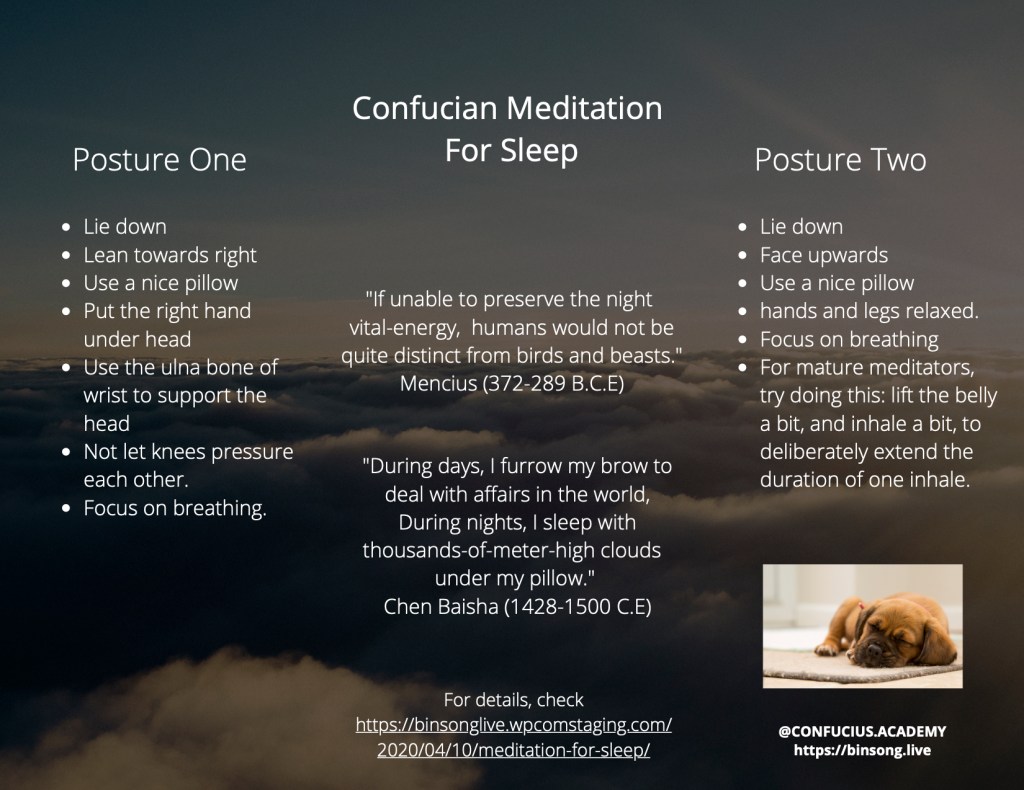
As shown in the pictures, I will introduce two postures of meditative sleep, and they are very suitable for practice before one’s sleeping.
One, you lean towards the right side, to avoid the pressure on your heart. When you lean towards the right, put your right hand under your neck. The part of the right hand that supports your head refers to the ulna bone part of your wrist. Please do not put the part of your wrist where you can feel the pulse under your head; in this case, it will bring pressure to your system of blood circulation, which causes no good. Also, where your head gets supported is the part of your neck below your ear. The final point for the head part in this sleeping posture is to put a nice pillow under your head and hand. So, in a word, lean towards right, on a nice pillow, put your right hand under your head, and use the bone part of your wrist to support your neck. If you position yourself well in this way, your head will be slightly higher than your knees, and you would not feel heavy-headed during the practice of meditative sleep.
Another key point of this posture is your knees. Do not let one knee directly upon another; you can put your left knee on your right lower leg, and in this case, your two legs would pass each other in a small angle. Then, you would not feel any extra pressure on your body.
The last point is a natural consequence of the aforementioned two points, that is when you lean right, do keep your tract of breathing relaxed and unblocked.
If you position yourself well in this sleeping posture, what remains for you to do is to focus upon breathing using the method of Ru breathing as I explained.
Sounds good? Yes, let’s move on the next posture of sleeping meditation. In this posture, You face upwards, and then, completely relax your four limbs. As indicated in the picture, there is almost no technique whatsoever for this posture other than using a pillow, which we all do.
In this completely relaxed sleeping posture, since we can feel our belly’s up and down more obviously, it will be a very good moment to practice the extra breathing practice I mentioned in third stage of Ru breathing. That is, you can deliberately extend the length of your inhale so as to let breathed oxygen more abundant, running deeper and broader in your body. So, when the belly rises a bit, breathes in a bit; rises a bit, breathes in a bit. There is a short time of holding breath after each bit of inhale. Sometimes, even without any further discipline, for mature practitioners of meditative breathing, this state just happens naturally. In this natural case, a deep, slow and delicate inhale will take a length of time longer than usual, and you will have an utterly joyful and even gratified feeling because of this deep breath. As a consequence, when your consciousness feels modified during the process, you will fall into a sound, fast, and deeply healing sleep.
Good. This will be the end of this session, and I hope you can have a very good sleep every day. Take care!
Hi, My name is Bin Song. I am a Ru scholar, therapist, and college professor in the disciplines of philosophy, religion, and theology. The audio is written and recorded by me to guide your practice of cross-legged quiet-sitting Ru meditation.
And this will be the second among seven postures of Ru meditation that I intend to introduce through this series of audio broadcast.
The posture of cross-legged quiet-sitting originates from ancient Hinduism, and migrates to China following Buddhism in around the 2 century C.E As I mentioned in last audio, the attitude of the majority of Ru scholars towards this posture in the beginning was to resist it, or simply not practice it. The major reason is that this posture was normally practiced by monks and nuns in monasteries in a very isolated way at that time, and Ruism in general opposes social disengagement and isolation.
However, in time, Ruist scholars started to practice and were quite fond of this posture. There are two major reasons for the change of their attitude:
(1) Firstly, although social engagement is a central commitment for Ru ethics, this ethic does not preclude those scholars or scholar-officials from enjoying leisure, ease or simply having a quiet time to regather and recharge from their busy life schedules. This means that when the time and situation allows, it would not be a bad idea to have a more extended period of time to practice quiet-sitting in a more intensive way. In this case, the already very popularized cross-legged Buddhist meditation became a readily available option. In the more developed stage of neo-Confucianism, around 16-17th century, Ru scholars like to organize local meditation groups to go into mountains for an extended period of quiet-sitting retreat, and during these retreats, the cross-legged posture was frequently practiced. Another good time to practice cross-legged quiet-sitting is during night and before one’s sleep. At this moment, all those busyness and agitations during one’s daytime cool down, and one’s mind does not need to think about any particular thing other than finding ways to enter a sound and deep sleep. In this way, a cross-legged quiet-sitting on one’s bed will be a very beneficial practice to prepare one’s deep sleep.
(2) Secondly, Ru scholars found that compared to quiet-sitting on a chair, the cross-legged posture puts human body in a more concentrated position, which will modify how the breathed air circulates and moves in their body. Their experience indicated that the practice of this more concentrated posture can help to mitigate or cure certain diseases. Since I have practiced this posture for many years, I would like to use some of my personal experiences as examples to explain it, although you can also find plenty of evidences from writings by those Ruist scholars in history.
[convertful id=”36168″]
I am right now 38 years old, and have practiced double-cross-legged quiet-sitting Ru meditation for one decade, and it helped me to mitigate or cure diseases such as insomnia, sleep paralysis, stomachache, toothache, and asthma, among many other benefits to enhance my mental health and general well-being. Let me tell some brief stories, so you can get a sense of what the therapeutic effect of meditation looks like.
When I am 20s, I was a very bad sleeper, and suffered a lot from sleep paralysis and insomnia. When my mind was too stirred and occupied, I normally woke up but could not move my body, and this is called a disease of sleep paralysis. One of the worst cases of sleep paralysis I suffered happened during my sophomore year in college, when I tried to read intensively the very abstruse and obscure Chinese translation of German philosophers. And I clearly remembered that is Schopenhouer and Nietzsche. I tried very hard to do the reading, exhausted my brain, and just couldn’t fall asleep, and even couldn’t get up when I finally fell asleep. I had to withdraw from my college to stay at home for about two weeks. During that two weeks, I did nothing but watching TV, and drinking coca cola to temporarily recover from it. After that, I made three decisions, firstly, never read Chinese translations of German philosophy any more; secondly, read ancient Chinese philosophy more; and three, start to learn and practice meditation. As mentioned, after many years of meditation practice, I am an extremely good sleeper now. The sleep paralysis completely disappeared, and even a small cup of coffee during the night would not deprive me of any sleep. And I sleep faster, and shorter than most of my family members. For instance, I started to sleep around 10:30 pm yesterday, and am sitting right now on my desk to write this transcript starting from around 6:30 am. This is my normal life schedule and I feel great about it because of the sleep quality I get.
Scientifically speaking, I find the reason why meditation practice can elevate sleep quality is that the frequency of electro-magnetic wave that is exuded from our brain when we enter the deeper level of meditation is very similar to the one when we are in deep sleep. So, a practice before sleep is actually to exercise our brain to prepare it for deep sleep. However, sometimes, we can also become super energized and super awake because of the practice of meditation before sleep. If this happens, it just means that we have extra energy in our body to move and to act, so my solution is usually to get up again, do some reading, writing, or some other household stuff so as to get back to sleep later. Believe me, you will not feel exhausted by this as long as you get the needed sleep in time. However, for professionals and busy people, this state of extra energy doesn’t happen quite often, so you do not need to worry too much about this side effect of the practice of quiet-sitting before sleep.
Cross-legged quiet-sitting meditation also helps to greatly mitigate my asthma in the spring of 2017. I was in the graduate school to pursue my second PhD of religious studies in the U.S. at that time. My life was extremely stressed by writing the dissertation prospectus and trying to get it passed. Because of the high work pressure and also the changing spring weather, I caught a cold, and it developed into a bad asthma that I never had before. Apart from ordinary medications provided by my doctor, I continually practiced cross-legged quiet-sitting when the symptom of asthma got worsened. The deep, delicate and very effective deep breathing during the process really helped a lot. Fortunately, I never caught a similar asthma after that. But for people that have a chronic issue of respiratory disease, I would highly recommend the practice as a supplementary therapy.
The third example I will raise is pain control. I have great experiences to quickly mitigate my acute pains using the method of cross-legged quiet-sitting in the case of stomachache and toothache. Let me describe the case of stomachache here. My body recently succumbs to a habit of stomachache during the few weeks when fall changes into winter. During this time, whenever I eat something that is not hot or warm, my stomach just feels uneasy about it. I tried to change my diets, and added some new elements of food to avoid the pains. But sometimes, the pains just happen suddenly and intensively without any prior sign during night. Last fall, I had two very bad scenarios when I had to wake up during the middle of night from excruciating stomachaches. After I went to bathroom to do everything possible to control the pains, eventually of no avail, what I remained to do is to double-cross my legs, focus upon my breathing and my lower abdomen, and start to practice quiet-sitting. What surprised me is that after practicing it for a while, it feels like a very warm pair of hands are doing a deeply healing massage to my belly, and after some time, the pains disappeared completely. This happened twice to my body in the same season! What is interesting is that I read similar stories by ancient Ruist scholars when I did researches on Ru meditation, but when it actually happened to my body in almost exactly the same manner, it just caused a great feeling of marvel.
Scientifically speaking, pain control due to meditation practice is actually starting to be evidenced and researched by scholars in varying traditions and in varying disciplines. Apart from the physical massage that our body is doing to itself due to deep breath and the specific meditative posture, the mechanism why meditation can control pains, I think, is similar to why hypnosis can also do the same job. When we meditate deeply, our attention is more extensive, deeper, and more focused. As a result, our whole span of consciousness, including sub-consciousness, will be modified to alleviate the sensory and affective component of the acute pains. I do not believe that we can completely eliminate the physical cause of our pains all together using meditation; but given my experience and my research, I am certain that it does have this effect of mitigating acute pains.
Good, enough examples for the second reason why cross-legged quiet-sitting was practiced by Ruist scholars. Let me talk of its method.
There are seven major points of the method. Because the upper body part of the posture will be almost the same as quiet-sitting on a Chair, I would not use too many words to explain this part.
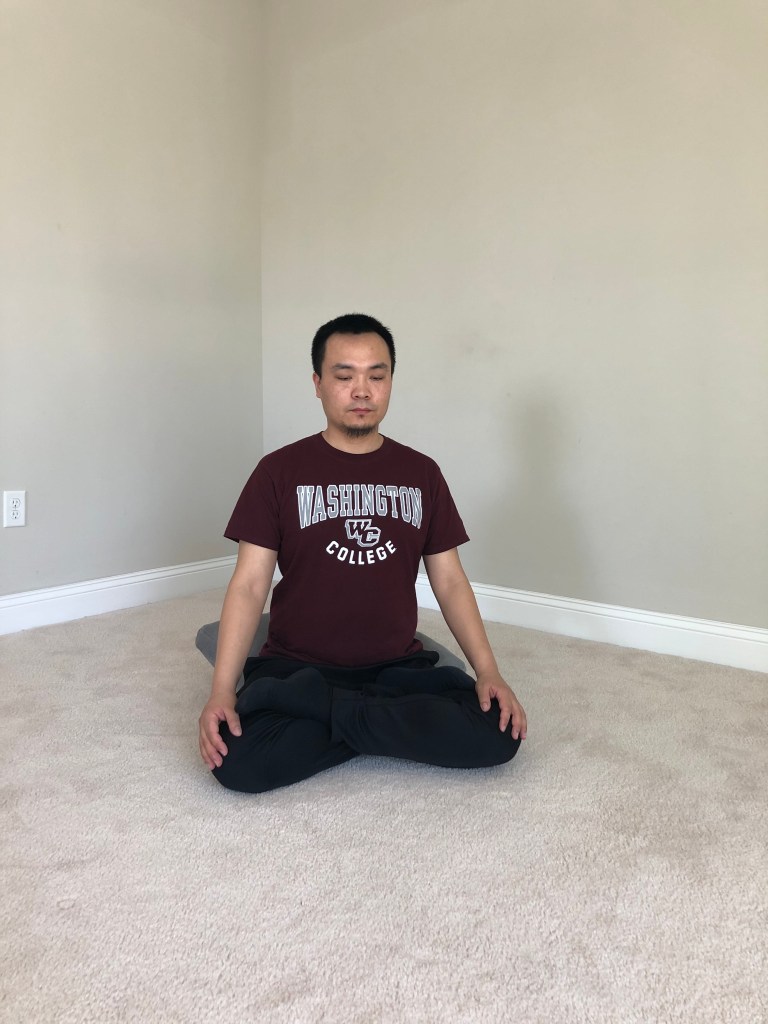
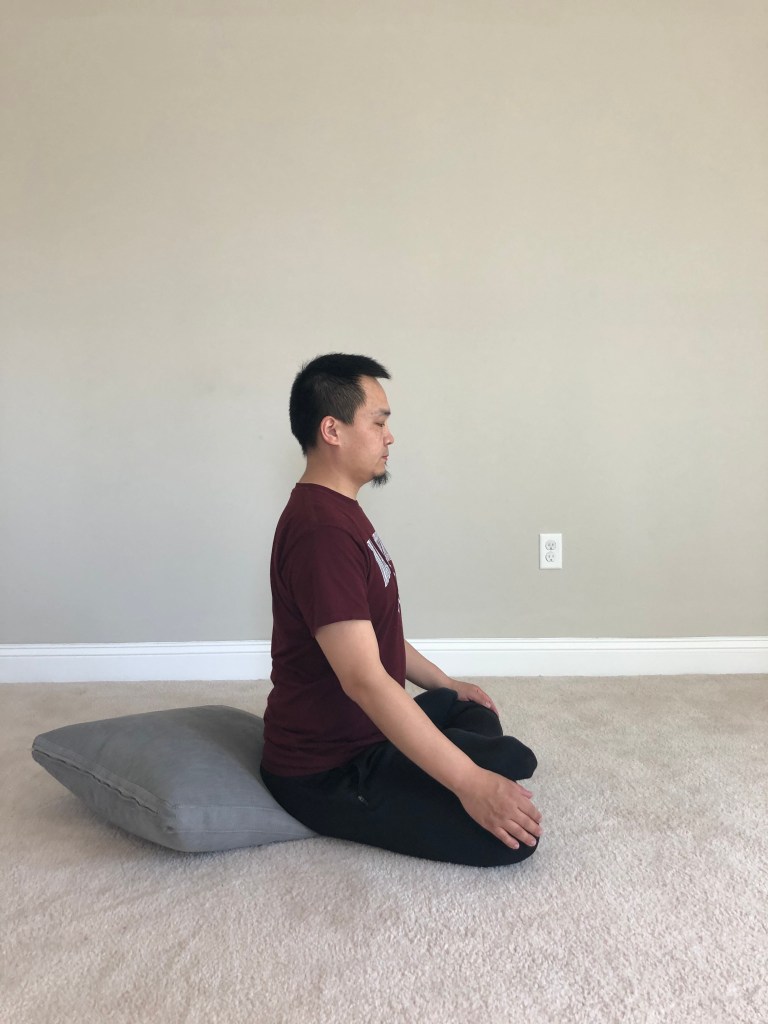
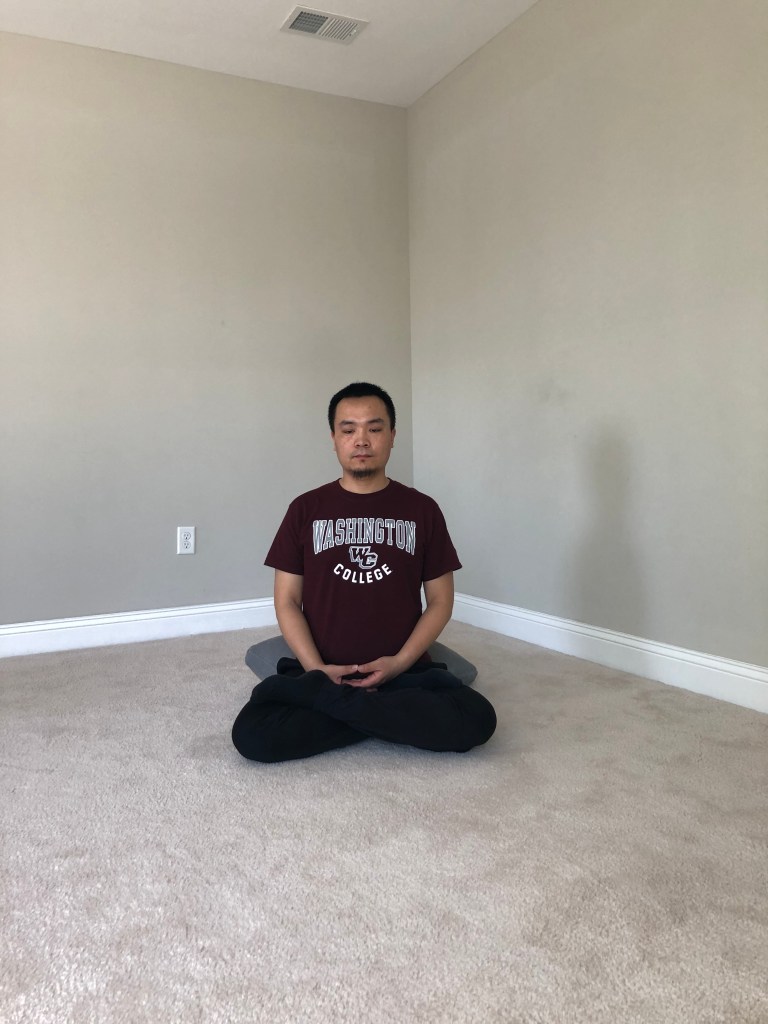
Cross you legs. This can be done in multiple ways. You can cross your feet and put them under your legs. You can also put either of the feet upon the thigh on the other side. This is called single-cross-legged quiet-sitting. The most difficult one for most of people is that you double-cross your legs. You will put the back of your right foot on your left thigh, and then, put the back of your left foot on your right thigh. This most difficult one has two orders: either your right lower leg is over the left one, or your left lower leg is on the right one. The pictures I show beside the audio is how I do double cross-legged quiet-sitting. If your body is not flexible enough, you will find it very hard to cross any leg to do this quiet-sitting posture. In this case, crossing your two feet and put them under your legs will be normally an easy start. Please do not worry over the fact that you cannot cross your legs. When I started to practice this posture, I cannot double cross my legs either. However, I singled cross my legs, and practiced it for a long time. One day, and I clearly remembered that was a day when I went to swim during the spring of 2010, I sat on the bench beside the swimming pool, and suddenly, I can double-cross my legs. And the story continues, in the beginning, I can only let my left lower-leg over my right one. But in time, I can do the other way as well. So, for beginning practitioners, do not worry about whether you can pursue the most difficult and concentrated form of cross-legged quiet-sitting meditation. As long as you persist in practicing in whatever posture fit for you, you will always get benefits of it, and one day, you can command all available postures.
Put a cushion under your butt, so as to make your butt a bit higher than your knees
Make your backbone naturally stacked-up. No pop-up nor slouch of your chest.
The Head naturally lines up with your back up.
Eyes closed or leave a slice of vision open broadly.
This is slightly different from the one of the quiet-sitting on a chair. Since you can sit for relatively a longer time using this cross-legged posture, you can close your mouth, let your tongue touch the gum of your upper teeth. In time, there could be some saliva gathering up in your mouth, and since the saliva is a liquid very smooth and delicate, letting it run down along your tongue, and then, swallowing it will furthermore lubricate your throat and other related parts of your body, which will feel very good.
You can make your hands cupped, and put them below the lower abdomen. Or palms down, and put them on your knees. You can also put them in other places or use other hand gestures, as long as you feel comfortable. During deep meditation, sometimes you may feel you want to move your hands and arms a little bit, such as drawing some shapes or figures in the air; this is also completely normal. As long as you do it in the balance of discipline and spontaneity which I mentioned before, you can enjoy whatever you intend to do during meditation.
Ok, these are the seven major points of cross-legged quiet-sitting meditation. Several caveats before concluding this audio:
Do remember to protect your joints when you do this posture of meditation, particularly your knees and your shoulder. They are the most exposed parts of your body during this posture. You can try to wear something or put a blanket on your legs if the temperature in the room is moderate or the outside weather is windy.
Long meditation is less ideal than short meditation but with more times of practices each day. So a 15-30 minute practice for two or three times a day will be ideal for beginning practitioners.
Good, this is the end of this audio on cross-legged quiet-sitting meditation. I hope you have a nice day, and take care!




 Bin Song