This article reviews Shaun O’Dwyer’s latest book, Confucianism’s Prospects: A Reassessment (SUNY, 2019). By critiquing philosophical theories of “Confucian democracy” and their shared sociological assumption that Confucianism still functions as a cultural matrix for East Asian societies, O’Dwyer argues that visions on the future of Confucianism alternative to what the currently fixed institutional infrastructure of liberal democracy entails are flawed. This is mainly because if unconstrained by the infrastructure, the hardwired paternalism and elitism of Confucian ethics would necessarily impose morally taxing burdens upon a de facto pluralistic society. This article assesses O’Dwyer’s counterarguments to “Confucian democracy,” and proposes a different approach to estimate the prospects of Confucianism in the contemporary world.
Song, B. (2020). Is Confucianism Beneath or Beyond Ethics and Politics?. Journal of World Philosophies, 5(2), 200–205
It is a daunting task for me to review Li Zehou’s work, not least because while born in and always philosophizing about the same land, Li had entered his intellectual heyday in the 1980s when I was not yet a teenager. While reading Li’s work using Andrew Lambert’s stellar translation, I repeatedly asked myself: what is the difference between him and me regarding the approach to doing comparative Chinese philosophy? Why is there such a difference? What can I learn from him? And what inspirations can Li’s work generate globally. Since there are English resources[1] that introduce Li’s thought, I won’t dwell on those questions. Instead, I will critique Li’s philosophy as presented in this book.
One big difference between Li and me[2] is that I am no longer sympathetic toward any grand narrative of Chinese history and philosophy. By “grand narrative,” I mean the effort to find objective rules through studying all of Chinese history in order to provide insights for guiding China’s transition to modernity. Li grand narrative differs from that of other Marxism-influenced thinkers in his mainly adopting Marx’s earlier thought on humanized nature, rather than Marx’s full-blown historical determinism and theory of class struggle. Li creates his own concept of cultural-psychological formation to argue that once certain traits of Chinese philosophies were created out of human praxes materialized in some historical periods, they could be “sedimented” (Li’s term) in Chinese people’s general cultural-psychological consciousness, attaining a degree of stability and inflexibility. Therefore, when pondering the viable path towards China’s modernization, Li thinks that this cultural-psychological formation should be taken as an underlying real historical force, in tandem with technologies, modes of production, economic institutions and other fundamental material powers identified by Marxism. In this sense, compared with the orthodox Marxism prevalent in the time of his writing, Li grants more autonomy to human individuals, and treats part of the so-called superstructure of a society as no less important than its economic basis.
Even if Li’s thought was a significant innovation on the orthodox Marxism of the time, I still view him as creating a grand narrative. His narrative is distinctive because he discovered another objective historical rule, termed the cultural-psychological formation, but this new discovery was still made largely using Marxism’s method of historical materialism, and served the same grand nationalistic goal. My suspicions about this type of grand narrative in the study of comparative Chinese philosophy derives from three major points.
First, Li’s work pivots around a typology of human thought conducted via a broad survey of selected Chinese thinkers and an even broader comparison with non-Chinese thoughts. For instance, in contrast with the Christian-Greek Western culture depicted as one of “guilt” coupled with a highly intellectual attitude towards nature and human beings, Li describes the cultural-psychological formation of Chinese people as constituting a culture of “delight” guided by a “pragmatic rationality” committed to human relationships and this-worldly happiness (xviii, 215, 220). Li thinks that this feature was first systemized in Confucius’s thought, incorporated by many other schools of thought in history, and eventually sedimented as a stable trait of Chinese culture in general.
My major issues with this sort of typological study are how we, as a scholarly community, debate these generalizations, and how far our debate can advance the related scholarship as a collective body of human knowledge aimed to solve common problems of human life in specific contexts. More concretely, suppose that scholars were to raise objection to Li’s generalizations, objections based on evidence within Chinese philosophies, how would Li defend himself? He could conceivably respond that such evidence was not prevalent enough to ground major characteristics of Chinese thought. However, how can we decide whether a characteristic is common to a majority or minority in Chinese cultural history? If we define “majority” in a purely quantitative sense, then, we need to do a social survey to ask all living China-born or Chinese-speaking people questions about their thought on contested points in those generalizations; or we can digitize the whole body of available historical literature pertaining to those generalizations and analyze whether certain views prevailed or not. Apart from the issue of the viability of doing so, I seriously doubt whether Li or any other philosopher would accept this approach, since whether a set of quantified “particles of thought” can adequately represent a thinker’s or a group of people’s philosophical mindset remains highly uncertain.
An alternative approach to identifying a majority characteristic of human thought in a given history is to take a selected topic of research and assess the characteristic’s influence, rather than its quantitative prevalence. For example, Li could argue that characterizing the dominant Confucian culture in China as one of delight coupled with pragmatic rationality helps to explain why it did not develop those distinctive traits of Western culture, and why the historical encounter of China with the West has proceeded in a specific manner. I have two issues with this qualitative approach to defining major features of Chinese thought. First, any contrary evidence that cannot be used to highlight the contrast between so-called Chinese and Western thought will be readily denounced by the comparativist as irrelevant, which will make those grand generalizations essentially non-debatable. Second, it requires a method other than the hermeneutics of philosophical texts to explain how a set of philosophical ideas has an impact on the actual unfolding of Chinese history in its varying periods and contexts. In other words, if the so-called cultural-psychological formation identified by Li can indeed be counted as a real historical force functioning as a “cause” of historical events, much more work needs to be done beyond a very finely crafted intellectual history of classical Chinese thought. I come back to this methodological point of historical study later when I compare Li with Max Weber.
In a word, I am suspicious of scholarship on comparative Chinese thought which is decisively structured by a typological method. Based on the reasons given above, I think the seemingly objective and scientific nature of typological study is hardly defensible in the area of humanities in general, and in the realm of comparative philosophy in particular. Generalizations may be inevitable for reading philosophical texts, but they had better be treated as temporary, or even subservient heuristic tools, the efficacy of which depends upon how they can help readers attend to details, diversifications, dynamics, and rigorously identified problems in the rich history of cultural interactions and human lives. I do not disapprove of generalization as such, but I do remain doubtful about generalization as one dominant motif of a study of comparative philosophy.
Second, if we look into the cultural-psychological formation, per se, generalized by Li through his reading of classical Chinese philosophical texts, we find that it coheres extraordinarily with itself, and almost intuitively serves his broader purpose of providing historical explanations regarding China’s encounter with the West. In brief, a metaphysical commitment of this formation to “no transcendent ontology” (319) grounds an aesthetical feeling of “delight” towards this “one world” (xvii) as a whole, and the aesthetics furthermore conditions an ethical attitude of optimism and pragmatic reasoning towards human life here and now rooted in the cherished value of human relationships to the well-being of individuals. These traits of Chinese thought are seen as aiming for “sageliness within” at the individual level, while in politics they entail a vision of virtuous leadership and coordinated social management characterized as “sageliness without” (118, 276).
Nevertheless, my second concern is precisely about why the generalized cultural-psychological consciousness could be this coherent. The relationship among each mentioned dimension of Chinese thought is actually much more diverse, with certain cases contrasted sharply with each other. For instance, even if we can admit that no transcendent ontology is common to all classical Chinese thought (which, however, remains highly controversial in current scholarship), different schools of thought or varying thinkers can have a very different aesthetic feeling (such as the Confucian delight, the Daoist coolness, or the Buddhist bitterness, to name a few) towards the world as a whole. Even if entertaining the same positive feeling towards the world, ethicists have vastly different understandings of human nature, showcased, for example, in the debate about human nature between Mencius and Xunzi in the Confucian tradition. Again, even if agreeing that human nature is essentially good, scholar-officials who actively pursued politics may have drastically different policy tendencies as indicated by all the in-fighting among Confucian ministers in history. However, I guess Li would respond to my objections by saying that his generalization is about mainstream classical Chinese thought, and that everything else lies on the margin. That said, let us go back to the majority issues I raised above: who decides the mainstream? How can it be done? And for what legitimate purpose does this need to be done? In particular, why is this mainstream a coherent whole, rather than an incoherent or semi-coherent cloud of ideas vulnerable to further organization and adaptation? Without a detailed answer to each of these questions, I’m inclined to think that what Li furnishes is simply another construction of classical Chinese thought per his own interest, which is hardly debatable from the perspective of public scholarship.
Since the concept of cultural-psychological formation is also intended by Li, as a Chinese philosopher, to guide his participation in global philosophical conversations (260-263), I take with a grain of salt that we need such a coherently self-defined image of “Chinese thought” for that reason. Contemporary philosophers enjoy the advantage of historical hindsight. Through hindsight we can find that many aspects of classical Chinese thought cannot be unambiguously valued as either true or false, reasonable or unreasonable, advanced or antiquated vis-à-vis its Western counterparts. For instance, the all-interconnected worldview featured in the theory of Yin-Yang and Five Phases, formed during the Han Dynasty, may be unsuitable for abstract logical thinking entailed by the formation of mechanistic modern science. However, the emphasis of the theory upon holism and process makes it a stellar candidate for reconfiguring the scientific model that humans need to use today in various life and social sciences such as biology, medicine, and economics. Given the deeply ambiguous nature of classical Chinese thought, what aspect of it needs to be highlighted by a comparativist in order to present a coherent philosophical interpretation of it to converse with other parts of the world? The answer depends on the concrete common issues the intended scholarly community is tackling, and whether the comparative insights can be constructed as contestable human knowledge according to rigorously defined research methodologies. Because of this, I feel quite uneasy whenever I am labeled a “Chinese philosopher” or an expert on Chinese philosophy in varying academic venues, since what is “Chinese” and how to construct “Chinese” in any philosophical endeavor are challenges a comparativist needs to face.
The two critiques I offered so far can be boiled down to this: without a further defense of one’s starting research interest and a corresponding clarification of how broad cultural generalizations contribute to a fallible and improvable piece of knowledge, we cannot decide which aspects of Chinese thought are the mainstream and whether this mainstream coheres with itself in face of the extremely diverse, complicated, and ambiguous nature of classical Chinese thought. Nevertheless, supposing that the traits identified by Li are all based on sound interpretations of classical Chinese thought, and are indeed its mainstream, we are still uncertain about how such a constructed cultural-psychological formation can explain the unfolding of historical events. This leads to my final critique of Li’s thought.
There is a major difficulty for Li’s claim that the formation is a real, sedimented historical force functioning as a cause of historical events. His argument doesn’t account for how the envisioned causal relationship plays out in concrete historical situations. Now, consider Weber’s work on the origin of capitalism, which is widely accepted by sociologists as having furnished a robust methodology to prove the causal role of ideas in social events. In his argument that the Protestant ethic is a cause of modern capitalist economy, Weber does not treat the ethic straightforwardly as one element in the superstructure of a society which can have a reverse influence towards the economic basis, a framework of Marxism that Li adopts. Instead, the ethic is seen as an “ideal type” which a sociologist constructs for the purpose of further causal analysis. In order to prove that such an ideal type can indeed cause a social event, the sociologist in question needs first to confirm the correspondence between it and the actual mentality of human agents involved in the social event. Accordingly, Weber connects his analysis of the Protestant ethic to the spirit of capitalism manifested by a capitalist workforce’s mindset. Secondly, the sociologist needs to locate a social mechanism to explain how ideas in humans’ minds can be transformed into materialized human behaviors conducive to the organization of the social event. In Weber’s work, this second moment of argument focuses upon the role of “pastoral care” provided by Protestant churches to the capitalistic workforce.[3]
We do not find any similar analysis of the key concept of cultural-psychological formation in Li’s work. Instead, Li presents the content of this formation through interpreting classical Chinese philosophical texts, and talks of how it functions as a historical cause in China in a very broad way. As a result, readers may remain confused about how the constructed formation works concretely in social realities. Li might respond that Weber’s method of sociology has gone beyond the normal purview of a philosopher’s work on the history of ideas. I surely agree that sociologists can be inspired by Li’s concept, and then continue to explore the causal role of classical Chinese thought using Weber’s methodology. However, since Li adopts Marxism’s historical materialism as a framework of his philosophy and treats the concept of cultural-psychological formation as intrinsically causal, I don’t think an emphasis upon the disciplinary boundary between philosophy and sociology is a significant defense.
This said, I ask my readers not to think, given my critique, that I did not learn anything from Li. I sincerely admire his spirit of free and original thinking that is so rare in the works of Chinese scholars in his generation. From a global perspective, the concept of cultural-psychological formation may not be as exciting as many of the concepts (e.g., feeling as the root state, anthropo-historical ontology, and human praxis as the foundation of aesthetic experience) that Li elaborates in his other books. Most importantly, we now have a new, very well-crafted and well-translated general history of classical Chinese thought, which is truly exciting!
REFERENCES
Lambert, Andrew. (forthcoming) “Li Zehou: Synthesizing Kongzi, Marx, and Kant.” The Dao Companion to Contemporary New Confucian Philosophy. David Elstein, ed. Springer Press.
Rošker, Jana S. (2020) “Enriching the Chinese Intellectual Legacy: A Review of Li Zehou’s ‘A History of Classical Chinese Thought’.” Social Epistemology Review and Reply Collective 8 (12): 1-7.
Song, Bin. (2018) “Confucianism, Gapponshugi, and the Spirit of Japanese Capitalism.” Confucian Academy, 2018 (4): 176-188.
Yang, C.K. (1968) “Introduction.” The Religion of China: Confucianism and Taoism. Trans. Hans H. Gerth. Free Press: i-xxix.
[1] Lambert (forthcoming) and Rošker (2020) include the most recent introduction to Li’s thought with extensive references to available English resources.
[2] I think the difference also registers for many peers of mine in the field of comparative Chinese philosophy, so the difference is not only individual, but generational. However, it is hard to speak on behalf of a generation without more organized reviews of peer-philosophers’ work, so I merely speak for myself in this review.
[3] Yang (1968) analyzes the structure of Weber’s argument, and I apply this structure to discussing the role of the Confucian ethic in Japan’s modernization in Song (2018).
Bin Song, Apophatic Paths from Europe to China: Regions without Borders. By William Franke, Journal of the American Academy of Religion, Volume 88, Issue 1, March 2020, Pages 278–281,
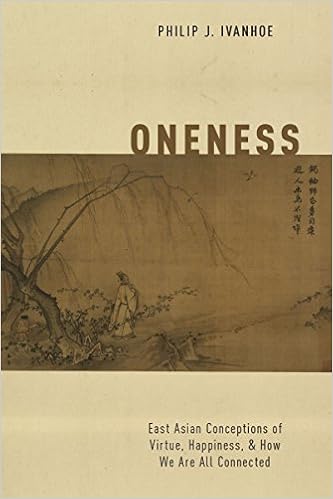
Philip J. Ivanhoe, Oneness: East Asian Conceptions of Virtue, Happiness, and How We are All Connected, Oxford University Press, 2017, 188 pp., $39.95, ISBN 9780190840518.
At the center of East Asian philosophical traditions lies a conception of oneness signifying that “we — and in particular our personal welfare or happiness — are inextricably intertwined with other people, creatures, and things,” which Ivanhoe calls the “oneness hypothesis.” (1) While drawing upon the writings of East Asian, especially neo-Confucian, thinkers to elucidate the conception of oneness, this book aims to show how these traditional views “can guide us in constructing contemporary versions of the oneness hypothesis.” (3) In an era when human civilization is constantly alarmed by ecological crisis and societal disintegration, this book has great appeal particularly to those who are willing to employ comparative philosophy to tackle these menacing issues.
After introducing the oneness hypothesis and offering examples of East Asian thinkers who have advocated particular versions of such a hypothesis, Ivanhoe discusses the relational conception of the self, and then goes on to illustrate the interrelated, yet different concepts of selfishness and self-centeredness. Ivanhoe views both of these as harmful for humans efforts to envision a more appropriate idea of self implied by the oneness hypothesis. Subsequent chapters explore the nature of virtues and the value of spontaneity and compare Kongzi’s (Confucius’) and Zhuangzi’s conceptions of happiness in order to show how these conceptions contribute to the proper goal of neo-Confucian ethics.
The most brilliant point that Ivanhoe makes is that the ethic required by the conception of oneness ought not to favor an act of care exclusively for the sake of another. Instead, with the awareness of an expanded self, a caring agent would rather pay attention to the particular needs of a cared-for individual so that the altruistic deeds will ultimately bring satisfaction and happiness to the agent. In this sense, we can “avoid infantile conceptions of oneness that shrink back and withdraw from a clear sense of ourselves as individual autonomous agents and seek to merge back into the safety of some surrogate womb.” (152) As Chinese intellectual history shows, many neo-Confucian thinkers championed the traditional Confucian learning as one of “learning for oneself”[1] in contrast with the Buddhist teaching of “no-self.” This sort of learning states that an identification of one’s self with all the world does not make the self get lost in the world. Therefore, Ivanhoe’s incisive analysis of the position of self in a desirable form of the conception of oneness is clearly inspired by neo-Confucianism.
The strength of Ivanhoe’s argument also consists in his meticulous effort to utilize comparative and inter-disciplinary perspectives to enhance the plausibility of the oneness hypothesis in a modern context. On the one hand, Ivanhoe points out that the neo-Confucian reasoning from what the world truly is to how human individuals ought to behave in the world is similar to parts of the Western philosophical tradition such as Plotinus’ metaphysical and ethical vision of the “chain of being.” (16) On the other hand, Ivanhoe quotes extensively from contemporary research in varying disciplines, such as evolutionary biology and moral psychology, to show the compatibility of modern scientific worldviews to the traditional East Asian conception of oneness. Given the distinctive Confucian idea of “harmony” (he), which urges scholars to consider all factors relevant to a topic and then to place each factor in its proper position, we can understand Ivanhoe’s presentation of the East Asian conception of oneness as a Confucian project aiming to make the greatest sense of a historical idea on the basis of a harmonious integration of all relevant human knowledge. The result is truly masterful.
Last but not least, this work avoids the weak point of some current scholarship in comparative philosophy, which tends to lump together “East Asian philosophy” as a coherent whole in order to compare it with its Western counterparts. Consider Ivanhoe’s comparative study of Kongzi’s and Zhuangzi’s ideas of “happiness.” After a detailed explanation of each idea, Ivanhoe concludes: “I do not intend to reduce one to the other, cast them both as expressions of some single higher truth, or obscure their differences in light of what they share. They offer two related but distinct perspectives on oneness and the good life.” (148) In my view, the thoughts of schools and philosophers in ancient East Asia are no less diverse, divergent, or sometimes even antagonistic to each other than those in Western philosophy. Ivanhoe’s careful treatment of both the similarities and differences among East Asian philosophies should be taken as a model for future scholars.
However, there are weak points in Ivanhoe’s argument on the plausibility of the oneness hypothesis, such as his ambivalent attitude towards metaphysics. While defining the neo-Confucian philosophy of oneness as a sort of metaphysical ethics or ethical metaphysics comparable to the neo-Platonic “chain of being,” Ivanhoe argues for its advantage over the empathy-based ethic. This is because its deeper metaphysical commitment to the all-encompassing oneness allows humans’ altruistic care to extend to “nonhuman animals and, even more challenging, plants and inanimate objects.” (11) While citing science to indicate the compatibility of the oneness hypothesis with a modern context, Ivanhoe also hopes that “we might draw upon and employ neo-Confucian conceptions of oneness as a model and guide for fashioning a plausible and attractive modern version of the oneness hypothesis and make use of it as a resource to develop a corresponding ethic.” (33)
All of these are very positive views towards the oneness hypothesis as a whole, including its metaphysical ingredient. However, in many other places, Ivanhoe expresses an unreserved negative evaluation of the contemporary prospect of neo-Confucian metaphysics, which centers on a view of the all-pervading patterns or principles (li) and vital-energies (qi) in the universe. For example, the metaphysical foundation of the neo-Confucian conception of oneness is said to be “clearly inconsistent with the best science of the day” (74), and “so deeply at odds with our contemporary scientific understanding of both self and world.” (151) The idea underlying these jarring statements seems to be that Ivanhoe thinks people today can just pay attention to and practice pragmatically the ethical part of the oneness hypothesis without being involved in any metaphysical controversy (79).
However, first, we do not exactly know how this can be done, and especially, how a truncated conception of the oneness hypothesis, if possible, can be claimed as being inspired by the neo-Confucian conception of oneness. Second, these statements are indeed deeply at odds with others quoted above (3, 11, and 33), which all speak to the central motif of the book: utilizing the traditional neo-Confucian conception of oneness, which is deeply metaphysical, to inspire a modern update. I believe Ivanhoe should distinguish three questions when he articulates his view on metaphysics: first, whether metaphysics is needed at all for constructing a contemporary conception of oneness and its corresponding ethic; second, if it is needed, what is the role of metaphysics for this purpose; third, what traditional metaphysical ideas in this regard are the most inspiring and conducive. Because Ivanhoe has not yet explained his stance on the first two questions, his ambiguous statements regarding the neo-Confucian metaphysics may make it hard for readers to understand his overall argument for the oneness hypothesis.
Another weak point is that Ivanhoe’s presentation of the neo-Confucian hypothesis risks over-simplification in its own right, although he succeeds in delivering a nuanced comparison of the Daoist and the Confucian conceptions of happiness, as mentioned above. In particular, readers might misunderstand the neo-Confucian conception of oneness as a coherent whole after they read this book, but the fact is that thinkers within the Chinese neo-Confucian tradition disagreed on multiple issues in a variety of ways. For example, while presenting the metaphysical core claim of oneness in neo-Confucianism, Ivanhoe says:
Under the influence of Buddhist metaphysical beliefs, neo-Confucians developed a more robust and dramatic sense of oneness as a kind of identity between self and world. Rather than seeing the world as an interconnected system or web of principles or patterns, they believed each and everything in the world contained within itself all the principles or patterns in the universe. (22, emphasis mine)
Here, “contain” is an ineffective word because it fails to show the rich diversity of ideas within neo-Confucianism on this crucial issue: the relationship between the human mind-heart (xin) within and the principles or patterns in the world without. For instance, two contemporary neo-Confucian thinkers of almost equal influence in their time, Wang Yangming and Zhan Ruoshui, both endorsed the idea that “the mind-heart is the pattern or principle” (xin ji li). However, Wang tended to think that the human mind-heart includes innately all principles and patterns in the outside world, while Zhan opposed Wang’s view and insisted that the human mind-heart needs to comply with patterns or principles in order to achieve the ultimate unification between the self and world.[2]
It is worthwhile to mention this debate because, at the end of the book, Ivanhoe specified one problem with the conception of oneness: the conception ought not lead us to “engulf the world by swallowing it into oneself” so as to “efface the variety and texture of our magnificently diverse and dabbled world.” (153) However, as shown in the intellectual history of neo-Confucianism, this problem is exactly what critics once pointed out to some of Wang Yangming’s radical followers. In a word, it is not only unjust to the history of neo-Confucian philosophy to treat the neo-Confucian conception of oneness as a coherent whole; this simplified presentation of neo-Confucianism also defies Ivanhoe’s own argumentative purpose: to construct an available modern conception of oneness under neo-Confucian inspiration.
The last critique I would like to offer is that despite being an accomplished and prolific scholar on ancient Chinese philosophy, Ivanhoe succumbs to certain questionable views that urgently need to be rethought. In conclusion, let me raise three examples.
First, the origin of neo-Confucian metaphysics needs to be reconsidered. Ivanhoe perpetuates a view prevalent among Anglophone students of Chinese philosophy that “Neo-Confucians have embedded earlier Confucian ideas in a much more complex and powerful metaphysical system derived largely from Daoist and Buddhist sources.” (144) However, although terms and characters were shared by neo-Confucian, Daoist and Buddhist metaphysical discourses, the texts upon which neo-Confucian thinkers based their new interpretations and thus built their own metaphysical conceptions all derived from earlier Confucianism. For example, chapters in the Classic of Rites (Liji) and the Classic of Changes (Yijing), two among the so-called Five Classics, were widely thought of by neo-Confucian thinkers as of crucial importance for neo-Confucian metaphysics. Moreover, these metaphysical chapters of classical Confucianism already produced their great influences among Chinese metaphysical thinkers in the Han dynasty, which was significantly earlier than the Song and Ming Dynasties when neo-Confucianism flourished. In other words, the Confucian tradition is undeniably and distinctively metaphysical from its very beginning, although whether Confucian thinkers adopt or emphasize these traditional metaphysical elements depends upon their own discretion.
Ivanhoe’s presentation of both classical Confucianism and neo-Confucianism focuses on writings authored by individual philosophers, but not on the traditional Five Classics and their commentaries. In Chinese intellectual historiographical terms, this means it focuses on the “learning of masters” (zixue), rather than the “learning of classics” (jingxue). Obviously, this perpetuates controversial views on Chinese philosophy as illustrated above.
Third, I have argued, together with other scholars,[3] that “Confucianism” is a misnomer invented by early Christian missionaries for the Ru tradition, and we should change the term “Confucianism” to “Ruism” in order to more accurately present the Ru tradition to Western audiences. Two conspicuous benefits can be derived from this rectification of names in the context of Ivanhoe’s work. First, Ivanhoe seems to have been envisioning a sentence like “Kongzi finds his joy in following the Confucian way” when he discussed Kongzi’s view of joy, perhaps in order to avoid the awkward sentence “Confucius finds his joy in following the Confucian way” through using the Romanized pinyin form Kongzi.[4] However, for readers versed in Chinese language and culture, the former equally smacks of narcissism, and is actually no less awkward than the latter. Replacing “Confucianism” with “Ruism” and “Confucian” with “Ru” or “Ruist,” the sentence can be neatly written as “Confucius finds his joy in following the Ru (or Ruist) way.” Second, if we can avoid “Confucianism” as an awkward Western misnomer, the term “neo-Confucianism” and some of the aforementioned controversial points can also be more easily rethought. There is no Chinese term corresponding to “neo-Confucianism.” In contemporary Chinese intellectual historiography, the Ru tradition in the Song and Ming dynasties is usually called “Song-Ming Ruxue,” i.e., Ruism of the Song and Ming Dynasties. Therefore, instead of “neo-Confucianism,” we can use “Song and Ming Ruism” to show the great continuity of the Ru tradition, and avoid suggesting that the metaphysics of neo-Confucianism derived from somewhere else, and thus, was entirely “neo-” to the “Confucian” tradition.
REFERENCES
Angle, Stephen (2016). “Should we use ‘Ruism’ instead of ‘Confucianism’?” Warp, Weft, and Way, posted May 4, 2016, accessed January 1, 2017.
Bol, Peter (1994). “This Culture of Ours”: Intellectual Transitions in T’ang and Sung China. Stanford University Press.
Huang, Mingtong (2001). Chen Xianzhang Ping Zhuan (An Annotated Biography of Chen Xianzhang). The Press of Nanjing University.
Slingerland, Edward (2003). Confucius Analects: With Selections from Traditional Commentaries. Hackett Publishing Company.
Swain, Tony (2017). Confucianism in China: An Introduction. Bloomsbury.
[1] This neo-Confucian thought is based upon the Analects 14:24 “The Master said, in ancient times scholars learned for their own sake; these days they learn for the sake of others.” See Slingerland (2003): 164. One of the best historical discussions of the neo-Confucian idea of “learning for oneself” in relation to the movement of “Learning of the Way (daoxue)” can be found in Bol (1994): 305-337.
[2] About the difference between Wang Yangming and Zhan Ruoshui on this point, see Huang (2001): 306-313.
[3] Most recent scholarly discussions on this issue can be found in Angle 2016 and Swain (2017): 3-22.
[4] The full sentences, upon which the quoted one is based, are from “Kongzi describes various stages of understanding the Dao,” until the end of the paragraph on page 133. See also the phrases “Kongzi, the founding figure of Confucianism” and “early Confucians such as Kongzi.” (129, 131)


![Apophatic Paths from Europe to China: Regions without Borders (SUNY series in Chinese Philosophy and Culture) by [Franke, William]](https://images-na.ssl-images-amazon.com/images/I/51T5NUzaauL.jpg)