Aristotle: A Short Introduction

Audio: A Short Introduction to Aristotle, by Dr. Bin Song
Video: A Short Introduction to Aristotle, by Dr. Bin Song

Hallo, this is Dr. Bin Song for the course of “introduction to philosophy” at Washington College.

After discussing Socrates and Plato, let’s address the third and final figure in the Trinity of ancient Greek philosophy: Aristotle.

In medieval Europe, when the origin of the modern institution of university started to emerge as stellar academic hubs such as the University of Bologna (1088), University of Paris (1150) and University of Oxford (1167), the name of Aristotle was replaced with the term “the Philosopher” whenever it was mentioned by scholars, teachers and students in these institutions. For these scholars, Aristotle’s architectonic philosophy represented everything that humans could know about the created world through human reason, and what universities remained to do was, on the one hand, to add “Christian faith” on top of it to create “theology” (therefore, the scholastic slogan that “philosophy as a maid to theology”), and on the other hand, to inherit and develop all other branches of the Aristotelian philosophy in light of new observations and human experiences.

You may wonder why it was Aristotle, not Plato, whose philosophy constituted the pedagogical principle of medieval universities. The reason lies largely in the difference of the two philosophers’ styles of thought and genres of writing.

Plato’s thought was very idealistic, who admires an eternal and unchanging, real world of ideas vis-à-vis the material, less real world vulnerable to decay and corruption. Since the material world was not that important to him, quite often, Plato made the points he wanted to make in the sharpest way regardless of what previous philosophers had said on related topics. Moreover, Plato wrote in the genre of Socratic dialogue, and would not hesitate to use Socrates’s mouth to speak for his own thoughts, which increased the power of persuasion while not necessarily conveying more knowledge.

In contrast, Aristotle believes philosophy starts from empirical observations of natural and social phenomena, and from investigating the views of his philosophical predecessors on shared topics. Therefore, when you open one volume in the complete works of Aristotle, the Metaphysics for instance, you will read many of pre-Aristotelian philosophers’ views on the origin of the world, as well as the empirical evidences that these views have referred to, before you can get to Aristotle’s own view. When writing his own views, Aristotle was also fond of using the logic of syllogism to organize varying statements according to the degrees of generality of categories.

For instance, in the books of On the Heavens and the Physics, we read that there are two parts of the entire universe: the sublunary earthly world which comprises four elements: air, fire, water and earth; and the superlunary heavenly world which comprises the divine element called the aether. Overall, all things in the world were moved by the unmoved mover called “Nous,” and the self-perpetuating and self-contemplative nature of the Nous constitutes the ultimate purpose for which all beings in the world move and strive.

Similarly, in the book of the Politics, we are presented with a purportedly exhaustive taxonomy of political regimes that human beings could ever observe. Aristotle employed the standard of whether a state is governed by one, a few, or many people to distinguish three pairs of regimes: monarchy/tyranny, aristocracy/oligarchy, polity/democracy. Within each pair of regimes, the former is thought of as being superior to the latter because it rules for the benefits of all people, rather than just for the ones of the people in the circle of rulership. For instance, polity is the regime where one party is elected among many while being able to represent the interests of all citizens, while democracy is the one where an elected party, due to the non-educated nature of its constituency, can only represent its own self-interest. Overall, Aristotle believes “polity” is the best regime because he thinks (1) humans are not God, and thus, no power can be held by either one singular person or one circle of elite forever no matter how virtuous and intelligent they are, and (2) the regime of polity trains citizens to be virtuous and educated, and therefore, can help to achieve the ultimate goal of human life, eudaimonia (human flourishing or happiness), which is furthermore an imitation of the perpetually self-contemplative divine life of Nous.

Not only did Aristotle have a more organized structure within each branch of philosophy, he also had an architectonic vision of philosophy as a whole. For Aristotle, the meaning of philosophy is virtually synonymous with science, and it includes the entire body of human knowledge. He says, this body of human knowledge comprises three parts: first, theoretical philosophy, which contains knowledge for the sake of knowledge itself without further concern with their practical application. Under this category, we have physics to deal with objects capable of movement, mathematics to target objects without movement, and metaphysics to investigate the most generic features of things in the world. Second, practical philosophy, which is concerned with human praxis and actions, such as ethics, political philosophy, economics, and rhetoric. Finally, what Aristotle called productive or poetic philosophy studies the products, rather than the actions of human beings. In modern philosophical term, this productive philosophy is concerned with both technology, such as house-building, ship-building, and other craftworks, and aesthetics, viz., the theory of beauty as the beauty is represented by artworks. In the pedagogical sense, Aristotle thinks each of these branches of philosophy as a “liberal art” since these subjects help humans to grow to be more virtuous and educated, and hence, to be more fit for the collective deliberation on varying issues in an educated democracy, which Aristotle terms Polity.

Now, I believe you have a better sense of why Aristotle’s works were taken as textbooks, and his philosophy was treated as the pedagogical underpinning of medieval universities. In a word, its organized, systematic, and scholarly quality is just so ready to be put into practice in classrooms. Given the historical root of modern universities in Aristotelianism, it will be highly probable that you will meet the name “Aristotle” sometime or somewhere during the study of your major, whether it is physics, chemistry, biology, political science, art history, etc.

However, since Aristotle’s thought has decisively shaped the intellectual landscape of medieval Europe, the birth of modernity in the same territory was also greatly influenced by his thought. Noticeably, this influence normally took a form of counteraction and resistance, because many aspects of modern thought derive from a critique or revision of Aristotle’s thought.

Regarding the profound changes modern Europe went through in that shaping period of 16-18th centuries, an effective angle to investigate these changes is from the disciplinary divisions that medieval universities once operated upon. In the area of theology, we have the movement of Protestant reformation. In the area of humanities, we have the movement of Renaissance. In natural science, we have modern scientific revolution; while in social science, we have the birth of modern capitalism and varying political movements leading to the establishment of modern democracies. Normally, proponents of these shaping modern movements were graduates of medieval universities who studied the concerned subjects in various departments. As mentioned, since the institutional structure of medieval universities was designed per the Aristotelian thought, we can imagine why the transition between pre-modern and modern human societies was philosophically manifested by critiques and contrasts that modern thinkers made about the ancient Aristotelian thought.

Let me enumerate several examples of the contrast between Aristotelianism and its modern counterparts.

Physics

In the works of the Physics and on the Heavens, Aristotle refuses to use geometry to form hypotheses about the movement of natural objects, because he thought physics deals with objects that can move while mathematics studies ideal objects that cannot move. In other words, physics and mathematics are fundamentally different areas of human knowledge, and thus, different methodologies should be adopted for the studies of them accordingly. However, modern science starts from Copernicus who proposed a geometrical model to conjecture whether the sun can be put into the center and all planets revolve around it. In other words, modern science starts from humans to ask questions to nature, and then, to design experiments forcing nature to answer whether those questioning hypotheses can be verified. During the process, to conduct the exact measurement of natural phenomena and construct deductive theoretical systems, mathematics is irreversibly incorporated into physics. Accordingly, the transition from the old Aristotelian physics solely relying upon observations and categorization to the new Galileo’s one structured by mathematical rationality and technologized experiments marks the birth of modernity in the area of natural philosophy.

Ethics

In line with the modern mentality committed to discovering calculable and universal natural laws in natural science, Kant articulated a new standard of modern ethics called “deontology.” In deontological ethics, the highest principles of human behavior are thought of as being universal and necessary, so that regardless of situations, all humans need to abide by these principles in order to be moral. For Kant, the ubiquitous existence of reason and free will is taken as the foundation of ethics so that he prescribes that “every human must be treated as an end itself, rather than merely as a means” is such a universal deontological rule by which every human being must abide in all their behaviors. Another equally important ethical theory in the modern era is John Mill’s utilitarianism, which says the principle of ethical human behaviors is to calculate whether one decision can lead to the maximal amount of benefits so as to increase the overall happiness or pleasure of human life. Clearly, this utilitarian ethical rule resonates a lot with the basic assumption of modern economics that humans are individual rational beings aiming to maximize their own interests in economic activities.

However, different from either approach of these modern ethics, Aristotle believes the cornerstone of ethics should be to explore how to cultivate a human being to become a fully flourished human person. Aristotle’s opposition lies in his insights that no matter how many rules we rationally understand, we still cannot be a good human person unless we know how to apply these rules in concrete situations. Also, the consequences of good character traits for a virtuous human being, such as courage, temperance and benevolence, are normally non-calculable. Even so, virtues as habits of good human living are still needed for the sake of Eudaimonia, the full-flourishing of human life. Therefore, Aristotle’s ethics is concerned with the formation of human personality, and is taken as a sort of “virtue ethics” alternative to its modern counterparts of deontology and utilitarianism.

Politics

Perhaps no area is more contrasting with our modern consciousness in Aristotle’s philosophy than politics. As depicted by Thomas Hobbes’s thought experiment on the “state of nature” of human conditions, a state is normally thought of by modern thinkers as a lesser evil that we human beings cannot avoid. This is because without a state, everyone will be an enemy to each other, and even the most powerful human being cannot survive the perpetual status of war and strife in the pre-contractual state of nature. So, in our modern consciousness, the rationale of the existence of a state is to protect individual human rights, in whatever sense these rights are conceived by varying philosophies and traditions.

However, for Aristotle, the public human life in a state, or a Polis using a Greek word, is a necessary good, and from the perspective of human sociality, it is even the highest good since without a state, humans cannot practice their unique ability of speech to think, debate, and hence, live a virtuous, just and good human life. While pondering which kind of regime is the best fit for humans, Aristotle also believes a representative regime, whose authority derives from the election by an educated and informed electorate, can create the needed leisure and atmosphere for all citizens to strive for being virtuous and educated. In other words, in modern thinkers’ mind, a state has no function to perfect its citizens, while for Aristotle, humans are in a process of formation, and without a justified public life in a state, the potential of being a good human remains unactualized. Therefore, in an ultimate sense, it is a duty, rather than a right, for every citizen to build and participate the public life in a state. Moreover, Aristotle also has a notoriously non-egalitarian view towards the dignity of human beings, and thinks that slaves and women must succumb to the governance of masters and men because they are thought of as being naturally unfit for rational deliberation over issues of public life.

Nevertheless, since Aristotle’s philosophy runs so contrastingly with modern consciousness, why do we still need to learn it today? It is worth our notice that today’s human society is post-modern, post-industrial, multi-cultural, and undergoing a profound process of increasing globalization. In this brave new world, many assumptions of modern philosophy that were taken by modernists as the foundation of human society were reflected, challenged, and quite often, reformed. If you think Aristotelian physics is too naïve to apply mathematics, his view on the teleological explanation of biological phenomena still holds onto much value in light of the development of contemporary evolutionary and genetic biology. If you think human behaviors and purposes are so complex as to refuse the simplified assumption of modern economics that rationalizes humans as calculative machines, Aristotle’s virtue ethics may still provide insights on how to live a good human life. Finally, the overt endorsement of slavery and misogynism is really worth condemning even if we put it in the full context of the social and economic conditions of ancient Greece. However, every human needs virtues to enact their duties entailed by the roles they play in varying human relationships; this Aristotelian insight on the perfectibility of individuals’ communal roles will still give many contemporary minds a pause whenever they think isolated individuals or atomic individualism is the only legitimate starting point for good human relationships.

In a word, “the philosopher” once shaped the intellectual landscape of medieval Europe; his thought stimulated the creation of modernity in varying aspects of human society, yet with normally a contrastive mode. Eventually, today, we still have many things to learn from Aristotle, such a noble, liberating, and encyclopedic mind who enjoyed his philosophical prime time towards the end of the golden era of ancient Greek philosophy.

Quiz:

(1) Why was Aristotle’s thought taken as the pedagogical principle of medieval universities?

A) His style of thought tends to be empirical, and thus, convey ancient human knowledge on the created world.
B) His genre of writing is organized by the method of categorization and the logic of syllogism, and hence, ready to be put into practice in classrooms.

(2) Which of the following are elements that comprise the universe according to Aristotle?

A) Air
B) Fire
C) Earth
D) Water
E) Aether
F) Wood

(3) What are the two standards by which Aristotle categorizes varying political regimes?

A) Whether a regime is governed by one, a few or many people.
B) Whether the people in power represents the interests of all citizens.
C) Whether the people in power are elected.

(4) What subjects belong to “liberal arts” according to Aristotle?

A) Physics, mathematics, and metaphysics,
B) Ethics, political philosophy, economics and rhetoric
C) Engineering and aesthetics.

(5) What events represent the creation of modernity in Europe during 16-18th centuries?

A) Renaissance
B) Modern Scientific Revolution
C) Protestant reformation
D) The birth of modern capitalism
E) The establishment of modern democracies

(6) Aristotle refuses to use mathematics to form hypothesis to study natural phenomena in physics, because he thought mathematics and physics are two fundamentally different subjects. Is this statement true or false?

(7) Which of the following ethical theories are modern ethics?

A) Immanuel Kant’s deontology
B) John Mill’s utilitarianism
C) Aristotle’s virtue ethics.
Unit 6: Social Media as Plato’s Cave

Audio: Social Media as Plato’s Cave, by Dr. Bin Song
Video: Social Media as Plato’s Cave, by Dr. Bin Song.

Hallo, this is Dr. Bin Song in the course of introduction to philosophy at Washington College.

In this unit, let’s continue to discuss Plato.

One of the most ironic technologies that humans ever invented is social media. It is ironic because its original purpose runs so contrary to what this technology can actually bring into human life. What I am talking about is the effect of feedback loop in social media. Nowadays, anyone can find their group, any opinion can have an audience, and any information, including misinformation, can find its channel of circulation and proliferation, all because of social media. However, originally, we know social media was created for the purpose of increasing human connection, but now, it becomes a powerful tool to divide humanity into different echo chambers, and hence, put people into different caves. The cast of images, shadows and sounds from the outside real world on the walls of these caves would represent different realities to those people who consume them. Within a cave, people become so subservient to their majority view, while across these caves, people become so difficult to talk with each other. A notable instance in this regard is the well-studied role of social media in the 2016 presidential election of the U.S, when people on the two sides of the aisle seem to be particularly difficult to debate on policy issues in a civil and constructive way.

However, there is one way to break down the walls between echo chambers built by social media even if you are a consumer of social media. The function of feedback loop in social media is based upon people’s habit of thinking and information-consumption, and these habits can be revealed by the social-media machine which collects a gigantic amount of data from users’ past consumptive habits. For instance, if you’ve ever posted your opinion of one presidential candidate, then social media will recommend to you ads, friends, groups or simply news according to your preference. Since these recommendations are feeding your preference, it makes you very inclined to click them. Normally, the connection between your post and these ad. is patterned as it is indicated by a high correlation in the collected data. In a cognitive sense, these connections can be called a “habit of thinking,” “pattern of views” or even “stereotypes” about certain social or political issues. However, if you have a unique habit of critical, logical and independent thought, and particularly, if you always try to nurture an art of reasoning and persuasion which equips you with skills and a warm-heart to communicate with people who may disagree with you, then, your social-media presence can significantly break these correlative patterns which the machine detects solely based upon its collection of previous data.

For instance, I have been a long user of facebook. Ever since I studied in the U.S., I used facebook to find friends who are interested in what I am learning, and the everyday English used in the platform also helps the growth of my own English skill, since English is not my born language. However, I also happen to have some very different thought on a variety of political and social issues. For instance, I critique both authoritarian and democratic governments; I do not buy into any binary thinking to categorize the Western and Eastern cultures as essentially different; and I have way more FB friends who happen to be of different colors from me than Chinese or Asians. All of these make FB very hard to feed news and ads to me, since I guess, the machine cannot predict my habit of consuming information based upon how other people consume it in the past. You cannot fear criticism when you post something significant to your views of human life either; but when someone disagrees with you, debate with them nicely and constructively just as what you can do in a philosophy classroom. In this way, given time, I find my social media account is managed relatively well. Nasty comments and hostile personae appear less, and I can still use facebook for a source of needed information.

Believe me, raising my own use of facebook as an example about how to break the echo chambers does not mean that it is easy. No, it is not easy. I experienced exactly the same frustration and distress as many fb users did when I read rude comments or even attacks from online strangers during the past decade. As I mentioned, in order to have a good online environment, you cannot post in fear of criticism, you cannot consume information from one singular source, and you must always hold on to your principle and habit of thinking for yourself. These are anything but easy things to do. It needs energy, time, and a tremendous amount of willpower.

Nevertheless, I think all the above depictions about how the consumption of social media shaped human life can be understood in a very classical way in light of Plato’s Allegory of Cave, which is part of Plato’s book called The Republic, and also the required reading for this unit.

Careful students may already find that when I depict the situation of human life in the echo chambers of social media, I used the term ‘cave’ to hint at its connection to Plato’s Allegory of Cave. If you zoom into the details of Plato’s work, you will find even more illuminations on the situation. The competitive and aggressive manner by which prisoners chained in the cave communicate with each other; their hostility towards the freed prisoner who has seen the genuine light while being willing to come back to inform his fellow prisoners; for the liberated prisoner, he does not consume information, viz., images and sounds moving and echoing on the walls, from one singular source; but when he climbs up the cave, he needs a strong willpower to overcome his fear, frustration, and discomfort. All of these make Plato’s cave a great prophecy to human activities in social media.

Surely, the angle of social media is not the only one you can read Plato’s allegory of cave. You can read it as a story about how one gets education, in whatever area of human activities you can imagine. You can also read it as a story of political emancipation, about how oppressed people stand up and fight against their oppressors. You can even read it as a story of psychoanalysis, because the dark, sweaty and noisy cave is very much like people’s subconsciousness, while when one wakes up and enters into their consciousness, they are like climbing outside of the cave to breathe in fresh air and bask in the sunshine. However, the reason why the Allegory of Cave can be read in so many ways and has indeed generated its huge influence upon the intellectual history of human beings is that as primarily a philosophical allegory, it touches a pair of big issues that are so fundamental to human life. That is, what is real? And if something is real, how can humans know it? In philosophical terms, the first question is metaphysical while the second is epistemological.

In the assigned reading of this unit, there are two places where Plato elaborates his answers to these two questions before he told us the story of his cave.

In one place (479a-479c), Plato calls forms and mathematical objects as “reality” since they are eternal, unchanging, and always proportionate and perfect, and calls its opposite as “non-reality” which denotes nothing to exist. Meanwhile, he calls the visible physical world as something between “reality” and “non-reality,” because everything in this physical world are changing, becoming, succumbing to corruption, and more importantly, can be perceived differently from different angles. For instance, a tree can be both high and low, big and small, beautiful and ugly from different perspectives. Correspondingly, Plato calls human perception of reality as knowledge, the one of non-reality as incomprehension or nonsense, and the one of the in-between reality as belief or opinion.

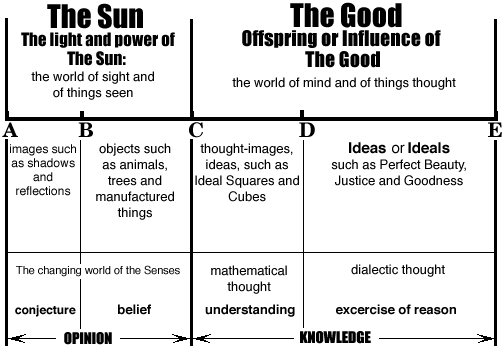
In another place (510a-551e), Plato elaborated his hierarchy of realities and human perceptions as one allegory of four lines. In these four lines, on the left half, realities are in the physical world, and they are furthermore divided into images and objects, like a shadow of tree and the tree itself. The perception of images is called conjecture or illusion, and the one of physical objects is called belief. And these two kinds of perceptions comprise human opinions. On the right half, realities are in the intelligible, non-physical world, and they are also divided into mathematical objects and forms (or “ideas”). The perception of the former is called understanding, while the latter is called thought, and these two comprise the realm of human knowledge. For Plato, the knowledge of forms is higher than mathematical knowledge because mathematical systems start from premises taken by mathematicians as granted, and mathematical reasoning must rely upon the assistance of figures and images in human mind. However, for the knowledge of forms, such as philosophical discussions on justice, courage, goodness, etc., nothing is taken for granted. Also, philosophical discussions can critically think of each and everything, and do not use images or figures as an assistance. For Plato, realities on the right hand of the line are more real than the left hand, and their corresponding knowledge also enjoys a certain order in superiority.

Plato’s Allegory of Four Lines (online source quoted here)

Eventually, Plato thinks the form of “goodness” is the highest reality that humans can ever imagine. The role of the form of goodness is like the one of “sun” in the physical world: it makes everything be what it is, and it also provides energy and vigor for everything to strive for their ideal, the ideal of what is uniquely good for themselves.

Understood in this way, the allegory of cave is a vivid depiction about how a prisoner trapped into lower levels of realities and perceptions strives for higher-level ones. It is a story of intellectual development, a story of personal transformation, and a story of human striving.

Frankly, Plato’s allegory of cave is among my favorite philosophical writings in the entire world and the entire history. You may disagree with Plato’s metaphysical and epistemological visions underlying this allegory; you may read this allegory from vastly different perspectives and angles. However, the unquenchable spirit of striving for what is truly real and good represents a deepest dimension of the motivation of human life, and believe me, you will always need to come back to this allegory to ponder a certain truth about human life when you learn more, have more, and experience more.

Required Reading:

Plato, The Republic, Book V, 475 e-518 d. (A reading guidance is provided in canvas)

Recommended Further Watch:

An animated narrative of Plato’s Allegory of the Cave.

Quiz:
1, What perspectives can you take to read Plato’s allegory of cave?

A, social media
B, education
C, political struggle for emancipation
D, psychoanalysis
E, and others.

2, what are the two most questions that Plato asked before he told his story of the cave in The Republic?

A, What really exists in the world?
B, If something is real, how can humans know it?
C, what is beauty?

3, The reasons Plato characterized the physical world as lying in between “reality” and “non-reality” include:

A, physical objects are changing, becoming, and thus, not as eternal and unchanging as mathematical objects.
B, physical objects are not completely nothing.
C, physical objects can have contrary attributes depending upon the perspectives of human perception.

4, The reasons Plato thinks philosophical knowledge is higher than mathematical knowledge include:

A, philosophical knowledge takes nothing for granted.
B, philosophical knowledge does not need to be aided by images and figures.
C, philosophical knowledge is higher than human opinions on the changing objects in the physical world.

5, what is the simile Plato uses to depict the highest form of “goodness”?

A, sun
B, moon
C, star

6, In 477d, Plato uses one term to refer to the ability of human beings to perceive the outside world, and it can be imagination, sense, intelligence, or memory. What is this term?

A, faculty
B, capability
C, power

7, According to 518e of the assigned reading, what is the decisive factor of education for Plato?

A, one’s will to learn
B, having good teachers.
C, having good textbooks.
D, entering good schools.

8, In the past several semesters, your schoolmates drew beautiful pictures to illustrate the setting-up of the whole story of the allegory of cave. Can you try to draw it on paper by yourself? The more details in the picture, the better. (This is not an assignment, and no grade will be given. You can choose to do it by yourself, and to post your answer if you want.)

Unit 5: Authority vs Freedom in Democracy

Audio: Authority vs Freedom in Democracy, by Dr. Bin Song.
Video: Authority vs Freedom in Democracy, by Dr. Bin Song.

Hallo, this is Dr. Bin Song in the course of introduction to philosophy at Washington College.

In light of the situation of the on-going global pandemic of Covid-19, and its seemingly unstoppable vigor in the U.S., we are witnessing a phenomenon in the American society which is very disturbing from a philosophical point of view. In the U.S., there is a strong trend of public opinion navigated by top politicians and pundits to be “anti-science,” and thus, to challenge the authority of scientists and experts during the process of policy makings in face of this public health crisis. This trend has contributed significantly to the direly high number of infection and death in the U.S.

This phenomenon looks particularly striking for me, and I also believe it looks so for people who share a similar personal experience with me. I grew up in a non-Western country, and have a memory on how in the colonial era, Western countries used their advanced science and technology to defeat our indigenous cultures, and ever since, to learn, pursue, and even transcend the scientific achievement of Western countries has become a national priority for many of these once-colonized non-Western countries. However, while non-Western countries are trying to imitate what the U.S has achieved in science, a large proportion of American citizens seem to not respect science at all, even if this would imply the tragical death of their fellow citizens!

So, the question is: why so? Why could it happen that in such a robust democracy as in the U.S., the country has the best scientists in the world and the strongest advocacy on freedom of speech, while voters can significantly defy against science so as to have irreversibly influenced the making of defective (to say the least) public policies?

This question, believe me, is very philosophical, because more than two thousand years ago, in ancient Greece, there was a giant philosopher who asked almost exactly the same question to the Athenian democracy, the very democracy which is often seen as the original model of the liberal democracies all over the world today. And this philosopher is Plato (c.a. 429-347 B.C).

Plato grew up during the Peloponnesian War, and learned with Socrates as his student for an extensive period of time in his youth. After Socrates was sent to death by the democratically elected Athenian court, Plato spent another 12 years travelling around, and studying with another philosopher, the mystic mathematician Pythagoras. During this time, he also began a lifelong relationship with the ruling family of Syracuse, and frequently gave advice on how to govern the city-state. After turning into his 40s, Plato returned to Athens, and founded his school named “Academy.” This is also allegedly the first liberal arts college in the Western civilization.

The question asked by Plato, which is extremely similar to the one that I just asked, is that: why did Athens kill Socrates? In other words, why did such a proud and powerful democracy kill its most intelligent citizen?

As discussed in last unit of this course, Socrates chose the sentence of death rather than being exiled because he had a faith in democracy. Despite being acutely aware of the fault of democracy, Socrates still believed that only in a democracy, can its citizens retain the right of questioning, and thus, sincerely believe what they do on the basis of vetting alternative answers to their questions. However, as Socrates’s most staunch and outspoken student, Plato understood his teacher’s death as more a sign of the stubborn and wicked ignorance of the Athenian mob, rather than as embodying any intrinsic strength or merit of the Athenian democracy. More importantly, in order to answer the question why Athens killed Socrates, Plato applied the Socratic method which he learned from Socrates to systematically tackle issues that the later development of philosophy was intensively focusing upon, such as the issue of metaphysics to explore what really exists in the world, the issue of epistemology to investigate, if some essential realities exist behind the appearance of the world, how humans can know them, the issue of ethics on how to differentiate good from bad human behaviors or habits, and the issue of political philosophy on who should be a ruler. In fact, Plato could be considered as the first systematic philosopher in human history, and because of this, some historian even claimed that the entire history of Western philosophy is just a long footnote to Plato.

Nevertheless, among all the writings of Plato’s, there is one work to stand prominently, and its title is The Republic. In The Republic, using the mouth of Socrates, Plato depicts a utopian state which is centered upon the supreme government of a philosopher-king, and thus represents his ideal of the best politics that humans can ever imagine. From this work, we select Book VI for this week’s required reading, and this excerpt also presents the most exemplary thinking of Plato to answer his question, why did Athens kill Socrates?

So, Why did Athens kill Socrates, its most intelligent citizen?

In the first part of the excerpt, Plato talks about who should be a ruler of a state. His view is that the person who affords to be a ruler should have genuine knowledge of rulership, viz., the knowledge about how to govern, how to organize, and how to put right persons into the right positions so as to realize the overall justice of their state. But what does genuine knowledge look like? Plato says that it would be like the knowledge of mathematics. In mathematics, once we have a definition of a triangle, for instance, and all its proven attributes, such as the sum of its three angles equal to a flat one, then, every particular triangular thing in the physical world, no matter how different they are from each other, must comply with the knowledge. By the same token, Plato thinks that genuine human knowledge is always about abstract objects in an intelligible world, and these intelligible objects are eternal, unchanging, always manifesting harmony and proportion. Plato has a great name for these intelligible objects, viz., this is a world of “forms.” After all, who can be a ruler? Plato’s answer is that only those people who have genuine knowledge of the forms of “rulership,” “governance,” “justice” and all others related to good government can rule, and accordingly, these people transcend limited opinions of human individuals and are able to claim “authority” over those public opinions. For Plato, this sort of people, who are definitely not many, have a proper name, “philosopher,” and his ideal state will be governed by a philosopher-king. In today’s context, particularly the one we just discussed above, these people would be those scientists and experts on public health, so that when a crisis of pandemic takes hold, ordinary citizens in a country can expect genuine knowledge from these scientists and experts about how to control it.

Since the difference between philosophers vs non-philosophers, between the authority of knowledge vs uninformed public opinions be understood as such, why did the Athenian democracy kill the best philosopher in its time? And why were the views of scientists and experts frequently overlooked and disregarded by the public during a crisis of public health?

Plato’s answer to this question is crystalized in his very famous “allegory of ship”. So, in the second part of the excerpt from The Republic, Plato tells a story about a mutiny among sailors against their captain. In this story, the owner of a ship, the captain, could not navigate the ship, so he has to appoint a leader among his sailors to hold the helm. Now, there were two people who can potentially be this leader. One is a demagogue who can do nothing but cater for the needs of those rebellious and greedy sailors; and another is a “star-gazer,” who knows genuinely how the season changes and how the wind blows on the seas, and thus, can really navigate the ship well. However, this star-gazer does not appeal to the needs of the sailors, since according to his best judgement, this star-gazer thought of those needs as largely irrelevant to the knowledge of seafaring, and what matters most for him is to get those authentic knowledge of seafaring. So, the result of the mutiny is quite expectable: since every sailor has the equal amount of freedom to vote, the demagogue is elected, and the star-gazer is disregarded, and what lies ahead of the crew would be just a complete disaster since no one in power really knows how to navigate the boat.

There is one sentence that summarizes the conclusion of Plato’s allegory of ship quite well, which is “the pilot should not humbly beg the sailors to be commanded by him – that is not the order of nature; neither are ‘the wise to go to the doors of the rich’ … but the truth is, that, when a man is ill, whether he be rich or poor, to the physician he must go, and he who wants to be governed, to him who is able to govern.” (The Republic, Book VI 490e)

So, in a word, why does it happen that in a democracy, philosophers were disregarded, Socrates got killed, while the authority of scientists and experts are distrusted and challenged? For Plato, this is because there is one intrinsic dimension to the existing political institution of democracy which can utilize the cruel power of the majority vote, viz., “the tyranny of the majority,” to defeat the authority of knowledge and merit. Because of the existence of this dimension of democracy, if the majority of voters remain uninformed, no institutional arrangement within such a democracy can guarantee an elected leader who has the needed knowledge and merit of leadership, and all policies can accordingly be made wisely for the genuine benefits of humanity.

My questions to you are that: do you agree with Plato’s answer? Do you have any better answer? Or, are you thinking about solutions to deal with this intrinsically self-defeating dimension of democracy?

Required Reading:

Plato, The Republic: Book VI (484a-490e), Trans. by Benjamin Jowett.

Recommended Further Reading:

About “freedom of speech and meritocracy,” please read Bryan W. Van Norden, “The Ignorant Do Not Have a Right to an Audience,” in The New York Times (June 25, 2018)

About an analysis of American politics about and during the pandemic, please read Jonathan Chait, “American Death Cult,” in New York magazine (July 20, 2020)

Recommended Further Watch:

The War on Science, CBS Full Decumentary
An illustration of Plato’s allegory of ship
A modern rendition of Plato’s Allegory of Ship

Quiz:

1, which philosophers have influenced Plato’s thought?

A, Socrates
B, Pythagoras
C, Aristotle

2, According to the required reading from The Republic Book VI, which of the following qualities belong to a philosopher?

A, Good memory
B, Having eternal, true knowledge
C, Being a lover of learning
D, Generosity
E, Being sociable and gracious rather than jealousy and covetous
F, Not fearing death and thus, being brave

3, According to the required reading from The Republic Book VI, Adeimantus critiques philosophers because he thinks philosophy is too abstract, and thus, useless for the public. Is this statement true or false?

4, Who is the analogy of “philosopher” in the allegory of the ship?

A, The star-gazer and able navigator.
B, The captain as the owner of the ship.
C, The elected leader of the sailors.

5, According to Plato, where should the authority of a leader come from?

A, the majority vote of the people
B, the needed knowledge and merit for genuine leadership.
C, the appointment of a monarch
C, the divine command of the God.

6, Plato calls abstract objects of genuine human knowledge as “forms,” and thinks that these forms are eternal, unchanging, and lies in an intelligible world which is different from the becoming and corruptible physical world. Is this statement true or false?

7, At the end of the lecture in this unit, Dr. Bin Song asked several questions. What’s your thought on them? Please choose some of these questions, and write a couple of sentences to answer it or them.

Unit 4: Be an Artist of Reasoning

Audio: the Art of Reasoning, by Dr. Bin Song
Video: the Art of Reasoning, by Dr. Bin Song

Hallo, this is Bin Song at the course of Introduction to Philosophy at Washington College.

Our course starts from telling my personal story on how I entered the study of philosophy, and then, we discussed ancient Greek philosophy as a tradition of rational criticism and debate. In last unit, we introduced the charismatic figure, Socrates, who would like to sacrifice his life to his belief in democracy and his practice of philosophy.

Now, it is a perfect time to introduce one of the central skills that a philosophy major is required to command: logic, and the art of Reasoning. Quite obviously, without the tool of good reasoning, those ancient Greek philosophers cannot rationally debate each other; and Socrates cannot apply his Socratic method to have extensive dialogues with his Athenian fellow citizens on varying topics either, such as what is justice, courage, goodness, etc. In other words, the birth of philosophy in ancient Greece is distinguished by its logical mindset, a mindset to use evidence, reasoning, and argument to collectively advance human knowledge.

I also linked two recent articles here to help you appreciate how important the skill of reasoning is. One is titled “Want a good job? Major in philosophy.” Its thrust is that the major of philosophy teaches students how to think critically, logically and independently, and it also teaches students how to find better solutions to problems with an open-minded awareness that real life problems normally do not have a singular, one-size-fit-for-all solution. And these skills of critical thinking and problem solving prepare philosophy students for a variety of jobs, and in particular, increase the needed momentum and adaptivity in their middle careers, no matter what job they would be pursuing. Another article is “how teaching philosophy could help combat extremism,” and its major claim is that the critical and independent thought to which a philosophy student is habituated is a powerful antidote to the simplistic, tribalist and extremist thinking that today’s extremely open yet dividing media environment is prone to inculcate. In other words, individually, learning how to think philosophically prepares one for jobs, while from the perspective of society, the consistent implementation of critical thinking, rational debate and free inquiry is absolutely vital to the well-functioning of a democracy.

Even if we do not quote any history or article, the significance of learning how to think makes a common sense. In the human society, if you look around, everything that humans have accomplished start from an idea. If you want to become rich, you need a business idea; if you want to speak a new language, live in a new country, and have new human relationships, you need an idea about how to do so. More importantly, when many ideas existing in your mind, how to differentiate good ideas from bad ones, how to connect these ideas to form a solid body of knowledge, and how to learn new ideas to complement the old, all of these lie rightly at the initial moment of any human activities. In this sense, we will find that the ability to think rigorously, creatively, and independently before delving into any depth of human activities is really what distinguishes humans from animals, humans from machines and more importantly, distinguishes human individuals from each other. In other words, this ability makes us not act from impulse, not act from old programming, but from our independent, autonomous, and creative center of human personality: reason.

Good, enough for the significance of the ability of thinking. Let’s move on to the basics of Logic, and the art of reasoning.

Regarding the art of reasoning, or how to make good argument, there are two aspects of it, one is technical and another is ethical. The technical side of it pertains to the basics of logic, and the ethical side of it is about how to rationally debate, persuade, and learn from your disputants. Let’s proceed following one aspect after another.

So, the first question is: what is logic?

Logic is the study of reasoning, which provides standards for distinguishing good reasoning from bad reasoning.

But, before we get to the standards part, the immediate second question is: what is reasoning?

All reasoning consists of two components: (1) at least one premise, and (2) one conclusion. The premise(s) of your reasoning provides the reasons or evidence that you are using to support your conclusion. Accordingly, the conclusion of your reasoning is a statement that you believe on the basis of your premise(s). For example, the following is reasoning: “I should stay quiet when others are studying in the library because that’s what I would expect of others.” Here, I am concluding that I should be quiet based on the premise that I would expect the same from others.

There are two general types of reasoning: Induction and deduction

Inductive reasoning is reasoning in which you base your conclusion on a premise(s) that supports your conclusion with some degree of probability. That is, the premise(s) gives you a strong reason for concluding something but doesn’t guarantee that this conclusion is true. For example, you might conclude that the courses in this fall semester (this refers to 2020 Fall) would end up in a few weeks after the Thanks Giving holiday so that you have booked a travel for that time, because in your mind, the school most often ended that way before. However, while this conclusion may be quite probable given your past experience, it is not automatic and certain. Indeed, something could happen abruptly so as to change the normal schedule. The current pandemic is one best example for this. So, all inductive reasoning is like this. Even if all your premises are true, your conclusion is at most probable, not certain.

Deductive reasoning is different. If the premise(s) of deductive reasoning is true, your conclusion will automatically be true too. In other words, there is an automatic transmission of truth value from the premises to the conclusion in deductive reasoning. In fact, we say that deductive reasoning is “valid” (viz., acceptable) only if the conclusion is automatically true when the premises are true. For example, the following is valid deductive reasoning: “If someone is a human then they will someday die; Socrates is a human; therefore Socrates will someday die.” Notice that, in the case of this reasoning, if the premises are true, the conclusion is automatically true. It’s guaranteed to be true. However, it is usually the case that the premises in valid deductive reasoning are not themselves certain. For example, the premise that if someone is a human then they will someday die is not certain because it is itself a conclusion drawn from inductive reasoning.

To see this, you need only consider how we can claim to know that all humans die. We believe this premise because we have concluded it from the further premise that all humans have always died in the past. But, it is still possible that in the future we might figure out how to make ourselves immortal. At least, the idea of immortal human beings is not self-contradictory, and hence, is possible in reality. So, we can’t conclude with certainty that if someone is a human, they will someday die. Of course, it’s very likely and for practical purposes we might not question it; but, strictly speaking, it is only probable and not automatically true.

So, even though the conclusions of deductive reasoning are automatically true given that their premises are true, the conclusions of such reasoning may still not be true. This can be the case when at least one of the premises is false. For example, consider this reasoning: “If you are a human then you will live forever; you are a human; therefore you will live forever.” Here one of the premises is probably false. So the conclusion that you will live forever is not automatically true. It would have to be true only if both of the premises were true.

From these discussions, we also find that deductive reasoning could be sound or valid. If all of the premises of a valid deductive argument are true then its conclusion will also be true. Such a deductive argument that has all true premises is called sound deductive reasoning. So, in valid deductive reasoning the conclusion is automatically true if all of its premises are true; and in sound deductive reasoning all of the premises are actually true.

In light of these discussions, since reasoning comprises of inductive one leading to probable conclusion, and of deductive one leading to certain conclusion as long as its premises are also certain, our standards to judge whether one’s reasoning is good or bad include the following points: whether they raise enough evidences to support the high probability of their conclusion, and whether they conform to the rules of deductive reasoning so that their arguments appear to be valid and sound. If not, we definitely can use two counter-arguments to refute them: that is, we can raise contrary evidence to refute that inductive conclusion, and we can also point out inconsistency of their deductive reasoning.

However, even if our own argument contains highly probable inductive reasoning, and sound deductive reasoning, we cannot guarantee that our arguments always sound persuasive to our audience. Why? That’s because as mentioned, apart from the technical side of reasoning, viz., the basics of logic that we just mentioned, there is another ethical side of argumentation and debate. In other words, for that sort of rational debate favored by ancient Greek philosophers which leads to the advancement of human knowledge, we do not only need the basics of logic, we also need a practical art of persuasion, one that could turn our audience into willing listeners even if we may disagree each other on certain points of views. Believe me, this side of the art of reasoning turns out to be more difficult than commanding the rules of good reasoning, although the latter is also utterly important. I also believe that this difficulty does not sound unfamiliar to you. An instinct of human beings which may be inherited from our aggressive animal nature is that we usually misunderstand disagreement of views as a sort of clash of persons, so that whenever someone refutes our view, our initial impulse tends to perceive it as a personal attack, and then, we will wield everything in our hand to fight back. In this case, debate may easily turn into being irrational, and the ideal of learning and advancing human knowledge through rational debate will be just thrown under the bus.

So, here, I will raise a six-step program for the art of persuasion, which is also the ethical part of the art of reasoning. And its central concern is how to criticize with kindness, and thus, realize the ideal of rational debate. Do remember, if you want to be a good artist of reasoning, you must practice both the technical side, and this ethical side of the art consistently. Neither of the two aspects can be dispensed with another.

So, how to deliver a successful critical response?

  1. You should attempt to re-express your target’s position so clearly, vividly, and fairly that your target says, “Thanks, I wish I’d thought of putting it that way.” This means you always understand your disputant accurately and thoroughly before criticizing their views. In an actual dialogue, this step could be said in a sentence like “Peter, let me try to grasp what you have said. … Is this what you mean?” or “Sarah, I do not fully understand the point you just mentioned … Can you clarify it a little bit before we’re moving forward? Did you say that …? Is this what you mean?”
  2. You should list any points of agreement (especially if they are not matters of general or widespread agreement). This is very important for the art of persuasion, which shows the existence of a common ground among disputants, and thus, would not turn the dialogue into overtly antagonistic or hostile.
  3. You should mention anything you have learned from your target. This point deepens the last point even further, isn’t it so? The necessity of rational debate consists in the limitedness of knowledge of any human individual. So we need to come together to debate, to analyze, and more importantly, to learn from each other. A highlight of what you have learned from your disputant is a must-do before moving the debate forward.
  4. Only then are you permitted to say so much as a word of rebuttal or criticism. Considering the standards of good reasoning we mentioned above, you can refute the view of your disputants through raising contrary evidences or pointing out their inconsistency. In the future, if you continue to sign up in philosophy courses, you will learn more methods of refutations and how to apply those methods into varying contexts. But overall, to raise contrary evidences and point out inconsistency are always a good start.
  5. If your refutation pertains to ethical issues, make sure you do before you say it. For instance, you may refute that your interlocutor’s view not to donate to a certain charity is too selfish. In order that this refutation is really persuasive, you need to do before you say it, which may mean that you must already have a such a record of donation, or you can make your interlocutor believe that you will make such a donation. Regarding ethical issues, humans are persuaded by examples and deeds more than by words.
  6. After all these five steps have been successfully conducted, you need to put yourselves into your disputants’ shoes, and explain from their perspective, how their pre-established views can accept your critique, and thus, how this critique can enlighten their own understanding on the addressed issue. In this way, you help your disputants realize that as a team, you are learning from each other, and collectively, you are contributing to the advancement of human knowledge, which is what rational debate is all about.

Ok, let me simplify these six steps in some pithy words so that you can memorize them:

To present persuasive criticism or refutation to others, you need to:

  • 1, Recapitulate others’ views.
  • 2, Find where you agree with them.
  • 3, Explain what you have learned from them.
  • 4, Present your criticism rationally, viz., following the basics of logic.
  • 5, If disputing ethical issues, do before you say.
  • 6, Explain how others can accept your criticism.

Recommended further reading:

Daniel Dennett, Intuition Pumps And Other Tools for Thinking (W. W. Norton & Company, 2013)

Recommended further watch:

Quiz

(1) When you arrive at your office, and find that the door has been opened; based upon your past experience, you conclude that the janitor is working inside right now. What type of reasoning are you utilizing to reach this conclusion?
A, Induction
B, Deduction

(2) A gym trainer is struggling to figure out whether he should quit the job he loves because he has the least clients among peer trainers. He thought that “All marketing strategies are to sell products that clients do not want, and I hate it. There is a specific way of marketing for gym trainers to promote their training programs. Therefore, I would not learn this marketing skill in my profession even if this means the decrease of the number of my clients.” What type of reasoning is this gym trainer using to reach his conclusion?
A, Induction
B, Deduction.

(3) If you get it correct on last question, how would you describe that gym trainer’s reasoning?
A, it is a valid and sound deductive reasoning.
B, It is a valid deductive reasoning because if the premises are true, the conclusion is true.
C, It is not a sound deductive reasoning because some premise of it is not true.

(4) There are two components for the art of reasoning. What are they?

A, the basics of logic which state the rule of good reasoning.
B, the art of persuasion which lays out the rules for the ethical practice of argumentation.

(5) There are six steps for the art of persuasion addressed by this meeting. Please find a topic to debate with your friends, family members, or peer-students following these steps, and then, submit a short report of the debate. In the report, you only need to state the topic of the debate, people’s views on the two sides, and what you have experienced or learned from the process. The report needs to be within 100 words.

Unit 3: Did Socrates Give Us any Answer?

Audio: Socrates by Dr. Bin Song.
Video: Socrates by Dr. Bin Song.
  • Part I: Socrates by Dr. Bin Song

Hallo, this is Bin Song from Washington College. In this episode of the series of “Introduction to Philosophy,” I will pursue one of the most daunting, yet exciting tasks as a philosophical instructor. That is to explain my understanding of Socrates.

I said this is one of the most daunting tasks to do, not because Socrates’s philosophy is abstruse and difficult so as to require a higher intelligence for its analysis. Neither is it because his philosophy was written in a very old language so as to need a sophisticated level of text-reading for scholars to grasp it. No, none of these normal reasons to understand a difficult philosopher applies here.

The primal reason for reading Socrates to be so challenging and exciting is, instead, that Socrates did not write a damn thing! Yes, he did not write down anything, and all we can know about him derives from how other authors wrote about him, such as Plato, Aris’tophanes and Xenopon. Let’s pause a bit to ponder this phenomenon and think about how amazing it is.

Although I am not sure of many things, I am very sure of this: Today, none of philosophers does not write. More probably, the survival of a philosophical scholar in the academy today would almost entirely depend upon how they publish, how they present, and in other words, how they turn their thoughts into ink, paper, digits and other materials. However, the forefather of western philosophy, who single-handedly turned the entire direction of ancient Greek thought from nature to humanity ourselves, and thus, became a name that is indispensable to the concept of “philosophy” ever since, did not even write down a damn thing!

Of course, scholars provided many answers to the question why Socrates did not write down anything. And after reading the original materials from which we can find witnesses to Socrates’ life, I also happen to have my own answer to this question. For instance, I think this is mainly because Socrates preferred talking with real people in the marketplace to writing papers or books for the circle of philosophical elite. The latter form of philosophizing may be thought of by Socrates to be too pedantic, rigid, and quite often, pretending to know something that the authors did not really know, or about which the authors simply would like to change their views quite readily when time passed by. However, all these answers still hang in the air, because after all, Socrates did not write down a damn thing. Even if we have zillions of answers to parse out Socrates’s philosophy, we still have to conclude our answers with another final question, that is, are these answers correct?

The same degree of perplexity can be used to describe Socrates’s attitude towards democracy. According to what we know, Socrates’s life experienced the devastating period of Peloponnesian war (431-401 B.C.E) during which the democratic Athens drastically declined from a regional empire to a diffident and despondent oligarchy after being defeated by its long-standing deadly rival, the Spartans. During this war, Socrates may have participated several of its major battles, but the most zealous activity out of his own will is always to go to the market place of the Athens, and to question all sorts of people about their conventional understandings of the world, their time, and their own persons. After democracy resumed, Socrates was put to death by the democratically elected Athenian court. And Socrates’s self-defense in this trial, according to Plato’s writing the Apology, can be summarized in this following way, which is no less perplexing to modern readers: Socrates said that

First, the charges against me, namely, impiety and corruption of youth, are absolutely non-sense.

Second, however, because the judgement is delivered by a democracy, I will still obey it.

And third, if I choose to be exiled from the Athens, rather than being executed, I will lose my life of continually questioning and examining human life together with my city fellows for ever, and this is more unbearable than death.

So, in a word, according to Socrates’s view, he would like to die for a democracy that allows a life of questioning, rather than living to avoid a wrong judgment, a wrong answer. To put it in a more blunt way, Socrates would like to die for questioning, even if this questioning can lead to seriously wrong answers.

Nevertheless, I believe any one, as long as they once lived under different types of governments, especially an authoritarian in contrast with a democratic one, will find that Socrates’s argument in his self-defense, and his attitude towards democracy in general, actually make a lot of sense. The sense mainly derives from the fact that in non-democratic states, their citizens do not have much a right of questioning. They have all the answers given beforehand, and thus, have no need to challenge any answer, or even no need to ask any questions and think through them by themselves. However, in a democracy, even if the people may be very ill-informed, and they answer questions in a profoundly wrong and disappointing way, at least, individuals can still question those answers if they like to, right? In a democracy, even if you refuse to think for yourself, which is very unfortunate and even immoral, the right of vote implies that at least in paper, you should have already thought for yourself when you cast the vote. So, the criteria for us to evaluate an authoritarian government vis-a-vis a democratic one, according to Socrates’s heroic deed of philosophical martyrdom , should not be only about what correct answers these governments can give to resolve problems in a society, but more importantly, the standard should be also about whether the government can allow its people to continue asking questions, to express their dissatisfaction about given answers, and to pursue their curiosity and interest in a diverse and whole-hearted way.

So, understood as such, the seemingly perplexing nature of Socrate’s life and Socrates’s philosophy becomes highly understandable. Perhaps, for Socrates, continually asking questions and discussing questions in the right way are more important than having any ready-made answers. The following three examples will help you understand why this is so.

First, why does Socrates think that he is wise because he knows he knows nothing, whereas no one else knows that they know nothing? This is because in order for humans to continually ask questions, none of us can be so arrogant as to think we already have the absolute knowledge on any issue. If we think so, dialogue will become unnecessary, and questioning will be forbidden, and therefore, humans will become more foolish, rather than wiser.

Second, why does Socrates think that virtuous life is the best life of human beings, and virtue is the reward of practicing virtue itself? Obviously, Asking questions and discussing them in a logical and reasonable way requires lots of virtues: we must be patient, we must respect our interlocutors, we must be honest about what we know and what we do not know, we also need to be courageous to admit our own ignorance or to reveal others’ if necessary, and we also need to care about the well-being of others because we do not want them to be misguided by false knowledge, etc. See, there are so many virtues that we need to acquire in order that questioning can be continually conducted. However, do we need to be benefited from the consequence of these virtues in order that we can practice them? No, according to Socrates, even if questioning leads to seriously wrong answers, we still need, and even need more, to continue the questioning. So, the process of practicing virtues is far more rewarding than the consequences of them.

Finally, why does Socrates think that unexamined life is not worth living, and his divine mission is to be a gadfly to the Athenian democracy so as to make his Athenian fellows stay away from complacency and intellectual stagnancy? That’s because democracy represents a noble ideal of human life that humans can actually govern themselves, and choose their own way of life based upon their full and sincere intellectual assent. Quite obviously, this ideal is based upon the guarantee of the right of questioning, rather than upon any ready-made answer to any type of questions.

So, let’s go back to the original question of this episode, as a philosopher, did Socrates give us any answer to questions we can ask about his thought? I think the answer to this question is both no and yes. No, he does not give us any doctrine, any theory, or any ready-made answer to any question. However, the answer to this question can also be yes. Yes, Socrates’s answer, if any, would lie exactly in the fact that he just wants us to continually ask questions, think for ourselves, and discuss all questions in a logical, methodical and improvable way.

However, am I correct on understanding Socrates as such? Do you agree or not? Have you read materials about Socrates so that you can debate with me? Do I read all of them? This list of questions will continue, and I am extremely happy to conclude this lecture with this list.

  • Part II: Ten Key Points of Socrates’s Life
  • Part III: Plato’s Apology, Ten Key Points

Quiz:

(1) Socrates didn’t write down anything, and scholars have to use other authors’ writing on him to investigate what are the life and philosophy of the historical Socrates. This is called the “Socratic Problem” in the studies on Socrates. Is this statement true or false.

A) True.
B) False.

(2) Which part of Plato’s writing is the more reliable account of Socrates’s thought?

A) Earlier one, such as the Apology.
B) Middle-period one, such as the Republic.
C) Later one, such as the Timaeus.

(3) By what charges was Socrates sent to death?

A) Impiety
B) Dishonesty
C) Corruption of the Youth.

(4) Socrates was told by the Oracle of Delphi as the wisest human among the Athenians. This is because

A) Socrates was the teacher of Plato.
B) Socrates transforms ancient Greek philosophy
C) Socrates knows that he knows nothing, but others do not know that they know nothing.

(5) Socrates demands that philosophers are different from sophists, because sophists teach people how to win arguments in the democratic assembly and thus, gain power, while philosophers use their argumentative skills to pursue wisdom for the sake of wisdom. Is this statement true of false?

A) True
B) False.

(6) Socrates transformed ancient Greek philosophy because he utilized the same method of rational criticism and open inquiry to discuss issues of human life, rather than nature, and thus, turned the attention of philosophy from nature to humanity ourselves. Is this statement true or false?

A) True
B) False.

7) How does Socrates defend himself in the trial? Do you agree with his defense? Please answer these questions using a couple of sentences.

8) What is the relationship between Socrates and ancient Greek democracy? Please answer this question using a couple of sentences.

Recommended Watch:

A fine documentary on Socrates and the Athens in his time.

Recommended Reading:

Plato, the Apology . in Plato in Twelve Volumes, Vol. 1. Translated by Harold North Fowler; Introduction by W.R.M. Lamb. Cambridge, MA, Harvard University Press; London, William Heinemann Ltd. 1966.