
芭蕉詩
芭蕉心盡展新枝,新卷新心暗已隨。
願學新心養新德,旋隨新葉起新知。
On the Basjoo Tree
The basjoo tree
perfects its core
to unfurl a new stem.
Unnoticed, a new curl of
a new core
is already emerging.
I love to learn
with a renewing mind-heart
to cultivate new virtues,
so that,
soon after a new leaf,
a new stem of knowledge
will arise.
Commentary:
Zhang Zai (1022-1077 CE) was a pioneering Ru philosopher of the so-called Dao Xue (Learning of the Way, 道學) movement, which is usually called Neo-Confucianism in English. Zhang is famous for his treatise, The Western Inscription (西铭), in which he grounds the Ru virtue of filiality (xiao, 孝) on the cosmic piety of human beings towards the heavens and the earth.
In this exquisite poem, On the Basjoo Tree, Zhang Zai uses the image of a Basjoo tree to express his Ruist thinking concerning the relationship between the world and human beings. For Ruists, the cosmos, called tian (天), is an all-encompassing process of continuous novelty and creativity. Correspondingly, the ethical commitment of human beings is thought of as a constant renewal process of learning such that a condition of dynamic harmony (he, 和) is continually being created in the evolving situations of human society.
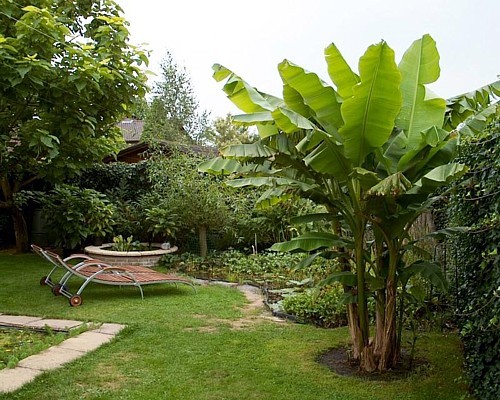
The biological peculiarity of the Basjoo tree is that what looks like its trunk is actually composed of curled-up stems packed together, so that when one curled stem becomes mature, a new leaf is unfurled and its stem then grows into a new branch of the plant. For Zhang Zai, this feature of the Basjoo tree represents perfectly the core of Ruist aesthetics: the world continually renewing itself. Thus, in the second half of the poem, Zhang Zai says he loves to learn with the Basjoo tree and in that way to continue to nurture and renew his virtues and to uncover new knowledge about the world.
Some use of puns or word-play in Chinese is crucial for the poem’s diction. In Chinese, 心 (xin) can mean “mind,” “heart” or “core.” It is used by Ruists to refer to the undivided central capacity of human consciousness and encompasses its intellectual, emotional and volitional dimensions. Therefore, a standard English translation of the Ruist idea of xin is “mind-heart.” Because xin also means “core” in Chinese, the curled-up stems making up the trunk of the Basjoo tree is portrayed by Zhang Zai as its xin, and its continual unfolding symbolizes a renewing of the human mind-heart that longs for continual learning and self-cultivation. Also, the Chinese term for “stem” (zhi, 枝) has the same pronunciation as the Chinese term for knowledge (zhi, 知). So, as each new stem is unfurled, it symbolizes a virtuous Ruist learner who has garnered a new piece of knowledge. Please pay attention to the fact that for Zhang Zai, knowledge and virtue are intertwined in the self-cultivation of a human being, and so these renewals are manifestations of the transformation of one’s own mind-heart. This reminds us of the first three paragraphs of Great Learning (Daxue, 大学), which lays out a detailed procedure for Ruist self-cultivation based upon attaining knowledge (致知), rectifying one’s mind-heart (正心), and illuminating one’s bright virtues (明明德).
Another important lesson from Ruist poetry is that in the perspective of comparative literature, Ruists are fond of using the same image to express multiple meanings. For example, “lotus” is an image heavily used in Buddhist literature to express Buddhism’s commitment to eliminating desires and anxieties and thereby to search for release from the suffering process of reincarnation through Buddhist practice. However, in Zhou Dunyi’s “On Loving the Lotus,” the lotus is described as “Inside, it is open; outside, it is straight” “It neither sprawls nor branches,” and in this way the lotus becomes a Ruist image, symbolizing the Ruist moral ideal of an upright and honest noble-person (junzi, 君子). Similarly, the Basjoo tree is an icon also popular in Buddhist literature where its trunk is actually “empty” once you account for all the unfolding stems. But in Zhang Zai’s poetry, the Basjoo tree becomes an icon expressive of the Ruist metaphysical insight concerning the constant creativity of Tian (cosmos) and the Ruist ethical commitment to the constantly being renewed self-cultivation of human beings.
(Translated and Commented by Bin Song)
If you feel moved to support this translation, you may do so here.


 Bin Song