On Ren (仁, Humaneness)

Introduction:

I translate and annotate Zhu Xi’s “On Ren” to show how Zhu Xi understood the cardinal human virtue of Ren (仁, humaneness). In my view, this is one of the most comprehensive explanation of the virtue Ren in Ruism.

仁說

天地以生物為心者也。而人物之生,又各得夫天地之心以為心者也。故語心之德,雖其總攝貫通,無所不備,然一言以蔽之,則曰仁而已矣。請試詳之:

蓋天地之心,其德有四,曰元亨利貞,而元無不統;其運行焉,則為春夏秋冬之序,而春生之氣無所不通。故人之為心,其德亦有四,曰仁義禮智,而仁無所不包;其發用焉,則為愛恭宜別之情,而惻隱之心無所不貫。故論天地之心者,則曰乾元、坤元,則四德之體用不待悉數而足; 論人心之妙者,則曰“仁,人心也”,則四德之體用亦不待遍舉而該。

蓋仁之為道,乃天地生物之心,即物而在。情之未發,而此體已具;情之既發,而其用不窮。誠能體而存之,則眾善之源、百行之本莫不在是。此孔門之教所以必使學者汲汲於求仁也。

其言有曰:“克己復禮為仁”,言能克去己私,復乎天理,則此心之體無不在,而此心之用無不行也。 又曰:“居處恭,執事敬,與人忠”,則亦所以存此心也。 又曰:“事親孝,事兄弟,及物恕”,則亦所以行此心也。

又曰:“求仁得仁”,則以讓國而逃,諫伐而餓,為能不失乎此心也。

又曰:“殺身成仁”,則以欲甚於生,惡甚於死,為能不害乎此心也。此心何心也?在天地則坱然生物之心,在人則溫然愛人利物之心,包四德而貫四端者也。

或曰:“若子之言,則程子所謂愛情仁性,不可以愛為仁者非與?”曰:“不然。程子之所訶,以愛之發而名仁者也。吾之所論,以愛之理而名仁者也。蓋所謂情性者,雖其分域之不同,然其脈絡之通,各有攸屬者,則曷嘗判然離絕而不相管哉?吾方病夫學者誦程子之言而不求其意,遂至於判然離愛而言仁,故特論此以發明其遺意,而子顧以為異乎程子之說,不亦誤哉?”

或曰:“程氏之徒言仁多矣,蓋有謂愛非仁,而以萬物與我為一,為仁之體者矣;亦有謂愛非仁,而以心有知覺,釋仁之名者矣。今子之言若是,然則彼皆非與?”

曰:“彼謂物我為一者,可以見仁之無不愛矣,而非仁之所以為體之真也。彼謂心有知覺者,可以見仁之包乎智矣,而非仁之所以得名之實也。觀孔子答子貢博施濟眾之問,與程子所謂覺不可以訓仁者,則可見矣,子尚安得復以此而論仁哉 ? 抑泛言同體者,使人含胡昏緩而無警切之功,其弊或至於認物為己者有之矣;專言知覺者,使人張皇迫躁而無沈潛之味,其弊或至於認欲為理者有之矣。一忘一助,二者蓋胥失之。而知覺之雲者,於聖門所示樂山能守之氣象尤不相似,子尚安得復以此而論仁哉?”

因並記其語,作《仁說》。(《朱子全書》二十四册)

On Ren (仁)

The being of Heaven and Earth consists in creativity. When things and people come into existence, they are endowed by Heaven and Earth with their natures. Because of this, the human mind-heart—within which human nature is embodied—has virtues which embrace all, penetrate all and thus, lack nothing. Nevertheless, one word can sum them up: Ren (仁, humaneness). Let me try to explain in detail.

There are four virtues for the creativity of Heaven and Earth: initiation, permeation, harmonization, and integration. The virtue of initiation governs them all (i). In their operation, these virtues are manifested in the four seasons—the vital-energy of spring permeates them all (ii).

Correspondingly, there are four virtues for the human mind-heart: Ren, righteousness, ritual-propriety, and wisdom—the virtue of Ren embraces them all. When these virtues come forth and function, they are manifested in the human feelings of love, obligation, respect, and judiciousness—the feeling of commiseration pervades them all (iii).

Therefore, when discussing the creativity of Heaven and Earth, if we simply say, “the initiative power of Qian (Heaven), the initiative power of Kun (Earth),” then its four virtues and their functions are encapsulated.

For discussing the magnificence of the human mind-heart, if we simply say, “Ren is what the human mind-heart is,” then its four virtues and their functions are summarized (iv).

So, the virtue of Ren is actually what the human mind-heart—which is produced and sustained by the creativity of Heaven and Earth—consists in. It functions when the human mind-heart engages with things. When feelings are not aroused, the virtue is already there. When feelings are aroused, it functions inexhaustibly.

If we can sincerely embody and preserve the virtue of Ren, then we have in it the fountain of all goodness and the root of all deeds. This is why the teachings of the Confucian school (Ruism) urge scholars to pursue, keenly and unceasingly, the virtue of Ren.

Ruism teaches, “Master oneself and return to ritual-propriety.”(v) This means, if we can eliminate selfishness, and recover the principle of Tian within ourselves, then this mind-heart will reach everywhere and its function will always be operative.

It also teaches, “Be respectful when you are at home, be dedicated when you work, and be trustworthy when dealing with people.”(vi) These are ways to preserve this mind-heart.

It also teaches: “Be filial when serving parents, be discreetly obedient when serving elder brothers, and be empathetic when engaging with all kinds of things.”(vii) These are ways to practice this mind-heart.

It also teaches: “(Bo Yi and Shu Qi) sought Ren and then, they found it.” (viii) This teaching is about Bo Yi, who declined a throne and left the state in favor of his younger brother Shu Qi. The brothers also remonstrated against King Wu’s rebellious expedition, and after failing to persuade him, they chose to starve to death. That they were determined to do this is because they didn’t lose this mind-heart. (ix)

It also teaches, “Sacrifice life in order to accomplish Ren.”(x) This implies that we desire something more than life and hate something more than death in order not to injure this mind-heart. What is this mind-heart all about? It is rooted in the all-encompassing creativity of Heaven and Earth, and in the human world, this mind-heart loves people and nurtures things. It incorporates the four virtues (i.e., Ren, righteousness, ritual-propriety, and wisdom) and bonds together the four moral incipient sprouts (i.e., the feeling of commiseration, the feeling of shame and disgust, the feeling of deference, and the feeling of distinguishing right and wrong) (xi) .

Someone asked: “According to your words, is it not wrong for Master Cheng (xii) to say that love is a particular feeling while Ren is the human nature and therefore, love should not be regarded as Ren?”

I answer, “Not so. What Master Cheng criticized was to use the human status when the feeling of love is aroused to portray what is Ren per se. What I argued is to use the principle of love to portray Ren per se. For human nature and human feelings—although they belong to different existential spheres—connect to each other like arteries and veins in the same body (xiii). How can they become sharply separated and have nothing to do with each other? Scholars recite Master Cheng’s words without understanding their meaning to the extent that they even talk about Ren as being something separate from love. I worry about this, and therefore, made the above exposition in order to reveal the lost meaning of Master Cheng’s teaching. You think of my view as divergent from Master Cheng, isn’t this wrong?”

Someone asked, “The followers of Master Cheng have given many explanations of Ren. Some say that love is not Ren, and regard the oneness of all things and one’s self as what is Ren per se. Others maintain that love is not Ren, but explain Ren in terms of awareness possessed by the mind-heart (xvi). If what you say is correct, are they all wrong?”

I answer, “From what they call the oneness of all things and one’s self, it can be known that Ren involves love for all, but this oneness is not what is Ren per se. From the fact that the mind-heart possesses awareness, it can be seen that the virtue of Ren includes wisdom, but this is not how the Ren per se can be named. If you look up Kongzi’ answer to (his pupil) Zi Gong’s question whether conferring extensive benefits on and thus, helping all the people will constitute Ren (xv) and also Master Cheng’s view that Ren ought not to be construed in terms of awareness, you will see the point. How can you still explain Ren in these terms?

“Furthermore, if the oneness of things and one’s self is superficially talked of, that will lead people to be indistinct and inattentive so that no effort is made to keep alert. The harmful effect—and there has been—may be to mistake exterior things for one’s own self. If Ren is construed in the specific term of awareness, that will lead people to be anxious, impatient, and impetuous so that the process of moral self-cultivation lacks depth. The harmful effect—and there has been—may be to mistake one’s desire as moral principle. In the first case, the mind-heart is oblivious, but in the second case, the mind-heart is agitated and disturbed. Both are wrong. Further, as for the construal of Ren in terms of awareness, this view is especially incongruent with Kongzi’ teachings that a person of Ren has the temperament of loving mountain (xvi) and that only the virtue of Ren can preserve what human knowledge has been aware of (xvii). How then can you still explain Ren in this way?”

It is because of all this that I record their questions and compose this essay on Ren.

Notes:

(i) Tian (天, heaven) is an all-encompassing constantly creative cosmic power. Its creativity has four generic features: (1) Tian creates the world from nothing and initiates the world as a process of continual creation, and in this sense, Tian’s creativity is initiative (元, yuan). (2) Tian creates everything, so Tian’s creativity is permeative (亨, heng). (3) Everything created by Tian is and becomes together within Tian, so Tian’s creativity is harmonizing (利, li). (4) Tian creates the world as a whole, and also, every creature is endowed with a nature to integrate itself, so Tian’s creativity is integrative (貞, zhen). These four basic features of Tian’s creativity are called by Zhu Xi its four ‘virtues’ (德, de). Also, Zhu Xi uses “Heaven and Earth” to refer to Tian. This is legitimate, because seeing from the human perspective, Tian is manifested as two parts: heaven and earth. Tian’s creativity is accordingly manifested in the co-creativity of heaven and earth. Furthermore, Zhu Xi thought the virtue of “initiation” governs all other virtues. This is because without the initiative power of Tian, there would be no world, and as a consequence, all other generic features of Tian’s creativity would lose their ground. Zhu Xi’s thought is based upon the statement of the hexagram for Hexagram Qian in the Classics of Change (易經): “元,亨, 利, 貞”.

(ii) Principle (理, li) and Vital-energy (氣, qi) is a basic dyad of categories in Zhu Xi’s thought, which is arguably comparable to the one of Form and Matter in Greek philosophy. The most generic features of the four virtues of Tian’s creativity are referred to by Zhu Xi as the “Principle of Tian” (天理) in the later part of the essay. These principles of Tian are manifested in the action of the cosmic vital-force during the course of four seasons.

(iii) The feeling of commiseration (惻隱之心, the Mencius 2A), according to Mencius, is what one spontaneously feels when one sees a baby about to fall into a well. For Mencius, this is the moral incipient sprout of the cardinal human virtue of Ren, which Mencius thinks is what human nature is all about. For Zhu Xi, he maintains Mencius’s thought and thinks that the feeling of commiseration is also one incipient form of the human feeling of universal love. However, in a more delicate way than Mencius, Zhu Xi furthermore grounds the feeling of love upon the virtue of Ren, and then, in turn, grounds the virtue of Ren upon the all-encompassing creativity of Tian.

(iv) Here we encounter another basic dyad of categories in Ruism: Ti (体, living-substance) and Yong (用, function). The ti of a thing is what the thing per se consists in, while its yong is one thing’s manifested functions when it engages with other things. For example, using Zhu Xi’s example in his other works, the ti of an ear is the ear itself as one organ of human body, while the yong of an ear is its ability to hear. In the context of this essay, the human feelings of love, obligation, deference, and judiciousness are thought of by Zhu Xi as the yong of the four human virtues: Ren, righteousness, ritual-propriety, and wisdom. Quite obviously, for Zhu Xi, every virtue has its ti and yong. For example, for Ren, its ti is universal human love which is rooted in the all-encompassing creativity of Heaven and Earth. But its yong is the particular human feeling of love, including, for example, the feeling of commiseration.

(v) The Analects 12:1.

(vi) The Analects 13:19

(vii) This quote is a combination of the Classic of Filial Devotion 孝經, ch. 14 and perhaps Cheng Yi’s teaching on empathy.

(viii) The Analects 7:14

(ix) Bo Yi and Shu Qi are sons of a king in a state during the Shang Dynasty. When their father left the throne to Shu Qi, he declined in deference to his elder brother Bo Yi, but Bo Yi would not violate the order of his father and therefore, chose to flee. Later, when King Wu (r. 1046-1043 B.C.E) overthrew the Shang dynasty in spite of their remonstration, and founded Zhou Dynasty, they would not eat the food of Zhou and starved to death. Their remonstration was arguably unjustified because King Wu’s rebellion was thought of by early Ru as legitimate since it aimed to overthrow a ruthless tyrant, the King Zhou of Shang Dynasty. However, because of the sense of duty that Bo Yi and Shu Qi showed to their father, to each other and to their country, their deeds were almost unanimously praised as being of high moral values by early Ru texts such as the Analects and the Mencius.

(x) The Analects 15:8.

(xi) The Mencius 2A

(xii) Master Cheng refers to Cheng Yi (1033-1107 C.E) or Cheng Hao (1032-1085 C.E), two pioneering Ru philosophers for Song and Ming Ruism who lived in Northern Song Dynasty.

(xiii) Xing (性, nature) and Qing (情, feeling) is another dyad of categories for Ruism. It corresponds to the aforementioned dyads ‘ti-yong’ and ‘li-qi’ in Zhu Xi’s thought. For Zhu Xi, human nature consists in the ti, also the li of the human mind-heart, viz., the four human virtues of Ren, righteousness, ritual-propriety and wisdom. In relation, human feelings are the yong, the manifested functions of vital-energy, of human nature. For Zhu Xi, these two aspects of human existence can never be separated.

(xiv) These two views are perhaps influenced by Buddhism.

(xv) The Analects 6:28.

(xvi) The Analects 6:21

(xvii) The Analects 15:32.

(Figure: A Chart of Ren)
Commentary: 

In order to more clearly explain Zhu Xi’s essay, On Ren, I have created The Chart of Ren According to Zhu Xi (please see the below). Through reading the texts and pondering the chart, I believe at least three goals can be achieved for contemporary readers of the Ru tradition: (1) They will understand how the most analytic mind in the Ru tradition thinks of the cardinal human virtue, Ren, 仁. (2) The reading will dissipate their doubt that Ruism may be just a social ethics, without any substantial metaphysical dimension undergirding its ethical teaching. (3) They will understand none of these metaphysical terms or thoughts was borrowed from Daoist or Buddhist traditions, as many stereotypical sayings about Song and Ming Ruism claimed it to be. The truth is that Ruism is a continuous living tradition of “ethical metaphysics” or “metaphysical ethics”, from Kongzi, through Zhu Xi, until now.

With all the rich meanings of terms in mind, I will try my best to explain this chart briefly. In order to understand the chart, Ru learners need to start by following the arrows. Once understood, the chart could be contemplated from anywhere. So, let’s begin:

The nature of Tian is creativity. Creativity means initiation. The initiative power of Tian is manifested in the one of Heaven (Qian) and the one of Earth (Kun). There are four virtues of the creativity of Heaven and Earth: initiation, permeation, harmonization and integration. The virtue of initiation governs them all. These four virtues are manifested in the action of cosmic vital-energy during the course of four seasons. The vital-energy of spring permeates them all.

These four virtues are the principle and living substance of Tian’s creativity, while the four seasons manifest the vital-energy and function of Tian’s creativity. Therefore, for discussing the creativity of Tian, once we say “the initiative power of Qian (heaven), the initiative power of Kun (earth),” then both the four virtues and their functions are encapsulated.

The lower part of the chart is about human beings. It has a parallel structure to the upper section of the chart. Human beings are born from the process of cosmic creativity of Tian. Human nature is embodied in the human mind-heart, and it is the virtue of Ren. There are four virtues for the human mind-heart: Ren, righteousness, ritual-propriety, and wisdom. The virtue of Ren embraces them all. When the human mind-heart is aroused and engages with things, the four virtues of human mind-heart are manifested as four human feelings.

There are two alternative ways to name these four feelings. For Zhu Xi, they are the feelings of love, obligation, deference, and judiciousness. For Mencius, they are the feelings of commiseration, shame and disgust, deference, and distinguishing right and wrong. Using Mencius’s words, these four feelings can be called the four incipient sprouts of human virtues. Zhu Xi’s alternative way to name the feelings derive from Mencius, but is more succinct. One apparent exception is the feeling of obligation, which is different from the one of shame and disgust. However, they are actually based upon the same virtue, righteousness—they connote different aspects of this virtue. When we feel we ought to do something, we have the feeling of obligation; but when we do something we ought not to do, we may feel shamed and disgusted by ourselves. Overall, the feeling of love or commiseration pervades all the other feelings.

The four virtues of human mind-heart are the principle, the substance, the nature and the non-aroused status of human mind-heart. The four human feelings for Zhu Xi and the four moral incipient sprouts for Mencius manifest the vital-force, the function, the feeling, and the aroused status of human mind-heart. Therefore, for discussing the magnificence of the human mind-heart, once we say “Ren, is what the human mind-heart is,” then both its four virtues and their functions are summarized.

Zhu Xi’s essay On Ren illustrates the cosmological root of the cardinal human virtue, Ren. In this sense, his thought could be seen as an ethical metaphysics.

( Translated and Annotated by Bin Song. Edited by Ben Butina.)

This essay has been incorporated into “Significant Figures in Confucianism (Ruism),” in Routledge Research Encyclopedia of Chinese Studies: Chinese Religion and Philosophy, ed. by Zhouxiang Lu (Routeldge, December  2023). A chart is also created for illustrating the concepts of Zhu Xi’s metaphysical ethical system in “On Ren.”

If you feel touched to support this research, you may do so here.

A Chart of Ruist Virtues

(This article was firstly published at Huffington Post: https://www.huffpost.com/entry/a-catechism-of-ruism-conf_4_b_11607540.)

In several recent essays on dynamic harmony, the five cardinal human relationships and ten riciprocal duties, and the three guides and five constant virtues, I discussed many Ruist virtues. To help you understand the relationships among these virtues, I’ve created this Chart of Ruist Virtues. I encourage you to read the chart from the top down at first. (After you have a sense of the chart as a whole, however, you can contemplate it from any point.) Because I’ve already explained most of the terms on the chart in previous essays, I’ll focus here on the relationships between and among the terms.

The Chart in Detail

First, let’s discuss the Way of Heaven (Tian) (天道, Tiandao), which appears at the top of the chart. Tian refers to an all-encompassing, constantly creative cosmic power. Tian is the transcendent in Ruism. Literally, Dao means “the way,” but when these two terms are used together, Dao takes on a special meaning: it refers to the principle that runs through the all-encompassing power. By placing Dynamic Harmony (和, he) below The Way of Tian, we’re saying that Dynamic Harmony is the principle that runs through Tian. In other words, we can say that Dynamic Harmony is the Way of Tian. Because virtue (德) in Chinese can be extended to characterize the generic features of Tian, we can also say that Dynamic Harmony is a virtue of Tian.

The reason we can say that Dynamic Harmony is a virtue of Tian is because, as explained earlier, Tian’s creativity is all-encompassing. Everything that has ever existed, exists now, or will ever exist is brought into being by Tian and every being in the universe is part of Tian. In other words, as created by Tian, everything is and becomes together, which is the basic meaning of ‘dynamic harmony’. If we understand this, we can see that Dynamic Harmony is embedded in every aspect of this constantly-unfolding cosmic creation. We can also see that this all-encompassing force is neither anthropomorphic nor anthropocentric. In other words, Tian is not a person, nor is it exclusively focused on humans. As such, humans cannot directly access Tian per se, but must approach it through Ruist mysticism, a topic I’ll discuss in future writings.

The way humans engage with Tian concretely is to realize Dynamic Harmony in human society. We do this through the virtue of Humaneness (仁, ren). For this reason, you’ll see on the chart that the virtue of humaneness is the Way of Human Beings.

In Ruist ethics, Humaneness is the highest human virtue. In the most general sense, the virtue of Humaneness is the manifestation of Tian’s creativity within human nature. When we look in more detail, however, Humaneness includes five different facets, each of which refers to a different dimension of Humaneness:

Humaneness (仁, ren),

Righteousness (義, yi),

Ritual-Propriety (禮, li),

Wisdom (智, zhi),

Trustworthiness (信, xin)

We refer to these as the Five Constant Virtues (五常, wuchang). The Five Constant Virtues are universal principles that govern concrete human relationships. For this reason, the lower region of the chart describes how the Ruist tradition understands and describes particular human relationships.

First, let’s look at the Three Guides (三綱, sangang), a Ruist ethical understanding of three major human relationships. Originally, 君為臣綱 meant “ruler is the guide of subjects.” In a modern context, however, it ought to be understood as something like “in public life, a superior is the guide of subordinates.” This refers to relationships such as those between the state and citizens or between employer and employees. Likewise, although 父為子綱 originally meant “father is the guide of son,” a modern formulation would be something like, “parents are the guides of children.” Finally, 夫為妻綱, which originally meant “husband is the guide of wife,” should now be understood as “husbands and wives are the guides of each other, depending upon their different areas of expertise.”

The ethics of the Three Guides is a distillation of Mencius’ teachings about the Five Cardinal Human Relationships (五倫, wulun), which appear next in the chart. These relationships are parents and children, ruler and subjects, husband and wife, elder and junior, and friendship. Mencius taught that the virtues that guide each of these relationships are affective closeness (親, qin) between parents and children, righteousness (義, yi) between ruler and subjects, distinction (別, bie) between husband and wife, proper order (序, xu) between elders and juniors, and trustworthiness (信, xin) between friends.

The ethics of the Ten Reciprocal Duties (十義, shiyi) are described in an important chapter of The Book of Rites (禮記) called The Unfolding of Ritual Propriety (禮運). The text prescribes a single virtue for each person as they act out their role in these relationships. In the chart, for example, you will find that in the relationship between parents and children, parents should be guided by the virtue of parental kindness (慈, ci) and children should be guided by the virtue of filial devotion (孝, xiao). The practice of these two reciprocal duties by parents and children respectively will nurture the guiding virtue of affective closeness (親, qin) taught by Mencius in the Five Cardinal Human Relationships. This pattern of reciprocal virtues is repeated for the remaining four relationships.

The Big Picture

This chart of Ruist virtues suggests that each of us should cultivate the Five Constant Virtues — which can be seen as different facets of a single cardinal virtue, Humaneness (仁, ren) — so that we can play our roles well in a variety of human relationships. The ultimate goal is to create and sustain Dynamic Harmony in society, which is a concrete manifestation of the Dynamic Harmony of Tian’s all-encompassing creative power.

Notes on Interpretation of This Chart

When using this chart, there are two important caveats to keep in mind. First, you’ve probably noticed that some characters appear in this chart multiple times. This is because they represent different virtues depending on the context. At the top of the chart, for example, Humaneness (仁, ren) appears as the single cardinal virtue, the Way of Human Beings. In the section on the Five Constant Virtues below, however, it appears as one of the five virtues, and is taken in this context to refer to universal human love. Likewise, Righteousness (義, yi) appears in the Five Constant Virtues as the way human beings love appropriately in various situations. When Righteousness (義, yi) appears in the Five Cardinal Human Relationships, however, it is presented as the guiding virtue of the relationship between ruler and subjects and refers to the primary duty of both rulers and subjects to act appropriately toward each other.

The second caveat to keep in mind is that this chart is not intended to prescribe an ethical law that requires each Ruist to understand and practice these virtues one-by-one. This chart doesn’t contain every virtue cherished by Ruists over the past 2,500 years — after all, society is far too complex to be described by a single chart, and the ways in which each of us manifest these virtues in our daily lives will depend a great deal on the context in which we live.

So, although this chart is neither comprehensive nor prescriptive, it can serve as kind of reference chart to help you understand the backbone of Ruist ethical teachings. It is my hope that by studying, contemplating, and meditating on this chart, you will be better equipped to practice Ruist wisdom in your daily life.

Zhang Zai

bajoo tree

芭蕉詩

芭蕉心盡展新枝,新卷新心暗已隨。

願學新心養新德,旋隨新葉起新知。

On the Basjoo Tree

The basjoo tree

perfects its core

to unfurl a new stem.

Unnoticed, a new curl of

a new core

is already emerging.

I love to learn

with a renewing mind-heart

to cultivate new virtues,

so that,

soon after a new leaf,

a new stem of knowledge

will arise.

Commentary:

Zhang Zai (1022-1077 CE) was a pioneering Ru philosopher of the so-called Dao Xue (Learning of the Way, 道學) movement, which is usually called Neo-Confucianism in English. Zhang is famous for his treatise, The Western Inscription (西铭), in which he grounds the Ru virtue of filiality (xiao, 孝) on the cosmic piety of human beings towards the heavens and the earth.

In this exquisite poem, On the Basjoo Tree, Zhang Zai uses the image of a Basjoo tree to express his Ruist thinking concerning the relationship between the world and human beings. For Ruists, the cosmos, called tian (天), is an all-encompassing process of continuous novelty and creativity. Correspondingly, the ethical commitment of human beings is thought of as a constant renewal process of learning such that a condition of dynamic harmony (he, 和) is continually being created in the evolving situations of human society.

The biological peculiarity of the Basjoo tree is that what looks like its trunk is actually composed of curled-up stems packed together, so that when one curled stem becomes mature, a new leaf is unfurled and its stem then grows into a new branch of the plant. For Zhang Zai, this feature of the Basjoo tree represents perfectly the core of Ruist aesthetics: the world continually renewing itself. Thus, in the second half of the poem, Zhang Zai says he loves to learn with the Basjoo tree and in that way to continue to nurture and renew his virtues and to uncover new knowledge about the world.

Some use of puns or word-play in Chinese is crucial for the poem’s diction. In Chinese, 心 (xin) can mean “mind,” “heart” or “core.” It is used by Ruists to refer to the undivided central capacity of human consciousness and encompasses its intellectual, emotional and volitional dimensions. Therefore, a standard English translation of the Ruist idea of xin is “mind-heart.”  Because xin also means “core” in Chinese, the curled-up stems making up the trunk of the Basjoo tree is portrayed by Zhang Zai as its xin, and its continual unfolding symbolizes a renewing of the human mind-heart that longs for continual learning and self-cultivation. Also, the Chinese term for “stem” (zhi, 枝) has the same pronunciation as the Chinese term for knowledge (zhi, 知). So, as each new stem is unfurled, it symbolizes a virtuous Ruist learner who has garnered a new piece of knowledge. Please pay attention to the fact that for Zhang Zai, knowledge and virtue are intertwined in the self-cultivation of a human being, and so these renewals are manifestations of the transformation of one’s own mind-heart. This reminds us of the first three paragraphs of Great Learning (Daxue, 大学), which lays out a detailed procedure for Ruist self-cultivation based upon attaining knowledge (致知), rectifying one’s mind-heart (正心), and illuminating one’s bright virtues (明明德).

Another important lesson from Ruist poetry is that in the perspective of comparative literature, Ruists are fond of using the same image to express multiple meanings. For example, “lotus” is an image heavily used in Buddhist literature to express Buddhism’s commitment to eliminating desires and anxieties and thereby to search for release from the suffering process of reincarnation through Buddhist practice. However, in Zhou Dunyi’s “On Loving the Lotus,” the lotus is described as “Inside, it is open; outside, it is straight” “It neither sprawls nor branches,” and in this way the lotus becomes a Ruist image, symbolizing the Ruist moral ideal of an upright and honest noble-person (junzi, 君子). Similarly, the Basjoo tree is an icon also popular in Buddhist literature where its trunk is actually “empty” once you account for all the unfolding stems. But in Zhang Zai’s poetry, the Basjoo tree becomes an icon expressive of the Ruist metaphysical insight concerning the constant creativity of Tian (cosmos) and the Ruist ethical commitment to the constantly being renewed self-cultivation of human beings.

(Translated and Commented by Bin Song)

Dynamic Harmony (和, he) as a Principle of Civil Disobedience

(An earlier version of the article was firstly published in Huffington Post: https://www.huffpost.com/entry/a-catechism-of-ruism-conf_2_b_10449592)

Hallo, this is Dr. Bin Song teaching and researching at Washington College. As we have learned from previous units of the course, students may already have a sense of the significance of “harmony” or “harmonization” for the Ru tradition. As the character of Ru implies, being a Ru is to utilize one’s cultural knowledge and skills to harmonize all involved beings in a civilization. But what does the Ru tradition mean by “harmony”? Is there any distinction of the Ru conception of “harmony” from other traditions? In this unit, we’ll focus upon these questions. As a conversation starter, I’ll use political philosophy as an example, but please do keep it in mind that the implications of harmony is far-reaching in the Ru lifestyle, and we’ll discuss these implications later.

By all commonsense standards, which may of course be lacking in academic sophistication, the mainland of China is not democratic. The appointment of the General Secretary for the Chinese Communist Party is similar to the selection of the Pope in Roman Catholicism: a small circle of high bishops hold a closed meeting, white smoke rises up, and a new Pope marches out. Accordingly, everyone begins to cheer! In China, the people can’t vote for local magistrates beyond the village level. People can’t openly criticize any governmental malfunction unless ‘the criticisms are of good will.’ I am here quoting the words recently used by China’s foreign minister to berate a Canadian journalist after she had challenged the lack of essential human rights available to people in mainland China ( please click here). There are no television debates, there are no campaigns; often people even know who will be the No.1 political leader, and sometimes also the No.2, almost a decade before he or she actually steps ‘unto the throne.’

Primarily for this reason, I am infinitely sympathetic with the protest carried out by Hong Kong’s young people in 2014, the so-called ‘umbrella revolution,’ when they realized their right of universal suffrage could be ‘cashed out’ by being required to vote only for candidates for chief executive who have been either approved or assigned in advance by China’s central government. This reminds me of my own experience of voting for a ‘deputy of the people’s congress’ (人大代表) when I was in college. China has the strangest ‘congress’ in the world. Although it is called ‘the people’s congress,’ and its main functions are, like other congresses around the world, to pass laws and oversee the functioning of the government, the deputies making up the congress are almost all elitists from various areas of the country: they are city or province magistrates, high governmental officials, directors of giant corporations, presidents of universities, famous entertainers such as singers, film stars or presenters on TV talk-shows, etc. As I said, what is most ludicrous is that citizens can only vote for those representatives who have already been assigned from ‘above.’ I can never forget that in 2000, my sophomore year in college, I was called up to vote for the deputies of congress on behalf of my university. There was only one candidate and I didn’t even know who she was, what her political beliefs were, or how or whether she would fight for the people’s rights and interests. Even so, a label with her name was stuck to a voting box waiting for everyone’s ballots. When I realized how ridiculous this was, I quit, and never voted again.

This gloomy picture of contemporary Chinese politics poses a special challenge for Ruism, the most political of the traditions of ancient China, which always strives to realize ‘humane government’ (仁 政). The question for modern Ruists is: where does the tradition stand today? Actually, a western political observer has noticed a discouraging phenomenon in China’s various democratic movements, such as the umbrella revolution in Hong Kong: a Ruist voice is lacking (click here). When people search for ideological resources to back up any appeal to democracy, they are more than likely to appropriate ideas and slogans from the West, such as Victo Hugo’s, ‘When dictatorship is a fact, revolution is a duty.’ Nevertheless, in my view, Ruism is a tradition deep enough to provide an indigenous ideological resource to back up the contemporary Chinese people’s appeal to democracy, and the only remaining job for contemporary Ruists is to let people know what these ideas are, and then to try to help put these ideas into practice. In the remainder of this essay, I will argue that the spiritual, ethical and political goal of Ruism, ‘dynamic harmony’ (和, he), is the sort of democratic idea that can point to the correct direction for political reformation so badly needed in China and in all other related places in the world.

The basic meaning of ‘harmony’ is ‘being together,’ and the etymology of both its Chinese character, 和, and its English translation, harmony [Gr. άρμονία], relates to music. However, there is a significant difference between the ancient Greek philosophers and the ancient Ruist thinkers in regard to their understanding of musical harmony. For the Pythagoreans, musical performances furnish great occasions to ponder those perfect mathematical laws, such as the calculable proportions among notes and pitches within instrumental performances. In this way, playing music is a way of applying universal laws to particular performances so that an intended harmony is produced. For Ruists, I think they would not disagree with Pythagoreans’ conception of harmony, since being harmonious in general requests a certain set of rules to follow in order to counteract disharmonies. However, the tendency of embodying and practicing abstract ideas makes the Ru tradition distinctively more emphasize the bodily and participatory dimensions of harmonization. For Ruists, playing music (樂, yue) is like joining a magnificent banquet comprised of a variety of factors: performing instruments, singing, dancing, reading, ritual-playing, drinking, eating and so on. In this way, the pattern-principle (理, li) governing the performance of one single element, such as how to correctly play a harp, will be analogically adopted by the other elements even though it may be manifested in completely different ways, such as by the dancers who must translate musical notes into body language in order for the dance performance to unfold together with the playing of the instruments. Here, the key to harmony is not one of pondering universal mathematical laws beyond particular performances, but the creative inter-play among each human participant in accordance with each different situation. Understood in this way, playing music is a dynamic process leading to endless novelty while simultaneously manifesting a recognizable set of pattern-principles. It is not a matter of applying static, universal mathematical laws onto concrete instrumental performances, but rather one of engendering novel expressions of recognizable pattern-principles which have been played out by other co-players or earlier exemplary musicians. Because of this dynamic and diversifying essence of the Ruist idea of ‘harmony,’ I always suggest translating 和 as ‘dynamic harmony’ in order to distance it from its Pythagorean cousin. In Ruism, this distinct understanding of ‘dynamic harmony’ is nicely summarized by Confucius in Analects, 13:23: ‘The exemplary person searches for harmony without uniformity, but the petty-person searches for uniformity without harmony’ (君子和而不同,小人同而不和).

Clearly, this idea of ‘dynamic harmony’ is what sets the foundation for the peoples’ conception of good politics. It requires a humane government that does not do what the current Chinese government has done to the people of Hong Kong and the citizens of mainland China, that is, to ignore appeals from minorities and other under-represented groups of people, and then to impose uniform laws from above. An harmonious process of governance ought to be based upon an all-encompassing process of negotiation and compromise, participated in by all relevant groups of people, which then allows all the people to live and flourish together in the same society. We find references that this is the Ruist understanding of humane governance in some of the earliest Ruist classics.

In the Zuozhuan (Zhaogong 20 昭公二十年), a scholar-minister, Yanzi 晏子 (?-500 B.C.E), whose later thought had a great influence on the Ruist tradition, is recorded to have remonstrated with the Duke of Qi when the duke praised a minister whose ideas always coincided with his own. First, said Yanzi, the process leading to dynamic harmony in governance is like cooking a delicious soup using diverse ingredients, or playing pleasing music using varying instruments. Additionally, Yanzi argued that a harmonious and good government must also be based upon a creative tension within diverse factors:

“When the duke says, ‘Yes,’ Ju (據, the minister whom the duke of Lu had praised) also says ‘Yes’; when the duke says ‘No’, Ju also says ‘No’. This is like mixing water with water. Who can eat such a soup? This is like using the same kind of instruments to produce music. Who can enjoy such music? This is why it is not all right to be uniform (同, tong).”

According to this passage, when the current Chinese government only allows candidates for chief-executive or deputy to the people’s congress who have been assigned from above, they are doing exactly what Yanzi criticized: they are mixing water with water and using the same kind of instruments to produce music—and who enjoys that? From this and other similar Ruist texts, we also find that the Ruist idea of ‘dynamic harmony’ does not mean that there should be no conflict during the process of harmonization. The diversity of interests expressed by different groups of people on which any form of dynamic harmony is based almost inevitably leads to conflict. But it does mean that people do not see such conflict as a source of eliminating antagonism, but rather as a great opportunity leading to change and growth. This requires that people with different interests need to listen to each other, become educated about their topic, and negotiate with one another. Furthermore, doing so constrains personal interest and requires accommodation to the ideas of others, and then, necessitates finding sustainable solutions which allow each inter-connected group to complement the others, and to thrive together in the same society.

Understood in this way, in a case in which unjustified uniform laws have been imposed from above, the Ruist idea of ‘dynamic harmony’ can be seen as a principle of civil disobedience. It urges citizen disobedience because harmony must be based upon an integrated diversity. Ruists believe that a dominant voice cannot be accepted from any authority unless it succeeds in harmonizing appeals voiced by varying groups of people all the way from bottom to top. It is ‘civil’ because the essential Ruist method for dealing with conflict is non-violent and ought ultimately to be oriented toward the establishment of a new harmony. This requires the human co-participators in this conflict-resolution process to creatively invent new forms of ritual-proprieties (禮, li), making the necessary negotiations and compromises practicable and sustainable. In a certain perspective, what Hong Kong’s young people have done in their peaceful demonstrations is a perfect example of how ‘dynamic harmony’ can be practiced in a modern situation: “I protest, I disobey, but I do this as a responsible and educated citizen. Therefore, I will respect the dignity of all involved humans, including my political enemies, using peaceful and civil manners, but I will fight for my basic human right to the death, since without taking account of other people’s diverse democratic views, there can be no humane government, and neither can there be true ‘dynamic harmony’ in human society.”

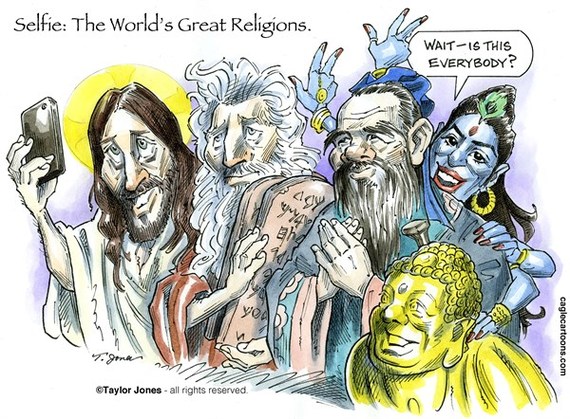
Is Confucius a Confucian?

2016-02-06-1454789056-6326582-misnomerofConfucianism.jpg

In the early 15th century, several Confucian missionaries embarked with Zheng He’s fleet, which was being sent out by the Ming emperor, Cheng Zu, both to demonstrate China’s national power and to build up international friendship with foreign countries. Relying on Zheng He’s incredible navigational skills and his massive ships, these missionaries reached every major country in southern and western Asia, eastern Africa, and the Cape of Good Hope, eventually arriving at their final destination, Europe. Their primary goal was to convert each non-Confucian, that is, each barbarian nation to Confucianism in order to spread Chinese civilization and also to bring, according to their view, ultimate goodness to everyone under the Heavens. But in order to do this, the missionaries first needed to understand the kind of education European people traditionally received. They found that in Europe everyone talked about Jesus. Jesus’ not so decent image, a nude, bloody and somewhat mutilated body crucified on a cross, was hanging everywhere and was venerated by almost everyone. As a result, the Confucian missionaries thought that since Jesus seemed to be the European’s sage, this tradition should be named, ‘Jesusism.’ Meanwhile, the missionaries reported this to the emperor of the Central Kingdom, and accordingly, the Chinese came to know the major teaching of Europe as Jesusism. However, these early Confucian missionaries’ efforts in Europe were not very successful. The Jesus believers refused to admit that Jesus was merely a sage, and it appeared that, to them, Jesus was much more than a sage. But because Chinese civilization maintained its technological and economic hegemony in the world from the early 15th century until the present, Chinese became such a powerful language that everyone in the world continually talked about ‘Jesusism,’ no matter whether ‘Jesusians’ approved of this name or not. At the same time, Confucianism spread into every corner of the world, and entertained, sometimes harmonious and sometimes conflicting, relationships with various indigenous traditions.

Yes, you are right! This is a fairy tale, a total fiction! But if you exchange ‘China’ for ‘Europe,’ replace ‘Confucianism’ by ‘Jesusism,’ and switch all the other relevant historical factors in this fiction, then I have been describing exactly what happened in the case of ‘Confucianism’!

Confucianism is a misnomer. It was created by early Christian missionaries for the purpose of comparison and, especially, of conversion. Although Christian missionaries created a number of names for the now so-called world religions, the term ‘Confucianism’ is especially unfortunate since it says nothing at all that is essential about the tradition that the name purports to describe.

We can see that this is so by making a comparison with other major world religions. In Christianity, ‘Christ’ means ‘the anointed,’ or ‘the savior.’ This is the Greek translation of the Hebrew word, ‘Messiah.’ For Christians, Jesus is the Christ, because he is thought to have cleansed the original sin of human beings through his crucifixion, and thus to be able to bring salvation to all the world. Similarly, in Buddhism, ‘Buddha’ means ‘the awakened’ or ‘the enlightened.’ For Buddhists, Siddhartha Gautama is a ‘Buddha’ because he has attained enlightenment. His teaching is thought to be capable of awakening people, allowing them to understand the origin of human suffering and helping them to transcend the otherwise endless cycle of reincarnation, the samsara.

By contrast, if we follow the name ‘Confucianism,’ and claim that Confucius is a Confucian, what could this mean? It is as tautological as to say a dog is doggy and the sun is sunny. I am quite skeptical concerning whether any Confucian practitioner approves of this name.

So what is the Chinese name for ‘Confucianism’? In other words, how would a contemporary Confucian wish to identify himself or herself when following this tradition? It is Ru (儒, pronounced like ‘zoo,’ but in an ascending tone). Given this name, it makes sense for Confucian practitioners to say that Confucius is a Ru because, similar to ‘Christ’ and ‘Buddha,’ Ru is not only a name. It also represents an ideal for human life. In this sense, to know why Confucius is venerated as a Ru is to understand the essential teaching of ‘Ruism,’ which in my view is the correct name to replace ‘Confucianism.’ So, what is this ideal? And what is the meaning of the Chinese character ‘儒’?

Although the division of ancient Chinese thought into named schools, such as Ruism, Daoism, Legalism, etc., was brought about by intellectual historians in the Han Dynasty (202 BCE-220 CE), the philosophical debate among major Chinese thinkers who were designated by these names had already begun several hundred years earlier. Mencius (approximately 372-289 BCE) considered that his own thought belonged to the school of Ru (Mencius, 7B). In addition, separate chapters entitled, “The Influence of a Ru“ (儒效) and “The Deeds of a Ru“ (儒行) are contained in Confucian classics such as the Xunzi and the Book of Rites, which were written during approximately the same time period as the Mencius. In other words, among various schools of ancient Chinese thought, the strong self-designation of Confucius’ students as Ru began shortly after Confucius passed away. If we now pay attention to the reason that the tradition selected the character 儒 (ru) to identify itself, we find there are two major meanings of 儒, both of which are warmly endorsed by Confucian practitioners.

First, rou (柔), a closely related character, means ‘being soft’. Why soft? This meaning relates to the sociological status of the term Ru before the time of Confucius. At this time, as a social order, Ru referred to a variety of professions: shamans, diviners, those who prayed for rain, dancers, those who presided over religious ceremonies, etc. In pre-Confucian China, this rank of people possessed one key skill which was thought by early Confucian thinkers to be of the utmost importance to human civilization: knowledge of ritual (li, 禮). From a Ruist perspective, the relationships among human beings and that between human beings and non-human nature are not immediate. Quite often, these relationships are, and ought to be, mediated by a variety of li: language, art, ceremonies, social etiquette, political institutions, technology, etc. In this way, li, although conventionally translated in English as ‘ritual,’ actually refers to all possible means of human civilization, and thus it is fair for us to paraphrase the Ruist concept of li to refer to all ‘civilized symbols.’ For example, faced with a beautiful, charming woman, no suggestion would ever be made that a civilized man should be driven immediately by his sexual impulses to grab her, kiss her, and touch her, without any scruple. On the contrary, civilized human sexual relationship is always mediated by kinds of symbols: a smile, particularized eye contact, intimate language, and probably also messages, emails, heartfelt gifts, etc. Finally, a civilized, more ideal result in this case for humans may be that even if the woman fails to accept the man, both must still show basic respect for each other, and thereby maintain a degree of humaneness throughout such interactive processes. Understood in this way, the uniqueness of civilized symbols consists in this, that as media, they are used by human beings to represent what happens in their subjective inner worlds in order to engage the objective realities which exist outside that inner world.

Therefore, li, according to this broad Ruist understanding, is a non-violent, uniquely human, way to facilitate human to human and human to nature relationships in order to advance human growth and to achieve the condition of dynamic harmony (he, 和) in every domain of human life. In a word, the ‘softness’ connoted by the character 儒 implies the essential and ideally non-violent nature of human civilization.

Secondly, ru means ‘to moisten’ (濡). In order to grasp the significance of this meaning of ru to Ruism, we must first understand a traditional Chinese idiom, 相濡以沫 (xiang-ru-yi-mo), which can be roughly translated as ‘(fishes) moisten each other using their saliva.’ The idiom refers to the following story: when a river dries up, fish become stranded in the river bed. In order to survive in this difficult situation, the fish spit saliva at each other, moistening and thus bringing relief to each other’s bodies. Understood in this way, a Ru, a ‘Confucian,’ was metaphorically thought to be able to ‘moisten’ people’s bodies because the Ru, by relying on their knowledge of all the resources of human civilization as well as on their own ‘practical moral influence’ (de, 德), are able to nourish people’s lives within human society. In comparison to other approaches to ethics in the West, this Ruist understanding of morality points to its distinctively holistic nature: if I am moral, I can nourish my life and the lives of other people, which thereby includes a significant bodily dimension. In other words, if I am moral, I will become healthy. In fact, based upon my previous analysis of the meaning of ‘dynamic harmony‘ (he, 和), this holistic approach to Ruist ethics is quite understandable.

In biological terms, a condition of dynamic harmony can be defined as one of ‘energy equilibrium,’ as when a biological entity employs the least amount of energy to exert optimal biological functioning, at the same time attaining a symbiotic relationship with each of the other entities within its local environment.

In this sense, if a Ru, by employing all kinds of non-violent civilized symbols, is able to bring a condition of dynamic harmony to his or her community, he or she is actually creating a healthy ecosphere within which all kinds of life benefit, nourish, and thus “moisten” each other. In this way, the character of 儒, which is made up of two parts, ren, 人, meaning ‘a human being,’ and xu, 需, meaning ‘need’ or ‘want,’ can be interpreted to refer to someone who is ‘a needed human being.’ But why should a Ru be needed by other people? It is precisely because he or she has command of the essential resources for human civilization, and so is able to ‘moisten’ people’s lives and thereby create those virtuous ecospheres which are needed within all domains of human society.

If we now combined these two meanings of Ru, ‘being soft’ and ‘to moisten,’ we can recognize that the standard meaning of Ru, as it is received in the Ruist tradition, is ‘non-violent transformation.’ To be a Ru is thus to be commissioned as a non-violent warrior and fighter who employs every resource of human civilization toward the realization of dynamic harmony in the world. A Ru is someone who tries to transform the world into an all-encompassing symbiotic ecosphere by employing his or her own personal moral cultivation. As a consequence, please do not forget that Confucius is not a Confucian; he is a Ru. And Confucianism is not Confucianism; it is Ruism. I hope that everyone who reads this article will help to spread this message, and will also commit to realizing the Ruist ideal in every dimension of human living.