
Why The ‘May Fourthers’ Were Wrong About Ruism (Confucianism): “The Three Guides’ (三綱) and ‘The Five Constant Virtues’ (五常)

2016-07-31-1469929055-1691468-rightandwrong2.jpg

In my effort to promote Ruism among ordinary American people I have encountered a major push-back from, of all people, Chinese Americans. Most of them are either indifferent or hostile to their own tradition. But regardless of the reason, an unvarnished ignorance underlies this opposition. A recent example took place this summer when I gave a talk to the largest Chinese evangelical Christian church in the Boston area about ‘The Three Guides’ and ‘The Five Constant Virtues.’ After I finished my talk, a pious Chinese woman, around 40 years old, came up and whispered to me: “I know Ruism was the dominant tradition of ancient China, but I had never heard anything like what you were saying during your talk. After hearing what you have explained about Ruism, I find that it is actually quite good (挺好的).” Anecdotes like this tell us that in comparison with other traditions such as Judaism, Hinduism or Roman Catholicism, most Chinese immigrants to the United States are actually an obstacle, rather than an aid, to introducing and advancing their supposed ‘home tradition’ to other Americans.

So, why is this happening? Where does this ignorance come from? As a scholar of the humanities, I have to assign the major reason to the May Fourth Movement and the radical anti-Ruist rhetoric which, in the 1910s, this movement created and afterwards was used in governing most of modern China’s public education. What happened was that, facing a national defeat by the Western colonial powers, some radically westernized Chinese intellectuals such as Lu Xun or Chen Duxiu, whom I call ‘The May Fourthers,’ invented a dualistic mindset separating East from West, and old from new. In order, they said, to surpass the West, China must give up its own culture and re-learn everything Western. For this reason, Ruist teachings such as ‘The Three Guides’ and ‘The Five Constant Virtues’ were condemned by the May Fourthers as representing the backward morals of a feudal society. They said that these ideas were hopelessly authoritarian, enslaved the independent will and spiritual freedom of individual people, and weakened Chinese cultural vitality. As a consequence, they thought, Chinese tradition must be completely jettisoned so that the Chinese people can learn the new morality of the West.

Although I appreciate the apparent sincerity of the May Fourthers’ intentions (they, after all, hoped to make China better and stronger), I nevertheless see that their racial, anti-Ruist rhetoric is as ridiculous as to say, for example, “A wise old man, punched in the face by an impetuous young guy, has to totally give up his own wisdom and identify spiritually with the young guy.” In fact, most of the May Fourthers’ criticisms of Ruism are simply wrong! In my view, in order to practice ‘The Three Guides’ and ‘The Five Constant Virtues,’ nothing more is needed than the independent spirit of individuals! In the remaining sections of this essay, I will demonstrate how this is the case.

First, a little history:

The first time that the single phrase ‘the Three Guides and the Five Constant Virtues’ (三綱五常) is mentioned in the Ruist classics was when Ma Rong (馬融, 79-166 CE) in the Eastern Han Dynasty used this phrase to comment on Analects 2:23 in order to explain the unchanging aspect of a harmonious human society. According to Ma, regardless of what happens on the outside, people must still practice Ruist ethics inwardly for human society to remain on the right track. Before Ma, it was Dong Zhongshu’s (董仲舒, 179-104 BCE) works and a later text entitled, ‘A Comprehensive Exposition in White Tiger Hall’ (白虎通義, compiled in 79 CE) that provided a separate philosophical exposition to each of the terms ‘The Three Guides’ and ‘The Five Constant Virtues’. As perhaps will be well known, the Han Dynasty (202 BCE-220 CE) was a very special period for Ruism. After other teachings, such as Legalism and Daoism, had proved not to be robust enough for maintaining a unified dynasty and an harmonious human society, Ruism was established as the state ideology. Accordingly, we can see that all those expositions about ‘the Three Guides’ and ‘the Five Constant Virtues’ which were provided by the Han Dynasty Ruists are actually a distillation of previous Ruist ethical teachings such as ‘The Five Cardinal Human Relationships‘ (五倫) and ‘The Ten Reciprocal Duties‘ (十義) from Ruism’s Pre-Qin classical period. These teachings were intended to function, and they actually did function, as a textbook version of Ruist ethics, and thus were perennially influential. In this sense, the May Fourthers were right to select these Guides and Virtues [三綱 and 五常] as representative of Ruist ethics, even though their understanding of these ideas was quite wrong.

Second, the philosophy:

The standard expression for ‘The Three Guides’ is that ‘The ruler is the guide for subjects, the father is the guide for the son, and the husband is the guide for the wife’ (君為臣綱, 父為子綱, 夫為妻綱).

The original meaning of the Chinese character, written 綱 gang, refers to the lead rope of a fishing net, and thus, by extension, it means guide, guideline, bond, or guiding principle, etc. In Ruist ethics, if X is said to be the guide (綱) for Y, it primarily connotes, first, that the relationship of X to Y is a major human relationship, and secondly, that this X-Y relationship is, in a practical sense, hierarchical, in which X takes the major and leading role while Y takes a minor and subordinate role. Therefore, both X and Y must fulfill those distinct duties which are entailed by their differing roles.

So, if X guides (綱 ) Y, it means that X must act as a moral model for Y. In other words, X has a great responsibility for instructing Y about right human behavior. In the subordinate role of Y, he or she needs to show consistent deference towards and thus, discreetly and responsibly follow X as long as a normal X-Y relationship is being maintained. Even so, to what extent can an X-Y relationship be seen as ‘normal’? The answer depends. The tradition tells us that for the ruler-subjects relationship, if a ruler continues to act badly, a minister ought to leave the state or resign after remonstration has failed three times. In more extreme cases, such as when a ruler proves to be a ruthless tyrant, revolt is urged. In the father-son relationship, if a father commits misdeeds and refuses to correct himself after his son has remonstrated three times, his son should ‘follow his father while crying and weeping’ (號泣而隨之, 禮記). This implies a persistent duty of the son to remonstrate since the father-son relationship can’t be abandoned as easily as that of ruler-subjects. For the husband-wife relationship, if a husband’s wrongdoing concerns only minor issues, the wife ought to tolerate while continuing to remonstrate, but if the misbehavior is really brutal such as killing the wife’s parents and other similar deeds that violate basic principles of human relationships, the wife has the right to a divorce (誖逆人倫,殺妻父母,廢絕綱紀,亂之大者。義絕,乃得去也”, 白虎通義).

Therefore, if there is anything that the teaching of ‘The Three Guides’ suggests to which a human being must be subordinated, it is only to one’s duties and to the universal moral principles that are entailed by each person’s distinct roles within various human relationships, rather than to any capricious human person who unjustly happens to hold authority. In relation to this, Xunzi taught us to “follow the Dao, rather than the ruler; to follow what is right, rather than the father.” If a person’s will is not firm, or if a person’s spirituality is not independent and principled, I want to ask the May Fourthers, “How could anyone be a Ruist who follows such teachings?”

The ethics of ‘The Five Constant Virtues’ is higher than those which concern ‘The Three Guides’, ‘The Five Cardinal Relationships’, or ‘The Ten Reciprocal Duties’. This is because these latter terms refer to concrete human relationships and their related duties, but meanwhile, human society is far more complex than what these terms refer to. Even when we know how to behave ourselves within three (or five) major human relationships, we still feel the need for a higher principle that can guide all human relationships. Therefore, the purpose of teaching ‘The Five Constant Virtues’ is to provide that ‘single’ principle which will apply in various occasions. These ‘Five Constant Virtues’ are Humaneness (仁, ren), Righteousness (義, yi), Ritual-Propriety (禮, li), Wisdom (智, zhi) and Trustworthiness (信, xin). I will explain these terms one by one.

The basic meaning of ‘Humaneness’ (仁, ren) is love. Ruism’s conception of love is all-encompassing. It can be as close by as one’s parents and one’s children, or in its incipient form, in the reaction one has when, seeing a baby about to fall into a well, one feels a sense of ‘commiseration’ (惻隱之心, Mencius) and is hardly able to prevent oneself from saving the baby. It can also be as distant as when tiles and stones are crushed and one feels concern and empathy for their reordering (Wang Yangming). In a word, the Ruist conception of human love is so universal that a person of humaneness is said to be able to ‘form one body with a myriad of things between Heaven and Earth.’

Nevertheless, even though human love is universal, Ruism also urges its particularization, so here we are with the virtue of ‘Righteousness’ (義, yi). The basic meaning of 義 refers to something that ‘ought’ to be done, that is, to what is right. In relation to ‘Humaneness,’ this virtue requires human beings to love appropriately in relation to particular people and in concrete situations. For example, as human beings, our love towards our own parents and children is naturally and understandably more intense than towards other people’s parents and children. However, love should not end with one’s own family. We must love other people’s parents and their children by extending our love outward from our own. In this regard, Ruism teaches us to correctly determine the value of one’s various relationships, and thus to bring about a graded form of dynamic harmony in one’s performance of various duties through a reasonable distribution of time and energy.

‘Ritual-Propriety’ (禮, li) refers to the audible and visible ways of human behavior, through which what the virtues of ‘Humaneness’ and ‘Righteousness’ require are practiced. For example, if one has good intentions to appropriately love one’s parents but does not actually practice the respectful ways for speaking, looking, hugging, or taking good care, it is hard to say that one has internalized the virtues of humaneness and righteousness in his or her person.

The virtue of Wisdom (智, zhi) balances the virtue of ‘Ritual-Propriety’ since it refers to knowledge. To know how to appropriately love is to possess wisdom. In line with the Ruist idea of dynamic harmony, the central task of human wisdom is to be thought of as knowing both the facts and values of things, and thus, of understanding how things in concrete situations can fit together based upon appropriate human reactions to that situation.

The virtue of Trustworthiness (信, xin) is mainly about one’s attitude, and thus, has no additional content compared to the other four. It requires that one sincerely practice the four aforementioned virtues, and thus really possess them (實有其德).

In a word, ‘Humaneness’ is universal human love, ‘Righteousness’ refers to how to love appropriately in concrete terms, ‘Ritual-Propriety’ is the audible and visible ways of human behavior in which ‘Humaneness’ and ‘Righteousness’ are practiced, ‘Wisdom’ is to know how to be humane, righteous, and ritually-proper using one’s deep axiological reasoning, while ‘Trustworthiness’ urges one to be sincere in the practice of these virtues, and thus, to truly own them. Overall, ‘The Five Constant Virtues’ is the principle that governs one’s behavior within various human relationships. For example, if a minister can be humane, righteous, ritually-proper, wise, and trustworthy in his or her behavior within the ruler-subjects relationship, he or she will be seen as fulfilling his or her duty of ‘loyalty’, as specified in the teaching of ‘Ten Reciprocal Duties’.

Based on this discussion, I have to ask one final question: Can we still believe, as the May Fourthers did, that the Ruist teachings of ‘The Three Guides’ and ‘The Five Constant Virtues’ represent the backward morals of a feudal society and thus are totally irrelevant to modern society? Absolutely not. In my view, every virtue listed in ‘The Five Constant Virtues’ continues to be extremely valuable for our time. Nothing need be changed in order to practice this teaching today. For ‘The Three Guides,’ we only need to make minor changes in order to adjust its social context. As I have argued in a previous essay, the ruler-subjects relationship ought to be understood as that of government-citizens, or any other hierarchical relationship in public life; the father-son relationship needs to be reformulated as that of parents-children; and the teaching about the husband-wife relationship ought to be reconsidered as one of a husband and wife who are guides for each other depending upon their differing levels of expertise. In my view, each of these adjustments is what the Ruist ethical principle of ‘The Five Constant Virtues’ requires for today’s human relationships.

In a word, I believe the teachings of ‘The Three Guides’ and ‘The Five Constant Virtues’ are still key for the realization of social harmony in every time period. May Fourthers, I have to say again, “Sorry, you were wrong. It is the Ruist tradition which is the antidote for our modern malaise!”

The Five Cardinal Human Relationships (五倫, wulun) and The Ten Reciprocal Duties (十義, shiyi)

2016-07-13-1468424963-4762151-hr4.jpg

Ruism is a tradition of non-theistic humanism. For Ruists, the way to build a harmonious human society is conceived of as the way to concretely engage with what is taken to be the transcendent, that is, to engage with Tian, the all-encompassing, constantly creative, cosmic power. Human society, in virtually all its aspects, is constantly changing. Imagine that Confucius could have taken a time machine from the late Spring and Autumn period of ancient China and landed in Boston in July, 2016. He would hardly be able to recognize our ‘brave new world.’ The question then remains: in order to build a harmonious society, what is the primary building block? In other words, in a harmonious society, what is it that does not change?

The answer given by the tradition is that of establishing good human relationships. An anecdote can help us to understand this answer. Today, many people know that ‘filial devotion’ (孝) and ‘parental kindness’ (慈) are two of the great virtues taught by Ruism, but they rarely understand why. The answer is that whatever happens to a human being, he or she must have had parents. You may have no marriage, no child, no job, no nationality and even no friends, but as long as a human being is alive, he or she owes his or her life to parents. In this way, if you are unable to learn how to nurture a harmonious relationship with your parents, there can be no way to enjoy similar relationships with others. In a word, the reciprocal duty of ‘filial devotion’ for children and ‘parental kindness’ for parents is understood by Ruists to be a way of providing an initial opportunity for humans to learn how to build a harmonious relationship, which can then be extended to other similar human relationships. For this reason, the relationship between parents and children has been taken to be the foundation for a harmonious human society in general.

Of course, the parent-child relationship is just one of the major human relationships. Whether this parental relationship should be considered to be the most important relationship is continually debated within the Ruist tradition. But there is no doubt that how to manage good human relationships is the tradition’s most consistent focus. One of the earliest Ruist classics, the Book of Documents (尚書), recounts that the legendary sage-king, Shun, when he found that it was difficult for people to get along well with their families, appointed his minister, Qi (契), to employ ‘five teachings’ (五教) to educate the people in their ‘five moral characters’ (五品). According to later commentators, the ‘five moral characters’ relate to the five major family roles: father, mother, elder sibling, younger sibling, and child. In another chapter, the goal of Ruist teaching is described as ‘graceful relationships fluidly continuing’ (彝倫攸敘). In the same spirit, when the Duke of Qi consulted Confucius about politics, Confucius’s famous answer was that for good politics, we must have ‘ruler as ruler, subject as subject, father as father, and son as son’ (Analects, 12.11). In other words, everyone needs to fulfill the roles and duties which are defined within these various human relationships.

Distilling previous discussions, and also considering his own contemporary situation, Mencius (372-289 BCE) formulated his teaching of the Five Cardinal Human Relationships (五倫):

“To be human is to follow the right Way: if they are well fed, warmly clothed, and comfortably lodged, without being taught at the same time, they become almost like beasts. The sage Shun was concerned with this, and therefore appointed Qi as the minister of instruction to teach the duties of human relationships: between parents and children, there ought to be affective closeness (親); between ruler and subjects, righteousness (義); between husband and wife, distinction (別); between old and young, a proper order (序); between friends, trustworthiness (信)” (Mencius, “Duke of Teng Wen”).

We can see that Mencius’ statement is a further development based upon the story told in the Book of Documents, but his formulation of these five cardinal human relationships, together with their corresponding duties, is more explicit and better organized. Among these relationships, parents-children and older-younger siblings are familial, and thus private. The ruler-subjects relationship is distinctively political, and thus public. Friendship is more egalitarian, while the relationship of husband-wife could potentially connect to each of the others. Supporting Mencius’s thought, we find in Li Yun (禮運, the “Unfolding of Ritual Propriety”), which was a chapter from the Book of Rites (禮記, compiled around the time of Mencius), a more detailed explanation of the duties each role-player must perform within these five human relationships:

“What are human duties? Kindness (慈) for parents, and filial devotion (孝) for children, amicability (良) for elder siblings, and discreet obedience (悌) for younger siblings; uprightness (義) for husband, and attentiveness (聽) for wife; considerateness (惠) for elders, and deference (順) for the young; benevolence (仁) for ruler, and loyalty (忠) for subjects. These are what are called human duties.”

Although there exist alternative formulations in other contemporaneous Ruist texts, and later Ruists continued to refine their views, the teaching of these two texts’ concerning the Five Cardinal Human Relationships with, thus, Ten Reciprocal Duties (五倫十義, wulun-shiyi) became a paradigm for later Ruists to ponder concerning the correct way to build good human relationships, and thereby to realize dynamic harmony (和, he) in human society. Although each of these relationships and duties is worthy of a separate study, it will be enough for a Ruist beginner to get to know several basic principles about them.

First: duty is absolute, but it is also mutual.

Even today, a denunciative rhetoric against Ruism is still in circulation, a falsehood fabricated by radically westernized Chinese intellectuals in the early 20th century, which claimed that Ruism is an essentially authoritarian tradition urging a one-dimensional, blind obedience by inferiors towards superiors in every social and political hierarchical relationship. With all my knowledge about the entire intellectual history of Ruism, I pledge here and now that this accusation targets anything but Ruism! From the quotations above, we can derive a general principle which is certain: each of the five human relationships is performed by human co-players. Insofar as each co-player stands in a position and plays a role within a particular human relationship, the duties required by the position and by the role are ‘absolute.’ This means that, for example, a wife ought to play her duty of ‘attentiveness’ as long as her wifely relationship with her husband is sustained. However, because it is one’s socio-political position and one’s relational socio-political role which determine one’s duty, rather than the other way around, a co-player’s duty is to perform his or her role only if and when the other co-player is not so far off in his or her own duties as to destroy the sustainability of that particular relationship. For example, if a ruler is so malevolent that it is impossible for his ministers to correct his wrong-doing in a remonstrative way such that the relationship of ruler-subjects can be maintained, his ministers cannot and ought not to continue to be loyal. (The only exception in this regard is for parents-children, and I will discuss this in my future articles.) Understood in this way, the five cardinal human relationships are actually five major opportunities for human beings to cooperatively perform the process of moral self-cultivation so that a particular form of dynamic harmony is created in concrete social situations. Therefore, those impetuous accusers of Ruism who claim that it is essentially authoritarian may only rarely be correct. Urging co-players to fulfill their duties when they do not is actually one great duty that other co-players have in all human relationships. In hierarchical relationships, such as ruler-subjects or parents-children, that is, when the urging is carried out by superiors toward subordinates or dependents, this is called ‘instruction’ (教); when directed by subordinates or dependents toward superiors, it is called ‘remonstration’ (諫). When the urging is done among people of equal position, such as friends, this is called ‘admonition’ (责).

Second: order matters.

The order in which Mencius enumerates the five cardinal human relationships also represents his evaluation of their differing importance. This means that when one’s duties within different relationships contradict one another, one should put the most important first, and accordingly, constrain one’s performance of one’s other duties. In this way, one can create a graded form of harmony in regard to the fulfillment of one’s overall duties. One famous example is from Mencius. His student asked him what Shun, as king, would do if his father, a notoriously bad person, committed homicide. Mencius answered that Shun would order his minister of justice to arrest his father, but before that happened, Shun would give up his kingship, carry his father on his back, and flee into hiding somewhere along the sea-coast (Mencius, 7A). In this thought experiment, Shun shapes his reaction to a touchy situation according to his different, yet conflicting duties, and his way of doing this represents the gradation of values which Mencius thinks these duties bear: the father-son relationship is more important than the ruler-subjects one.

Of course, the order set out by Mencius is just one among many within the tradition. For example, in Zhong Yong (中庸, Equilibrium and Ordinariness), the ruler-subjects relationship is placed before parents-children. Xunzi treats the order as ruler-subjects, parents-children, older-younger siblings, and then husband-wife. This speaks to the fact that Ruists continue to adjust their evaluation of the values of various duties according to the context. But if we had to adopt a single universal rule in regard to these evaluations, I would select what is said in the Appended Texts section of the Book of Changes:

“There are heaven and earth, and then a myriad of things. There are a myriad of things, and then male and female. There are male and female, and then husband and wife. There are husband and wife, and then parents and children. There are parents and children, and then ruler and subjects. There are ruler and subjects, and then superiors and inferiors. There are superiors and inferiors, and then rituals and rules are arranged.”

Based upon the fact that human relationships evolved from the cosmic process within Tian’s creation, the order enunciated by the Book of Changes is as follows: husband-wife, parents-children, and then ruler-subjects. This makes great sense to me because Ruist ethics is generally family-centered, and without a husband and wife, there is no family. Accordingly, I endorse this version as the universal order concerning the priority of human relationships.

Be that as it may, we still need to remember that Ruist ethics is highly contextualized, which means that each co-player needs to adjust his or her evaluation of what to do in relation to the given context. In today’s world, if we take stages of personal growth into serious consideration, I suggest that before leaving home and entering college or a new job, you will have treated the parents-children and older-younger siblings relationships as the most important. And between adolescence and marriage, friendship probably took more weight. Then, after getting married, the husband-wife relationship and then parents-children relationship ought to matter the most. Meanwhile, according to circumstances, the ruler-subject (that is, the state-citizen) relationship or the superior-subordinate relationship during one’s career may take on more or less weight, but generally, these two ought to be less important than the other family-based duties.

Third: though its content may change, principle remains.

The way I have just interpreted the Five Cardinal Human Relationships and The Ten Reciprocal Duties already relates to contemporary contexts. For example, originally, the parents-children relationship was written as ‘father-son.’ Such initial formulations represent a particular social context in which Ruist ethics was embedded: ancient China was a patriarchal society. However, today, we don’t require this context, which means that we can detach Ruist ethics from its historical social context even while still highlighting its principles as being of great value for us today.

This is particularly true for the ruler-subjects relationship. Democracy has been thriving in the world for several centuries, and thus it makes little sense to depict the relationship between, for example, President Obama and the American citizenry, as one of ‘ruler-subjects.’ Therefore, in the political arena, I have replaced it with the relationship of ‘state-citizens.’ This does not mean, however, that everything that Ruism teaches about ruler-subjects is outdated. In my view, human society can never eliminate hierarchical relationships. Even if the president of the United States is equal to other citizens under the law, he or she still has far greater power than any ordinary American citizen in terms of political administration. Also, in the course of one’s career, the employer-employees relationship resonates particularly well with the Ruist teachings which concern ‘ruler-subjects,’ since a similar hierarchical structure undergirds it.

In a word, for contemporary Ruists, though the content of human relationships may have changed somewhat, still, the principle of maintaining them well has not. In order to enjoy a dynamically harmonious relationship in either an hierarchical or an egalitarian situation, human beings must still think of themselves as relational co-players. In this way, we can individually and cooperatively perform the process of moral self-cultivation in gradually expanding circles of the human community: from self to family, to neighborhood, to employment in a group, to state, country, and to the whole earth. For only in this way can a continually growing, harmonious human society be sustained.

If you feel touched to support this research, you may do so here.

Confucianism as Not An Atheism

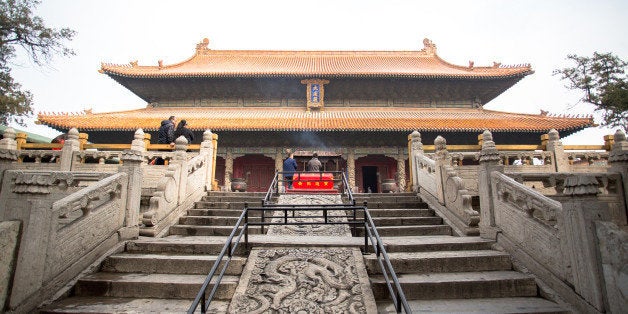
QUFU, SHANDONG PROVINCE, CHINA - 2015/03/19: Dragon carved stone steps leading to Dacheng Hall, also called the Hall of Great

One of the most perplexing aspects of Confucianism is that people easily misunderstand it as a 100% humanism. An example is that, when early Jesuit missionaries went to China and found Zhu Xi’s Neo-Confucianism of “Pattern-Principle” (理)and “Matter-Energy” (氣)was taken to be orthodox by Confucian elite, they categorized Confucianism as a form of “atheism” and thus, thought it deeply corrupted.

In Christianity, even love towards one’s neighbors is ultimately driven by divine grace. That means it is God who commands and makes us love our neighbors. However, because Confucianism lacks this kind of “divine agency” concept, it is very hard for Confucians to say when we love our parents and kids, it is ultimately and exclusively “Heaven” (天) who drives us towards this love.

The divergent situation is that Heaven in Confucianism is an all-encompassing constantly creative cosmic power. It lacks the Christian feature of “agency.” The Heavenly creation is spontaneous, natural, and if we use a term in modern control theory, it can also be self-organized in certain circumstances such as on the earth, but there is no guarantee that every creation of Heaven is ordered according to human expectation. Since Heaven is constantly creating, the essence of human beings, as an organic part of Heaven, is also constantly creating. This constantly creating human nature is named by “Ren” (仁) in Confucianism. An impressive allegory made by Neo-Confucianism is that this human nature “Ren” embodied in humans is like the “kernel” (果仁)contained in the nutshell (果壳), so represents the essential of life. But what is distinct in Confucianism is, Heaven provides the creative energy to human beings, but how humans, as an “agent”, use this energy is solely due to themselves.

As a matter of fact, when Confucians feel united with Heaven through an arduous process of self-cultivation, they would love a myriad of things under Heaven. But in this mystical situation, we can say, the great body of ours which we form with Heaven makes us want to love, but how to love concretely is still exclusively due to ourselves. In this way, the idea of “Heaven” as the divine reality in Confucianism provides ultimate axiological and aesthetic motives for humans’ universal love, but it can’t provide the “agency” which is the last crucial link leading to a concrete action of human love.

In this sense, it is wrong to characterize Confucianism as an “atheism”, since “Heaven” is indeed the divine reality which provides the ultimate axiological and aesthetic values to human deeds. But it is not a “theism” too, since “Heaven” is not a personal God and lacks the Christian-like “agency”. In fact, It is a non-theism. What Confucians worship about “Heaven” is a benevolent but wild cosmic creative power, without any anthropomorphic sort of purpose, will or plan. Correspondingly, the Confucian humanism is a non-theistic humanism, and in this strictly defined sense, it is a spiritual humanism.