“The Rang Stream Study Hall” by Zhou Dunyi

Introduction

In the lineage of Ru exemplars within the Daoxue movement, Zhou Dunyi (周敦颐, 1017-1073) was frequently was frequently regarded as the pioneering figure. Born into a family with a long tradition of passing the highest civil examinations and serving in government, Zhou was steeped in Ruist teachings from a young age. At the age of 24, he began his official career upon his uncle’s recommendation, holding various local governmental positions until his passing at 57.

Regarding Zhou Dunyi’s personality and governance style, his contemporary Huang Tingjian (1145-1105), a renowned calligrapher, poet, and scholar-official, once praised him as follows:

“Mr. Zhou Dunyi possessed a serene and open heart, akin to the sunlit breeze and luminous moon after a rainfall. He was humble in seeking recognition yet determined in pursuing his aspirations. Personal fortune held little value to him, as his dedication lay in serving others. He practiced restraint in his own pleasures but extended generosity to the widowed and lonely. While contemporary acclaim mattered little to him, he cherished enduring friendships that transcend time.” (Huang, et al., 1846, vol 12, p.26.)

Huang’s metaphorical description, “the sunlit breeze and luminous moon after a rainfall (光風霽月),” has been widely cited by later Ru scholars. Hence, it serves as the inspiration for the title of this collection of Neo-Confucian poetry.

A few notable points about Zhou’s thought, as expressed in the following translated poetry:

Firstly, Zhou’s attitude towards Buddhism and Daoism, two major contemporary spiritual traditions that had significant influence among Ru literati in his time, remained more open and appreciative than that of most translated Ru masters in this collection. He frequently visited Buddhist temples and Daoist shrines, interacting with practitioners of both traditions, and expressing a longing to live a hermetic life in mountains and forests. Several poems thematizing hermit life attest to Zhou’s enduring interest in this aspect.

Secondly, however, the Ru tradition, starting from Confucius, also emphasizes a hermetic life under necessary circumstances. As particularly indicated by “Passing the Ancient Temple,” Zhou Dunyi’s genuine intention in thematizing hermit life in his poetry was to incorporate Buddhist and Daoist influences into an overall Ruist framework. He displayed a unique Ruist lifestyle that simultaneously addressed worldly concerns and lofty spiritual aspirations. As we’ll explore further in the following chapters, Zhou’s approach to the multi-spiritual environment of his time is shared by many Ru poets and exemplars.

Thirdly, in “The Rang Stream Study Hall,” Zhou named a stream in Mount Lu as Lian (integrity), following a Ru predecessor who admired the name of another stream in the same region as Rang (deference). In “A Letter from My Governmental Post to Old Acquaintances in My Hometown,” Zhou sought to preempt corruption by emphasizing his modest lifestyle to his old acquaintances. And in “On Loving the Lotus,” Zhou expressed his love for the lotus as “the epitome of noble virtues,” contrasting it with the hermit’s love for the chrysanthemum. These poems reflect Zhou Dunyi’s commitment to the Ruist lifestyle focused on cultivating noble virtues, explaining why the Ru lineage of the Daoxue movement in the Song Dynasty regarded him as an initiator.

瀼溪書堂

元子溪曰瀼,詩傳到於今。

此俗良易化,不欺顧相钦。

廬山我久愛,買田山之陰。

田間有流水,清泚出山心。

山心無塵土,白石磷磷沈。

潺湲來數里,到此始澄深。

有龍不可測,岸木寒森森。

書堂構其上,隱几看雲岑。

倚梧或欹枕,風月盈中襟。

或吟或冥默,或酒或鳴琴。

數十黃卷軸,聖賢談無音。

窗前叩疇囿,囿外桑麻林。

芋蔬可卒歲,絹布足衣衾。

飽煖大富貴,康寧無價金。

吾樂蓋易足,名濂朝暮箴。

元子与周子,相邀风月寻。

The Rang Stream Study Hall

Master Yuan’s creek, called Rang, a humble stream,

Carries forth his poetic theme (i).

Here, customs shift with a gentle sway,

Honest folk nod with respect, day by day.

Mount Lu, steeped in longing and lore,

I acquired fields on its northern floor.

Another stream meanders through, crisp and pure,

Born from the mountain’s heart, steady and sure.

In the mountain’s heart, where no dust dwells,

White rocks, sturdy and jagged, clear the veil.

Winding its way, gaining depth and gleam,

The stream holds a hidden dragon, in waters unseen.

Around it, trees stand stark and pristine.

I built a study hall beside the stream, concealed behind a low table,

Gazing up at clouds, in peaks above.

Leaning against a parasol tree or on a tilted pillow, I find my rest,

Wind and moon come to fill the folds of my robe.

Sometimes chanting, or in silence deep,

Sometimes with wine, or a zither’s sweep.

Dozens of yellow scrolls lie beside,

Where sages and worthies converse without a sound.

By the window, tapping on the garden grounds;

Beyond, a grove of mulberry and hemp abounds.

Taro and vegetables suffice for the year,

Silk and cloth enough for clothes and quilts.

Warmth and fullness, the truest of riches,

Contentment worth more than gold’s entices.

My joy is easily fulfilled, naming the stream Lian, “Integrity,” (ii)

As my daily guide.

Master Yuan and I, inviting each other here,

Seek the company of the wind and moon.

Notes:

(i) Yuan Jie (719-772) was a Ru scholar and government official during the Tang Dynasty (618-907). Upon relocating his family to the region of Mount Lu (廬山), he discovered a local stream named Rang (瀼), which phonetically resembled the virtue of Rang (讓), meaning deference or humility. He composed poems to honor this stream and the life it nurtured.

(ii) Lian (濂), phonetically resembling the virtue of Lian (廉), signifying honesty or integrity. Zhou Dunyi’s choice to name and write poetry about this new stream demonstrated his admiration for his predecessor, Yuan Jie.

Commentary:

According to the “Biography of Zhou Dunyi (周敦頤年譜)” of Zhou (1990, p.99),  Zhou Dunyi was appointed as a Circuit Judge (通判) in Qian Zhou of the Mount Lu region in 1061, at the age of 45. This poem was composed in the same year, depicting Zhou’s establishment of a residence near the newly named Lian stream. Zhou Dunyi, known by his pen name Lian Xi (濂溪), was often referred to as Master Stream of Integrity by Ru literati. This poem sheds light on the origin of his pen name.

Bin Song Interviewed by Journal of Contemplative Studies

Inspired by the ancient Confucian tradition, this conversation explores a timely question: How can we meditate as scholars, administrators, or modern professionals?

I also explain the misnomer of “Confucianism,” clarifying the Ruist (Confucian) tradition of contemplative practices and self-cultivation, and distinguishing it from other major ancient Asian traditions, such as Chinese Mahayana Buddhism.

Excerpt:

Contemplation in the Ru tradition is best understood as a state of heightened attention grounded in reverence. It means focusing your energy and aligning your consciousness with a guiding principle in order to gain insight into reality and engage with it.

What does heightened attention involve? It requires integrating all dimensions of the self, including understandings, feelings, emotions, actions, and more. This is traditionally described as sincerity or authenticity (cheng). You study ethical and metaphysical teachings, practice them, and cultivate a unified way of living. This coherence is what Ru thinkers mean by heightened attention.

And what about insights? As we see in Buddhism’s emphasis on mindfulness, many traditions seek direct, unclouded awareness of reality. Ruists (or Confucians) also aim for this: accessing reality free from prejudice and partiality. However, each tradition defines reality in its own way.

The full interview can be checked here.

Patience in Interfaith Teaching 

The following essay reflects my Interfaith teaching experience at Washington College, published by the Interfaith America Magazine (https://www.interfaithamerica.org/article/patience-in-interfaith-teaching/)

Excerpt:

“…I define patience as a radical acceptance of obstacles or burdens we face on the path to any meaningful goal. Imperfection is an inevitable part of human experience. Recognizing this, especially when navigating challenges related to faith, has become invaluable in my teaching. Patience allows me — and my students — to embrace our differences and cultivate deeper, more meaningful cross-cultural and interfaith understanding. I’ve had three key teaching experiences that illustrate the profound impact of patience in the classroom …”

Zhu Xi as the Reservoir of the Daoxue (道學) Movement

Hallo, this is Dr. Bin Song at Washington College to teach Ruism, global philosophies and religions.

The Ru tradition experienced a major reboot in its second millennium after being adopted as the state ideology in Han Dynasty (202 BCE – 220 CE). And there are two major historical backgrounds of this reboot. Firstly, the immigration of Buddhism and the establishment of Daoist religions stimulated Ru thinkers to create a new version of Ruism able to orient individuals’ life more comprehensively. Since seeking the genuine Dao, the Way, so as to provide guidance to all major aspects of human life is always a goal of Ru self-cultivation, these Ru thinkers referred to this historical reboot of Ruism as a Daoxue movement, and Daoxue (道學) means the learning of Dao. In English scholarship, we also call it Neo-Confucianism. Secondly, since the 8th century, the Chinese imperial system had endured a series of severe domestic and foreign threats. Ru literati therefore sought to overcome the threats and recover the ancient ideal of humane governance while creatively reinterpreting Ru classics. To such a reacting and synthesizing Daoxue movement, Zhu Xi (1130-1200)’s philosophy played the role of an intellectual reservoir into which his predecessors’ thoughts confluence and out of which later Ru thinkers derive and diverge. To evidence such a role, Zhu Xi condensed the originally expansive Ru classics into a new canon comprising four books, viz., the Great Learning, the Analects, the Mengzi and the Centrality and Commonality, and his 四书章句集注 (Commentaries of the Four Books) was thereafter officialized as a textbook for the systems of civil examination in East Asia.

Zhu Xi’s synthetic Ru philosophy, despite its extraordinary scope and complexity, pivots itself upon one singular concept, Li (理, translated alternatively as principle, pattern-principle, Pattern, or coherence, see Angle & Tiwald 2017:28-34), and aims to parse out the three phases and eight steps of self-cultivation articulated by the Great Learning which furnishes a comprehensive guide to the Ru way of life. According to the Great Learning, the realization of the ideal of peace and harmony among all under heaven rests upon the regulation of one’s state and the alignment of one’s family, which furthermore rest upon the cultivation of one’s genuine self comprising four major steps, viz., rectifying the heartmind, authenticating intentions, attaining the knowledge, and investigating things (格物, gewu). Zhu Xi maintains that the object of the ultimate step of gewu is Li, defined as “the reason why things come to be so and the rule how things ought to be so.” (Zhu 2002 Vol. 6 大学或问 An Inquiry into the Great Learning:512)For instance, the Li of a table is the sum of all the conditions which explain why the table is produced in a certain material with a certain shape so as to fit itself with all surrounding items in a given environment. Because the factual ways to fit oneself with all the others in a given context lead to the ideal state of harmonization in which all beings evolve and thrive together without undermining the essential identity of each, Li is both descriptive and prescriptive. In the natural world, Li refers to the patterns of changing realities which co-exist in the broadest ontological scale of the whole universe, viz., Tian. In the human world, Li designates the moral principles and social conventions which perfect human relationships so as to sustain the development of civilization, and hence, to manifest the cosmic harmony of Tian in the human realm.

With Li construed as such, appropriate intentions of the heartmind towards external things are those in line with Li so that one does not merely intend objectives sincerely, but also authentically. For Zhu Xi, the process of authenticating intentions to rectify the heartmind leads to the recovery of one’s genuine human nature endowed by Tian, a trope continuous with the teaching of the Mengzi and the Centrality and Commonality. And the process is characterized by accumulation, ecstasy and extrapolation. Accumulatively, one needs to broadly engage the world via activities such as reading classics, canvassing histories, studying the nature, having discussions with friends, and dealing with human affairs so as to learn each and every Li. (Zhu 2002 Vol. 6 大学或问:527-528) While one’s practical knowledge of Li continually increases, an ecstatic moment would transpire when one can comprehend the coherence of all Li in the universe, and hence, grasp the interconnection of all dimensions of moral living. (Zhu 2002 Vol. 6 大学章句 An Exegesis of the Great Learning: 20) After the ecstasy, one needs to extrapolate their general knowledge of the Li of the world into minute and novel details, and hence, keep being centered in the everyday moments of mundane life. (Chen 2000: 309-314)  

Among the three aspects of “thoroughly studying Li (穷理),” the ecstatic moment begs more attention since it reveals the overarching structure of Zhu Xi’s thought. The following chart illuminates the structure via illustrating Zhu Xi’s treatise of “On Ren (humaneness) (仁说).” I link my full translation of this treatise here, and I’ll read the most relevant few paragraphs in this treatise, and explain them later.

A Chart of Ren (Humaneness) according to Zhu Xi

The being of Heaven and Earth consists in creativity. When things and people come into existence, they are endowed by Heaven and Earth with their natures. Because of this, the human heartmind—within which human nature is embodied—has virtues which embrace all, penetrate all and thus, lack nothing. Nevertheless, one word can sum them up: Ren (仁, humaneness). Let me try to explain in detail.

There are four virtues for the creativity of Heaven and Earth: initiation, permeation, harmonization, and integration. The virtue of initiation governs them all. In their operation, these virtues are manifested in the four seasons—the vital-energy of spring permeates them all .

Correspondingly, there are four virtues for the human heartmind: Ren, righteousness, ritual-propriety, and wisdom—the virtue of Ren embraces them all. When these virtues come forth and function, they are manifested in the human feelings of love, obligation, respect, and judiciousness—the feeling of commiseration pervades them all.

Therefore, when discussing the creativity of Heaven and Earth, if we simply say, ‘the initiative power of Qian (Heaven), the initiative power of Kun (Earth),’ then its four virtues and their functions are encapsulated.

For discussing the magnificence of the human heartmind, if we simply say, “Ren is what the human heartmind is,” then its four virtues and their functions are summarized.

So, the virtue of Ren is actually what the human heartmind—which is produced and sustained by the creativity of Heaven and Earth—consists in. It functions when the human heartmind engages with things. When feelings are not aroused, the virtue is already there. When feelings are aroused, it functions inexhaustibly.

If we can sincerely embody and preserve the virtue of Ren, then we have in it the fountain of all goodness and the root of all deeds. This is why the teachings of the Confucian school (Ruism) urge scholars to pursue, keenly and unceasingly, the virtue of Ren.

As demonstrated by the chart, several categorical dyads have structured Zhu Xi’s philosophy. Firstly, with Li construed as principle, Qi (气) is the material vital-energy pervading the entire universe, the dynamics of which manifests the normativity of principles. The dyad of principle and vital-energy is thus, albeit with an emphasis on process and change, comparable to the one of form and matter in ancient Greek philosophy. Secondly, the relationship between Li and Qi is further interpreted as the one of Ti (体, substance) and Yong (用, function). The Ti of a thing is what the thing per se consists in in its enduring form, while its Yong is the manifested functions of the thing when it engages with other things. Thirdly, Xing (性, nature) and Qing (情, feeling) characterize the dimensions of human heartmind which correspond to the dyads “Li-Qi” and “Ti-Yong.” For Zhu Xi, human nature is equivalent to the Li or Ti aspect of the heartmind, while the nature is signified by four cardinal virtues of Ren, righteousness, ritual-propriety and wisdom. Human feelings are the Yong, viz., the manifested functions of Qi, aspect of the heartmind. Using a contemplative language, Zhu Xi also describes the aspect of principle, substance or nature of the heartmind as underlying one’s experience of inner peace and centrality prior to any concrete feeling aroused by external things. Therefore, another dyad of “non-aroused (未发)” and “being-aroused (已发)” indicates one’s respective experiences of spiritual formation in the different states of heartmind characterized by the aforementioned dyads.  

Understood as such, the system of Zhu Xi’s thought per the chart can be explained as follows: 

According to the Classic of Change, The nature of Tian is creativity. Creativity primarily means initiation. The initiative power of Tian is manifested jointly by the proactive Heaven (Qian, the most Yang hexagram) and the receptive Earth (Kun, the most Yin hexagram). There are four virtues, viz., four generic traits, of the creativity of Heaven and Earth: initiation (which means Tian creates everything from nothing), permeation (which means Tian’s creativity pervades everything), harmonization (which means everything dynamically co-exists within Tian), and integration (which means each created thing is endowed with a nature and all things comprise an interconnected whole within Tian). The virtue of initiation governs them all. These four virtues are manifested in the proceeding of cosmic vital-energy during the course of four seasons. The vital-energy of spring permeates them all.

Those four virtues are the principle and living substance of Tian’s creativity, while the four seasons manifest its vital-energy and function. Therefore, for discussing the creativity of Tian, when the initiative power of Qian (heaven) and the initiative power of Kun (earth) are mentioned,  both the four virtues and their functions are encapsulated.

The lower part of the chart is about human beings. It has a parallel structure to the upper one. Human beings are born from the process of cosmic creativity of Tian, and the endowed human nature is the virtue of Ren embedded in the human heartmind. There are four cardinal virtues for the heartmind, viz., Ren, righteousness, ritual-propriety, and wisdom, and the virtue of Ren embraces them all. When the heartmind is aroused and engages with things, the four virtues are manifested as four incipient moral feelings.

There are two alternative ways to name these four feelings. For Zhu Xi, they are the feelings of love, obligation, deference, and judiciousness. For Mengzi, they are the feelings of commiseration, shame and disgust, deference, and distinguishing right and wrong. Zhu Xi’s alternative way to name the feelings derive from Mengzi, but is more succinct. Overall, the feeling of love or commiseration pervades all the other feelings.

The four virtues are the principle, substance, nature or non-aroused status of the human heartmind. The four human feelings for Zhu Xi, which are the four moral incipient sprouts for Mengzi, manifest the vital-energy, function, feeling, or aroused status of the heartmind. Therefore, for discussing the magnificence of the human heartmind, once it is pointed out that Ren is what the heartmind consists in,  then both its four virtues and their functions are summarized.

In a word, Zhu Xi’s treatise of “On Ren” demonstrates the cosmological root of the distinctively good human nature, which is summarized by the cardinal human virtue, humaneness. While urging individuals to rediscover and nurture such a cosmically endowed human nature via cumulatively studying and practicing Li, Zhu Xi’s philosophy can be understood overall as an all-encompassing ethical metaphysics which aims to manifest the supreme harmonization of Tian’s creativity in the human world. 

If you feel touched to support this research, you may do so here.

Confucianism as Not An Atheism

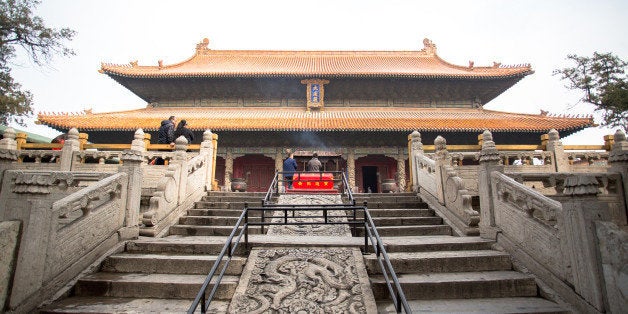
QUFU, SHANDONG PROVINCE, CHINA - 2015/03/19: Dragon carved stone steps leading to Dacheng Hall, also called the Hall of Great

One of the most perplexing aspects of Confucianism is that people easily misunderstand it as a 100% humanism. An example is that, when early Jesuit missionaries went to China and found Zhu Xi’s Neo-Confucianism of “Pattern-Principle” (理)and “Matter-Energy” (氣)was taken to be orthodox by Confucian elite, they categorized Confucianism as a form of “atheism” and thus, thought it deeply corrupted.

In Christianity, even love towards one’s neighbors is ultimately driven by divine grace. That means it is God who commands and makes us love our neighbors. However, because Confucianism lacks this kind of “divine agency” concept, it is very hard for Confucians to say when we love our parents and kids, it is ultimately and exclusively “Heaven” (天) who drives us towards this love.

The divergent situation is that Heaven in Confucianism is an all-encompassing constantly creative cosmic power. It lacks the Christian feature of “agency.” The Heavenly creation is spontaneous, natural, and if we use a term in modern control theory, it can also be self-organized in certain circumstances such as on the earth, but there is no guarantee that every creation of Heaven is ordered according to human expectation. Since Heaven is constantly creating, the essence of human beings, as an organic part of Heaven, is also constantly creating. This constantly creating human nature is named by “Ren” (仁) in Confucianism. An impressive allegory made by Neo-Confucianism is that this human nature “Ren” embodied in humans is like the “kernel” (果仁)contained in the nutshell (果壳), so represents the essential of life. But what is distinct in Confucianism is, Heaven provides the creative energy to human beings, but how humans, as an “agent”, use this energy is solely due to themselves.

As a matter of fact, when Confucians feel united with Heaven through an arduous process of self-cultivation, they would love a myriad of things under Heaven. But in this mystical situation, we can say, the great body of ours which we form with Heaven makes us want to love, but how to love concretely is still exclusively due to ourselves. In this way, the idea of “Heaven” as the divine reality in Confucianism provides ultimate axiological and aesthetic motives for humans’ universal love, but it can’t provide the “agency” which is the last crucial link leading to a concrete action of human love.

In this sense, it is wrong to characterize Confucianism as an “atheism”, since “Heaven” is indeed the divine reality which provides the ultimate axiological and aesthetic values to human deeds. But it is not a “theism” too, since “Heaven” is not a personal God and lacks the Christian-like “agency”. In fact, It is a non-theism. What Confucians worship about “Heaven” is a benevolent but wild cosmic creative power, without any anthropomorphic sort of purpose, will or plan. Correspondingly, the Confucian humanism is a non-theistic humanism, and in this strictly defined sense, it is a spiritual humanism.