A Chart of Ruist Virtues

(This article was firstly published at Huffington Post: https://www.huffpost.com/entry/a-catechism-of-ruism-conf_4_b_11607540.)

In several recent essays on dynamic harmony, the five cardinal human relationships and ten riciprocal duties, and the three guides and five constant virtues, I discussed many Ruist virtues. To help you understand the relationships among these virtues, I’ve created this Chart of Ruist Virtues. I encourage you to read the chart from the top down at first. (After you have a sense of the chart as a whole, however, you can contemplate it from any point.) Because I’ve already explained most of the terms on the chart in previous essays, I’ll focus here on the relationships between and among the terms.

The Chart in Detail

First, let’s discuss the Way of Heaven (Tian) (天道, Tiandao), which appears at the top of the chart. Tian refers to an all-encompassing, constantly creative cosmic power. Tian is the transcendent in Ruism. Literally, Dao means “the way,” but when these two terms are used together, Dao takes on a special meaning: it refers to the principle that runs through the all-encompassing power. By placing Dynamic Harmony (和, he) below The Way of Tian, we’re saying that Dynamic Harmony is the principle that runs through Tian. In other words, we can say that Dynamic Harmony is the Way of Tian. Because virtue (德) in Chinese can be extended to characterize the generic features of Tian, we can also say that Dynamic Harmony is a virtue of Tian.

The reason we can say that Dynamic Harmony is a virtue of Tian is because, as explained earlier, Tian’s creativity is all-encompassing. Everything that has ever existed, exists now, or will ever exist is brought into being by Tian and every being in the universe is part of Tian. In other words, as created by Tian, everything is and becomes together, which is the basic meaning of ‘dynamic harmony’. If we understand this, we can see that Dynamic Harmony is embedded in every aspect of this constantly-unfolding cosmic creation. We can also see that this all-encompassing force is neither anthropomorphic nor anthropocentric. In other words, Tian is not a person, nor is it exclusively focused on humans. As such, humans cannot directly access Tian per se, but must approach it through Ruist mysticism, a topic I’ll discuss in future writings.

The way humans engage with Tian concretely is to realize Dynamic Harmony in human society. We do this through the virtue of Humaneness (仁, ren). For this reason, you’ll see on the chart that the virtue of humaneness is the Way of Human Beings.

In Ruist ethics, Humaneness is the highest human virtue. In the most general sense, the virtue of Humaneness is the manifestation of Tian’s creativity within human nature. When we look in more detail, however, Humaneness includes five different facets, each of which refers to a different dimension of Humaneness:

Humaneness (仁, ren),

Righteousness (義, yi),

Ritual-Propriety (禮, li),

Wisdom (智, zhi),

Trustworthiness (信, xin)

We refer to these as the Five Constant Virtues (五常, wuchang). The Five Constant Virtues are universal principles that govern concrete human relationships. For this reason, the lower region of the chart describes how the Ruist tradition understands and describes particular human relationships.

First, let’s look at the Three Guides (三綱, sangang), a Ruist ethical understanding of three major human relationships. Originally, 君為臣綱 meant “ruler is the guide of subjects.” In a modern context, however, it ought to be understood as something like “in public life, a superior is the guide of subordinates.” This refers to relationships such as those between the state and citizens or between employer and employees. Likewise, although 父為子綱 originally meant “father is the guide of son,” a modern formulation would be something like, “parents are the guides of children.” Finally, 夫為妻綱, which originally meant “husband is the guide of wife,” should now be understood as “husbands and wives are the guides of each other, depending upon their different areas of expertise.”

The ethics of the Three Guides is a distillation of Mencius’ teachings about the Five Cardinal Human Relationships (五倫, wulun), which appear next in the chart. These relationships are parents and children, ruler and subjects, husband and wife, elder and junior, and friendship. Mencius taught that the virtues that guide each of these relationships are affective closeness (親, qin) between parents and children, righteousness (義, yi) between ruler and subjects, distinction (別, bie) between husband and wife, proper order (序, xu) between elders and juniors, and trustworthiness (信, xin) between friends.

The ethics of the Ten Reciprocal Duties (十義, shiyi) are described in an important chapter of The Book of Rites (禮記) called The Unfolding of Ritual Propriety (禮運). The text prescribes a single virtue for each person as they act out their role in these relationships. In the chart, for example, you will find that in the relationship between parents and children, parents should be guided by the virtue of parental kindness (慈, ci) and children should be guided by the virtue of filial devotion (孝, xiao). The practice of these two reciprocal duties by parents and children respectively will nurture the guiding virtue of affective closeness (親, qin) taught by Mencius in the Five Cardinal Human Relationships. This pattern of reciprocal virtues is repeated for the remaining four relationships.

The Big Picture

This chart of Ruist virtues suggests that each of us should cultivate the Five Constant Virtues — which can be seen as different facets of a single cardinal virtue, Humaneness (仁, ren) — so that we can play our roles well in a variety of human relationships. The ultimate goal is to create and sustain Dynamic Harmony in society, which is a concrete manifestation of the Dynamic Harmony of Tian’s all-encompassing creative power.

Notes on Interpretation of This Chart

When using this chart, there are two important caveats to keep in mind. First, you’ve probably noticed that some characters appear in this chart multiple times. This is because they represent different virtues depending on the context. At the top of the chart, for example, Humaneness (仁, ren) appears as the single cardinal virtue, the Way of Human Beings. In the section on the Five Constant Virtues below, however, it appears as one of the five virtues, and is taken in this context to refer to universal human love. Likewise, Righteousness (義, yi) appears in the Five Constant Virtues as the way human beings love appropriately in various situations. When Righteousness (義, yi) appears in the Five Cardinal Human Relationships, however, it is presented as the guiding virtue of the relationship between ruler and subjects and refers to the primary duty of both rulers and subjects to act appropriately toward each other.

The second caveat to keep in mind is that this chart is not intended to prescribe an ethical law that requires each Ruist to understand and practice these virtues one-by-one. This chart doesn’t contain every virtue cherished by Ruists over the past 2,500 years — after all, society is far too complex to be described by a single chart, and the ways in which each of us manifest these virtues in our daily lives will depend a great deal on the context in which we live.

So, although this chart is neither comprehensive nor prescriptive, it can serve as kind of reference chart to help you understand the backbone of Ruist ethical teachings. It is my hope that by studying, contemplating, and meditating on this chart, you will be better equipped to practice Ruist wisdom in your daily life.
Introducing a New Ruist (Confucian) Ritual: Tian-worship and Confucius-veneration (敬天尊孔)

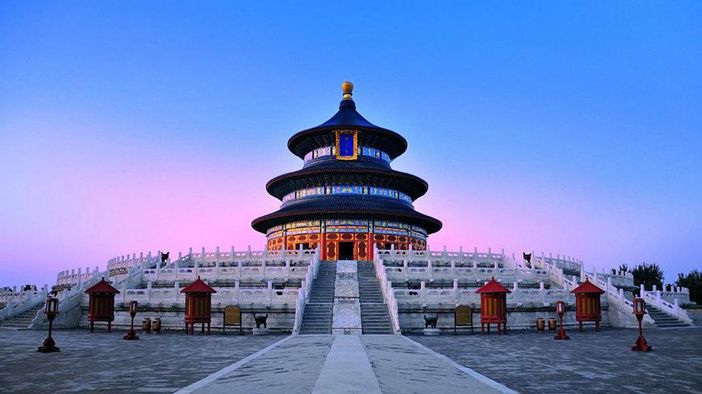
There is a religious ritual system in Ruism which has been translated as ‘The Three Sacrifices’ (三祭, sanji): Sacrifice in celebration of Tian (Heaven), sacrifice in celebration of distinguished teachers such as Confucius, and sacrifice in celebration of one’s ancestors. Traditionally, the sacrificial ritual in celebration of Tian could only be performed by an emperor, the so-called Son of Tian (天子). This ritual used to take place in the suburb of a capital such as this:

The 'Platform of Tian' (天壇) in Beijing
The ‘Platform of Tian’ (天壇) in Beijing

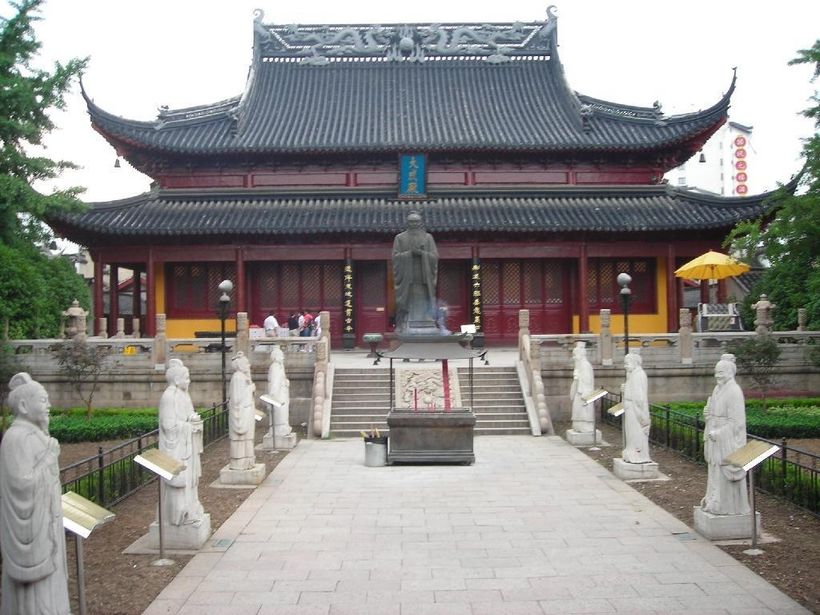
The sacrificial ritual in celebration of Confucius was performed in Confucian temples such as this:

Confucius Temple in Nanjing

Everyone is allowed to perform this ritual. However, because Confucius is taken to be the common teacher of everyone in the Ru tradition, the main participators in this ritual were the Ruist literati.

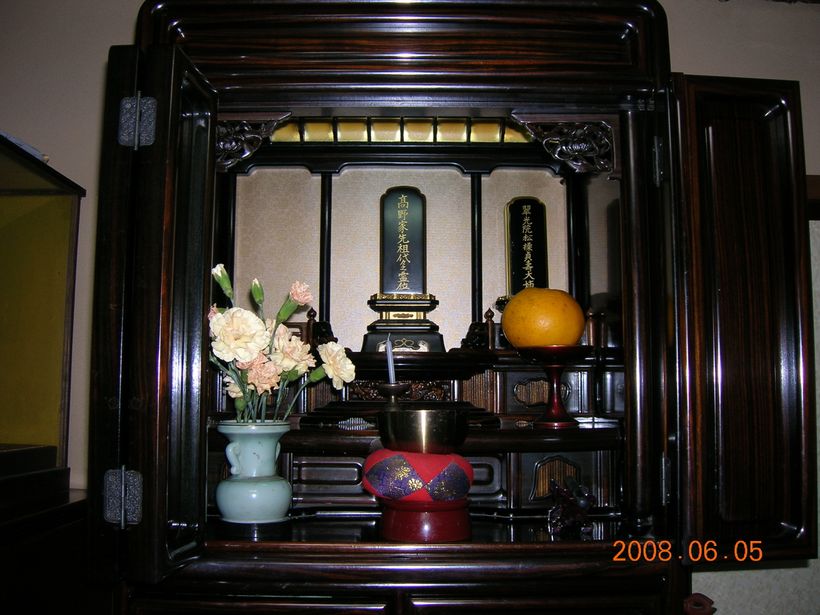
By comparison, the ritual of sacrifice to one’s ancestors is more private. It is either performed before an ancestral altar in each individual household, in cemeteries, or in an ancestral temple shared by an extended family. It looks like this:

An ancestor altar in household

At this time, I would like to introduce a new ritual which combines the first two rituals, which I am calling a ritual of Tian-worship and Confucius-veneration(敬天尊孔).

The major reason that such a combination is needed is that in a contemporary context, the celebration of Tian can no longer be performed by an emperor alone. As a Ru committed and connected to the all-encompassing transcendent power of Tian, not just an emperor but every person has the need and right to celebrate it. Actually, traditional Ru literati also realized the egalitarian power of the idea of Tian, since each individual Ru was free to interpret this idea in his or her own particular way in order to counteract the ideologies and political policies which may have been endorsed by his or her emperor. This was a distinctive Ruist check and balance system within the traditional Chinese dynastic polity. However, because the polity was imperial, the ritual aspect of Tian-worship could not be decoupled from the monopoly power of the emperor. Nowadays, the political context of emperor has died out, and every Ru has accordingly recovered the right to perform a ritual of Tian-worship.

The reason I suggest combining the ritual of Tian-worship and the ritual of Confucius-veneration is that the relationship among Ru, as students of Confucius, is egalitarian. They are friends (友, you), committed to the Dao of Tian (天道, tiandao), who are trying to realize dynamic harmony at all levels of human existence in accordance with Confucius’ teachings. Therefore, when an occasion arises for Ruist friends “who are coming from afar” [Analects, 1:1] to join each other and to advance their Ruist learning, they will be able to perform the ritual of Confucius-veneration and the ritual of Tian-worship at the same time. This will remind the Ruist community that when studying the tradition, each Ru is not only a student of Confucius, but also a citizen of Tian (天民, tianmin). In this way, each Ru will continually nurture the feeling of gratitude towards the ultimate origin of their personal lives and personal energy; simultaneously, they will enhance their devotion to a life of manifesting Tian’s creativity in a distinctively human way in accordance with Confucius’s teaching about ‘humaneness’ (仁, ren).

Based upon these reasonable considerations which encourage the creation of an updated ritual (“to create rituals according to what is right,” – “以義起禮”, 禮記∙禮運), during the first ‘Ruist Friends From Afar’ Retreat in North America, held at Marsh Chapel, Boston University, on July 1-3rd, 2016, and before any formal readings and discussions even began, Ru friends performed a new Ruist ritual of Tian-worship and Confucius-veneration.

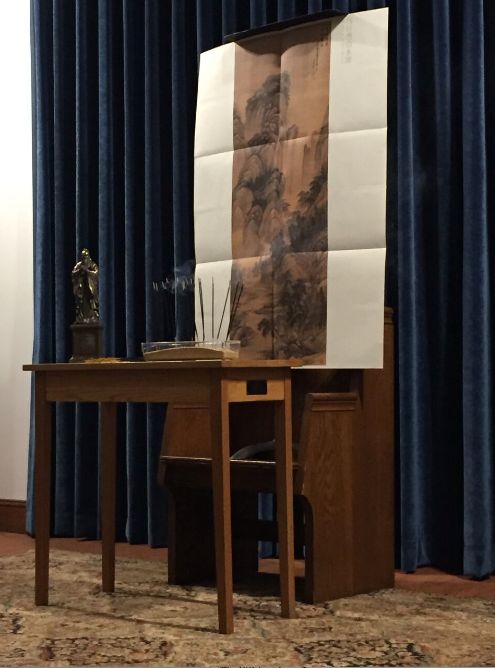
We tried to make the set-up of the ritual simple, since simplicity and authenticity are a consistent concern which traditional Ruist rituals convey. The set-up of the ritual looked like this:

We used a Chinese landscape painting to symbolize Tian. It was hung out in front. Then, we placed a Confucius statue on a small table in front of it, and an altar in the middle for holding incense. The painting we chose was drawn by Wang Hui (王翚, 1632-1717 CE) during the early Qing dynasty. A digital version of it looks like this:

This painting was selected by courtesy of Yair Lior, as Yair, among all the friends who attended the retreat, is a Ru versed in Chinese art history. The ‘Tian’ which this painting depicts feels solemn and energetic. In choosing the painting, we made sure that it was one which included Heaven, Earth, and Human Beings, since these three are the constitutive co-creators (三才) within Tian. In future, we have a plan to choose some western landscape paintings to symbolize the same Tian. This is because Tian’s creativity is all-encompassing, whether in the East or in the West, and one major concern of the participants of the retreat was how to share the Ru tradition’s wisdom and experience with fellow Americans.

The performative act of the ritual was also simple. At the beginning of the ritual, a Presider held two sticks of incense, bowed to Tian three times, and then stepped aside a bit, and bowed to Confucius once. After this, the Presider placed the incense in the altar, and then handed another couple of sticks to a second Ruist friend. After all friends had completed their celebrations, we stood in a line facing the altar, meditated for a while, and then completed the ritual.

There is no strict meaning for the numbers mentioned above. Neither does any step in the sequence have to be rigorously followed. After the Presider has performed the ritual, each friend can follow it in his or her favorite way: bowing to Tian but not bowing to Confucius, or as we elected to do during the retreat when some friends didn’t feel comfortable performing a religious-seeming ritual, giving them the option to wait in the reading room during the entire event. In a word, the performance of this suggested ritual is entirely voluntary.

However, because I was lucky enough to be supported by friends to act as Presider of the ritual, I tried to endow a Ruist meaning in my mind at each step of the ritual. Once again, these meanings were my own interpretation, and they are heuristic, and not in any way prescriptive. Future practitioners will surely choose whether to follow my interpretation or not according to their own understanding of the Ruist tradition. Here was my thinking:

I used two sticks of incense to symbolize Yin and Yang, the two most basic forms of cosmic reality in the Ruist cosmology. In this way, holding two sticks of incense while bowing to Tian symbolized that Tian is an even higher cosmological concept than Yin and Yang, since the power it refers to creates everything in the universe including these two realities. I bowed three times to Tian because, as I mentioned earlier, Tian includes three parts: Heaven, Earth and Human Beings. This trinitarian idea of Tian in Ruism underpins the Ruist commitment to Tian as both ecological and humanistic.

We all bowed to Tian in front of the statue of Confucius because we wanted our celebration of Tian to witness to our common teacher Confucius, who taught us to treat Tian as what is ultimately meaningful and powerful, that is, what is transcendent for human life. Each friend may also choose whether or not to bow to Confucius after bowing to Tian depending upon how comfortable he or she feels about bowing to a statue of a human being.

In conclusion, what I have set out in this essay is the totality of the new Ruist ritual of Tian-worship and Confucius-veneration performed during the first retreat. The effect of the performance, I have to say, felt good and appropriate. Friends told me that it was simple and felt authentic. Their feelings toward Tian and toward Confucius were expressed and enhanced. In this way, they also felt more at home in this beloved Ru community and in the more than 2,500 year-old living Ru tradition.

Confucianism as Not An Atheism

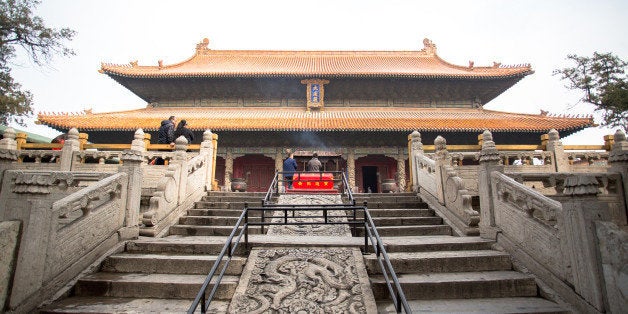
QUFU, SHANDONG PROVINCE, CHINA - 2015/03/19: Dragon carved stone steps leading to Dacheng Hall, also called the Hall of Great

One of the most perplexing aspects of Confucianism is that people easily misunderstand it as a 100% humanism. An example is that, when early Jesuit missionaries went to China and found Zhu Xi’s Neo-Confucianism of “Pattern-Principle” (理)and “Matter-Energy” (氣)was taken to be orthodox by Confucian elite, they categorized Confucianism as a form of “atheism” and thus, thought it deeply corrupted.

In Christianity, even love towards one’s neighbors is ultimately driven by divine grace. That means it is God who commands and makes us love our neighbors. However, because Confucianism lacks this kind of “divine agency” concept, it is very hard for Confucians to say when we love our parents and kids, it is ultimately and exclusively “Heaven” (天) who drives us towards this love.

The divergent situation is that Heaven in Confucianism is an all-encompassing constantly creative cosmic power. It lacks the Christian feature of “agency.” The Heavenly creation is spontaneous, natural, and if we use a term in modern control theory, it can also be self-organized in certain circumstances such as on the earth, but there is no guarantee that every creation of Heaven is ordered according to human expectation. Since Heaven is constantly creating, the essence of human beings, as an organic part of Heaven, is also constantly creating. This constantly creating human nature is named by “Ren” (仁) in Confucianism. An impressive allegory made by Neo-Confucianism is that this human nature “Ren” embodied in humans is like the “kernel” (果仁)contained in the nutshell (果壳), so represents the essential of life. But what is distinct in Confucianism is, Heaven provides the creative energy to human beings, but how humans, as an “agent”, use this energy is solely due to themselves.

As a matter of fact, when Confucians feel united with Heaven through an arduous process of self-cultivation, they would love a myriad of things under Heaven. But in this mystical situation, we can say, the great body of ours which we form with Heaven makes us want to love, but how to love concretely is still exclusively due to ourselves. In this way, the idea of “Heaven” as the divine reality in Confucianism provides ultimate axiological and aesthetic motives for humans’ universal love, but it can’t provide the “agency” which is the last crucial link leading to a concrete action of human love.

In this sense, it is wrong to characterize Confucianism as an “atheism”, since “Heaven” is indeed the divine reality which provides the ultimate axiological and aesthetic values to human deeds. But it is not a “theism” too, since “Heaven” is not a personal God and lacks the Christian-like “agency”. In fact, It is a non-theism. What Confucians worship about “Heaven” is a benevolent but wild cosmic creative power, without any anthropomorphic sort of purpose, will or plan. Correspondingly, the Confucian humanism is a non-theistic humanism, and in this strictly defined sense, it is a spiritual humanism.

Is Confucius a Confucian?

2016-02-06-1454789056-6326582-misnomerofConfucianism.jpg

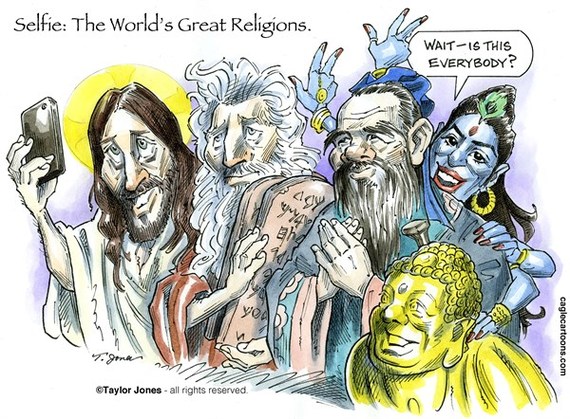
In the early 15th century, several Confucian missionaries embarked with Zheng He’s fleet, which was being sent out by the Ming emperor, Cheng Zu, both to demonstrate China’s national power and to build up international friendship with foreign countries. Relying on Zheng He’s incredible navigational skills and his massive ships, these missionaries reached every major country in southern and western Asia, eastern Africa, and the Cape of Good Hope, eventually arriving at their final destination, Europe. Their primary goal was to convert each non-Confucian, that is, each barbarian nation to Confucianism in order to spread Chinese civilization and also to bring, according to their view, ultimate goodness to everyone under the Heavens. But in order to do this, the missionaries first needed to understand the kind of education European people traditionally received. They found that in Europe everyone talked about Jesus. Jesus’ not so decent image, a nude, bloody and somewhat mutilated body crucified on a cross, was hanging everywhere and was venerated by almost everyone. As a result, the Confucian missionaries thought that since Jesus seemed to be the European’s sage, this tradition should be named, ‘Jesusism.’ Meanwhile, the missionaries reported this to the emperor of the Central Kingdom, and accordingly, the Chinese came to know the major teaching of Europe as Jesusism. However, these early Confucian missionaries’ efforts in Europe were not very successful. The Jesus believers refused to admit that Jesus was merely a sage, and it appeared that, to them, Jesus was much more than a sage. But because Chinese civilization maintained its technological and economic hegemony in the world from the early 15th century until the present, Chinese became such a powerful language that everyone in the world continually talked about ‘Jesusism,’ no matter whether ‘Jesusians’ approved of this name or not. At the same time, Confucianism spread into every corner of the world, and entertained, sometimes harmonious and sometimes conflicting, relationships with various indigenous traditions.

Yes, you are right! This is a fairy tale, a total fiction! But if you exchange ‘China’ for ‘Europe,’ replace ‘Confucianism’ by ‘Jesusism,’ and switch all the other relevant historical factors in this fiction, then I have been describing exactly what happened in the case of ‘Confucianism’!

Confucianism is a misnomer. It was created by early Christian missionaries for the purpose of comparison and, especially, of conversion. Although Christian missionaries created a number of names for the now so-called world religions, the term ‘Confucianism’ is especially unfortunate since it says nothing at all that is essential about the tradition that the name purports to describe.

We can see that this is so by making a comparison with other major world religions. In Christianity, ‘Christ’ means ‘the anointed,’ or ‘the savior.’ This is the Greek translation of the Hebrew word, ‘Messiah.’ For Christians, Jesus is the Christ, because he is thought to have cleansed the original sin of human beings through his crucifixion, and thus to be able to bring salvation to all the world. Similarly, in Buddhism, ‘Buddha’ means ‘the awakened’ or ‘the enlightened.’ For Buddhists, Siddhartha Gautama is a ‘Buddha’ because he has attained enlightenment. His teaching is thought to be capable of awakening people, allowing them to understand the origin of human suffering and helping them to transcend the otherwise endless cycle of reincarnation, the samsara.

By contrast, if we follow the name ‘Confucianism,’ and claim that Confucius is a Confucian, what could this mean? It is as tautological as to say a dog is doggy and the sun is sunny. I am quite skeptical concerning whether any Confucian practitioner approves of this name.

So what is the Chinese name for ‘Confucianism’? In other words, how would a contemporary Confucian wish to identify himself or herself when following this tradition? It is Ru (儒, pronounced like ‘zoo,’ but in an ascending tone). Given this name, it makes sense for Confucian practitioners to say that Confucius is a Ru because, similar to ‘Christ’ and ‘Buddha,’ Ru is not only a name. It also represents an ideal for human life. In this sense, to know why Confucius is venerated as a Ru is to understand the essential teaching of ‘Ruism,’ which in my view is the correct name to replace ‘Confucianism.’ So, what is this ideal? And what is the meaning of the Chinese character ‘儒’?

Although the division of ancient Chinese thought into named schools, such as Ruism, Daoism, Legalism, etc., was brought about by intellectual historians in the Han Dynasty (202 BCE-220 CE), the philosophical debate among major Chinese thinkers who were designated by these names had already begun several hundred years earlier. Mencius (approximately 372-289 BCE) considered that his own thought belonged to the school of Ru (Mencius, 7B). In addition, separate chapters entitled, “The Influence of a Ru“ (儒效) and “The Deeds of a Ru“ (儒行) are contained in Confucian classics such as the Xunzi and the Book of Rites, which were written during approximately the same time period as the Mencius. In other words, among various schools of ancient Chinese thought, the strong self-designation of Confucius’ students as Ru began shortly after Confucius passed away. If we now pay attention to the reason that the tradition selected the character 儒 (ru) to identify itself, we find there are two major meanings of 儒, both of which are warmly endorsed by Confucian practitioners.

First, rou (柔), a closely related character, means ‘being soft’. Why soft? This meaning relates to the sociological status of the term Ru before the time of Confucius. At this time, as a social order, Ru referred to a variety of professions: shamans, diviners, those who prayed for rain, dancers, those who presided over religious ceremonies, etc. In pre-Confucian China, this rank of people possessed one key skill which was thought by early Confucian thinkers to be of the utmost importance to human civilization: knowledge of ritual (li, 禮). From a Ruist perspective, the relationships among human beings and that between human beings and non-human nature are not immediate. Quite often, these relationships are, and ought to be, mediated by a variety of li: language, art, ceremonies, social etiquette, political institutions, technology, etc. In this way, li, although conventionally translated in English as ‘ritual,’ actually refers to all possible means of human civilization, and thus it is fair for us to paraphrase the Ruist concept of li to refer to all ‘civilized symbols.’ For example, faced with a beautiful, charming woman, no suggestion would ever be made that a civilized man should be driven immediately by his sexual impulses to grab her, kiss her, and touch her, without any scruple. On the contrary, civilized human sexual relationship is always mediated by kinds of symbols: a smile, particularized eye contact, intimate language, and probably also messages, emails, heartfelt gifts, etc. Finally, a civilized, more ideal result in this case for humans may be that even if the woman fails to accept the man, both must still show basic respect for each other, and thereby maintain a degree of humaneness throughout such interactive processes. Understood in this way, the uniqueness of civilized symbols consists in this, that as media, they are used by human beings to represent what happens in their subjective inner worlds in order to engage the objective realities which exist outside that inner world.

Therefore, li, according to this broad Ruist understanding, is a non-violent, uniquely human, way to facilitate human to human and human to nature relationships in order to advance human growth and to achieve the condition of dynamic harmony (he, 和) in every domain of human life. In a word, the ‘softness’ connoted by the character 儒 implies the essential and ideally non-violent nature of human civilization.

Secondly, ru means ‘to moisten’ (濡). In order to grasp the significance of this meaning of ru to Ruism, we must first understand a traditional Chinese idiom, 相濡以沫 (xiang-ru-yi-mo), which can be roughly translated as ‘(fishes) moisten each other using their saliva.’ The idiom refers to the following story: when a river dries up, fish become stranded in the river bed. In order to survive in this difficult situation, the fish spit saliva at each other, moistening and thus bringing relief to each other’s bodies. Understood in this way, a Ru, a ‘Confucian,’ was metaphorically thought to be able to ‘moisten’ people’s bodies because the Ru, by relying on their knowledge of all the resources of human civilization as well as on their own ‘practical moral influence’ (de, 德), are able to nourish people’s lives within human society. In comparison to other approaches to ethics in the West, this Ruist understanding of morality points to its distinctively holistic nature: if I am moral, I can nourish my life and the lives of other people, which thereby includes a significant bodily dimension. In other words, if I am moral, I will become healthy. In fact, based upon my previous analysis of the meaning of ‘dynamic harmony‘ (he, 和), this holistic approach to Ruist ethics is quite understandable.

In biological terms, a condition of dynamic harmony can be defined as one of ‘energy equilibrium,’ as when a biological entity employs the least amount of energy to exert optimal biological functioning, at the same time attaining a symbiotic relationship with each of the other entities within its local environment.

In this sense, if a Ru, by employing all kinds of non-violent civilized symbols, is able to bring a condition of dynamic harmony to his or her community, he or she is actually creating a healthy ecosphere within which all kinds of life benefit, nourish, and thus “moisten” each other. In this way, the character of 儒, which is made up of two parts, ren, 人, meaning ‘a human being,’ and xu, 需, meaning ‘need’ or ‘want,’ can be interpreted to refer to someone who is ‘a needed human being.’ But why should a Ru be needed by other people? It is precisely because he or she has command of the essential resources for human civilization, and so is able to ‘moisten’ people’s lives and thereby create those virtuous ecospheres which are needed within all domains of human society.

If we now combined these two meanings of Ru, ‘being soft’ and ‘to moisten,’ we can recognize that the standard meaning of Ru, as it is received in the Ruist tradition, is ‘non-violent transformation.’ To be a Ru is thus to be commissioned as a non-violent warrior and fighter who employs every resource of human civilization toward the realization of dynamic harmony in the world. A Ru is someone who tries to transform the world into an all-encompassing symbiotic ecosphere by employing his or her own personal moral cultivation. As a consequence, please do not forget that Confucius is not a Confucian; he is a Ru. And Confucianism is not Confucianism; it is Ruism. I hope that everyone who reads this article will help to spread this message, and will also commit to realizing the Ruist ideal in every dimension of human living.

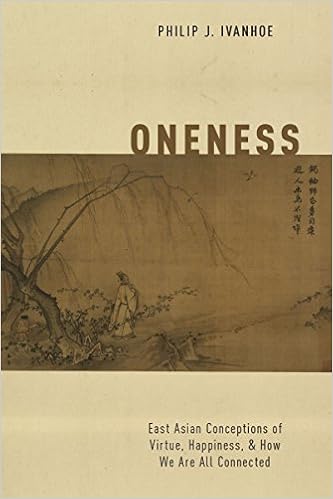
“Oneness: East Asian Conceptions of Virtue, Happiness, and How We are All Connected” (Oxford University Press, 2017)

Philip J. Ivanhoe, Oneness: East Asian Conceptions of Virtue, Happiness, and How We are All Connected, Oxford University Press, 2017, 188 pp., $39.95, ISBN 9780190840518.

Reviewed by Bin Song, Washington College

First Published at Notre Dame Philosophical Review, 2018.5.5.

At the center of East Asian philosophical traditions lies a conception of oneness signifying that “we — and in particular our personal welfare or happiness — are inextricably intertwined with other people, creatures, and things,” which Ivanhoe calls the “oneness hypothesis.” (1) While drawing upon the writings of East Asian, especially neo-Confucian, thinkers to elucidate the conception of oneness, this book aims to show how these traditional views “can guide us in constructing contemporary versions of the oneness hypothesis.” (3) In an era when human civilization is constantly alarmed by ecological crisis and societal disintegration, this book has great appeal particularly to those who are willing to employ comparative philosophy to tackle these menacing issues.

After introducing the oneness hypothesis and offering examples of East Asian thinkers who have advocated particular versions of such a hypothesis, Ivanhoe discusses the relational conception of the self, and then goes on to illustrate the interrelated, yet different concepts of selfishness and self-centeredness. Ivanhoe views both of these as harmful for humans efforts to envision a more appropriate idea of self implied by the oneness hypothesis. Subsequent chapters explore the nature of virtues and the value of spontaneity and compare Kongzi’s (Confucius’) and Zhuangzi’s conceptions of happiness in order to show how these conceptions contribute to the proper goal of neo-Confucian ethics.

The most brilliant point that Ivanhoe makes is that the ethic required by the conception of oneness ought not to favor an act of care exclusively for the sake of another. Instead, with the awareness of an expanded self, a caring agent would rather pay attention to the particular needs of a cared-for individual so that the altruistic deeds will ultimately bring satisfaction and happiness to the agent. In this sense, we can “avoid infantile conceptions of oneness that shrink back and withdraw from a clear sense of ourselves as individual autonomous agents and seek to merge back into the safety of some surrogate womb.” (152) As Chinese intellectual history shows, many neo-Confucian thinkers championed the traditional Confucian learning as one of “learning for oneself”[1] in contrast with the Buddhist teaching of “no-self.” This sort of learning states that an identification of one’s self with all the world does not make the self get lost in the world. Therefore, Ivanhoe’s incisive analysis of the position of self in a desirable form of the conception of oneness is clearly inspired by neo-Confucianism.

The strength of Ivanhoe’s argument also consists in his meticulous effort to utilize comparative and inter-disciplinary perspectives to enhance the plausibility of the oneness hypothesis in a modern context. On the one hand, Ivanhoe points out that the neo-Confucian reasoning from what the world truly is to how human individuals ought to behave in the world is similar to parts of the Western philosophical tradition such as Plotinus’ metaphysical and ethical vision of the “chain of being.” (16) On the other hand, Ivanhoe quotes extensively from contemporary research in varying disciplines, such as evolutionary biology and moral psychology, to show the compatibility of modern scientific worldviews to the traditional East Asian conception of oneness. Given the distinctive Confucian idea of “harmony” (he), which urges scholars to consider all factors relevant to a topic and then to place each factor in its proper position, we can understand Ivanhoe’s presentation of the East Asian conception of oneness as a Confucian project aiming to make the greatest sense of a historical idea on the basis of a harmonious integration of all relevant human knowledge. The result is truly masterful.

Last but not least, this work avoids the weak point of some current scholarship in comparative philosophy, which tends to lump together “East Asian philosophy” as a coherent whole in order to compare it with its Western counterparts. Consider Ivanhoe’s comparative study of Kongzi’s and Zhuangzi’s ideas of “happiness.” After a detailed explanation of each idea, Ivanhoe concludes: “I do not intend to reduce one to the other, cast them both as expressions of some single higher truth, or obscure their differences in light of what they share. They offer two related but distinct perspectives on oneness and the good life.” (148) In my view, the thoughts of schools and philosophers in ancient East Asia are no less diverse, divergent, or sometimes even antagonistic to each other than those in Western philosophy. Ivanhoe’s careful treatment of both the similarities and differences among East Asian philosophies should be taken as a model for future scholars.

However, there are weak points in Ivanhoe’s argument on the plausibility of the oneness hypothesis, such as his ambivalent attitude towards metaphysics. While defining the neo-Confucian philosophy of oneness as a sort of metaphysical ethics or ethical metaphysics comparable to the neo-Platonic “chain of being,” Ivanhoe argues for its advantage over the empathy-based ethic. This is because its deeper metaphysical commitment to the all-encompassing oneness allows humans’ altruistic care to extend to “nonhuman animals and, even more challenging, plants and inanimate objects.” (11) While citing science to indicate the compatibility of the oneness hypothesis with a modern context, Ivanhoe also hopes that “we might draw upon and employ neo-Confucian conceptions of oneness as a model and guide for fashioning a plausible and attractive modern version of the oneness hypothesis and make use of it as a resource to develop a corresponding ethic.” (33)

All of these are very positive views towards the oneness hypothesis as a whole, including its metaphysical ingredient. However, in many other places, Ivanhoe expresses an unreserved negative evaluation of the contemporary prospect of neo-Confucian metaphysics, which centers on a view of the all-pervading patterns or principles (li) and vital-energies (qi) in the universe. For example, the metaphysical foundation of the neo-Confucian conception of oneness is said to be “clearly inconsistent with the best science of the day” (74), and “so deeply at odds with our contemporary scientific understanding of both self and world.” (151) The idea underlying these jarring statements seems to be that Ivanhoe thinks people today can just pay attention to and practice pragmatically the ethical part of the oneness hypothesis without being involved in any metaphysical controversy (79).

However, first, we do not exactly know how this can be done, and especially, how a truncated conception of the oneness hypothesis, if possible, can be claimed as being inspired by the neo-Confucian conception of oneness. Second, these statements are indeed deeply at odds with others quoted above (3, 11, and 33), which all speak to the central motif of the book: utilizing the traditional neo-Confucian conception of oneness, which is deeply metaphysical, to inspire a modern update. I believe Ivanhoe should distinguish three questions when he articulates his view on metaphysics: first, whether metaphysics is needed at all for constructing a contemporary conception of oneness and its corresponding ethic; second, if it is needed, what is the role of metaphysics for this purpose; third, what traditional metaphysical ideas in this regard are the most inspiring and conducive. Because Ivanhoe has not yet explained his stance on the first two questions, his ambiguous statements regarding the neo-Confucian metaphysics may make it hard for readers to understand his overall argument for the oneness hypothesis.

Another weak point is that Ivanhoe’s presentation of the neo-Confucian hypothesis risks over-simplification in its own right, although he succeeds in delivering a nuanced comparison of the Daoist and the Confucian conceptions of happiness, as mentioned above. In particular, readers might misunderstand the neo-Confucian conception of oneness as a coherent whole after they read this book, but the fact is that thinkers within the Chinese neo-Confucian tradition disagreed on multiple issues in a variety of ways. For example, while presenting the metaphysical core claim of oneness in neo-Confucianism, Ivanhoe says:

Under the influence of Buddhist metaphysical beliefs, neo-Confucians developed a more robust and dramatic sense of oneness as a kind of identity between self and world. Rather than seeing the world as an interconnected system or web of principles or patterns, they believed each and everything in the world contained within itself all the principles or patterns in the universe. (22, emphasis mine)

Here, “contain” is an ineffective word because it fails to show the rich diversity of ideas within neo-Confucianism on this crucial issue: the relationship between the human mind-heart (xin) within and the principles or patterns in the world without. For instance, two contemporary neo-Confucian thinkers of almost equal influence in their time, Wang Yangming and Zhan Ruoshui, both endorsed the idea that “the mind-heart is the pattern or principle” (xin ji li). However, Wang tended to think that the human mind-heart includes innately all principles and patterns in the outside world, while Zhan opposed Wang’s view and insisted that the human mind-heart needs to comply with patterns or principles in order to achieve the ultimate unification between the self and world.[2]

It is worthwhile to mention this debate because, at the end of the book, Ivanhoe specified one problem with the conception of oneness: the conception ought not lead us to “engulf the world by swallowing it into oneself” so as to “efface the variety and texture of our magnificently diverse and dabbled world.” (153) However, as shown in the intellectual history of neo-Confucianism, this problem is exactly what critics once pointed out to some of Wang Yangming’s radical followers. In a word, it is not only unjust to the history of neo-Confucian philosophy to treat the neo-Confucian conception of oneness as a coherent whole; this simplified presentation of neo-Confucianism also defies Ivanhoe’s own argumentative purpose: to construct an available modern conception of oneness under neo-Confucian inspiration.

The last critique I would like to offer is that despite being an accomplished and prolific scholar on ancient Chinese philosophy, Ivanhoe succumbs to certain questionable views that urgently need to be rethought. In conclusion, let me raise three examples.

First, the origin of neo-Confucian metaphysics needs to be reconsidered. Ivanhoe perpetuates a view prevalent among Anglophone students of Chinese philosophy that “Neo-Confucians have embedded earlier Confucian ideas in a much more complex and powerful metaphysical system derived largely from Daoist and Buddhist sources.” (144) However, although terms and characters were shared by neo-Confucian, Daoist and Buddhist metaphysical discourses, the texts upon which neo-Confucian thinkers based their new interpretations and thus built their own metaphysical conceptions all derived from earlier Confucianism. For example, chapters in the Classic of Rites (Liji) and the Classic of Changes (Yijing), two among the so-called Five Classics, were widely thought of by neo-Confucian thinkers as of crucial importance for neo-Confucian metaphysics. Moreover, these metaphysical chapters of classical Confucianism already produced their great influences among Chinese metaphysical thinkers in the Han dynasty, which was significantly earlier than the Song and Ming Dynasties when neo-Confucianism flourished. In other words, the Confucian tradition is undeniably and distinctively metaphysical from its very beginning, although whether Confucian thinkers adopt or emphasize these traditional metaphysical elements depends upon their own discretion.

Ivanhoe’s presentation of both classical Confucianism and neo-Confucianism focuses on writings authored by individual philosophers, but not on the traditional Five Classics and their commentaries. In Chinese intellectual historiographical terms, this means it focuses on the “learning of masters” (zixue), rather than the “learning of classics” (jingxue). Obviously, this perpetuates controversial views on Chinese philosophy as illustrated above.

Third, I have argued, together with other scholars,[3] that “Confucianism” is a misnomer invented by early Christian missionaries for the Ru tradition, and we should change the term “Confucianism” to “Ruism” in order to more accurately present the Ru tradition to Western audiences. Two conspicuous benefits can be derived from this rectification of names in the context of Ivanhoe’s work. First, Ivanhoe seems to have been envisioning a sentence like “Kongzi finds his joy in following the Confucian way” when he discussed Kongzi’s view of joy, perhaps in order to avoid the awkward sentence “Confucius finds his joy in following the Confucian way” through using the Romanized pinyin form Kongzi.[4] However, for readers versed in Chinese language and culture, the former equally smacks of narcissism, and is actually no less awkward than the latter. Replacing “Confucianism” with “Ruism” and “Confucian” with “Ru” or “Ruist,” the sentence can be neatly written as “Confucius finds his joy in following the Ru (or Ruist) way.” Second, if we can avoid “Confucianism” as an awkward Western misnomer, the term “neo-Confucianism” and some of the aforementioned controversial points can also be more easily rethought. There is no Chinese term corresponding to “neo-Confucianism.” In contemporary Chinese intellectual historiography, the Ru tradition in the Song and Ming dynasties is usually called “Song-Ming Ruxue,” i.e., Ruism of the Song and Ming Dynasties. Therefore, instead of “neo-Confucianism,” we can use “Song and Ming Ruism” to show the great continuity of the Ru tradition, and avoid suggesting that the metaphysics of neo-Confucianism derived from somewhere else, and thus, was entirely “neo-” to the “Confucian” tradition.

REFERENCES

  • Angle, Stephen (2016). “Should we use ‘Ruism’ instead of ‘Confucianism’?” Warp, Weft, and Way, posted May 4, 2016, accessed January 1, 2017.
  • Bol, Peter (1994). “This Culture of Ours”: Intellectual Transitions in T’ang and Sung China. Stanford University Press.
  • Huang, Mingtong (2001). Chen Xianzhang Ping Zhuan (An Annotated Biography of Chen Xianzhang). The Press of Nanjing University.
  • Slingerland, Edward (2003). Confucius Analects: With Selections from Traditional Commentaries. Hackett Publishing Company.
  • Swain, Tony (2017). Confucianism in China: An Introduction. Bloomsbury.

[1] This neo-Confucian thought is based upon the Analects 14:24 “The Master said, in ancient times scholars learned for their own sake; these days they learn for the sake of others.” See Slingerland (2003): 164. One of the best historical discussions of the neo-Confucian idea of “learning for oneself” in relation to the movement of “Learning of the Way (daoxue)” can be found in Bol (1994): 305-337.

[2] About the difference between Wang Yangming and Zhan Ruoshui on this point, see Huang (2001): 306-313.

[3] Most recent scholarly discussions on this issue can be found in Angle 2016 and Swain (2017): 3-22.

[4] The full sentences, upon which the quoted one is based, are from “Kongzi describes various stages of understanding the Dao,” until the end of the paragraph on page 133. See also the phrases “Kongzi, the founding figure of Confucianism” and “early Confucians such as Kongzi.” (129, 131)