“…I define patience as a radical acceptance of obstacles or burdens we face on the path to any meaningful goal. Imperfection is an inevitable part of human experience. Recognizing this, especially when navigating challenges related to faith, has become invaluable in my teaching. Patience allows me — and my students — to embrace our differences and cultivate deeper, more meaningful cross-cultural and interfaith understanding. I’ve had three key teaching experiences that illustrate the profound impact of patience in the classroom …”
In my effort to promote Ruism among ordinary American people I have encountered a major push-back from, of all people, Chinese Americans. Most of them are either indifferent or hostile to their own tradition. But regardless of the reason, an unvarnished ignorance underlies this opposition. A recent example took place this summer when I gave a talk to the largest Chinese evangelical Christian church in the Boston area about ‘The Three Guides’ and ‘The Five Constant Virtues.’ After I finished my talk, a pious Chinese woman, around 40 years old, came up and whispered to me: “I know Ruism was the dominant tradition of ancient China, but I had never heard anything like what you were saying during your talk. After hearing what you have explained about Ruism, I find that it is actually quite good (挺好的).” Anecdotes like this tell us that in comparison with other traditions such as Judaism, Hinduism or Roman Catholicism, most Chinese immigrants to the United States are actually an obstacle, rather than an aid, to introducing and advancing their supposed ‘home tradition’ to other Americans.
So, why is this happening? Where does this ignorance come from? As a scholar of the humanities, I have to assign the major reason to the May Fourth Movement and the radical anti-Ruist rhetoric which, in the 1910s, this movement created and afterwards was used in governing most of modern China’s public education. What happened was that, facing a national defeat by the Western colonial powers, some radically westernized Chinese intellectuals such as Lu Xun or Chen Duxiu, whom I call ‘The May Fourthers,’ invented a dualistic mindset separating East from West, and old from new. In order, they said, to surpass the West, China must give up its own culture and re-learn everything Western. For this reason, Ruist teachings such as ‘The Three Guides’ and ‘The Five Constant Virtues’ were condemned by the May Fourthers as representing the backward morals of a feudal society. They said that these ideas were hopelessly authoritarian, enslaved the independent will and spiritual freedom of individual people, and weakened Chinese cultural vitality. As a consequence, they thought, Chinese tradition must be completely jettisoned so that the Chinese people can learn the new morality of the West.
Although I appreciate the apparent sincerity of the May Fourthers’ intentions (they, after all, hoped to make China better and stronger), I nevertheless see that their racial, anti-Ruist rhetoric is as ridiculous as to say, for example, “A wise old man, punched in the face by an impetuous young guy, has to totally give up his own wisdom and identify spiritually with the young guy.” In fact, most of the May Fourthers’ criticisms of Ruism are simply wrong! In my view, in order to practice ‘The Three Guides’ and ‘The Five Constant Virtues,’ nothing more is needed than the independent spirit of individuals! In the remaining sections of this essay, I will demonstrate how this is the case.
First, a little history:
The first time that the single phrase ‘the Three Guides and the Five Constant Virtues’ (三綱五常) is mentioned in the Ruist classics was when Ma Rong (馬融, 79-166 CE) in the Eastern Han Dynasty used this phrase to comment on Analects 2:23 in order to explain the unchanging aspect of a harmonious human society. According to Ma, regardless of what happens on the outside, people must still practice Ruist ethics inwardly for human society to remain on the right track. Before Ma, it was Dong Zhongshu’s (董仲舒, 179-104 BCE) works and a later text entitled, ‘A Comprehensive Exposition in White Tiger Hall’ (白虎通義, compiled in 79 CE) that provided a separate philosophical exposition to each of the terms ‘The Three Guides’ and ‘The Five Constant Virtues’. As perhaps will be well known, the Han Dynasty (202 BCE-220 CE) was a very special period for Ruism. After other teachings, such as Legalism and Daoism, had proved not to be robust enough for maintaining a unified dynasty and an harmonious human society, Ruism was established as the state ideology. Accordingly, we can see that all those expositions about ‘the Three Guides’ and ‘the Five Constant Virtues’ which were provided by the Han Dynasty Ruists are actually a distillation of previous Ruist ethical teachings such as ‘The Five Cardinal Human Relationships‘ (五倫) and ‘The Ten Reciprocal Duties‘ (十義) from Ruism’s Pre-Qin classical period. These teachings were intended to function, and they actually did function, as a textbook version of Ruist ethics, and thus were perennially influential. In this sense, the May Fourthers were right to select these Guides and Virtues [三綱 and 五常] as representative of Ruist ethics, even though their understanding of these ideas was quite wrong.
Second, the philosophy:
The standard expression for ‘The Three Guides’ is that ‘The ruler is the guide for subjects, the father is the guide for the son, and the husband is the guide for the wife’ (君為臣綱, 父為子綱, 夫為妻綱).
The original meaning of the Chinese character, written 綱 gang, refers to the lead rope of a fishing net, and thus, by extension, it means guide, guideline, bond, or guiding principle, etc. In Ruist ethics, if X is said to be the guide (綱) for Y, it primarily connotes, first, that the relationship of X to Y is a major human relationship, and secondly, that this X-Y relationship is, in a practical sense, hierarchical, in which X takes the major and leading role while Y takes a minor and subordinate role. Therefore, both X and Y must fulfill those distinct duties which are entailed by their differing roles.
So, if X guides (綱 ) Y, it means that X must act as a moral model for Y. In other words, X has a great responsibility for instructing Y about right human behavior. In the subordinate role of Y, he or she needs to show consistent deference towards and thus, discreetly and responsibly follow X as long as a normal X-Y relationship is being maintained. Even so, to what extent can an X-Y relationship be seen as ‘normal’? The answer depends. The tradition tells us that for the ruler-subjects relationship, if a ruler continues to act badly, a minister ought to leave the state or resign after remonstration has failed three times. In more extreme cases, such as when a ruler proves to be a ruthless tyrant, revolt is urged. In the father-son relationship, if a father commits misdeeds and refuses to correct himself after his son has remonstrated three times, his son should ‘follow his father while crying and weeping’ (號泣而隨之, 禮記). This implies a persistent duty of the son to remonstrate since the father-son relationship can’t be abandoned as easily as that of ruler-subjects. For the husband-wife relationship, if a husband’s wrongdoing concerns only minor issues, the wife ought to tolerate while continuing to remonstrate, but if the misbehavior is really brutal such as killing the wife’s parents and other similar deeds that violate basic principles of human relationships, the wife has the right to a divorce (誖逆人倫,殺妻父母,廢絕綱紀,亂之大者。義絕,乃得去也”, 白虎通義).
Therefore, if there is anything that the teaching of ‘The Three Guides’ suggests to which a human being must be subordinated, it is only to one’s duties and to the universal moral principles that are entailed by each person’s distinct roles within various human relationships, rather than to any capricious human person who unjustly happens to hold authority. In relation to this, Xunzi taught us to “follow the Dao, rather than the ruler; to follow what is right, rather than the father.” If a person’s will is not firm, or if a person’s spirituality is not independent and principled, I want to ask the May Fourthers, “How could anyone be a Ruist who follows such teachings?”
The ethics of ‘The Five Constant Virtues’ is higher than those which concern ‘The Three Guides’, ‘The Five Cardinal Relationships’, or ‘The Ten Reciprocal Duties’. This is because these latter terms refer to concrete human relationships and their related duties, but meanwhile, human society is far more complex than what these terms refer to. Even when we know how to behave ourselves within three (or five) major human relationships, we still feel the need for a higher principle that can guide all human relationships. Therefore, the purpose of teaching ‘The Five Constant Virtues’ is to provide that ‘single’ principle which will apply in various occasions. These ‘Five Constant Virtues’ are Humaneness (仁, ren), Righteousness (義, yi), Ritual-Propriety (禮, li), Wisdom (智, zhi) and Trustworthiness (信, xin). I will explain these terms one by one.
The basic meaning of ‘Humaneness’ (仁, ren) is love. Ruism’s conception of love is all-encompassing. It can be as close by as one’s parents and one’s children, or in its incipient form, in the reaction one has when, seeing a baby about to fall into a well, one feels a sense of ‘commiseration’ (惻隱之心, Mencius) and is hardly able to prevent oneself from saving the baby. It can also be as distant as when tiles and stones are crushed and one feels concern and empathy for their reordering (Wang Yangming). In a word, the Ruist conception of human love is so universal that a person of humaneness is said to be able to ‘form one body with a myriad of things between Heaven and Earth.’
Nevertheless, even though human love is universal, Ruism also urges its particularization, so here we are with the virtue of ‘Righteousness’ (義, yi). The basic meaning of 義 refers to something that ‘ought’ to be done, that is, to what is right. In relation to ‘Humaneness,’ this virtue requires human beings to love appropriately in relation to particular people and in concrete situations. For example, as human beings, our love towards our own parents and children is naturally and understandably more intense than towards other people’s parents and children. However, love should not end with one’s own family. We must love other people’s parents and their children by extending our love outward from our own. In this regard, Ruism teaches us to correctly determine the value of one’s various relationships, and thus to bring about a graded form of dynamic harmony in one’s performance of various duties through a reasonable distribution of time and energy.
‘Ritual-Propriety’ (禮, li) refers to the audible and visible ways of human behavior, through which what the virtues of ‘Humaneness’ and ‘Righteousness’ require are practiced. For example, if one has good intentions to appropriately love one’s parents but does not actually practice the respectful ways for speaking, looking, hugging, or taking good care, it is hard to say that one has internalized the virtues of humaneness and righteousness in his or her person.
The virtue of Wisdom (智, zhi) balances the virtue of ‘Ritual-Propriety’ since it refers to knowledge. To know how to appropriately love is to possess wisdom. In line with the Ruist idea of dynamic harmony, the central task of human wisdom is to be thought of as knowing both the facts and values of things, and thus, of understanding how things in concrete situations can fit together based upon appropriate human reactions to that situation.
The virtue of Trustworthiness (信, xin) is mainly about one’s attitude, and thus, has no additional content compared to the other four. It requires that one sincerely practice the four aforementioned virtues, and thus really possess them (實有其德).
In a word, ‘Humaneness’ is universal human love, ‘Righteousness’ refers to how to love appropriately in concrete terms, ‘Ritual-Propriety’ is the audible and visible ways of human behavior in which ‘Humaneness’ and ‘Righteousness’ are practiced, ‘Wisdom’ is to know how to be humane, righteous, and ritually-proper using one’s deep axiological reasoning, while ‘Trustworthiness’ urges one to be sincere in the practice of these virtues, and thus, to truly own them. Overall, ‘The Five Constant Virtues’ is the principle that governs one’s behavior within various human relationships. For example, if a minister can be humane, righteous, ritually-proper, wise, and trustworthy in his or her behavior within the ruler-subjects relationship, he or she will be seen as fulfilling his or her duty of ‘loyalty’, as specified in the teaching of ‘Ten Reciprocal Duties’.
Based on this discussion, I have to ask one final question: Can we still believe, as the May Fourthers did, that the Ruist teachings of ‘The Three Guides’ and ‘The Five Constant Virtues’ represent the backward morals of a feudal society and thus are totally irrelevant to modern society? Absolutely not. In my view, every virtue listed in ‘The Five Constant Virtues’ continues to be extremely valuable for our time. Nothing need be changed in order to practice this teaching today. For ‘The Three Guides,’ we only need to make minor changes in order to adjust its social context. As I have argued in a previous essay, the ruler-subjects relationship ought to be understood as that of government-citizens, or any other hierarchical relationship in public life; the father-son relationship needs to be reformulated as that of parents-children; and the teaching about the husband-wife relationship ought to be reconsidered as one of a husband and wife who are guides for each other depending upon their differing levels of expertise. In my view, each of these adjustments is what the Ruist ethical principle of ‘The Five Constant Virtues’ requires for today’s human relationships.
In a word, I believe the teachings of ‘The Three Guides’ and ‘The Five Constant Virtues’ are still key for the realization of social harmony in every time period. May Fourthers, I have to say again, “Sorry, you were wrong. It is the Ruist tradition which is the antidote for our modern malaise!”
In several recent essays on dynamic harmony, the five cardinal human relationships and ten riciprocal duties, and the three guides and five constant virtues, I discussed many Ruist virtues. To help you understand the relationships among these virtues, I’ve created this Chart of Ruist Virtues. I encourage you to read the chart from the top down at first. (After you have a sense of the chart as a whole, however, you can contemplate it from any point.) Because I’ve already explained most of the terms on the chart in previous essays, I’ll focus here on the relationships between and among the terms.
The Chart in Detail
First, let’s discuss the Way of Heaven (Tian) (天道, Tiandao), which appears at the top of the chart. Tian refers to an all-encompassing, constantly creative cosmic power. Tian is the transcendent in Ruism. Literally, Dao means “the way,” but when these two terms are used together, Dao takes on a special meaning: it refers to the principle that runs through the all-encompassing power. By placing Dynamic Harmony (和, he) below The Way of Tian, we’re saying that Dynamic Harmony is the principle that runs through Tian. In other words, we can say that Dynamic Harmony is the Way of Tian. Because virtue (德) in Chinese can be extended to characterize the generic features of Tian, we can also say that Dynamic Harmony is a virtue of Tian.
The reason we can say that Dynamic Harmony is a virtue of Tian is because, as explained earlier, Tian’s creativity is all-encompassing. Everything that has ever existed, exists now, or will ever exist is brought into being by Tian and every being in the universe is part of Tian. In other words, as created by Tian, everything is and becomes together, which is the basic meaning of ‘dynamic harmony’. If we understand this, we can see that Dynamic Harmony is embedded in every aspect of this constantly-unfolding cosmic creation. We can also see that this all-encompassing force is neither anthropomorphic nor anthropocentric. In other words, Tian is not a person, nor is it exclusively focused on humans. As such, humans cannot directly access Tian per se, but must approach it through Ruist mysticism, a topic I’ll discuss in future writings.
The way humans engage with Tian concretely is to realize Dynamic Harmony in human society. We do this through the virtue of Humaneness (仁, ren). For this reason, you’ll see on the chart that the virtue of humaneness is the Way of Human Beings.
In Ruist ethics, Humaneness is the highest human virtue. In the most general sense, the virtue of Humaneness is the manifestation of Tian’s creativity within human nature. When we look in more detail, however, Humaneness includes five different facets, each of which refers to a different dimension of Humaneness:
Humaneness (仁, ren),
Righteousness (義, yi),
Ritual-Propriety (禮, li),
Wisdom (智, zhi),
Trustworthiness (信, xin)
We refer to these as the Five Constant Virtues (五常, wuchang). The Five Constant Virtues are universal principles that govern concrete human relationships. For this reason, the lower region of the chart describes how the Ruist tradition understands and describes particular human relationships.
First, let’s look at the Three Guides (三綱, sangang), a Ruist ethical understanding of three major human relationships. Originally, 君為臣綱 meant “ruler is the guide of subjects.” In a modern context, however, it ought to be understood as something like “in public life, a superior is the guide of subordinates.” This refers to relationships such as those between the state and citizens or between employer and employees. Likewise, although 父為子綱 originally meant “father is the guide of son,” a modern formulation would be something like, “parents are the guides of children.” Finally, 夫為妻綱, which originally meant “husband is the guide of wife,” should now be understood as “husbands and wives are the guides of each other, depending upon their different areas of expertise.”
The ethics of the Three Guides is a distillation of Mencius’ teachings about the Five Cardinal Human Relationships (五倫, wulun), which appear next in the chart. These relationships are parents and children, ruler and subjects, husband and wife, elder and junior, and friendship. Mencius taught that the virtues that guide each of these relationships are affective closeness (親, qin) between parents and children, righteousness (義, yi) between ruler and subjects, distinction (別, bie) between husband and wife, proper order (序, xu) between elders and juniors, and trustworthiness (信, xin) between friends.
The ethics of the Ten Reciprocal Duties (十義, shiyi) are described in an important chapter of The Book of Rites (禮記) called The Unfolding of Ritual Propriety (禮運). The text prescribes a single virtue for each person as they act out their role in these relationships. In the chart, for example, you will find that in the relationship between parents and children, parents should be guided by the virtue of parental kindness (慈, ci) and children should be guided by the virtue of filial devotion (孝, xiao). The practice of these two reciprocal duties by parents and children respectively will nurture the guiding virtue of affective closeness (親, qin) taught by Mencius in the Five Cardinal Human Relationships. This pattern of reciprocal virtues is repeated for the remaining four relationships.
The Big Picture
This chart of Ruist virtues suggests that each of us should cultivate the Five Constant Virtues — which can be seen as different facets of a single cardinal virtue, Humaneness (仁, ren) — so that we can play our roles well in a variety of human relationships. The ultimate goal is to create and sustain Dynamic Harmony in society, which is a concrete manifestation of the Dynamic Harmony of Tian’s all-encompassing creative power.
Notes on Interpretation of This Chart
When using this chart, there are two important caveats to keep in mind. First, you’ve probably noticed that some characters appear in this chart multiple times. This is because they represent different virtues depending on the context. At the top of the chart, for example, Humaneness (仁, ren) appears as the single cardinal virtue, the Way of Human Beings. In the section on the Five Constant Virtues below, however, it appears as one of the five virtues, and is taken in this context to refer to universal human love. Likewise, Righteousness (義, yi) appears in the Five Constant Virtues as the way human beings love appropriately in various situations. When Righteousness (義, yi) appears in the Five Cardinal Human Relationships, however, it is presented as the guiding virtue of the relationship between ruler and subjects and refers to the primary duty of both rulers and subjects to act appropriately toward each other.
The second caveat to keep in mind is that this chart is not intended to prescribe an ethical law that requires each Ruist to understand and practice these virtues one-by-one. This chart doesn’t contain every virtue cherished by Ruists over the past 2,500 years — after all, society is far too complex to be described by a single chart, and the ways in which each of us manifest these virtues in our daily lives will depend a great deal on the context in which we live.
So, although this chart is neither comprehensive nor prescriptive, it can serve as kind of reference chart to help you understand the backbone of Ruist ethical teachings. It is my hope that by studying, contemplating, and meditating on this chart, you will be better equipped to practice Ruist wisdom in your daily life.
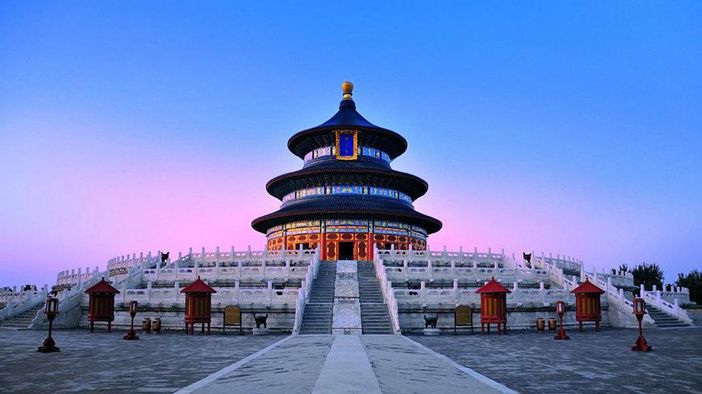
There is a religious ritual system in Ruism which has been translated as ‘The Three Sacrifices’ (三祭, sanji): Sacrifice in celebration of Tian (Heaven), sacrifice in celebration of distinguished teachers such as Confucius, and sacrifice in celebration of one’s ancestors. Traditionally, the sacrificial ritual in celebration of Tian could only be performed by an emperor, the so-called Son of Tian (天子). This ritual used to take place in the suburb of a capital such as this:
The ‘Platform of Tian’ (天壇) in Beijing
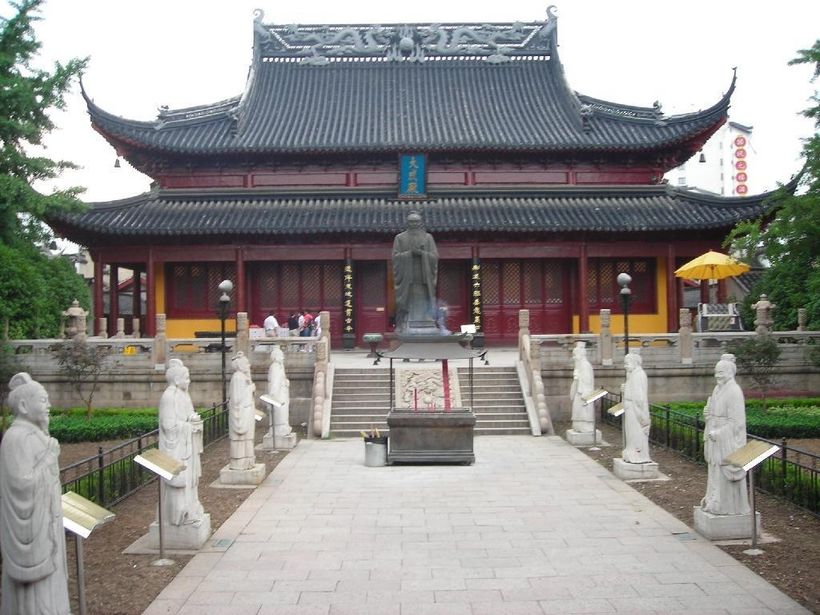
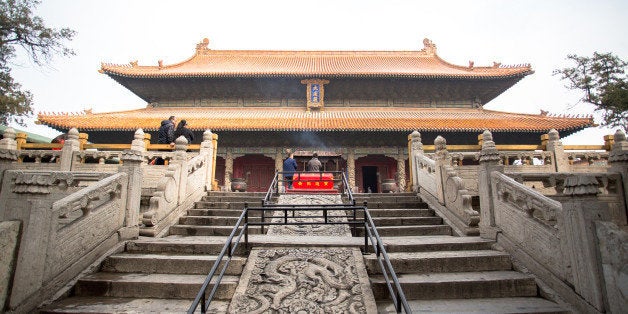
The sacrificial ritual in celebration of Confucius was performed in Confucian temples such as this:
Confucius Temple in Nanjing
Everyone is allowed to perform this ritual. However, because Confucius is taken to be the common teacher of everyone in the Ru tradition, the main participators in this ritual were the Ruist literati.
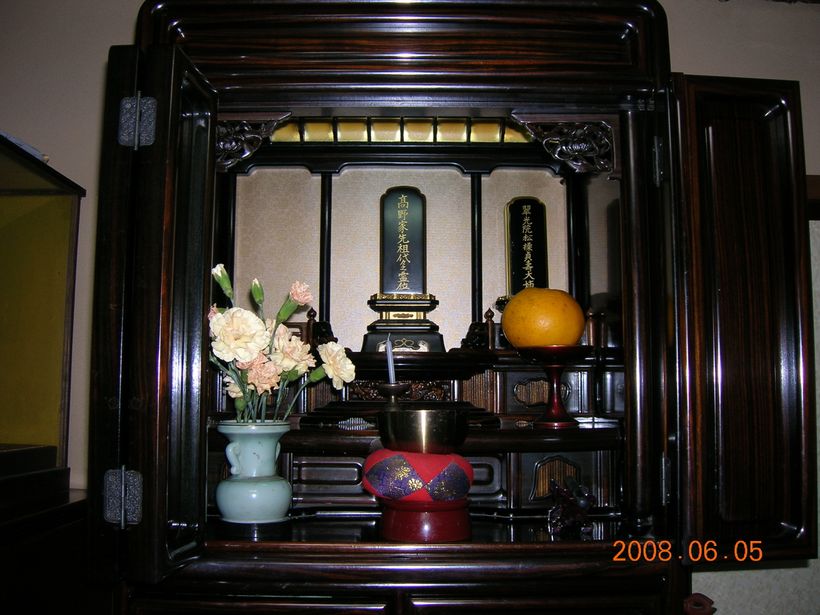
By comparison, the ritual of sacrifice to one’s ancestors is more private. It is either performed before an ancestral altar in each individual household, in cemeteries, or in an ancestral temple shared by an extended family. It looks like this:
An ancestor altar in household
At this time, I would like to introduce a new ritual which combines the first two rituals, which I am calling a ritual of Tian-worship and Confucius-veneration(敬天尊孔).
The major reason that such a combination is needed is that in a contemporary context, the celebration of Tian can no longer be performed by an emperor alone. As a Ru committed and connected to the all-encompassing transcendent power of Tian, not just an emperor but every person has the need and right to celebrate it. Actually, traditional Ru literati also realized the egalitarian power of the idea of Tian, since each individual Ru was free to interpret this idea in his or her own particular way in order to counteract the ideologies and political policies which may have been endorsed by his or her emperor. This was a distinctive Ruist check and balance system within the traditional Chinese dynastic polity. However, because the polity was imperial, the ritual aspect of Tian-worship could not be decoupled from the monopoly power of the emperor. Nowadays, the political context of emperor has died out, and every Ru has accordingly recovered the right to perform a ritual of Tian-worship.
The reason I suggest combining the ritual of Tian-worship and the ritual of Confucius-veneration is that the relationship among Ru, as students of Confucius, is egalitarian. They are friends (友, you), committed to the Dao of Tian (天道, tiandao), who are trying to realize dynamic harmony at all levels of human existence in accordance with Confucius’ teachings. Therefore, when an occasion arises for Ruist friends “who are coming from afar” [Analects, 1:1] to join each other and to advance their Ruist learning, they will be able to perform the ritual of Confucius-veneration and the ritual of Tian-worship at the same time. This will remind the Ruist community that when studying the tradition, each Ru is not only a student of Confucius, but also a citizen of Tian (天民, tianmin). In this way, each Ru will continually nurture the feeling of gratitude towards the ultimate origin of their personal lives and personal energy; simultaneously, they will enhance their devotion to a life of manifesting Tian’s creativity in a distinctively human way in accordance with Confucius’s teaching about ‘humaneness’ (仁, ren).
Based upon these reasonable considerations which encourage the creation of an updated ritual (“to create rituals according to what is right,” – “以義起禮”, 禮記∙禮運), during the first ‘Ruist Friends From Afar’ Retreat in North America, held at Marsh Chapel, Boston University, on July 1-3rd, 2016, and before any formal readings and discussions even began, Ru friends performed a new Ruist ritual of Tian-worship and Confucius-veneration.
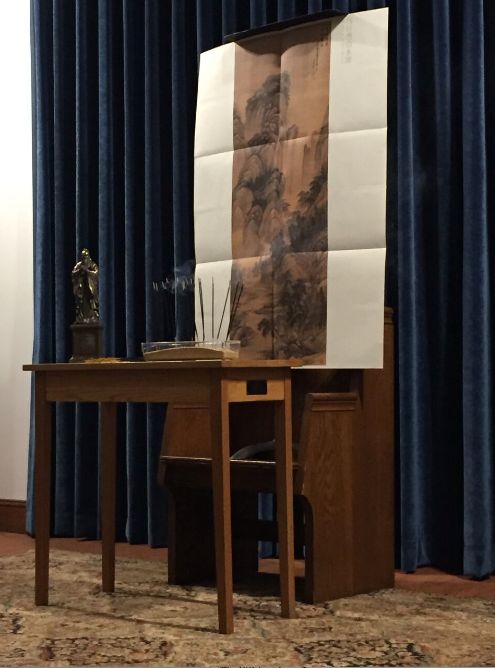
We tried to make the set-up of the ritual simple, since simplicity and authenticity are a consistent concern which traditional Ruist rituals convey. The set-up of the ritual looked like this:
We used a Chinese landscape painting to symbolize Tian. It was hung out in front. Then, we placed a Confucius statue on a small table in front of it, and an altar in the middle for holding incense. The painting we chose was drawn by Wang Hui (王翚, 1632-1717 CE) during the early Qing dynasty. A digital version of it looks like this:
This painting was selected by courtesy of Yair Lior, as Yair, among all the friends who attended the retreat, is a Ru versed in Chinese art history. The ‘Tian’ which this painting depicts feels solemn and energetic. In choosing the painting, we made sure that it was one which included Heaven, Earth, and Human Beings, since these three are the constitutive co-creators (三才) within Tian. In future, we have a plan to choose some western landscape paintings to symbolize the same Tian. This is because Tian’s creativity is all-encompassing, whether in the East or in the West, and one major concern of the participants of the retreat was how to share the Ru tradition’s wisdom and experience with fellow Americans.
The performative act of the ritual was also simple. At the beginning of the ritual, a Presider held two sticks of incense, bowed to Tian three times, and then stepped aside a bit, and bowed to Confucius once. After this, the Presider placed the incense in the altar, and then handed another couple of sticks to a second Ruist friend. After all friends had completed their celebrations, we stood in a line facing the altar, meditated for a while, and then completed the ritual.
There is no strict meaning for the numbers mentioned above. Neither does any step in the sequence have to be rigorously followed. After the Presider has performed the ritual, each friend can follow it in his or her favorite way: bowing to Tian but not bowing to Confucius, or as we elected to do during the retreat when some friends didn’t feel comfortable performing a religious-seeming ritual, giving them the option to wait in the reading room during the entire event. In a word, the performance of this suggested ritual is entirely voluntary.
However, because I was lucky enough to be supported by friends to act as Presider of the ritual, I tried to endow a Ruist meaning in my mind at each step of the ritual. Once again, these meanings were my own interpretation, and they are heuristic, and not in any way prescriptive. Future practitioners will surely choose whether to follow my interpretation or not according to their own understanding of the Ruist tradition. Here was my thinking:
I used two sticks of incense to symbolize Yin and Yang, the two most basic forms of cosmic reality in the Ruist cosmology. In this way, holding two sticks of incense while bowing to Tian symbolized that Tian is an even higher cosmological concept than Yin and Yang, since the power it refers to creates everything in the universe including these two realities. I bowed three times to Tian because, as I mentioned earlier, Tian includes three parts: Heaven, Earth and Human Beings. This trinitarian idea of Tian in Ruism underpins the Ruist commitment to Tian as both ecological and humanistic.
We all bowed to Tian in front of the statue of Confucius because we wanted our celebration of Tian to witness to our common teacher Confucius, who taught us to treat Tian as what is ultimately meaningful and powerful, that is, what is transcendent for human life. Each friend may also choose whether or not to bow to Confucius after bowing to Tian depending upon how comfortable he or she feels about bowing to a statue of a human being.
In conclusion, what I have set out in this essay is the totality of the new Ruist ritual of Tian-worship and Confucius-veneration performed during the first retreat. The effect of the performance, I have to say, felt good and appropriate. Friends told me that it was simple and felt authentic. Their feelings toward Tian and toward Confucius were expressed and enhanced. In this way, they also felt more at home in this beloved Ru community and in the more than 2,500 year-old living Ru tradition.
One of the most perplexing aspects of Confucianism is that people easily misunderstand it as a 100% humanism. An example is that, when early Jesuit missionaries went to China and found Zhu Xi’s Neo-Confucianism of “Pattern-Principle” (理)and “Matter-Energy” (氣)was taken to be orthodox by Confucian elite, they categorized Confucianism as a form of “atheism” and thus, thought it deeply corrupted.
In Christianity, even love towards one’s neighbors is ultimately driven by divine grace. That means it is God who commands and makes us love our neighbors. However, because Confucianism lacks this kind of “divine agency” concept, it is very hard for Confucians to say when we love our parents and kids, it is ultimately and exclusively “Heaven” (天) who drives us towards this love.
The divergent situation is that Heaven in Confucianism is an all-encompassing constantly creative cosmic power. It lacks the Christian feature of “agency.” The Heavenly creation is spontaneous, natural, and if we use a term in modern control theory, it can also be self-organized in certain circumstances such as on the earth, but there is no guarantee that every creation of Heaven is ordered according to human expectation. Since Heaven is constantly creating, the essence of human beings, as an organic part of Heaven, is also constantly creating. This constantly creating human nature is named by “Ren” (仁) in Confucianism. An impressive allegory made by Neo-Confucianism is that this human nature “Ren” embodied in humans is like the “kernel” (果仁)contained in the nutshell (果壳), so represents the essential of life. But what is distinct in Confucianism is, Heaven provides the creative energy to human beings, but how humans, as an “agent”, use this energy is solely due to themselves.
As a matter of fact, when Confucians feel united with Heaven through an arduous process of self-cultivation, they would love a myriad of things under Heaven. But in this mystical situation, we can say, the great body of ours which we form with Heaven makes us want to love, but how to love concretely is still exclusively due to ourselves. In this way, the idea of “Heaven” as the divine reality in Confucianism provides ultimate axiological and aesthetic motives for humans’ universal love, but it can’t provide the “agency” which is the last crucial link leading to a concrete action of human love.
In this sense, it is wrong to characterize Confucianism as an “atheism”, since “Heaven” is indeed the divine reality which provides the ultimate axiological and aesthetic values to human deeds. But it is not a “theism” too, since “Heaven” is not a personal God and lacks the Christian-like “agency”. In fact, It is a non-theism. What Confucians worship about “Heaven” is a benevolent but wild cosmic creative power, without any anthropomorphic sort of purpose, will or plan. Correspondingly, the Confucian humanism is a non-theistic humanism, and in this strictly defined sense, it is a spiritual humanism.