My Ru Pedagogy (II): Video Production

The goal of the 21st century’s liberal arts education should be to cultivate tech-savvy gentlemen and gentlewomen. For this purpose, I assign students in my course “History of Modern Philosophy” (PHL 214, Washington College, 2019 Spring) to produce a 3-4 minute instructional video in tandem with a 1000-1500 word research paper as their final project. The video takes prospective students in the course of “introduction to philosophy” as its primary audience, and it is essentially an introductory material shortened from the producer’s more detailed research paper.

As a Ru practitioner, I am intensively concerned with how to guide students of similar interest in the college to form a campus wide learning community, and for the purpose, I think instructional videos with an introductory level of content will be a powerful conduit to the construction of the envisioned community. The assignment’s efficacy in this regard is mainly manifested by the following aspects.

(1) The content of the video is a simplified, introductory version of a corresponding research paper. Since the production of video runs parallel to the process of writing a research paper, the two components of the same assignment can constantly feedback each other, which creates a wealth of opportunities for students to team-work with classmates, librarians and their instructor. For example, a pre-production oral presentation of the research topic in the class, and a post-production peer-review workshop on the editing of video images will significantly increase the chance of communal engagement.

(2) Submitted videos can be shared in future courses of similar topic for the following two major uses: one, beginning learners of philosophy usually find difficulty in reading philosophical materials. An instructional video casted by one’s schoolmates will be very helpful for these new beginners to get a quick orientation while accessing to unfamiliar philosophical writings. Two, instructional videos are a powerful medium to facilitate discussions in the classroom. Students can watch separate videos with related content, learn new materials, and then, share their knowledge with each other, or watch the same video and debate their understandings on the same material. This will also make students clearly realize that the audience of their academic output, such as research paper or video, are the entire college learning community, which will significantly motivate their engagement in the class. Needless to say, an excellent opportunity is therefore created for those student-producers to cultivate a more tech-savvy presentation and communicative skill fit for this new digital age.

(3) Submitted videos can be used in the courses of other faculty members in varying disciplines. This can significantly enhance collaboration among colleagues.

(4) Submitted videos can be used broadly in extra-curricular activities. For example, it can be used for the purpose of admission into the college, and can also be posted in the website of the corresponding department to increase people’s disciplinary awareness.

Here are some examples of the final products of this video project. (The posting of them has been permitted by their student-producers)

Ms. Elizabeth Lilly (Washington College, 21′) explains David Hume’s ideas of moral sentimentalism.
Mr. Mason Drummey (Washington College, 22′) explains his understanding of John Locke’s ideas of religious toleration and the separation of church and state, and presents his view on the role of religion in modern society.
Using Hume’s idea of moral sentimentalism, Ms. April Jones (Washington College, 21′) explains why the legitimacy of the legal concept of “voluntary manslaughter” should be challenged.
Mr. Jason Economidis (Washington College, 22′) uses George Berkeley’s empiricist philosophy “to be is to be perceived” to explain the movie “The Matrix.”
Mr. Harry Redding (Washington College, 21′) is inspired by David Hume’s and Immanuel Kant’s epistemologies to construct his own theory of developmental psychology.

Are they all awesome? Absolutely Yes!
My Ru Pedagogy (I): The Discipline of Body

Ruism (Confucianism) is a comprehensive way of life. To be a Ru, you cannot only be good at reading, arguing, and writing, but also doing and practicing. Think about the “six-art” curriculum  in Confucius’ school: ritual, music, archery, charioteering, calligraphy, and applied math. From the very first beginning of their school, Ru must have done a lot of things during the process of learning. In order to manifest this holistic spirit of cultivation and education, I have students demonstrate their favorite body practices, and explain them using Ruist philosophy in my 2018 Fall course of “Introduction to Confucianism/Ruism” at Washington College. Here are some examples. 

Patrick plays flute to explain why one wrong note in one melody could be the right one in another. Therefore, no emotion is inherently wrong, and the thrust of good human life is to express each emotion in its due measure, as it is taught by the Ruist text of  “Centrality and Ordinariness” (Zhong Yong).

Patrick’s Explanation of the “Due Measure” of each note in a harmony.

Patrick has a full performance of a beautiful melody. And he furthermore explains that this practice is particularly good for him to cultivate the Ruist virtues of ritual-propriety (禮, li) and harmony (和, he). 

Sometimes, you can close your eyes, let the notes flow themselves, and you are really in a meditative mood at this moment. Patrick says this helps him a good sleep, to re-gather the “night-energy” mentioned by Mencius. 

Stell chooses to play the art of Poi. (Frankly, I never knew this before!) He does a fantastic explanation on how the practice can embody the Ruist idea of li (理, pattern-principle)! You can see he draws charts on the whiteboard to explain there are natural patterns for the movements of the Poi and human body. What a performer does is to recognize and reconnect to these pattern-principles so as to make the entire person merge into the art-performing activity, and from that, merge into the surrounding natural energy, which he called “Tian” (天, heaven). How Ruist this is!

Stell also has a mind-blowing performance of “colorful Poi” in the dark, with his chosen music!

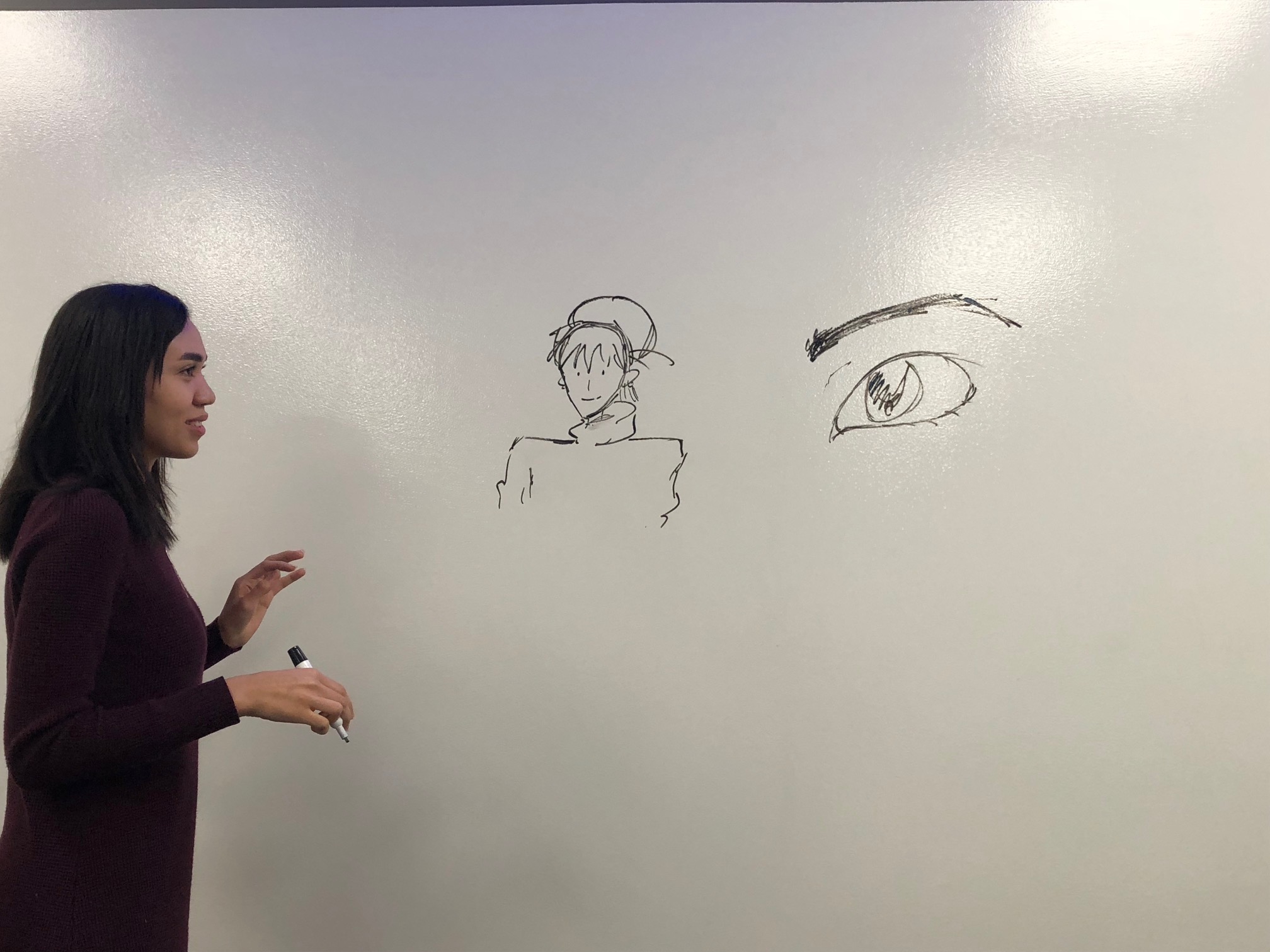
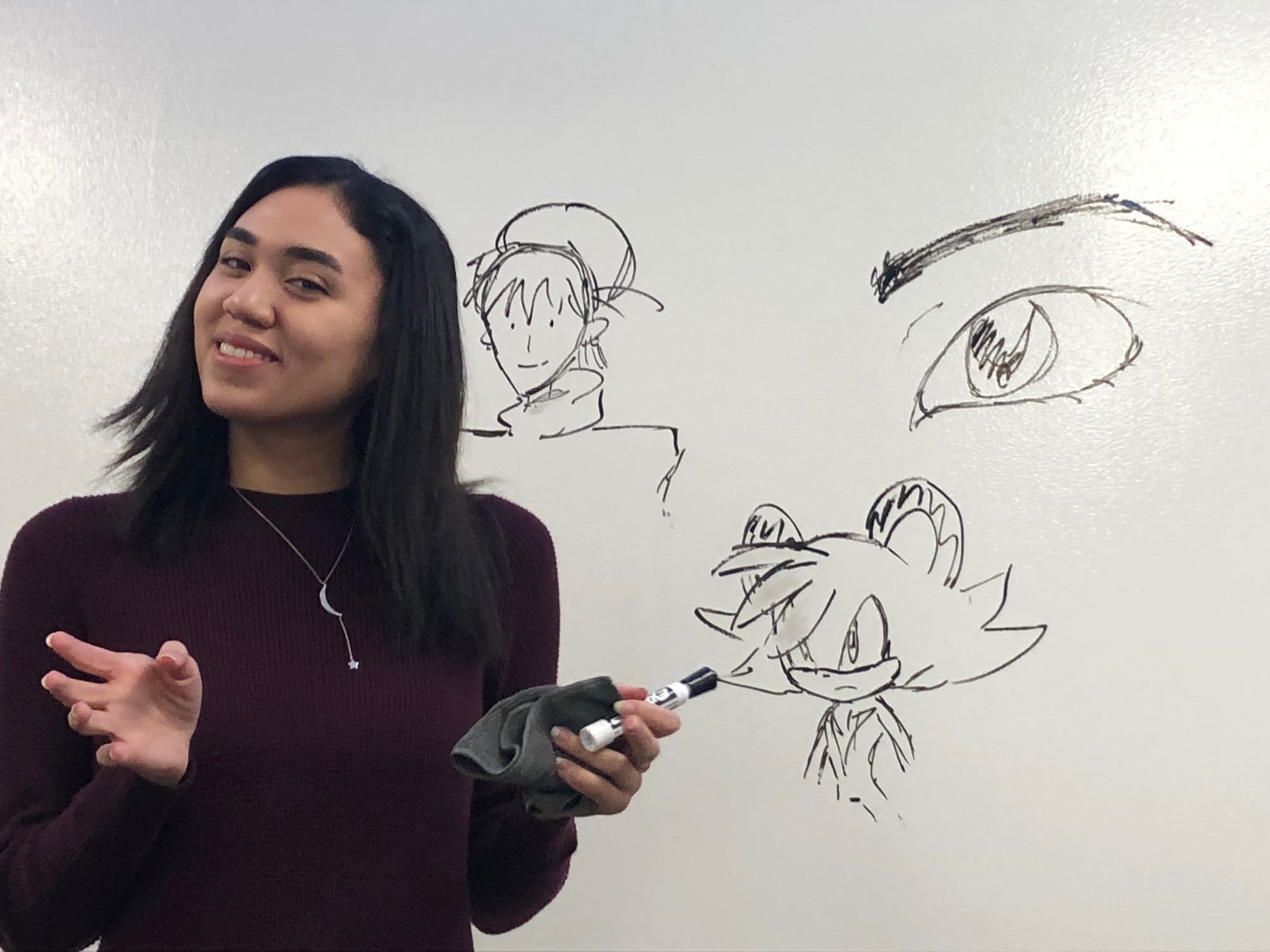
Bethy chooses to draw pictures on the whiteboard. She says she began to do this from 3 years old, and it ever since became the most effective way for her to recharge during busy times of the day, and then re-engage the ordinary world. She mainly uses  Xunzi’s idea of learning to illustrate why this is connected to Ruism. Finding the right teacher, learning in a community, and knowing the history of art, all of these lead to how she perfects herself through perfecting her drawing. Isn’t it beautiful?

Jenny is a double major in Chemistry and Philosophy. She is one of the most brilliant students in the class, and it seems she naturally grasps all those key Ruist concepts. What is more amazing is that she seems to have been practicing Ruism for a long time even before she learns anything about it. She demonstrates how she did “everyday positive quiet-sitting” (her own title of it) and used journal writing to remain focused, mindful, and positive everyday. 

Jenny is quiet-sitting
Jenny’s journal page. 

I told Jenny that Journal-writing is a powerful way of self-cultivation which is very popular among Ru practitioners, from ancient times to today. We didn’t discuss this topic in the class, and Jenny just broaches it by herself!

So, these are all the great examples of body demonstration which we conducted in our course today! I am so proud of these students and feel extremely happy!

Bin Song. 12/04/2018