Thoughts on the Day of 2026 Commencement

Governor Hogan delivered a speech that I found particularly meaningful. He mentioned that as a governor of Maryland, he once worked in the space directly above the original conference room where George Washington had worked. He also noted that Washington College was the first college chartered after the establishment of the United States, and that Washington himself was the founder of the college, personally granting his name to the school. Hogan, a notably bipartisan politician, also announced the formal establishment of the Larry Hogan Institute at Washington College for nurturing future generations of young leaders.

All of this made the workplace of students, faculty and staff feel meaningful, and meaning itself is a scarce resource in our time. During the late Qing dynasty, some Confucian/Ruist officials were sent to the United States to study its political institutions. After learning that George Washington relinquished power and declined kingship after winning the Revolutionary War, these Ru scholars compared him to ancient sage-kings such as Yao and Shun, who abdicated power to the most virtuous members of the next generation rather than keeping it within their own family. We often see a person’s true character when they possess power, and I still believe this historical resonance reveals something important.

What I most want to reflect upon, however, is the students whom I have taught and interacted with over the years. This year has been especially strong in terms of recommending students to graduate programs. I wrote four recommendation letters for Washington College undergraduates applying to graduate school: one to a university near Seattle for clinical psychology; another to a university in Pennsylvania for higher education management, particularly athlete management and coaching; a third to law school at Capital University in Ohio, after receiving multiple offers; and a fourth to the PhD program in education at the University of Hawai‘i. This fourth case involved a former Washington College undergraduate who applied after completing her master’s degree at another university. 

In previous years, I have successfully recommended students to graduate programs in law, information science, psychology, and other fields. But this year, because there were four such students, and because several of them shared their decisions and news with me during the commencement ceremony itself, I felt especially joyful about both the timing and the number.

Whenever I receive a request for a recommendation letter, I return to the assignments students submitted, reread my feedback and their grades, and only then begin writing the letter with as much care and detail as possible. At a small liberal arts college like ours, my knowledge of students also tends to deepen through unhurried conversations both inside and outside the classroom. Honestly, this makes me happy, even happier than receiving a promotion or an award myself. This is probably the best part of being a teacher: seeing students with whom one has worked closely move toward success.

Another point worth noting is that, although most of these students are not pursuing graduate study in philosophy or religious studies, all of them took my philosophy and religion courses at different stages of their college education. Many also majored or minored in philosophy or religious studies. From my observation, these students possess remarkably clear visions of what they want to pursue in graduate school. Their chosen directions are highly specific, and when faced with multiple offers, they make decisions with a strong awareness of both their aspirations and their strengths. In most cases, these students choose professional programs as their direction of graduate study, and in America, this often provides a strong foundation for a stable middle-class life. 

I believe this is one of the underappreciated achievements of liberal education at an American-style liberal arts college. Serious and hardworking students often develop a profound self-awareness that undergirds both their career choices and broader life development. This is not surprising, since small classrooms nurture depth of individuation, while the relatively abundant institutional resources available to each student allow them to explore and cultivate different intellectual and personal possibilities. Compared to technical skills alone, I believe this kind of self-awareness will accompany and benefit them throughout their lives.

Mencius once said: “A person of virtue has three central joys, and bringing the kingly way of governance to all under heaven is not among them.” A person of virtue (君子) remains cautious about political power because of the elevated position it confers. Instead, among the three joys, Mencius says: “To gain fine talents from all under heaven and educate them—this is the third joy” (7A20, my translation). Mencius’s thought resonates deeply with Hogan’s speech, and also with my own joyful feelings today. Perhaps this final quoted sentence should serve as the subtitle of today’s post.
My Ru Pedagogy (II): Video Production

The goal of the 21st century’s liberal arts education should be to cultivate tech-savvy gentlemen and gentlewomen. For this purpose, I assign students in my course “History of Modern Philosophy” (PHL 214, Washington College, 2019 Spring) to produce a 3-4 minute instructional video in tandem with a 1000-1500 word research paper as their final project. The video takes prospective students in the course of “introduction to philosophy” as its primary audience, and it is essentially an introductory material shortened from the producer’s more detailed research paper.

As a Ru practitioner, I am intensively concerned with how to guide students of similar interest in the college to form a campus wide learning community, and for the purpose, I think instructional videos with an introductory level of content will be a powerful conduit to the construction of the envisioned community. The assignment’s efficacy in this regard is mainly manifested by the following aspects.

(1) The content of the video is a simplified, introductory version of a corresponding research paper. Since the production of video runs parallel to the process of writing a research paper, the two components of the same assignment can constantly feedback each other, which creates a wealth of opportunities for students to team-work with classmates, librarians and their instructor. For example, a pre-production oral presentation of the research topic in the class, and a post-production peer-review workshop on the editing of video images will significantly increase the chance of communal engagement.

(2) Submitted videos can be shared in future courses of similar topic for the following two major uses: one, beginning learners of philosophy usually find difficulty in reading philosophical materials. An instructional video casted by one’s schoolmates will be very helpful for these new beginners to get a quick orientation while accessing to unfamiliar philosophical writings. Two, instructional videos are a powerful medium to facilitate discussions in the classroom. Students can watch separate videos with related content, learn new materials, and then, share their knowledge with each other, or watch the same video and debate their understandings on the same material. This will also make students clearly realize that the audience of their academic output, such as research paper or video, are the entire college learning community, which will significantly motivate their engagement in the class. Needless to say, an excellent opportunity is therefore created for those student-producers to cultivate a more tech-savvy presentation and communicative skill fit for this new digital age.

(3) Submitted videos can be used in the courses of other faculty members in varying disciplines. This can significantly enhance collaboration among colleagues.

(4) Submitted videos can be used broadly in extra-curricular activities. For example, it can be used for the purpose of admission into the college, and can also be posted in the website of the corresponding department to increase people’s disciplinary awareness.

Here are some examples of the final products of this video project. (The posting of them has been permitted by their student-producers)

Ms. Elizabeth Lilly (Washington College, 21′) explains David Hume’s ideas of moral sentimentalism.
Mr. Mason Drummey (Washington College, 22′) explains his understanding of John Locke’s ideas of religious toleration and the separation of church and state, and presents his view on the role of religion in modern society.
Using Hume’s idea of moral sentimentalism, Ms. April Jones (Washington College, 21′) explains why the legitimacy of the legal concept of “voluntary manslaughter” should be challenged.
Mr. Jason Economidis (Washington College, 22′) uses George Berkeley’s empiricist philosophy “to be is to be perceived” to explain the movie “The Matrix.”
Mr. Harry Redding (Washington College, 21′) is inspired by David Hume’s and Immanuel Kant’s epistemologies to construct his own theory of developmental psychology.

Are they all awesome? Absolutely Yes!

My Ru Pedagogy (I): The Discipline of Body

Ruism (Confucianism) is a comprehensive way of life. To be a Ru, you cannot only be good at reading, arguing, and writing, but also doing and practicing. Think about the “six-art” curriculum  in Confucius’ school: ritual, music, archery, charioteering, calligraphy, and applied math. From the very first beginning of their school, Ru must have done a lot of things during the process of learning. In order to manifest this holistic spirit of cultivation and education, I have students demonstrate their favorite body practices, and explain them using Ruist philosophy in my 2018 Fall course of “Introduction to Confucianism/Ruism” at Washington College. Here are some examples. 

Patrick plays flute to explain why one wrong note in one melody could be the right one in another. Therefore, no emotion is inherently wrong, and the thrust of good human life is to express each emotion in its due measure, as it is taught by the Ruist text of  “Centrality and Ordinariness” (Zhong Yong).

Patrick’s Explanation of the “Due Measure” of each note in a harmony.

Patrick has a full performance of a beautiful melody. And he furthermore explains that this practice is particularly good for him to cultivate the Ruist virtues of ritual-propriety (禮, li) and harmony (和, he). 

Sometimes, you can close your eyes, let the notes flow themselves, and you are really in a meditative mood at this moment. Patrick says this helps him a good sleep, to re-gather the “night-energy” mentioned by Mencius. 

Stell chooses to play the art of Poi. (Frankly, I never knew this before!) He does a fantastic explanation on how the practice can embody the Ruist idea of li (理, pattern-principle)! You can see he draws charts on the whiteboard to explain there are natural patterns for the movements of the Poi and human body. What a performer does is to recognize and reconnect to these pattern-principles so as to make the entire person merge into the art-performing activity, and from that, merge into the surrounding natural energy, which he called “Tian” (天, heaven). How Ruist this is!

Stell also has a mind-blowing performance of “colorful Poi” in the dark, with his chosen music!

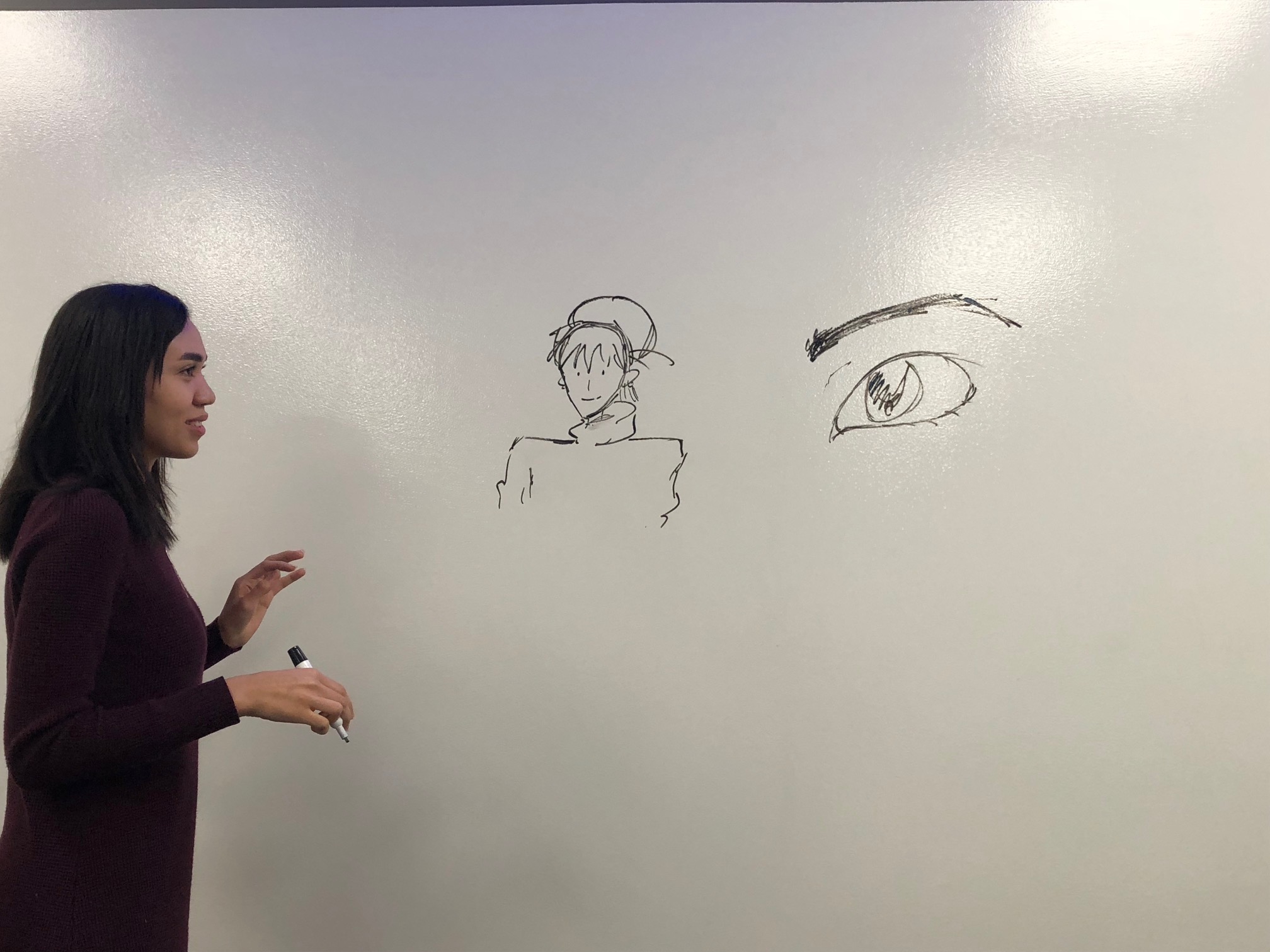
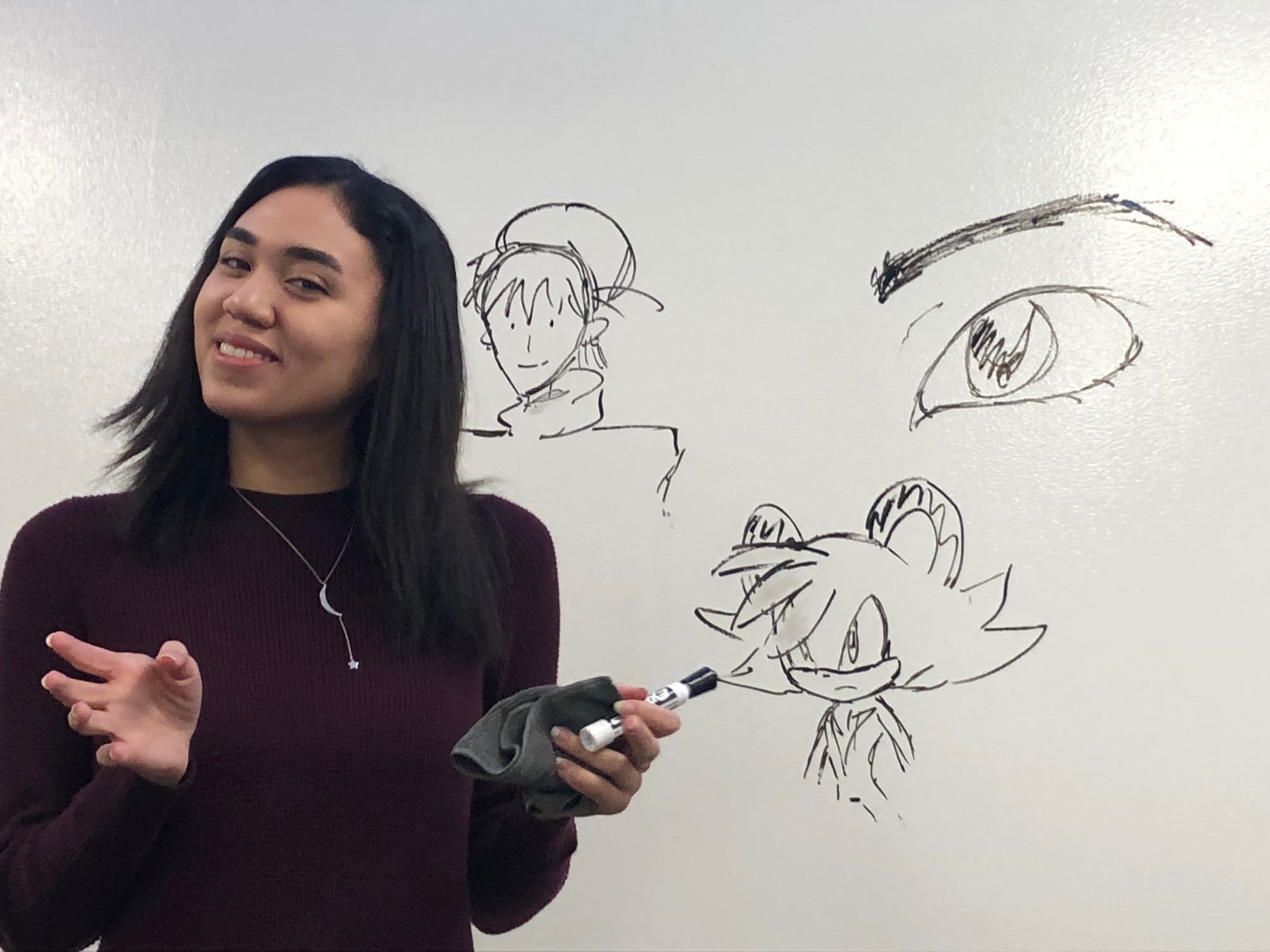
Bethy chooses to draw pictures on the whiteboard. She says she began to do this from 3 years old, and it ever since became the most effective way for her to recharge during busy times of the day, and then re-engage the ordinary world. She mainly uses  Xunzi’s idea of learning to illustrate why this is connected to Ruism. Finding the right teacher, learning in a community, and knowing the history of art, all of these lead to how she perfects herself through perfecting her drawing. Isn’t it beautiful?

Jenny is a double major in Chemistry and Philosophy. She is one of the most brilliant students in the class, and it seems she naturally grasps all those key Ruist concepts. What is more amazing is that she seems to have been practicing Ruism for a long time even before she learns anything about it. She demonstrates how she did “everyday positive quiet-sitting” (her own title of it) and used journal writing to remain focused, mindful, and positive everyday. 

Jenny is quiet-sitting
Jenny’s journal page. 

I told Jenny that Journal-writing is a powerful way of self-cultivation which is very popular among Ru practitioners, from ancient times to today. We didn’t discuss this topic in the class, and Jenny just broaches it by herself!

So, these are all the great examples of body demonstration which we conducted in our course today! I am so proud of these students and feel extremely happy!

Bin Song. 12/04/2018