
Hi, My name is Bin Song. I am a Ru scholar, therapist, and college professor in the disciplines of philosophy, religion, and theology. The audio is written and recorded by me to guide your practice of cross-legged quiet-sitting Ru meditation.
And this will be the second among seven postures of Ru meditation that I intend to introduce through this series of audio broadcast.
The posture of cross-legged quiet-sitting originates from ancient Hinduism, and migrates to China following Buddhism in around the 2 century C.E As I mentioned in last audio, the attitude of the majority of Ru scholars towards this posture in the beginning was to resist it, or simply not practice it. The major reason is that this posture was normally practiced by monks and nuns in monasteries in a very isolated way at that time, and Ruism in general opposes social disengagement and isolation.
However, in time, Ruist scholars started to practice and were quite fond of this posture. There are two major reasons for the change of their attitude:
(1) Firstly, although social engagement is a central commitment for Ru ethics, this ethic does not preclude those scholars or scholar-officials from enjoying leisure, ease or simply having a quiet time to regather and recharge from their busy life schedules. This means that when the time and situation allows, it would not be a bad idea to have a more extended period of time to practice quiet-sitting in a more intensive way. In this case, the already very popularized cross-legged Buddhist meditation became a readily available option. In the more developed stage of neo-Confucianism, around 16-17th century, Ru scholars like to organize local meditation groups to go into mountains for an extended period of quiet-sitting retreat, and during these retreats, the cross-legged posture was frequently practiced. Another good time to practice cross-legged quiet-sitting is during night and before one’s sleep. At this moment, all those busyness and agitations during one’s daytime cool down, and one’s mind does not need to think about any particular thing other than finding ways to enter a sound and deep sleep. In this way, a cross-legged quiet-sitting on one’s bed will be a very beneficial practice to prepare one’s deep sleep.
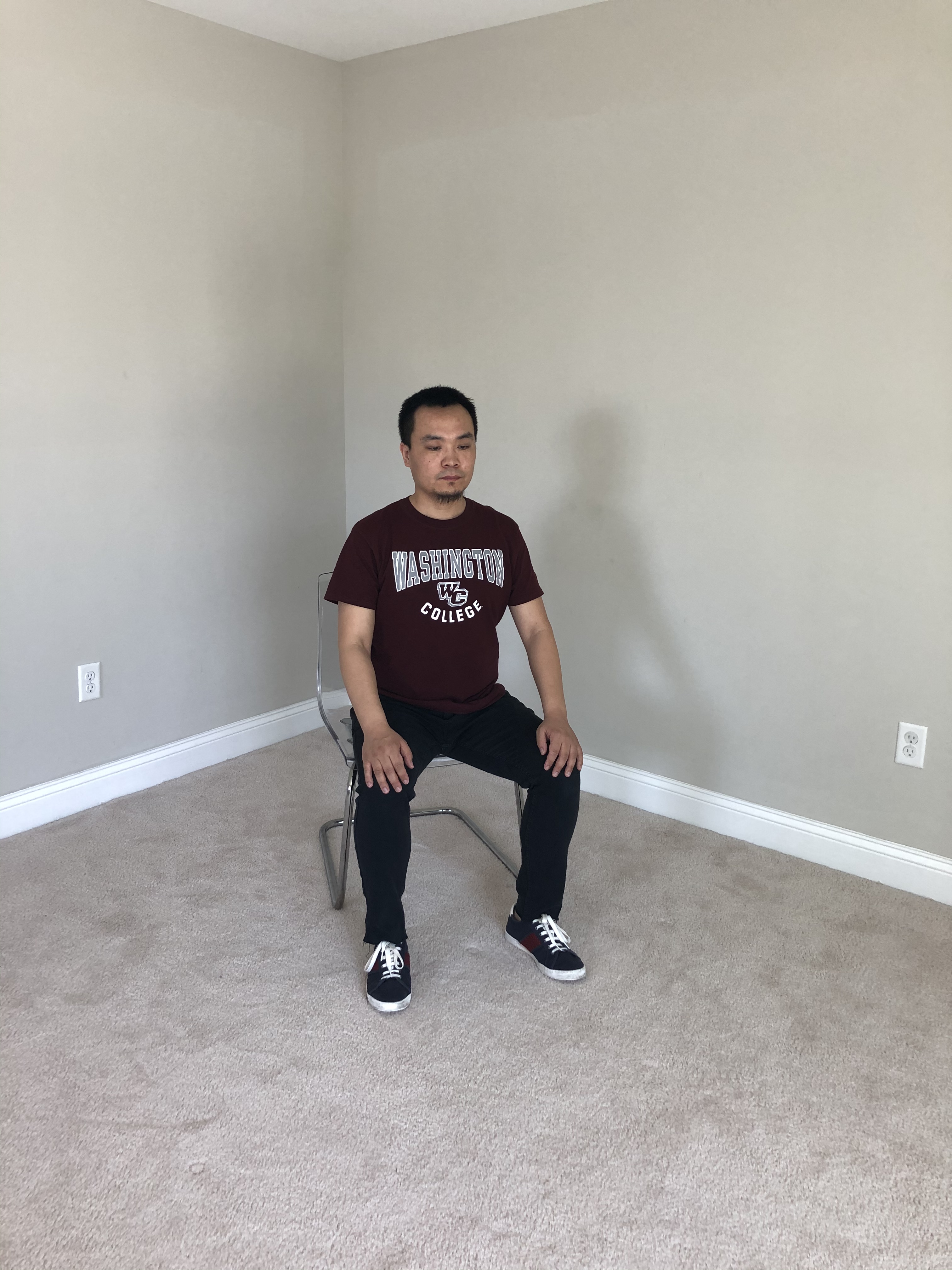
(2) Secondly, Ru scholars found that compared to quiet-sitting on a chair, the cross-legged posture puts human body in a more concentrated position, which will modify how the breathed air circulates and moves in their body. Their experience indicated that the practice of this more concentrated posture can help to mitigate or cure certain diseases. Since I have practiced this posture for many years, I would like to use some of my personal experiences as examples to explain it, although you can also find plenty of evidences from writings by those Ruist scholars in history.
[convertful id=”36168″]
I am right now 38 years old, and have practiced double-cross-legged quiet-sitting Ru meditation for one decade, and it helped me to mitigate or cure diseases such as insomnia, sleep paralysis, stomachache, toothache, and asthma, among many other benefits to enhance my mental health and general well-being. Let me tell some brief stories, so you can get a sense of what the therapeutic effect of meditation looks like.
When I am 20s, I was a very bad sleeper, and suffered a lot from sleep paralysis and insomnia. When my mind was too stirred and occupied, I normally woke up but could not move my body, and this is called a disease of sleep paralysis. One of the worst cases of sleep paralysis I suffered happened during my sophomore year in college, when I tried to read intensively the very abstruse and obscure Chinese translation of German philosophers. And I clearly remembered that is Schopenhouer and Nietzsche. I tried very hard to do the reading, exhausted my brain, and just couldn’t fall asleep, and even couldn’t get up when I finally fell asleep. I had to withdraw from my college to stay at home for about two weeks. During that two weeks, I did nothing but watching TV, and drinking coca cola to temporarily recover from it. After that, I made three decisions, firstly, never read Chinese translations of German philosophy any more; secondly, read ancient Chinese philosophy more; and three, start to learn and practice meditation. As mentioned, after many years of meditation practice, I am an extremely good sleeper now. The sleep paralysis completely disappeared, and even a small cup of coffee during the night would not deprive me of any sleep. And I sleep faster, and shorter than most of my family members. For instance, I started to sleep around 10:30 pm yesterday, and am sitting right now on my desk to write this transcript starting from around 6:30 am. This is my normal life schedule and I feel great about it because of the sleep quality I get.
Scientifically speaking, I find the reason why meditation practice can elevate sleep quality is that the frequency of electro-magnetic wave that is exuded from our brain when we enter the deeper level of meditation is very similar to the one when we are in deep sleep. So, a practice before sleep is actually to exercise our brain to prepare it for deep sleep. However, sometimes, we can also become super energized and super awake because of the practice of meditation before sleep. If this happens, it just means that we have extra energy in our body to move and to act, so my solution is usually to get up again, do some reading, writing, or some other household stuff so as to get back to sleep later. Believe me, you will not feel exhausted by this as long as you get the needed sleep in time. However, for professionals and busy people, this state of extra energy doesn’t happen quite often, so you do not need to worry too much about this side effect of the practice of quiet-sitting before sleep.
Cross-legged quiet-sitting meditation also helps to greatly mitigate my asthma in the spring of 2017. I was in the graduate school to pursue my second PhD of religious studies in the U.S. at that time. My life was extremely stressed by writing the dissertation prospectus and trying to get it passed. Because of the high work pressure and also the changing spring weather, I caught a cold, and it developed into a bad asthma that I never had before. Apart from ordinary medications provided by my doctor, I continually practiced cross-legged quiet-sitting when the symptom of asthma got worsened. The deep, delicate and very effective deep breathing during the process really helped a lot. Fortunately, I never caught a similar asthma after that. But for people that have a chronic issue of respiratory disease, I would highly recommend the practice as a supplementary therapy.
The third example I will raise is pain control. I have great experiences to quickly mitigate my acute pains using the method of cross-legged quiet-sitting in the case of stomachache and toothache. Let me describe the case of stomachache here. My body recently succumbs to a habit of stomachache during the few weeks when fall changes into winter. During this time, whenever I eat something that is not hot or warm, my stomach just feels uneasy about it. I tried to change my diets, and added some new elements of food to avoid the pains. But sometimes, the pains just happen suddenly and intensively without any prior sign during night. Last fall, I had two very bad scenarios when I had to wake up during the middle of night from excruciating stomachaches. After I went to bathroom to do everything possible to control the pains, eventually of no avail, what I remained to do is to double-cross my legs, focus upon my breathing and my lower abdomen, and start to practice quiet-sitting. What surprised me is that after practicing it for a while, it feels like a very warm pair of hands are doing a deeply healing massage to my belly, and after some time, the pains disappeared completely. This happened twice to my body in the same season! What is interesting is that I read similar stories by ancient Ruist scholars when I did researches on Ru meditation, but when it actually happened to my body in almost exactly the same manner, it just caused a great feeling of marvel.
Scientifically speaking, pain control due to meditation practice is actually starting to be evidenced and researched by scholars in varying traditions and in varying disciplines. Apart from the physical massage that our body is doing to itself due to deep breath and the specific meditative posture, the mechanism why meditation can control pains, I think, is similar to why hypnosis can also do the same job. When we meditate deeply, our attention is more extensive, deeper, and more focused. As a result, our whole span of consciousness, including sub-consciousness, will be modified to alleviate the sensory and affective component of the acute pains. I do not believe that we can completely eliminate the physical cause of our pains all together using meditation; but given my experience and my research, I am certain that it does have this effect of mitigating acute pains.
Good, enough examples for the second reason why cross-legged quiet-sitting was practiced by Ruist scholars. Let me talk of its method.
There are seven major points of the method. Because the upper body part of the posture will be almost the same as quiet-sitting on a Chair, I would not use too many words to explain this part.
- Cross you legs. This can be done in multiple ways. You can cross your feet and put them under your legs. You can also put either of the feet upon the thigh on the other side. This is called single-cross-legged quiet-sitting. The most difficult one for most of people is that you double-cross your legs. You will put the back of your right foot on your left thigh, and then, put the back of your left foot on your right thigh. This most difficult one has two orders: either your right lower leg is over the left one, or your left lower leg is on the right one. The pictures I show beside the audio is how I do double cross-legged quiet-sitting. If your body is not flexible enough, you will find it very hard to cross any leg to do this quiet-sitting posture. In this case, crossing your two feet and put them under your legs will be normally an easy start. Please do not worry over the fact that you cannot cross your legs. When I started to practice this posture, I cannot double cross my legs either. However, I singled cross my legs, and practiced it for a long time. One day, and I clearly remembered that was a day when I went to swim during the spring of 2010, I sat on the bench beside the swimming pool, and suddenly, I can double-cross my legs. And the story continues, in the beginning, I can only let my left lower-leg over my right one. But in time, I can do the other way as well. So, for beginning practitioners, do not worry about whether you can pursue the most difficult and concentrated form of cross-legged quiet-sitting meditation. As long as you persist in practicing in whatever posture fit for you, you will always get benefits of it, and one day, you can command all available postures.
- Put a cushion under your butt, so as to make your butt a bit higher than your knees
- Make your backbone naturally stacked-up. No pop-up nor slouch of your chest.
- The Head naturally lines up with your back up.
- Eyes closed or leave a slice of vision open broadly.
- This is slightly different from the one of the quiet-sitting on a chair. Since you can sit for relatively a longer time using this cross-legged posture, you can close your mouth, let your tongue touch the gum of your upper teeth. In time, there could be some saliva gathering up in your mouth, and since the saliva is a liquid very smooth and delicate, letting it run down along your tongue, and then, swallowing it will furthermore lubricate your throat and other related parts of your body, which will feel very good.
- You can make your hands cupped, and put them below the lower abdomen. Or palms down, and put them on your knees. You can also put them in other places or use other hand gestures, as long as you feel comfortable. During deep meditation, sometimes you may feel you want to move your hands and arms a little bit, such as drawing some shapes or figures in the air; this is also completely normal. As long as you do it in the balance of discipline and spontaneity which I mentioned before, you can enjoy whatever you intend to do during meditation.
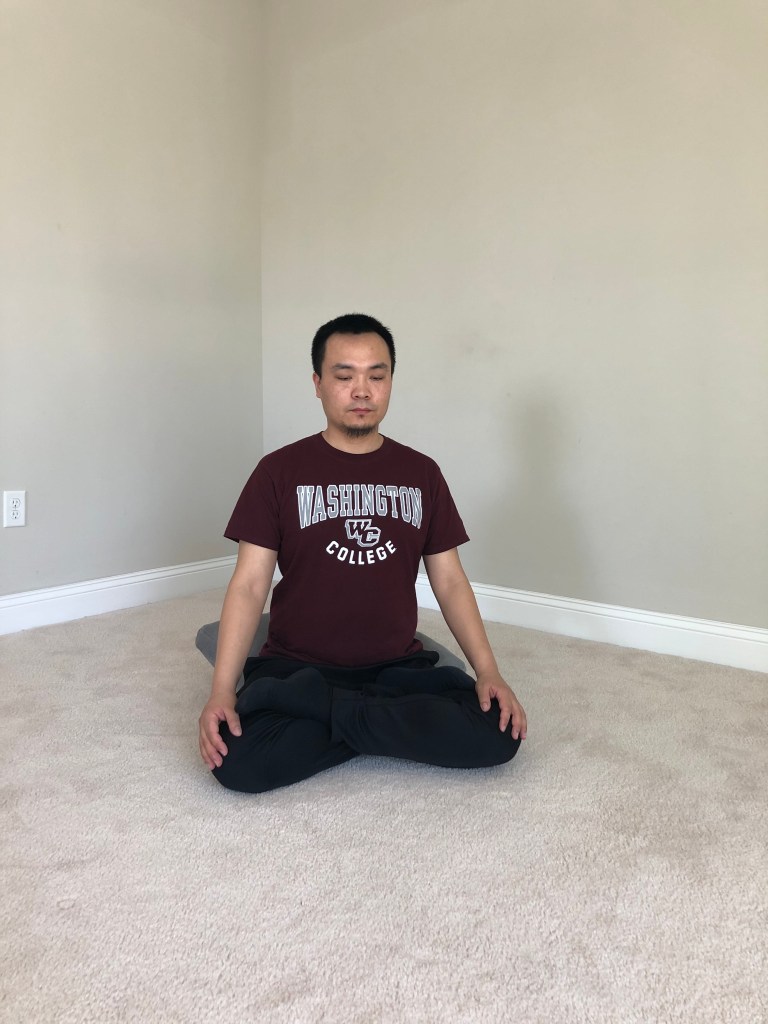
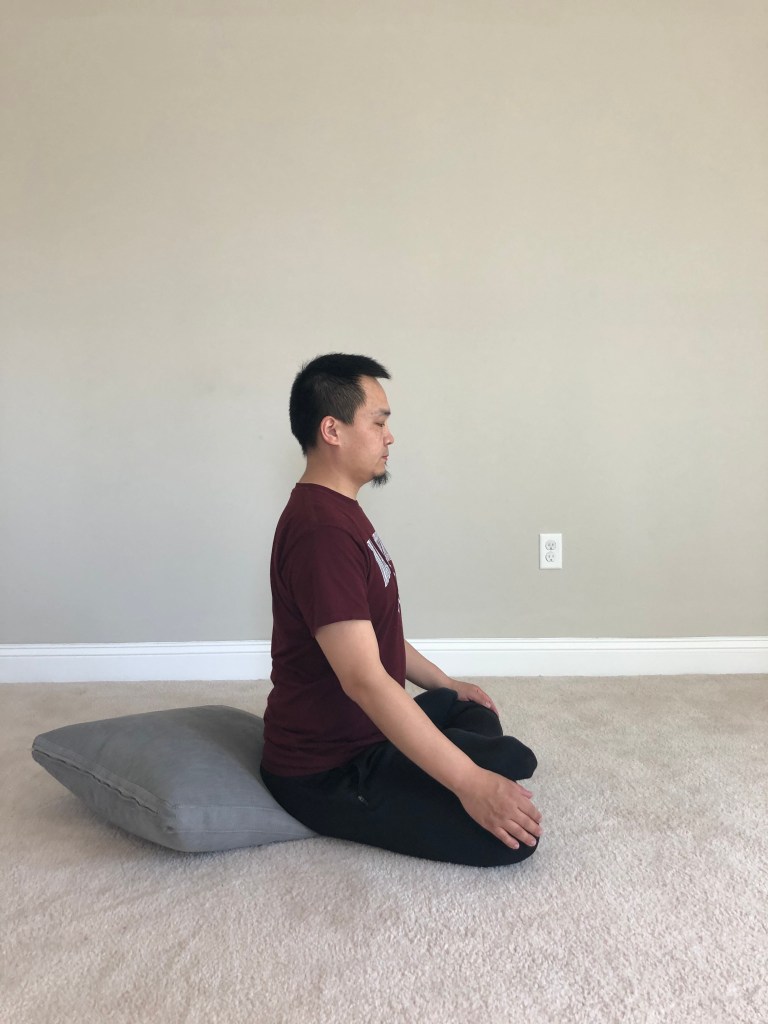
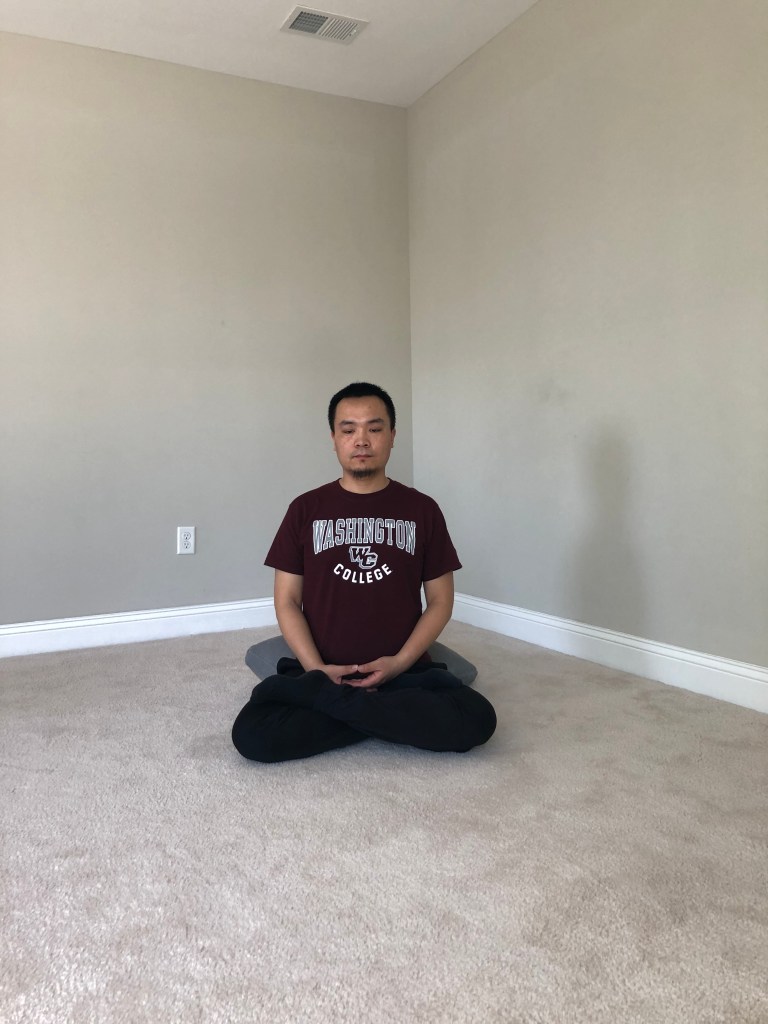
Ok, these are the seven major points of cross-legged quiet-sitting meditation. Several caveats before concluding this audio:
- Do remember to protect your joints when you do this posture of meditation, particularly your knees and your shoulder. They are the most exposed parts of your body during this posture. You can try to wear something or put a blanket on your legs if the temperature in the room is moderate or the outside weather is windy.
- Long meditation is less ideal than short meditation but with more times of practices each day. So a 15-30 minute practice for two or three times a day will be ideal for beginning practitioners.
Good, this is the end of this audio on cross-legged quiet-sitting meditation. I hope you have a nice day, and take care!


 Bin Song