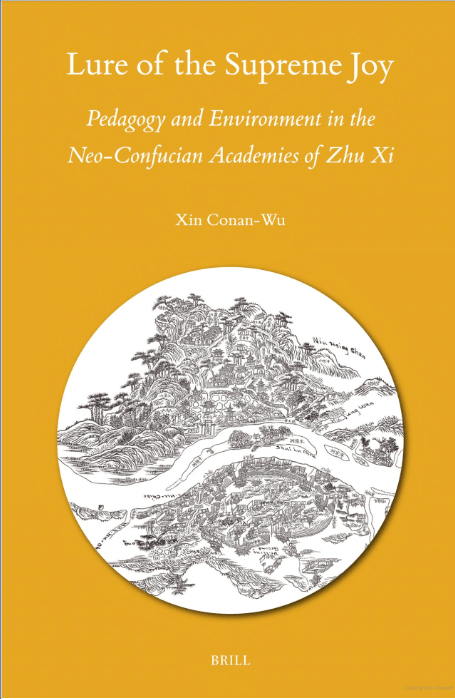
Song Reviews “Lure of the Supreme Joy: Pedagogy and Environment in the Neo-Confucian Academies of Zhu Xi” (By Xin Conan-Wu. Brill 2024) in the 2025, No. 80 issue of Journal of Chinese Studies.
Excerpt:
If Tian (天) is translated as “nature,” the upper-case Nature designates the broadest realm of being—one beyond which human imagination cannot reach. It encompasses the ritualized human world as an integral part of its order. When Zeng Dian immerses himself in this Nature, his excursion is neither solitary (as he “assembles a company of five or six young people and six or seven children”) nor detached from the human world (since the group “enjoys the breeze upon the Rain Dance Altar and then returns singing to their residence”). Rather, the harmonious, dynamic, and spontaneous unfolding of cosmic unity between human individuals and the totality of being gives rise to a profound sense of joy, ecstasy, and mystery—an experience from which a distinctly Ruist form of “religious experience” emerges. (p.236)
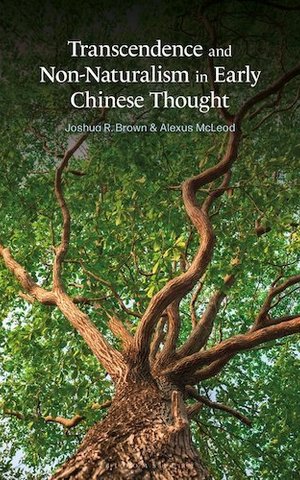
Joshua R. Brown and Alexus McLeod, Transcendence and Non-Naturalism in Early Chinese Thought, Bloomsbury, 2021, 245pp., $115.00 (hbk), ISBN 9781350082533.
To paraphrase Kant’s words on enlightenment, I propound that on the topic of transcendence and non-naturalism in Chinese and comparative philosophy, although we do not have a reckoned book yet, we finally have a book of reckoning.
Joshua R. Brown and Alexus McLeod discern two major reasons why scholars assume there is no robust idea of transcendence, and hence, take naturalism as an inevitable lens for interpreting early Chinese thought: Firstly, some of these scholars would like to find in early Chinese thought something that is different from the West, mainly from Christianity. Secondly, some of them would like to find in early Chinese thought something that looks the same as the West, viz., the same as the scientific and analytic mindset prevalent in Western academia since early modern Europe. Regardless, one common assumption has been taken by these apparently contrasting approaches: All these scholars take what is purported to be the West as a fixed and pre-established standard, and then read early Chinese thought against it. While doing so, they have overlooked other hermeneutical possibilities, firstly, that early Chinese thought may imply more than what comparisons via a set standard can tell. Secondly, the pre-established standard may itself not be adequate to the rich diversity and potentiality of Western thought. Therefore, what Brown and McLeod try to accomplish in this book is to prove there are a number of texts of early Chinese thought (such as the Chunqiu fanlu (CQFL), Xunzi, Laozi, Zhuangzi, Mozi, etc.) which can be interpreted fruitfully by means of a conversation with Western thinkers rich on transcendence and non-naturalism, such as Plotinus, Thomas Aquinas, Pseudo-Dionysius, etc. As a consequence, Brown and McLeod also urge the field of Chinese and comparative philosophy to pass the domination of “whether or not” questions concerning transcendence, and instead to ask more interesting questions such as “what these concepts were like in early China, what roles they played in both particular systems and broader swaths of the intellectual tradition, and in what ways early Chinese understandings of these concepts compare with those of other traditions.” (193)
I celebrate that, because of their sophisticated analyses of so many early Chinese texts, Brown and McLeod have accomplished their goal. One good example of this is how they argue the transcendence of the Dao in perhaps still the most well-known ancient Chinese cosmology to the West, viz., Laozi’s Dao De Jing. The text is frequently taken by scholars such as Roger Ames and Francois Jullien as the evidence par excellence that classical Chinese thought lacks the Western idea of hierarchical transcendence, since the Dao is interpreted by these scholars as a hidden force which unfolds within a single plane of being. In comparison, the Western conception of transcendence normally implies a supreme being on a superior plane of being which contrasts with the inferior ones.[1] However, Brown and McLeod argue: “Concepts of transcendence are meant to capture the idea that there are different orders of existence, some of which are outside of or in important ways not subject to the states and conditions of the orders of existence and the rest of the sensible world are subject to.” (185) They also believe that there are good reasons for interpreting Laozi’s Dao as indicating such a different order of existence. For instance, Dao is described by the initial chapter of Dao De Jing as “constant” (常), and therefore, although the Dao is surely a principle immanent to the process of growth and decay of worldly phenomena, we need to admit that “the process of growth and decay is not itself subject to the process of growth and decay.” (151) By the same token, the change of world phenomena is conceptualized by the Dao De Jing as being caused by the interaction between the yin and yang aspects of the Dao. However, yin and yang are “how Dao maintains the generation of the phenomenal world, but the process does not work in reverse.” (152) In other words, as causing the yin-yang change of the phenomenal world, the Dao itself cannot be changed by yin and yang in the same way things in the world are changed. All these analyses by Brown and McLeod demonstrate that Laozi’s Dao indicates significant traits of transcendence, even if these traits may not belong to the hierarchical, contrastive type of transcendence against which Ames and Jullien read Laozi.
Although the goal of the book has been accomplished, not all of the concrete interpretations of selected early Chinese texts are convincing. This is mainly because the five key concepts of the framework employed by Brown and McLeod for the interpretations — naturalism, non-naturalism, contrastive transcendence, non-contrastive transcendence, and non-transcendence — are either not clearly defined, or while being clearly defined, not consistently applied in the course of interpretation. For instance, after investigating the ambiguous connotations of “naturalism” in contemporary philosophical scholarship, Brown and McLeod conclude by treating “naturalism” more as an affiliation claim than as a marker of a substantive philosophical position, and hence define “naturalism” as “a commitment to standing with the sciences, to adopting views and constructing systems that are respectable from the point of view of the physical sciences and their practitioners, or at least do not directly oppose them.” (22) In tandem with this treatment of naturalism, they also define “contrastive transcendence” via a quote of Kathryn Tanner’s theological work: In contrastive theories of transcendence, “divinity and the rest of the world taken as whole are viewed as logical contraries within a single spectrum: this forces an a priori separation of the two.” (35) A non-contrastive transcendence of the divinity would underlie the entire spectrum of all beings in the world, and thus would imply that “divine involvement with the world need be neither partial, nor mediate, nor simply formative: if divinity is not characterized by contrast with any sort of being, it may be the immediate source of being of every sort.” (36) In other words, a contrastive transcendence characterizes ultimate reality as a supreme being which stands alongside worldly beings and imposes an imperial order of existence upon the de facto existence of those beings. However, a non-contrastive transcendence explains the origin of the being of the world. While being itself is ultimately unknowable and ineffable, such a ground of being does not dictate what the world is apart from the existing empirical order of the world. Instead, the empirical order of the world would be the only means by which humans can know such an ultimate ground.
Among all the three mentioned concepts, naturalism has not been clearly defined, although Brown and McLeod may have good reasons not to do so. However, according to the presented conceptual framework, we envision there could be a serious philosophical endeavor to construct a worldview which is both transcendent in a non-contrastive mode and naturalistic in the sense that what the worldview presents is compatible with modern physical sciences. This also means that when we discern robust themes of transcendence in early Chinese texts, we cannot infer ipso facto that they are non-naturalistic. However, the core commitment of a philosophy cannot be both contrastively transcendent and naturalistic at the same time. Unfortunately, I find that Brown and McLeod frequently combine these logically inconsistent concepts to interpret selected early Chinese texts. For instance, while analyzing CQFL, they conclude: “in the cosmology of the CQFL, tian is understood in terms governed by contrastive transcendence but the text concomitantly embraces what are apparently both naturalistic and transcendental aspects of tian.” (81) If Brown and McLeod were correct, the thought of CQFL would be incoherent since it is interpreted by them as advocating both the contrastive transcendence of tian, which impinges on the de facto order of the empirical world, and the naturalism of tian. The conclusion is surely worth debating. Similarly, while analyzing the Xunzi, Brown and McLeod say,
we think it is fair and accurate to interpret the Tianlun as defending some aspects of tian’s transcendence . . . Consequently, far from seeing Xunzi as a poor naturalist, we think it is better to interpret him as a very unique and interesting non-naturalist, whose conception of tian should be placed in conversation with other non-naturalist conceptions of the world and the divine. (113)
Readers would wonder why Xunzi cannot be simultaneously transcendent and naturalistic, since this is a reasonable combination according to the adopted framework.
While remaining sympathetic with their overall goal of the book, in the remaining part of this review I will try to perfect Brown and McLeod’s conceptual framework so as to pave a way for future scholars to more consistently and continually furnish novel and legitimate readings of the addressed early Chinese texts. The aforementioned five concepts can be refined as follows, and such a refinement would surely succumb to further critique.
I agree with Brown and McLeod that naturalism is a name of affiliation which speaks to one’s commitment to the concept of “nature” fashioned by modern physical sciences. However, as indicated by historians and philosophers of science such as Karl Popper, Imre Lakatos, and Geoffrey Lloyd, this name of affiliation also designates a marker of a substantive philosophical position on “nature,” which is predicated on the following two claims: Firstly, there is a set of orders which operates upon the totality of existing realities in the universe, and these orders can be discovered in the form of laws of nature via a bottom-up method of empirical observation and human reasoning. Whether these orders come from a deeper realm of being remains undefined by this concept of nature. Secondly, the set of orders is stable in the sense that these orders remain uninfluenced by unpredictable metaphysical entities, such as souls, spirits and other magical forces which may also exist among the realities of the observed world, and hence the discovered laws of nature are testable, falsifiable, and improvable so that the knowledge of nature can progress on the basis of accumulative human endeavors within scientific communities. Still, whether these unpredictable metaphysical entities exist and whether they come from another realm of being remain unanswered by this concept of nature. In a word, naturalism would refer to a worldview which either affirms or remains compatible with the two conditional claims: the order of the existing world can be discovered empirically via human reason, and the order is recognized as being stable in a certain degree so that derived laws of nature remain debatable. According to this re-definition of “naturalism,” the so-called naturalistic transition detected by Brown and McLeod in early Han texts cannot be assessed as strictly naturalistic, since as admitted by Brown and McLeod (84 and 92), the correlative cosmology of early Han texts enchants the world. Such an enchantment makes the world so full of omens, signs, and mysterious resonances among apparently unrelated things that, as pointed out by Joseph Needham,[2] the theories that are used by early Han thinkers to explain the worldly phenomena, such as the one of yin-yang vital energy and five phases, cannot be seen as laws of nature in the strict sense of modern physical sciences.
Non-naturalism would be a view of nature that denies the validity of either of the two conditional claims which naturalism as defined makes. This explains further why an enchanted worldview of early Han cannot be seen as fully naturalistic, since it complies with part of the first condition of naturalism, but is not compatible with the second.
A view of non-transcendence would affirm that the totality of existing realities in the universe has no origin other than themselves. I also agree with Brown and Alexus’s conceptions of contrastive and non-contrastive transcendence, and would furthermore indicate that this distinction is essentially the same as the one by which Paul Tillich distinguishes God as “a supreme being” from “the ground of being.” Consequently, a view of transcendence would aver that the totality of existing realities in the universe cannot explain the origin of themselves, and thus need another realm of being for such an explanation, regardless of whether this original realm of being is contrastive or not.
According to this refined conceptual framework, we can envision multiple possibilities of combination and be better positioned to interpret varying philosophies. For instance, both naturalism and non-naturalism can be non-transcendent. A non-transcendent naturalism would imply the self-sufficiency of the scientifically perceived world to explain itself, whereas a non-transcendent non-naturalism would present an enchanted world not supervised by a supreme deity, such as the one which may be envisioned by astrology, alchemy or other so-called pseudo-sciences. Furthermore, a naturalism could be non-contrastively transcendent. This would be the case when what a thing is gets explained by the de facto relationship among things, whereas where a thing comes from gets explained by another realm of being which does not impinge upon the empirical order of the existing world. However, naturalism cannot be contrastively transcendent unless the order implied by the divine realm of being remains compatible with the empirical order of the existing world. We cannot find an easy example of such a compatibility particularly in the Abrahamic religions, since the idea of a supreme God normally implies a divine plan which is conceived by God even prior to the existence of the world. Moreover, a non-naturalism could be either non-contrastively transcendent, when an enchanted world is said to derive from an ultimately ineffable God, or contrastively transcendent, when the enchanted world is thought of as being grounded within such a divine origin.
If we employ this refined conceptual framework to interpret early Chinese thought, we’ll garner new insights. For instance, CQFL would present a non-naturalistic view of the enchanted world with a contrastively transcendent Tian, which governs the world providentially. Laozi’s Dao De Jing presents a naturalistic Daoist view of nature with a non-contrastive transcendence, but such a view does not prioritize the role of human beings in realizing the cosmic Dao in the human world. However, the Xici (the Appended Texts of the Classic of Change) presents a naturalistic Ruist (Confucian) view of nature with a non-contrastive transcendence, which does prioritize the role of humanity in realizing the humane manifestation of the cosmic Dao. Moreover, the Xunzi presents a mainly naturalistic Ruist view of nature with a mainly non-transcendent view of Tian, because although Tian is still treated as being the evolutionary origin of existing things in the universe, humans are encouraged by Xunzi to utilize Tian to serve the flourishing of human society and, hence, to strip Tian of its divine depth. The view of Mozi would be both non-naturalistic and contrastively transcendent, since the text advocates both the existence of ghosts and the supreme status of Tian as a providential deity.
I would not claim that the refined framework is the right way to interpret early Chinese thought. However, concurring with Brown and McLeod’s urge to ask more interesting questions of Chinese and comparative philosophy concerning transcendence, I do think we need more refined comparative categories to treat both Western and non-Western thought with more respect, nuances, and novelties.
REFERENCES
Song, Bin (2020). A review of Apophatic Paths from Europe to China: Regions without Borders, by William Franke (State University of New York Press, 2018). Journal of the American Academy of Religion, Volume 88, Issue 1 (2020): 278-281. Needham, Joseph (1956). Science and Civilization in China, Vol. II (Cambridge University Press).
[1] For details of Ames’s and Jullien’s interpretations of the Daoist metaphysics in the Dao De Jing, please refer to Song 2020. [2] Needham 1956: 290.
I also reviewed this book from the perspective of interreligious studies in the Journal of Interreligious Studies, please click here.
This article reviews Shaun O’Dwyer’s latest book, Confucianism’s Prospects: A Reassessment (SUNY, 2019). By critiquing philosophical theories of “Confucian democracy” and their shared sociological assumption that Confucianism still functions as a cultural matrix for East Asian societies, O’Dwyer argues that visions on the future of Confucianism alternative to what the currently fixed institutional infrastructure of liberal democracy entails are flawed. This is mainly because if unconstrained by the infrastructure, the hardwired paternalism and elitism of Confucian ethics would necessarily impose morally taxing burdens upon a de facto pluralistic society. This article assesses O’Dwyer’s counterarguments to “Confucian democracy,” and proposes a different approach to estimate the prospects of Confucianism in the contemporary world.
Song, B. (2020). Is Confucianism Beneath or Beyond Ethics and Politics?. Journal of World Philosophies, 5(2), 200–205
It is a daunting task for me to review Li Zehou’s work, not least because while born in and always philosophizing about the same land, Li had entered his intellectual heyday in the 1980s when I was not yet a teenager. While reading Li’s work using Andrew Lambert’s stellar translation, I repeatedly asked myself: what is the difference between him and me regarding the approach to doing comparative Chinese philosophy? Why is there such a difference? What can I learn from him? And what inspirations can Li’s work generate globally. Since there are English resources[1] that introduce Li’s thought, I won’t dwell on those questions. Instead, I will critique Li’s philosophy as presented in this book.
One big difference between Li and me[2] is that I am no longer sympathetic toward any grand narrative of Chinese history and philosophy. By “grand narrative,” I mean the effort to find objective rules through studying all of Chinese history in order to provide insights for guiding China’s transition to modernity. Li grand narrative differs from that of other Marxism-influenced thinkers in his mainly adopting Marx’s earlier thought on humanized nature, rather than Marx’s full-blown historical determinism and theory of class struggle. Li creates his own concept of cultural-psychological formation to argue that once certain traits of Chinese philosophies were created out of human praxes materialized in some historical periods, they could be “sedimented” (Li’s term) in Chinese people’s general cultural-psychological consciousness, attaining a degree of stability and inflexibility. Therefore, when pondering the viable path towards China’s modernization, Li thinks that this cultural-psychological formation should be taken as an underlying real historical force, in tandem with technologies, modes of production, economic institutions and other fundamental material powers identified by Marxism. In this sense, compared with the orthodox Marxism prevalent in the time of his writing, Li grants more autonomy to human individuals, and treats part of the so-called superstructure of a society as no less important than its economic basis.
Even if Li’s thought was a significant innovation on the orthodox Marxism of the time, I still view him as creating a grand narrative. His narrative is distinctive because he discovered another objective historical rule, termed the cultural-psychological formation, but this new discovery was still made largely using Marxism’s method of historical materialism, and served the same grand nationalistic goal. My suspicions about this type of grand narrative in the study of comparative Chinese philosophy derives from three major points.
First, Li’s work pivots around a typology of human thought conducted via a broad survey of selected Chinese thinkers and an even broader comparison with non-Chinese thoughts. For instance, in contrast with the Christian-Greek Western culture depicted as one of “guilt” coupled with a highly intellectual attitude towards nature and human beings, Li describes the cultural-psychological formation of Chinese people as constituting a culture of “delight” guided by a “pragmatic rationality” committed to human relationships and this-worldly happiness (xviii, 215, 220). Li thinks that this feature was first systemized in Confucius’s thought, incorporated by many other schools of thought in history, and eventually sedimented as a stable trait of Chinese culture in general.
My major issues with this sort of typological study are how we, as a scholarly community, debate these generalizations, and how far our debate can advance the related scholarship as a collective body of human knowledge aimed to solve common problems of human life in specific contexts. More concretely, suppose that scholars were to raise objection to Li’s generalizations, objections based on evidence within Chinese philosophies, how would Li defend himself? He could conceivably respond that such evidence was not prevalent enough to ground major characteristics of Chinese thought. However, how can we decide whether a characteristic is common to a majority or minority in Chinese cultural history? If we define “majority” in a purely quantitative sense, then, we need to do a social survey to ask all living China-born or Chinese-speaking people questions about their thought on contested points in those generalizations; or we can digitize the whole body of available historical literature pertaining to those generalizations and analyze whether certain views prevailed or not. Apart from the issue of the viability of doing so, I seriously doubt whether Li or any other philosopher would accept this approach, since whether a set of quantified “particles of thought” can adequately represent a thinker’s or a group of people’s philosophical mindset remains highly uncertain.
An alternative approach to identifying a majority characteristic of human thought in a given history is to take a selected topic of research and assess the characteristic’s influence, rather than its quantitative prevalence. For example, Li could argue that characterizing the dominant Confucian culture in China as one of delight coupled with pragmatic rationality helps to explain why it did not develop those distinctive traits of Western culture, and why the historical encounter of China with the West has proceeded in a specific manner. I have two issues with this qualitative approach to defining major features of Chinese thought. First, any contrary evidence that cannot be used to highlight the contrast between so-called Chinese and Western thought will be readily denounced by the comparativist as irrelevant, which will make those grand generalizations essentially non-debatable. Second, it requires a method other than the hermeneutics of philosophical texts to explain how a set of philosophical ideas has an impact on the actual unfolding of Chinese history in its varying periods and contexts. In other words, if the so-called cultural-psychological formation identified by Li can indeed be counted as a real historical force functioning as a “cause” of historical events, much more work needs to be done beyond a very finely crafted intellectual history of classical Chinese thought. I come back to this methodological point of historical study later when I compare Li with Max Weber.
In a word, I am suspicious of scholarship on comparative Chinese thought which is decisively structured by a typological method. Based on the reasons given above, I think the seemingly objective and scientific nature of typological study is hardly defensible in the area of humanities in general, and in the realm of comparative philosophy in particular. Generalizations may be inevitable for reading philosophical texts, but they had better be treated as temporary, or even subservient heuristic tools, the efficacy of which depends upon how they can help readers attend to details, diversifications, dynamics, and rigorously identified problems in the rich history of cultural interactions and human lives. I do not disapprove of generalization as such, but I do remain doubtful about generalization as one dominant motif of a study of comparative philosophy.
Second, if we look into the cultural-psychological formation, per se, generalized by Li through his reading of classical Chinese philosophical texts, we find that it coheres extraordinarily with itself, and almost intuitively serves his broader purpose of providing historical explanations regarding China’s encounter with the West. In brief, a metaphysical commitment of this formation to “no transcendent ontology” (319) grounds an aesthetical feeling of “delight” towards this “one world” (xvii) as a whole, and the aesthetics furthermore conditions an ethical attitude of optimism and pragmatic reasoning towards human life here and now rooted in the cherished value of human relationships to the well-being of individuals. These traits of Chinese thought are seen as aiming for “sageliness within” at the individual level, while in politics they entail a vision of virtuous leadership and coordinated social management characterized as “sageliness without” (118, 276).
Nevertheless, my second concern is precisely about why the generalized cultural-psychological consciousness could be this coherent. The relationship among each mentioned dimension of Chinese thought is actually much more diverse, with certain cases contrasted sharply with each other. For instance, even if we can admit that no transcendent ontology is common to all classical Chinese thought (which, however, remains highly controversial in current scholarship), different schools of thought or varying thinkers can have a very different aesthetic feeling (such as the Confucian delight, the Daoist coolness, or the Buddhist bitterness, to name a few) towards the world as a whole. Even if entertaining the same positive feeling towards the world, ethicists have vastly different understandings of human nature, showcased, for example, in the debate about human nature between Mencius and Xunzi in the Confucian tradition. Again, even if agreeing that human nature is essentially good, scholar-officials who actively pursued politics may have drastically different policy tendencies as indicated by all the in-fighting among Confucian ministers in history. However, I guess Li would respond to my objections by saying that his generalization is about mainstream classical Chinese thought, and that everything else lies on the margin. That said, let us go back to the majority issues I raised above: who decides the mainstream? How can it be done? And for what legitimate purpose does this need to be done? In particular, why is this mainstream a coherent whole, rather than an incoherent or semi-coherent cloud of ideas vulnerable to further organization and adaptation? Without a detailed answer to each of these questions, I’m inclined to think that what Li furnishes is simply another construction of classical Chinese thought per his own interest, which is hardly debatable from the perspective of public scholarship.
Since the concept of cultural-psychological formation is also intended by Li, as a Chinese philosopher, to guide his participation in global philosophical conversations (260-263), I take with a grain of salt that we need such a coherently self-defined image of “Chinese thought” for that reason. Contemporary philosophers enjoy the advantage of historical hindsight. Through hindsight we can find that many aspects of classical Chinese thought cannot be unambiguously valued as either true or false, reasonable or unreasonable, advanced or antiquated vis-à-vis its Western counterparts. For instance, the all-interconnected worldview featured in the theory of Yin-Yang and Five Phases, formed during the Han Dynasty, may be unsuitable for abstract logical thinking entailed by the formation of mechanistic modern science. However, the emphasis of the theory upon holism and process makes it a stellar candidate for reconfiguring the scientific model that humans need to use today in various life and social sciences such as biology, medicine, and economics. Given the deeply ambiguous nature of classical Chinese thought, what aspect of it needs to be highlighted by a comparativist in order to present a coherent philosophical interpretation of it to converse with other parts of the world? The answer depends on the concrete common issues the intended scholarly community is tackling, and whether the comparative insights can be constructed as contestable human knowledge according to rigorously defined research methodologies. Because of this, I feel quite uneasy whenever I am labeled a “Chinese philosopher” or an expert on Chinese philosophy in varying academic venues, since what is “Chinese” and how to construct “Chinese” in any philosophical endeavor are challenges a comparativist needs to face.
The two critiques I offered so far can be boiled down to this: without a further defense of one’s starting research interest and a corresponding clarification of how broad cultural generalizations contribute to a fallible and improvable piece of knowledge, we cannot decide which aspects of Chinese thought are the mainstream and whether this mainstream coheres with itself in face of the extremely diverse, complicated, and ambiguous nature of classical Chinese thought. Nevertheless, supposing that the traits identified by Li are all based on sound interpretations of classical Chinese thought, and are indeed its mainstream, we are still uncertain about how such a constructed cultural-psychological formation can explain the unfolding of historical events. This leads to my final critique of Li’s thought.
There is a major difficulty for Li’s claim that the formation is a real, sedimented historical force functioning as a cause of historical events. His argument doesn’t account for how the envisioned causal relationship plays out in concrete historical situations. Now, consider Weber’s work on the origin of capitalism, which is widely accepted by sociologists as having furnished a robust methodology to prove the causal role of ideas in social events. In his argument that the Protestant ethic is a cause of modern capitalist economy, Weber does not treat the ethic straightforwardly as one element in the superstructure of a society which can have a reverse influence towards the economic basis, a framework of Marxism that Li adopts. Instead, the ethic is seen as an “ideal type” which a sociologist constructs for the purpose of further causal analysis. In order to prove that such an ideal type can indeed cause a social event, the sociologist in question needs first to confirm the correspondence between it and the actual mentality of human agents involved in the social event. Accordingly, Weber connects his analysis of the Protestant ethic to the spirit of capitalism manifested by a capitalist workforce’s mindset. Secondly, the sociologist needs to locate a social mechanism to explain how ideas in humans’ minds can be transformed into materialized human behaviors conducive to the organization of the social event. In Weber’s work, this second moment of argument focuses upon the role of “pastoral care” provided by Protestant churches to the capitalistic workforce.[3]
We do not find any similar analysis of the key concept of cultural-psychological formation in Li’s work. Instead, Li presents the content of this formation through interpreting classical Chinese philosophical texts, and talks of how it functions as a historical cause in China in a very broad way. As a result, readers may remain confused about how the constructed formation works concretely in social realities. Li might respond that Weber’s method of sociology has gone beyond the normal purview of a philosopher’s work on the history of ideas. I surely agree that sociologists can be inspired by Li’s concept, and then continue to explore the causal role of classical Chinese thought using Weber’s methodology. However, since Li adopts Marxism’s historical materialism as a framework of his philosophy and treats the concept of cultural-psychological formation as intrinsically causal, I don’t think an emphasis upon the disciplinary boundary between philosophy and sociology is a significant defense.
This said, I ask my readers not to think, given my critique, that I did not learn anything from Li. I sincerely admire his spirit of free and original thinking that is so rare in the works of Chinese scholars in his generation. From a global perspective, the concept of cultural-psychological formation may not be as exciting as many of the concepts (e.g., feeling as the root state, anthropo-historical ontology, and human praxis as the foundation of aesthetic experience) that Li elaborates in his other books. Most importantly, we now have a new, very well-crafted and well-translated general history of classical Chinese thought, which is truly exciting!
REFERENCES
Lambert, Andrew. (forthcoming) “Li Zehou: Synthesizing Kongzi, Marx, and Kant.” The Dao Companion to Contemporary New Confucian Philosophy. David Elstein, ed. Springer Press.
Rošker, Jana S. (2020) “Enriching the Chinese Intellectual Legacy: A Review of Li Zehou’s ‘A History of Classical Chinese Thought’.” Social Epistemology Review and Reply Collective 8 (12): 1-7.
Song, Bin. (2018) “Confucianism, Gapponshugi, and the Spirit of Japanese Capitalism.” Confucian Academy, 2018 (4): 176-188.
Yang, C.K. (1968) “Introduction.” The Religion of China: Confucianism and Taoism. Trans. Hans H. Gerth. Free Press: i-xxix.
[1] Lambert (forthcoming) and Rošker (2020) include the most recent introduction to Li’s thought with extensive references to available English resources.
[2] I think the difference also registers for many peers of mine in the field of comparative Chinese philosophy, so the difference is not only individual, but generational. However, it is hard to speak on behalf of a generation without more organized reviews of peer-philosophers’ work, so I merely speak for myself in this review.
[3] Yang (1968) analyzes the structure of Weber’s argument, and I apply this structure to discussing the role of the Confucian ethic in Japan’s modernization in Song (2018).
Bin Song, Apophatic Paths from Europe to China: Regions without Borders. By William Franke, Journal of the American Academy of Religion, Volume 88, Issue 1, March 2020, Pages 278–281,


![Apophatic Paths from Europe to China: Regions without Borders (SUNY series in Chinese Philosophy and Culture) by [Franke, William]](https://images-na.ssl-images-amazon.com/images/I/51T5NUzaauL.jpg)

 Bin Song